Overview
Summary
The useful answer before the supporting detail.
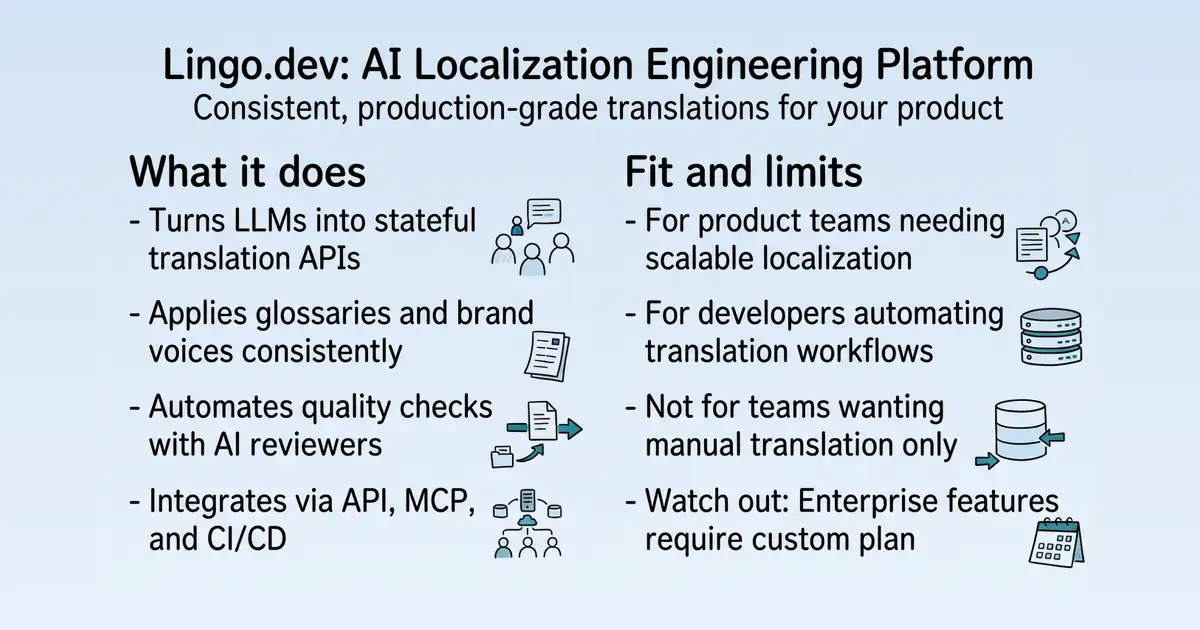
Lingo.dev is an AI-powered localization engineering platform that helps product teams turn LLMs into stateful translation APIs for consistent, production-grade translations across apps, docs, and content S8. It is used by developers and product teams who need to manage translation workflows with configurable engines, glossaries, brand voices, and AI reviewers S8 S44. The platform provides a REST API and MCP server for programmatic access, enabling teams to integrate localization into their CI/CD pipelines and automate quality monitoring S1 S8.
Product identity and positioning
Name, category, positioning, audience, and first-party claims.
- Identity: Lingo.dev, an AI-powered localization engineering platform S8.
- Core purpose: Turns LLMs into stateful translation APIs for consistent, production-grade translations S8.
- Intended users: Product teams and developers needing scalable, consistent localization S8.
- Product scope: A platform with localization engines, glossaries, brand voices, AI reviewers, and API/MCP access S8 S44 S14.
- Positioning: Emphasizes localization engineering as reproducible infrastructure for consistent translations S8.
- Claimed distinction: Provides organization-owned configuration and AI-driven quality checks S12 S14.
Use cases and audiences
Who the product serves and the jobs it is designed to handle.
| Audience | Practical use case |
|---|---|
| Product teams | Localize apps, docs, and content with consistent brand voice and terminology S8 S44. |
| Developers | Integrate translation API into CI/CD pipelines for automated localization S8. |
| AI assistants | Manage localization engine configuration through natural language via MCP S12. |
| Compliance teams | Use audit logs to track state-changing actions for SOC 2-style controls S33. |
Traffic and search
SEO analysis
Collected Oct 24, 2026lingo.dev: an estimated 6,100 total monthly visits and about 23 monthly organic visits across 47 ranking keywords. Scout crawled 15 pages and measured a technical health score of 93/100.
Search summary
The useful answer before the supporting detail.
On Lingo. dev, teams configure localization engines with glossaries, brand voice, and per-locale model chains, called from code, CLI, CI/CD, or MCP. lingo.dev: an estimated 6,100 total monthly visits and about 23 monthly organic visits across 47 ranking keywords. Scout crawled 15 pages and measured a technical health score of 93/100.
- Total traffic (modeled): 6,100 monthly visits across all channels.
- Organic search traffic (estimated): 23 monthly visits from search.
- Strongest sampled ranking: lingo dev at position 1.
- Leading page in the collected evidence: https://lingo.dev/en/docs/platform/glossaries.
- Closest measured organic competitor: lingojam.com, appearing 2 times in the sampled first-page SERPs.
- Technical crawl: 15 pages, health score 93/100.
Website intelligence — Collected evidence
Company identity and positioning
| Page type | Evidence | Source |
|---|---|---|
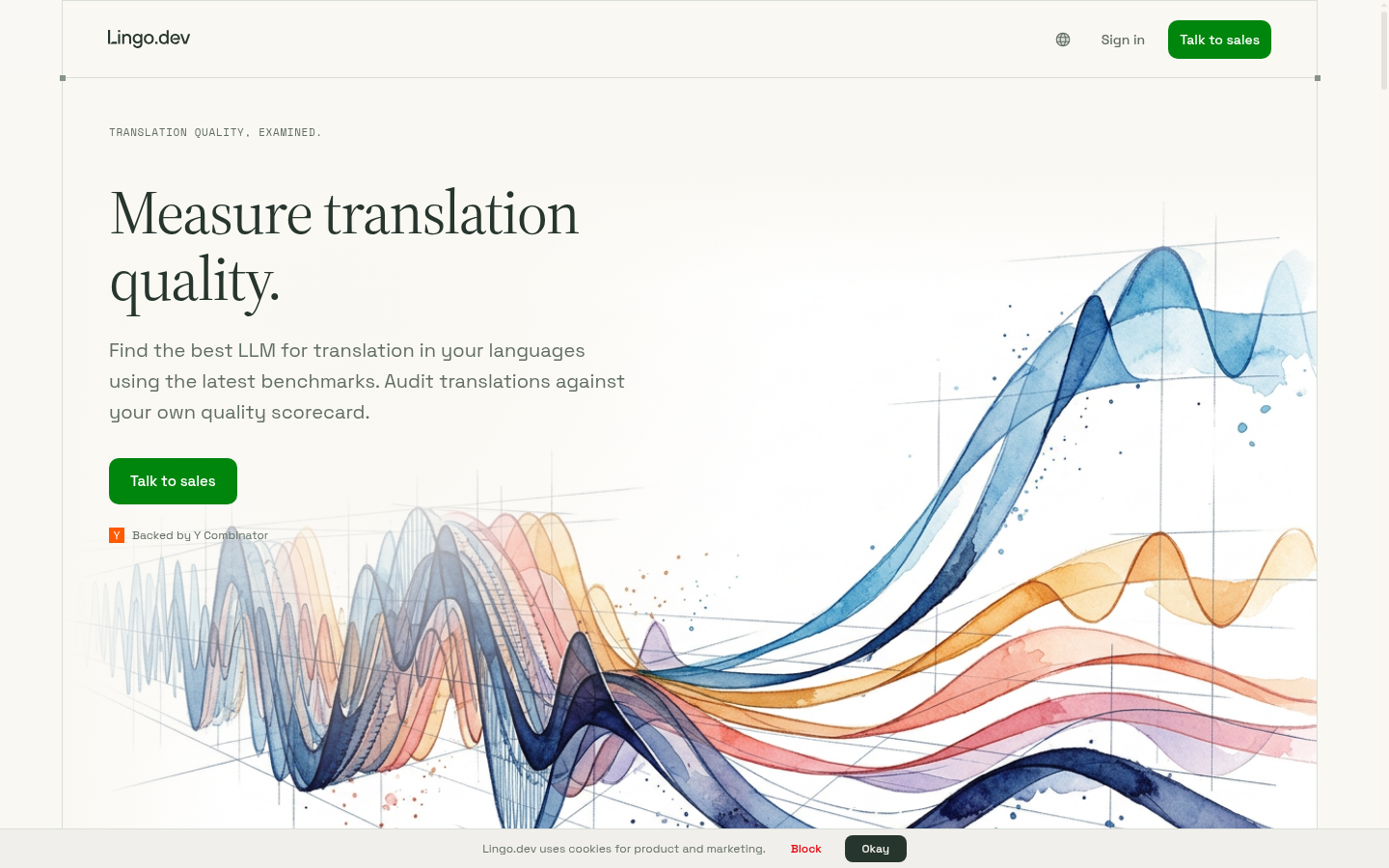
| features | Find the best LLM for translation in your languages using the latest benchmarks. Audit translations against your own quality scorecard. | https://lingo.dev/en |
| features | Trusted by international teams managing content at scale. | https://lingo.dev/en |
| features | 01Find changes in meaning.02Install Lingo.dev in the tools you already use.03Inspect the passages behind quality flags.04Compare audit findings with your team’s reviews.05Review the most serious findings first.06Check your product terminology.07Check translations against your brand voice.08Check consistency across related content.09Apply different scorecards to different content.10Recheck translations after edits. | https://lingo.dev/en |
| features | Check for omitted information, added claims, and wording that changes the source meaning. | https://lingo.dev/en |
| features | Exploded drawing of a source passage above its translation. One red projection line runs for each finding. One source clause has no counterpart: its line ends at an empty slot in the translation. One translated clause has changed wording. One translated claim rises to an empty slot in the source, because nothing there matches it. | https://lingo.dev/en |
| features | Your existing tools, a TMS, a CMS and GitHub, stand on one base with room for more. Your quality scorecard sits above them, connected down to each tool, so every connected tool is audited against the same criteria. | https://lingo.dev/en |
| features | See the source, translation, quality criterion, and reason for each finding. | https://lingo.dev/en |
| features | Compare audit findings with your team’s reviews. | https://lingo.dev/en |
| features | YOUR TEAM'S REVIEWThe same passage | https://lingo.dev/en |
| features | The same passage appears twice: once with the audit's findings and once with your team's review marks. A finding both agree on is tied across. One finding only the audit flagged shows where reviewers disagree, and one issue only the reviewers reported shows what the audit did not flag. | https://lingo.dev/en |
| features | Your severity rules sit above two trays of findings. The critical tray stands in front and holds two findings to review first. The minor tray behind it holds more findings, which stay visible for review next. | https://lingo.dev/en |
| features | YOUR GLOSSARYYour team approves each term | https://lingo.dev/en |
Domain performance
Modeled total traffic, six-month trend, engagement, countries, and domain identity.
Total website traffic
| Month | Modeled visits |
|---|---|
| 2026-04 | 25,179 |
| 2026-05 | 17,184 |
| 2026-06 | 13,604 |
| 2026-07 | 10,808 |
| 2026-08 | 7,816 |
| 2026-09 | 6,100 |
Top visitor countries
| Country | Name | Traffic share |
|---|---|---|
| DE | Germany | 31.8% |
| FR | France | 21.0% |
| PL | Poland | 15.5% |
| IN | India | 13.9% |
| AR | Argentina | 9.6% |
Domain identity
| Signal | Value |
|---|---|
| Registered | May 3, 2021 |
| Last changed | Apr 10, 2026 |
| Expires | May 3, 2031 |
| WHOIS server | — |
| DNSSEC | Signed |
| Nameservers | ian.ns.cloudflare.com, maeve.ns.cloudflare.com |
Website capture
Organic keywords
Top keywords and an independent Google result page.
Top organic keywords
| Keyword | Volume | CPC | Estimated value |
|---|---|---|---|
| lingodev | 90 | $0.00 | $90 |
| 複数形 ジェネレータ | 0 | $0.00 | $50 |
| lingo dev | 380 | $0.00 | $20 |
| localization platform | 600 | $0.00 | $10 |
| lingo | 67,530 | $4.47 | $0 |
Independent Google result page
Query: lingo dev
| Position | Title | URL | Description |
|---|---|---|---|
| 1 | Localization engineering platform · Lingo.dev | https://lingo.dev/en | On Lingo.dev, teams configure localization engines with glossaries, brand voice, and per-locale model chains, called from code, CLI, CI/CD, or MCP. |
| 2 | lingodotdev/lingo.dev: Open-source localization ... | https://github.com/lingodotdev/lingo.dev | Lingo.dev is the localization engineering platform: the best way to measure translation quality, translate with LLMs, and proofread with native speakers. |
| 3 | Lingo.dev: The Localization Engineering Platform | https://www.ycombinator.com/companies/lingodotdev | Lingo.dev is the localization engineering platform: the best way to translate with LLMs, measure translation quality, and proofread with native speakers. |
| 4 | Lingo.dev | https://www.linkedin.com/company/lingodotdev | Lingo.dev is the best way to create localization engines – stateful translation APIs, purpose-built for producing professional culture-aware translations using ... |
| 5 | r/lingodotdev | https://www.reddit.com/r/lingodotdev/ | The official developer hub for Lingo.dev! We're AI localization for teams that ship fast. Translate apps, websites, and entire... |
| 6 | Lingo.dev (@lingodotdev) / X | https://x.com/lingodotdev?lang=en | Lingo.dev. @lingodotdev. The Localization Engineering Platform. San Francisco. lingo.dev · Joined January 2024 · 40. Following · 10.1K. Followers. Mention. |
| 7 | Lingo.dev - Crunchbase Company Profile & Funding | https://www.crunchbase.com/organization/replexica | Lingo.dev automates localization by generating instant translations and creating pull requests with translations for UI code changes. |
Important pages
Pages earning the most estimated search traffic in the sample.
| URL | Ranking keywords | Estimated traffic | Best position |
|---|---|---|---|
| https://lingo.dev/en/docs/platform/glossaries | 1 | 9.1 | 1 |
| https://lingo.dev/en | 13 | 8.7 | 6 |
| https://lingo.dev/en/docs/cli-legacy/translation-keys | 2 | 0.7 | 19 |
| https://lingo.dev/en/changelog/2026-w32 | 1 | 0.1 | 20 |
| https://lingo.dev/en/docs/platform | 1 | 0.1 | 21 |
| https://lingo.dev/en/auth/signin | 1 | 0.1 | 32 |
| https://lingo.dev/en/docs/cli | 1 | 0 | 25 |
Website intelligence — Collected evidence
Prioritized website intelligence pages
| Type | Page | Words | Change | URL |
|---|---|---|---|---|
| features | Localization engineering platform · Lingo.dev | 3,416 | new | https://lingo.dev/en |
| pricing | Pricing · Lingo.dev | 452 | new | https://lingo.dev/en/pricing |
| features | The Localization Engineering Platform · Lingo.dev | 598 | new | https://lingo.dev/en/docs/platform |
| features | AI Reviewers · Lingo.dev | 1,927 | new | https://lingo.dev/en/docs/platform/ai-reviewers |
| features | API Keys · Lingo.dev | 837 | new | https://lingo.dev/en/docs/platform/api-keys |
| features | Audit Logs · Lingo.dev | 1,039 | new | https://lingo.dev/en/docs/platform/audit-logs |
| features | Brand Voices · Lingo.dev | 1,128 | new | https://lingo.dev/en/docs/platform/brand-voices |
| features | Bring Your Own Key (BYOK) for localization · Lingo.dev | 979 | new | https://lingo.dev/en/docs/platform/byok |
| features | Cache Tokens · Lingo.dev | 832 | new | https://lingo.dev/en/docs/platform/cache-tokens |
| features | Connect Your Engine · Lingo.dev | 536 | new | https://lingo.dev/en/docs/platform/connect-your-engine |
| features | Engine Suggestions · Lingo.dev | 1,590 | new | https://lingo.dev/en/docs/platform/engine-suggestions |
| features | Localization Engines · Lingo.dev | 851 | new | https://lingo.dev/en/docs/platform/engines |
| features | Glossaries · Lingo.dev | 1,379 | new | https://lingo.dev/en/docs/platform/glossaries |
| features | LLM Models · Lingo.dev | 1,047 | new | https://lingo.dev/en/docs/platform/llm-models |
| features | Locale Resolution · Lingo.dev | 930 | new | https://lingo.dev/en/docs/platform/locale-resolution |
Features
| Page type | Evidence | Source |
|---|---|---|
| features | [](/en/orgs/~)[](/en) | https://lingo.dev/en |
| features | Sign inTalk to salesOpen app | https://lingo.dev/en |
| features | Translation quality, examined. | https://lingo.dev/en |
| features | Measure translation quality. | https://lingo.dev/en |
| features | Find the best LLM for translation in your languages using the latest benchmarks. Audit translations against your own quality scorecard. | https://lingo.dev/en |
| features | Talk to sales | https://lingo.dev/en |
| features | Trusted by international teams managing content at scale. | https://lingo.dev/en |
| features | 01 / LOOK CLOSELY | https://lingo.dev/en |
| features | Measure translation quality | https://lingo.dev/en |
| features | Audit human and LLM translations against your quality scorecard. Track quality by language and translation provider. | https://lingo.dev/en |
| features | 01Find changes in meaning.02Install Lingo.dev in the tools you already use.03Inspect the passages behind quality flags.04Compare audit findings with your team’s reviews.05Review the most serious findings first.06Check your product terminology.07Check translations against your brand voice.08Check consistency across related content.09Apply different scorecards to different content.10Recheck translations after edits. | https://lingo.dev/en |
| features | Find changes in meaning. | https://lingo.dev/en |
| features | Check for omitted information, added claims, and wording that changes the source meaning. | https://lingo.dev/en |
| features | SOURCEThe original passage | https://lingo.dev/en |
| features | TRANSLATIONThe same passage,translated | https://lingo.dev/en |
| features | CHANGED MEANINGWording shifts the claim | https://lingo.dev/en |
| features | OMITTED INFORMATIONThe translation drops a detail | https://lingo.dev/en |
| features | ADDED CLAIMThe source never says this | https://lingo.dev/en |
| features | Exploded drawing of a source passage above its translation. One red projection line runs for each finding. One source clause has no counterpart: its line ends at an empty slot in the translation. One translated clause has changed wording. One translated claim rises to an empty slot in the source, because nothing there matches it. | https://lingo.dev/en |
| features | Install Lingo.dev in the tools you already use. | https://lingo.dev/en |
Pricing and plans
| Page type | Evidence | Source |
|---|---|---|
| pricing | The bill counts processed translations and AI review runs, and the LLM provider’s price passes through unchanged. You start in the sandbox at $0/mo. | https://lingo.dev/en/pricing |
| pricing | Plan to compare | https://lingo.dev/en/pricing |
| pricing | \ | $0 \ |
| pricing | \ | $0.50/engine/mo \ |
| pricing | \ | $2/MTok \ |
| pricing | \ | $0.01/run \ |
| pricing | \ | Credits, auto-reload \ |
Integrations and supported platforms
No supporting public-page evidence was collected for this category.
Product and company updates
No supporting public-page evidence was collected for this category.
Rank tracking
Persistent keyword baselines and position movement.
This analysis created the first position baseline at 2026-10-24T03:19:40.173Z. Movement appears after the next fresh analysis using the same location and language.
| Keyword | Current | Previous | Movement | Volume | Ranking URL |
|---|---|---|---|---|---|
| lingo dev | 1 | Baseline | Baseline | 30 | https://lingo.dev/en/docs/platform/glossaries |
| lingo translator | 6 | Baseline | Baseline | 140 | https://lingo.dev/en |
| lingpad | 22 | Baseline | Baseline | 1,000 | https://lingo.dev/en |
| localize platform | 18 | Baseline | Baseline | 140 | https://lingo.dev/en |
| translation key | 19 | Baseline | Baseline | 140 | https://lingo.dev/en/docs/cli-legacy/translation-keys |
| translation keys | 21 | Baseline | Baseline | 140 | https://lingo.dev/en/docs/cli-legacy/translation-keys |
| create a translator for your own language | 13 | Baseline | Baseline | 40 | https://lingo.dev/en |
| lingrowth | 29 | Baseline | Baseline | 90 | https://lingo.dev/en |
| app localization tool | 36 | Baseline | Baseline | 90 | https://lingo.dev/en |
| translator dashboard | 14 | Baseline | Baseline | 30 | https://lingo.dev/en |
| lingows | 36 | Baseline | Baseline | 70 | https://lingo.dev/en |
| waitress lingo | 20 | Baseline | Baseline | 40 | https://lingo.dev/en/changelog/2026-w32 |
| translation localization software | 33 | Baseline | Baseline | 50 | https://lingo.dev/en |
| linangdata | 37 | Baseline | Baseline | 50 | https://lingo.dev/en |
| lingoport | 21 | Baseline | Baseline | 40 | https://lingo.dev/en/docs/platform |
| ai localization tools | 27 | Baseline | Baseline | 40 | https://lingo.dev/en |
| lingo sign in | 32 | Baseline | Baseline | 40 | https://lingo.dev/en/auth/signin |
| lua translator | 24 | Baseline | Baseline | 30 | https://lingo.dev/en |
| engine translator | 30 | Baseline | Baseline | 30 | https://lingo.dev/en |
| phrase cli | 25 | Baseline | Baseline | 20 | https://lingo.dev/en/docs/cli |
Features
Features and capabilities
Core functions and evidence-backed product capabilities.
| Capability | What it does |
|---|---|
| Localization Engines | Build and configure engines that apply glossary, brand voice, and rules to every translation request S8 S1. |
| Glossaries | Define terms that must be localized exactly or not at all, ensuring consistency S12. |
| Brand Voices | Define tone, formality, and style per locale, applied automatically to translations S44. |
| AI Reviewers | Automated quality checks for glossary and rule adherence, with pass/fail or percentage scores S14. |
| API and MCP Server | Programmatic translation via REST API and AI assistant management via MCP S1 S12. |
| Audit Logs | Append-only, tamper-evident history of state-changing actions for compliance S33. |
| BYOK | Bring your own model provider API key for localization, with direct billing S59. |
Integrations and ecosystem
Connected products, exports, APIs, and workflow compatibility.
| Integration or interface | Type | What it enables |
|---|---|---|
| REST API | API | Programmatic translation with configurable engine, glossary, and brand voice S1. |
| MCP Server | AI interface | AI assistants can manage engines, glossaries, and API keys via natural language S12. |
| CLI | Developer tool | Translate from the command line S8. |
| Compiler | Developer tool | Build-time i18n integration S8. |
| CI/CD (GitHub Actions, GitLab CI, Bitbucket Pipelines) | Integration | Automate translation in build pipelines S8. |
| Webhooks | Integration | Receive notifications for pipeline events S1. |
| WebSocket | Integration | Live progress updates for translation jobs S1. |
Pricing
Pricing and plans
Published plans, free access, trials, credits, and pricing limitations.
| Plan or offer | Verified price and billing | Included | Limits |
|---|---|---|---|
| Sandbox | $0 base, credits auto-reload, per month plus usage S1 | 100K tokens per day S1 | $0.50 per engine per month; $2 per million tokens; $0.01 per AI review run; 7-day retention S1 |
| Production | $99 base, credits auto-reload, per month plus usage S1 | 5M tokens per day S1 | Same usage rates; 30-day retention S1 |
| Enterprise | Custom, annual contract S1 | Unlimited S1 | Human review, compliance, dedicated support; Jira, Zendesk, Payload CMS S1 |
Competition
Competitive landscape
Domains competing for the same organic search demand.
Sampled competitors
| Competitor | First-page appearances | Sampled queries | Average position | Queries observed |
|---|---|---|---|---|
| lingojam.com | 2 | 1 | 5.5 | lingo translator |
| play.google.com | 2 | 1 | 5.5 | lingo translator |
| worldlingo.com | 1 | 1 | 1 | lingo translator |
| github.com | 1 | 1 | 2 | lingo dev |
| ycombinator.com | 1 | 1 | 3 | lingo dev |
| linkedin.com | 1 | 1 | 4 | lingo dev |
| openl.io | 1 | 1 | 4 | lingo translator |
| reddit.com | 1 | 1 | 5 | lingo dev |
| deepl.com | 1 | 1 | 5 | lingo translator |
| x.com | 1 | 1 | 6 | lingo dev |
Website intelligence — Collected evidence
Customers, testimonials, and first-party review claims
No supporting public-page evidence was collected for this category.
Independent review sources discovered
| Platform | Status | Discovered source |
|---|---|---|
| discovered_not_scraped | https://ai.google.dev/gemini-api/docs/models |
AI visibility
Measured ChatGPT and Google AI mentions with cited sources.
AI-assistant referral traffic
- Estimated current generative-AI referral share: 1.6%
Scout traffic model did not return a separate AI-referral trend series for this domain.
Website intelligence — Collected evidence
Site-stated AI capabilities
| Page type | Evidence | Source |
|---|---|---|
| features | Find the best LLM for translation in your languages using the latest benchmarks. Audit translations against your own quality scorecard. | https://lingo.dev/en |
| features | LLM Models | https://lingo.dev/en/docs/platform |
| features | LLM Models | https://lingo.dev/en/docs/platform/ai-reviewers |
| features | LLM Models | https://lingo.dev/en/docs/platform/api-keys |
| features | LLM Models | https://lingo.dev/en/docs/platform/audit-logs |
| features | Find the best LLM for translation in your languages using the latest benchmarks. Audit translations against your own quality scorecard. | https://lingo.dev/en |
| features | Audit human and LLM translations against your quality scorecard. Track quality by language and translation provider. | https://lingo.dev/en |
| features | LLM Models | https://lingo.dev/en/docs/platform |
| features | AI Reviewers | https://lingo.dev/en/docs/platform |
| features | Lingo.dev is an AI-powered localization engineering platform. It helps product teams turn LLMs into stateful translation APIs - to produce consistent, production-grade translations for apps, docs, and content across every language. | https://lingo.dev/en/docs/platform |
| features | LLM Models | https://lingo.dev/en/docs/platform/ai-reviewers |
| features | AI Reviewers | https://lingo.dev/en/docs/platform/ai-reviewers |
| features | AI Reviewers | https://lingo.dev/en/docs/platform/ai-reviewers |
| features | [](https://x.com/intent/tweet?text=TIL%20%40lingodotdev%20has%20built-in%20AI%20reviews%20per%20localization%20engine%20-%20glossary%20compliance%2C%20rule%20adherence%2C%20and%20custom%20AI%20reviewers%20all%20run%20automatically%20after%20each%20translation%2C%20producing%20pass%2Ffail%20verdicts%20without%20manual%20review&url=https%3A%2F%2Flingo.dev%2Fen%2Fdocs%2Fplatform%2Fai-reviewers&via=LingoDotDev)[](https://www.linkedin.com/sharing/share-offsite/?url=https%3A%2F%2Flingo.dev%2Fen%2Fdocs%2Fplatform%2Fai-reviewers)[](https://news.ycombinator.com/submitlink?u=https%3A%2F%2Flingo.dev%2Fen%2Fdocs%2Fplatform%2Fai-reviewers&t=AI%20Reviewers) | https://lingo.dev/en/docs/platform/ai-reviewers |
| features | AI reviews are automated quality checks that evaluate translations produced by your localization engine. After each translation request, Lingo.dev runs independent LLM evaluations to verify the output - checking glossary compliance, rule adherence, and any custom criteria you define. Reviews run asynchronously and never block the translation response. | https://lingo.dev/en/docs/platform/ai-reviewers |
| features | In the dashboard, AI reviewers are called measurements. They live under Observability → Measurements (AI Reviews). The two names mean the same thing. | https://lingo.dev/en/docs/platform/ai-reviewers |
| features | When the localization engine completes a translation request, it queues the applicable reviews for asynchronous evaluation. Each review runs an independent LLM that receives the source text, translated output, context, and evaluation criteria. It returns a structured result - pass/fail or a percentage score - with reasoning for imperfect results. | https://lingo.dev/en/docs/platform/ai-reviewers |
| pricing | The bill counts processed translations and AI review runs, and the LLM provider’s price passes through unchanged. You start in the sandbox at $0/mo. | https://lingo.dev/en/pricing |
| pricing | \ | $0.01/run \ |
These are first-party product claims, not independent measurements of AI-search visibility.
Marketing opportunities
Actions calculated directly from the collected evidence.
| Opportunity | Recommended action | Evidence |
|---|---|---|
| Striking-distance keyword | Move “lingo translator” from position 6 toward the top three. | Volume 140 · https://lingo.dev/en |
| Important page | Strengthen the page already earning search visibility before creating an unrelated page. | https://lingo.dev/en · 13 sampled keywords · best position 6 |
| Competitor gap | Review the sampled queries where lingojam.com appears. | 2 first-page appearances across lingo translator |
Website intelligence — Collected evidence
Website evidence gaps
- integrations: no usable public page was collected; verify whether the site publishes this evidence.
- customers: no usable public page was collected; verify whether the site publishes this evidence.
- reviews: no usable public page was collected; verify whether the site publishes this evidence.
- changes: no usable public page was collected; verify whether the site publishes this evidence.
- identity: no usable public page was collected; verify whether the site publishes this evidence.
- technical: no usable public page was collected; verify whether the site publishes this evidence.
Trust and proof
Customers, proof, and reviews
Published proof, customer signals, and review evidence.
Independent reviews
| Platform | Page | How it was found | Note |
|---|---|---|---|
| lingo.dev | AI Reviewers · Lingo.dev | Grounded web search | AI reviews are automated quality checks that evaluate translations produced by your localization engine. After each translation request, Lingo.dev runs independent LLM evaluations to verify the output - checking glossary compliance, rule adherence, and any custom criteria you define. Reviews run asynchronously and never block the translation response. ... When the localization engine completes a translation request, it queues the applicable reviews for asynchronous evaluation. Each review runs a |
| lingo.dev | Introducing Lingo.dev v1.0 · Lingo.dev | Grounded web search | A problem you can't measure is a problem you can't fix. Lingo.dev v1.0 ships with AI Reviewers - automated quality checks that evaluate each translation by dimension, not by a single holistic number. Define criteria in natural language: "Are all HTML tags preserved?" or "Rate naturalness for a native speaker." An independent LLM evaluates the output - if AI model translates, AI modelSonnet scores, eliminating self-assessment bias. ... Lingo.dev v1.0 is purpose-built for engineering teams, localiza |
| lingo.dev | Review Localizations · Lingo.dev | Grounded web search | Evaluate localizations against your engine's rules without modifying anything. Your assistant reads the engine's configuration and reports violations per string. ... 1. The assistant reads your engine's glossary, rules, and brand voice for `de` 2. Evaluates each localization for glossary compliance, rule adherence, and tone consistency 3. Reports violations per string: "Line 3: 'Checkout' was localized to |
Customer proof
No named customers, testimonials, or customer case studies were found.
Independent mentions
- Localization engineering platform · Lingo.dev — Find the best LLM for translation in your languages using the latest benchmarks. Audit translations against your own quality scorecard. ... Audit human and LLM translations against your quality scorecard. Track quality by language and translation provider.
- Changelog · Lingo.dev — . October 9, 2026 - W39 – Infrastructure, where you configure localization engines Infrastructure is where you configure how localization works: a model and a ... each language pair, the glossaries, rulesets, and brand voices your organization owns and
- Blog · Lingo.dev — The Localization API Professional localization - source refinement, glossary enrichment, quality scoring, and optional ... .dev v1.0 - a localization engineering platform where teams create stateful localization engines with
- @lingo.dev/cli · Lingo.dev — `@lingo.dev/cli` ships your source content to a localization ... , which translates it server-side, and writes the outputs back to disk — in ... same command with `--wait`, or later with `lingo pull`. It
- W37 – The new Lingo.dev · Lingo.dev — The new Lingo.dev is here, and it is live for every organization. ... do: see where things stand on Home, configure your localization engines in Infrastructure, connect your tools in Studio, clear what needs a person in Queue, and check quality in
- Continuous Localization · Lingo.dev — Lingo.dev keeps translations in sync with your code. On every change, it detects what content changed, translates it using your connected localization engine - with glossary rules, brand voice, and per-locale model configuration applied consistently - and commits the results or opens a pull request. Incomplete
- Localization engineering in practice · Lingo.dev — # Localization engineering in practice How teams configure a localization engine, connect it to the tools they already use, and stop thinking about translations. ... replaced their translation agencies – more languages, fewer complaints 34 languages
External links were grounded in one live web search. Search snippets are leads, not independently scraped page content; rejected links remain available in Review evidence.
Company, security, and trust
Ownership, policies, security signals, and public trust evidence.
| Signal | Finding | Source |
|---|---|---|
| Company and ownership | Organization keys are part of the RBAC entitlement. If the entitlement is removed, every organization key is deactivated — requests come back with a 403 and a message pointing at the plan, not at the engine scope. Pe | source |
| Contact and support | Not published on the collected pages. | — |
| Legal and privacy | The metadata column stores IDs, not human-readable values. The UI joins to current names at read time, so renaming an engine or user doesn't rewrite history. It also keeps audit rows out of GDPR right-to-erasure conflict | source |
| Security and compliance | / SOC 2 Type II report / –Not included / –Not included / Included / | source |
| Uptime and status page | Enterprise uptime SLA | source |
| Domain registered | 2021-05-03 | — |
| Domain expires | 2031-05-03 | — |
Not found on the collected pages: contact and support. This only means Scout did not find it on the pages it read; it says nothing about the company itself.
Documentation and product updates
Help resources, product guidance, and visible changes over time.
| Resource or update | Type | What is available | Date or freshness |
|---|---|---|---|
| Welcome · Lingo.dev | Documentation | The Lingo.dev API translates your content through a localization engine you configure once – glossary, brand voice, rules, and per-locale model selection applied on every call. Translate one locale in a single request, or fan out to many locales as background jobs. (source) | Not dated |
| The Localization Engineering Platform · Lingo.dev | Documentation | Lingo.dev is an AI-powered localization engineering platform. It helps product teams turn LLMs into stateful translation APIs - to produce consistent, production-grade translations for apps, docs, and content across every language. (source) | Not dated |
| Capabilities · Lingo.dev | Documentation | Full reference of what your AI assistant can manage through the Lingo.dev MCP server - engines, glossaries, brand voices, rules, model configuration, engine suggestions, API keys, and team access. (source) | Not dated |
| AI Reviewers · Lingo.dev | Documentation | Configure built-in and custom AI reviews that evaluate translation quality - glossary compliance, rule adherence, and custom criteria - with pass/fail verdicts or percentage scores after each localization engine request. (source) | Not dated |
| API Keys · Lingo.dev | Documentation | Create and manage Personal and Organization API keys that authenticate requests to the Lingo.dev localization API and MCP server. (source) | Not dated |
| Audit Logs · Lingo.dev | Documentation | Review an append-only, tamper-evident history of state-changing actions in your organization — who did what, when, from where. (source) | Not dated |
| Brand Voices · Lingo.dev | Documentation | Define tone, formality, and style as one organization-owned brand voice carrying a text per target locale, applied to any localization engine. (source) | Not dated |
| Bring Your Own Key (BYOK) for localization · Lingo.dev | Documentation | Store your organization's own Anthropic, OpenAI, Google, and Mistral AI keys so localization requests run on your key and the provider bills you directly. (source) | Not dated |
Not found in the collected public sources: public roadmap, changelog or release notes, status page, separate help center or knowledge base.
Technical
Technical and delivery signals
Delivery model, platforms, API, data ownership, reliability claims and release activity.
| Signal | Finding | Source |
|---|---|---|
| Delivery model (cloud, self-hosted, desktop, browser extension) | Cloud-based platform with API and MCP server access S1 S12. | S1 S12 |
| Platforms and apps | Web-based dashboard and API; no native mobile or desktop apps mentioned S1. | S1 |
| API and extensibility (API, SDK, webhooks, MCP, plugins) | REST API, MCP server, CLI, compiler, webhooks, WebSocket S1 S8. | S1 S8 |
| Data ownership and export | Audit data has no exports yet; surfaced through dashboard S33. | S33 |
| Performance and reliability claims | Not published on the collected pages. | — |
| Release activity | Not published on the collected pages. | — |
Measured infrastructure
Domain, certificate, and hosting signals, measured directly.
| Signal | Finding |
|---|---|
| Domain registered | 2021-05-03 — GoDaddy.com, LLC |
| Domain expires | 2031-05-03 |
| TLS certificate | Google Trust Services, valid, expires 2027-01-17 |
| Security headers | HSTS, CSP, X-Frame-Options |
| Headers not served | X-Content-Type-Options, Referrer-Policy |
| Server header | cloudflare |
| Mail handled by | aspmx.l.google.com, alt2.aspmx.l.google.com |
| Nameservers | maeve.ns.cloudflare.com, ian.ns.cloudflare.com |
Technical site audit
A bounded multi-page crawl with page-level issues and URLs.
Scout — Bounded technical crawl
- Pages crawled: 15 of 15 maximum
- Technical health: 93/100
- Critical issues: 0
- Warnings: 16
- Notices: 13
Issues
| Severity | Issue | Value | Affected URL |
|---|---|---|---|
| warning | Missing canonical URL | — | https://lingo.dev/en/auth/signin?next=%2Fen%2Forgs%2F%7E |
| notice | Page is marked noindex | — | https://lingo.dev/en/auth/signin?next=%2Fen%2Forgs%2F%7E |
| notice | Low visible word count | 51 | https://lingo.dev/en/auth/signin?next=%2Fen%2Forgs%2F%7E |
| warning | Missing canonical URL | — | https://lingo.dev/en/auth/signin |
| notice | Page is marked noindex | — | https://lingo.dev/en/auth/signin |
| notice | Low visible word count | 51 | https://lingo.dev/en/auth/signin |
| notice | Meta description length should be reviewed | 17 | https://cal.com/team/lingodotdev/intro |
| warning | Page should have one primary H1 | 0 | https://cal.com/team/lingodotdev/intro |
| notice | Page is marked noindex | — | https://cal.com/team/lingodotdev/intro |
| notice | Low visible word count | 0 | https://cal.com/team/lingodotdev/intro |
| warning | Title length should be reviewed | 89 | https://lingo.dev/en/customers/sosafe |
| notice | Meta description length should be reviewed | 234 | https://lingo.dev/en/customers/cal-com |
| warning | Title length should be reviewed | 68 | https://lingo.dev/en/customers/papermark |
| notice | Meta description length should be reviewed | 213 | https://lingo.dev/en/customers/papermark |
| warning | Title length should be reviewed | 93 | https://lingo.dev/en/customers/laurel |
| warning | Title length should be reviewed | 84 | https://lingo.dev/en/customers/truely |
| notice | Meta description length should be reviewed | 252 | https://lingo.dev/en/customers/truely |
| warning | Title length should be reviewed | 106 | https://lingo.dev/en/customers/scribemail |
| notice | Meta description length should be reviewed | 262 | https://lingo.dev/en/customers/jarvi |
| notice | Meta description length should be reviewed | 265 | https://lingo.dev/en/docs/api |
| notice | Meta description length should be reviewed | 231 | https://lingo.dev/en/docs/platform |
| warning | Duplicate title in audit sample | 2 | https://lingo.dev/en |
| warning | Duplicate title in audit sample | 2 | https://lingo.dev/en |
| warning | Duplicate title in audit sample | 2 | https://lingo.dev/en/auth/signin?next=%2Fen%2Forgs%2F%7E |
| warning | Duplicate title in audit sample | 2 | https://lingo.dev/en/auth/signin |
| warning | Duplicate meta description in audit sample | 4 | https://lingo.dev/en |
| warning | Duplicate meta description in audit sample | 4 | https://lingo.dev/en/auth/signin?next=%2Fen%2Forgs%2F%7E |
| warning | Duplicate meta description in audit sample | 4 | https://lingo.dev/en |
| warning | Duplicate meta description in audit sample | 4 | https://lingo.dev/en/auth/signin |
Crawled pages
| Status | Title | H1s | Words | Response | URL |
|---|---|---|---|---|---|
| 200 | Localization engineering platform · Lingo.dev | 1 | 4784 | 202 ms | https://lingo.dev/en |
| 200 | Sign in · Lingo.dev | 1 | 51 | 49 ms | https://lingo.dev/en/auth/signin?next=%2Fen%2Forgs%2F%7E |
| 200 | Localization engineering platform · Lingo.dev | 1 | 4784 | 1,073 ms | https://lingo.dev/en |
| 200 | Sign in · Lingo.dev | 1 | 51 | 804 ms | https://lingo.dev/en/auth/signin |
| 200 | Lingo.dev · Intro \ | Lingo.dev \ | Cal.com | 0 | 0 |
| 200 | SoSafe replaced their translation agencies – more languages, fewer complaints · Lingo.dev | 1 | 2307 | 591 ms | https://lingo.dev/en/customers/sosafe |
| 200 | How Cal.com Automated Localization for 36 Languages · Lingo.dev | 1 | 673 | 1,510 ms | https://lingo.dev/en/customers/cal-com |
| 200 | How Papermark Automated Docs Localization with Lingo.dev · Lingo.dev | 1 | 687 | 587 ms | https://lingo.dev/en/customers/papermark |
| 200 | Laurel added a language to their product in a day – without an engineering sprint · Lingo.dev | 1 | 2283 | 447 ms | https://lingo.dev/en/customers/laurel |
| 200 | How Truely Replaced 32 Uncontrolled Languages with a Localization Engine · Lingo.dev | 1 | 735 | 348 ms | https://lingo.dev/en/customers/truely |
| 200 | Two founders, 16 languages: how Scribe configured a localization engine by talking to an agent · Lingo.dev | 1 | 2266 | 432 ms | https://lingo.dev/en/customers/scribemail |
| 200 | How Jarvi Kept 300+ Agencies in Sync Across Languages · Lingo.dev | 1 | 651 | 494 ms | https://lingo.dev/en/customers/jarvi |
| 200 | Pricing · Lingo.dev | 1 | 563 | 911 ms | https://lingo.dev/en/pricing |
| 200 | Welcome · Lingo.dev | 1 | 858 | 588 ms | https://lingo.dev/en/docs/api |
| 200 | The Localization Engineering Platform · Lingo.dev | 1 | 557 | 384 ms | https://lingo.dev/en/docs/platform |
This is a bounded Scout crawl. Core Web Vitals and Lighthouse scores are not claimed unless a dedicated performance audit is connected.
Search Console and Analytics
First-party search and behavioral data connection state.
Modeled acquisition channels
| Channel | Estimated share |
|---|---|
| direct | 39.8% |
| search | 32.6% |
| search organic | 31.2% |
| search paid | 1.4% |
| social | 7.8% |
| social organic | 7.1% |
| social paid | 0.7% |
| referrals | 10.4% |
| paid referrals | 3.0% |
| 2.9% | |
| gen ai | 1.6% |
| affiliate | 2.0% |
| other | 0.0% |
First-party connections
| Integration | Status | Data available after connection |
|---|---|---|
| Google Search Console | Not connected | Clicks, impressions, CTR, average position, queries, pages, countries, and devices |
| Google Analytics | Not connected | Organic sessions, engagement, landing pages, conversions, geography, and devices |
No first-party Search Console or Analytics numbers are shown until the site owner authorizes the corresponding Google account. Scout traffic model values above are modeled estimates, not private analytics totals.
Limits and method
Limitations and open questions
Known constraints and missing evidence from the collected pages.
The collected pages do not mention specific competitors. Evidence gaps include lack of customer testimonials, case studies, and independent reviews. Some audit log action types are not yet wired, and audit data exports are not available S33. Pricing details for Enterprise are not fully published S1.
Sources, method, and limitations
Evidence inventory, collection method, provider use, and constraints.
This report is based on 15 collected pages from lingo.dev, including documentation and pricing pages, gathered on 2026-10-23. The evidence catalog includes static and rendered pages, with external proof search limited to one query. Limitations: no customer reviews or case studies were collected; some claims rely on vendor documentation.
- Official Websitehttps://lingo.dev/enVerified
- Documentationhttps://lingo.dev/en/docs/apiVerified
- Pricing Pagehttps://lingo.dev/en/pricingVerified
- Official Websitehttps://lingo.dev/en/docs/platformVerified
- Official Websitehttps://lingo.dev/en/docs/mcp/capabilitiesVerified
- Official Websitehttps://lingo.dev/en/docs/platform/ai-reviewersVerified
- Official Websitehttps://lingo.dev/en/docs/platform/api-keysVerified
- Official Websitehttps://lingo.dev/en/docs/platform/audit-logsVerified
- Official Websitehttps://lingo.dev/en/docs/platform/brand-voicesVerified
- Official Websitehttps://lingo.dev/en/docs/platform/byokVerified
- Official Websitehttps://lingo.dev/en/docs/platform/cache-tokensVerified
- Official Websitehttps://lingo.dev/en/docs/platform/connect-your-engineVerified
- Official Websitehttps://lingo.dev/en/docs/platform/engine-suggestionsVerified
- Official Websitehttps://lingo.dev/en/docs/platform/enginesVerified
- Official Websitehttps://lingo.dev/en/docs/platform/glossariesVerified
- Articlehttps://lingo.dev/en/changelogVerified
- Review Sitehttps://lingo.dev/en/blog/introducing-lingodotdev-v1Verified
- Review Sitehttps://lingo.dev/en/docs/mcp/reviewVerified
- Articlehttps://lingo.dev/en/blogVerified
- Articlehttps://lingo.dev/en/docs/cliVerified
- Articlehttps://lingo.dev/en/changelog/2026-w37Verified
- Articlehttps://lingo.dev/en/docs/workflowsVerified
- Articlehttps://lingo.dev/en/customersVerified