In simple English
Making a website work in multiple languages is usually hard work. You have to move every piece of text into large dictionary files and keep them updated by hand. This tool lets you leave your text right inside your user interface code. It wraps your components and handles the translation work for you automatically. It saves you hours of boring copying and pasting when you add a new language. You will need an API key from their service to power the translations.
What it is
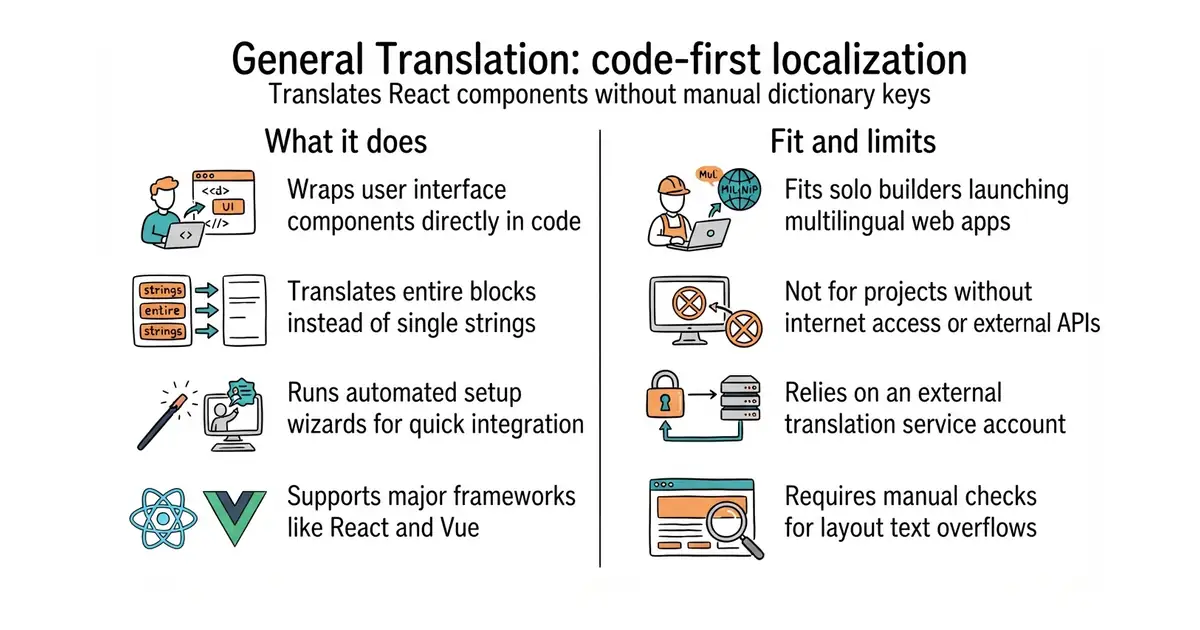
A full-stack localization toolkit (a set of software libraries that help adapt software for different languages and regions) designed for modern JavaScript and React applications. It provides component wrappers and command-line tools to translate whole user interfaces instead of single string keys.
What it is good for
Solo builders who want to launch their web applications in multiple languages quickly without managing complex translation files or setting up traditional localization pipelines.
- Translates entire UI components directly without manual dictionary refactoring.
- Provides a simple setup wizard that configures your project automatically.
- Supports major frameworks like React, Next.js, and Vue out of the box.
- Requires an external API key from the service provider to generate translations.
- Relies on third-party services which might introduce ongoing translation costs at scale.
- Debugging layout issues in right-to-left or longer translated languages still requires manual styling work.
Traditional manual localization JSON files and dictionary keys
Next.js
- i18next/i18next8.6k stars
A mature internationalization framework for JavaScript that relies on traditional translation files and keys.
- formatjs/formatjs15k stars
A collection of libraries for internationalizing web apps using standard message formatting.


- sphinx-doc/sphinx8.1k stars
Builds a documentation website, and a PDF, from text files and from the comments beside the code.
- facebook/docusaurus67k stars
A static site generator from Meta that turns Markdown files into a documentation website.
npx gt@latest