66.5k stars · MIT | [docusaurus.io](https://docusaurus.io) · v3.10.2 (2026-07-10) · Track this in Scout
A static site generator from Meta that turns Markdown files into a documentation website.
▶Repo detailsthe review · specs · pros & cons · install
What it does
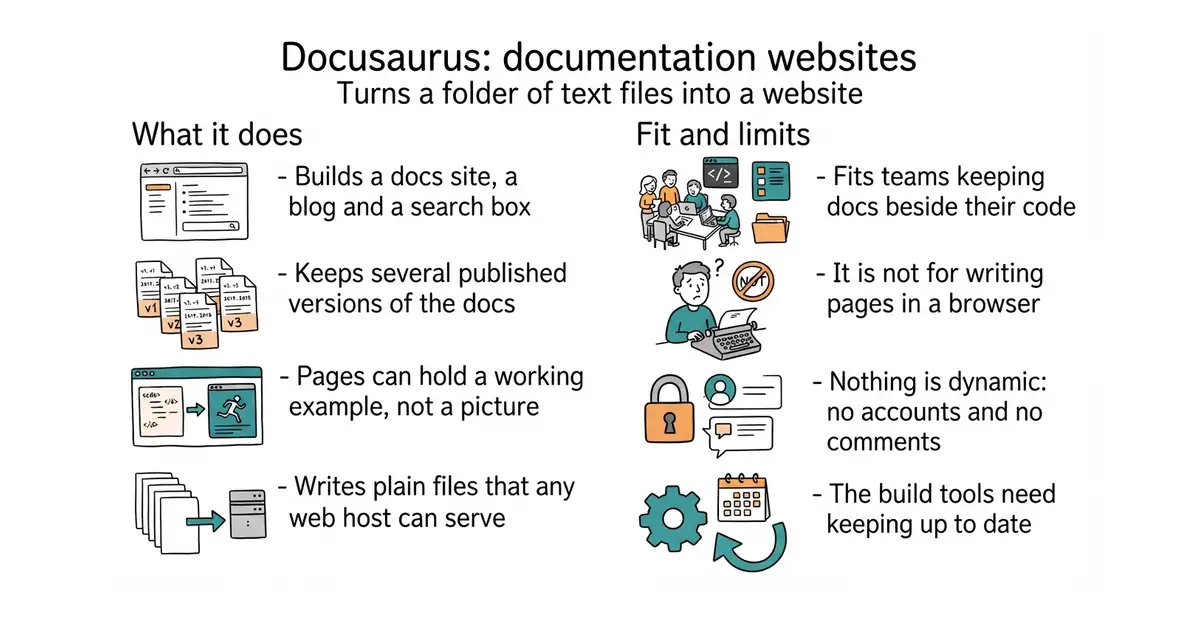
Docusaurus reads a folder of Markdown files and produces a complete website as static files, meaning plain pages with no database and no server-side code to run. One command, npx create-docusaurus@latest my-website classic, creates a project with a documentation section, a blog, custom pages, a CSS theme and dark mode already wired together. Pages can be MDX, which is Markdown with React components mixed in, so a page can hold a live example rather than a picture of one. The sidebar order lives in sidebars.js, the site settings in docusaurus.config.js, and anything in static/ is copied straight to the root of the output. It handles versioned documentation and translation, with CrowdIn named in the README for the translation side. It needs Node.js 20.0 or newer. It does not host anything and it runs nothing at request time: npm run build writes a build/ folder and from there it is a plain website, so features that need a server — comments, accounts, search over private content — are not its job.
Why it matters
Who it suits. Anyone who has to document a project and does not want to run a content management system to do it. It is the strongest option when the documentation lives beside the code in the same repository, when several versions must stay published at once, and when some pages need an interactive example. Skip it if you want to write in a browser rather than in files, and skip it if a React toolchain is more than you want to maintain for ten pages.
Verdict. Worth fifteen minutes to see a running site, and it is the safe default in this corner. Two honest limits. It is a React application underneath, so upgrades mean Node and npm work, and a site left untouched for a year will need attention before it builds again. And it is heavier than its rivals: if all you have is Markdown and no need for versions or embedded components, squidfunk/mkdocs-material from Edition 52 asks far less. The current release is v3.10.2 from 10 July 2026, with code pushed on 16 October 2026, and the npm registry agrees at @docusaurus/core 3.10.2.
- One command to a complete site with navigation, search, blog and dark mode already working.
- Versioned documentation and translation are built in rather than bolted on.
- MDX lets a documentation page carry a working example instead of a screenshot.
- It is a React and Node project, so the toolchain is yours to keep current; Node 20.0 is the floor.
- Heavier than plain Markdown generators, and more than a small site needs.
- Nothing dynamic: no accounts, no comments, no server-side logic, by design.
 squidfunk/mkdocs-material
The same job in Python, much lighter to run and with no React; covered in Edition 52.
Track this in Scout withastro/starlight
Documentation sites built on Astro, with smaller output and faster builds but less built in around versions.
Track this in Scout- vuejs/vitepress
A Vite and Vue generator for the same purpose, very fast while you write, with a smaller set of documentation-specific features.
Track this in Scout
npx create-docusaurus@latest my-website classic
cd my-website
npm start          # a live preview at http://localhost:3000
npm run build      # writes the finished site into build/