6.1k stars · GPL-3.0 · weblate-2026.10.1 (2026-10-09) · Track this in Rising ↗
Translation management that works from the git repository and marks the Russian text as needing work the moment the English changes.
Radar check
What we found when we opened it. Every bar is one fact, with its date.
Last code pushed 25 Oct 2026, 2 days before this check.
Latest release weblate-2026.10.1 on 9 Oct 2026.
Public since February 2012, a little over 14 years.
6,130 stars and 1,376 forks.
4,091 commits and 115 new issues in the last 90 days.
2,290 contributors. 1268 pull requests merged in 90 days.
A security policy says how to report a problem. 48 published security advisories.
How the bars are scored
- Alive. Days since the last code push: a week or less 100, a month 90, three months 70, six months 50, a year 30, eighteen months 15, older 0.
- Releases. Age of the latest GitHub release, on a similar scale; no bar when the project publishes no releases.
- Maturity. Age of the project: eight years 100, five 90, three 70, two 55, one 40, six months 25, younger 10.
- Adoption. Stars on a log scale: 100,000 stars is 100, 10,000 is 80, 1,000 is 60, 100 is 40.
- Activity. Commits in the last 90 days: 300 or more 100, 100 85, 30 65, 10 45, any 25.
- Community. People who have contributed: 100 or more 100, 30 80, 10 60, 5 40, 2 25, one 10.
- Security. A published security policy 80, none 40; published advisories are listed, not scored.
Checked by Repo Radar on 25 Oct 2026 from the repository on GitHub. Covered in Edition 14.
▶Repo detailsthe review · specs · pros & cons · install
What it does
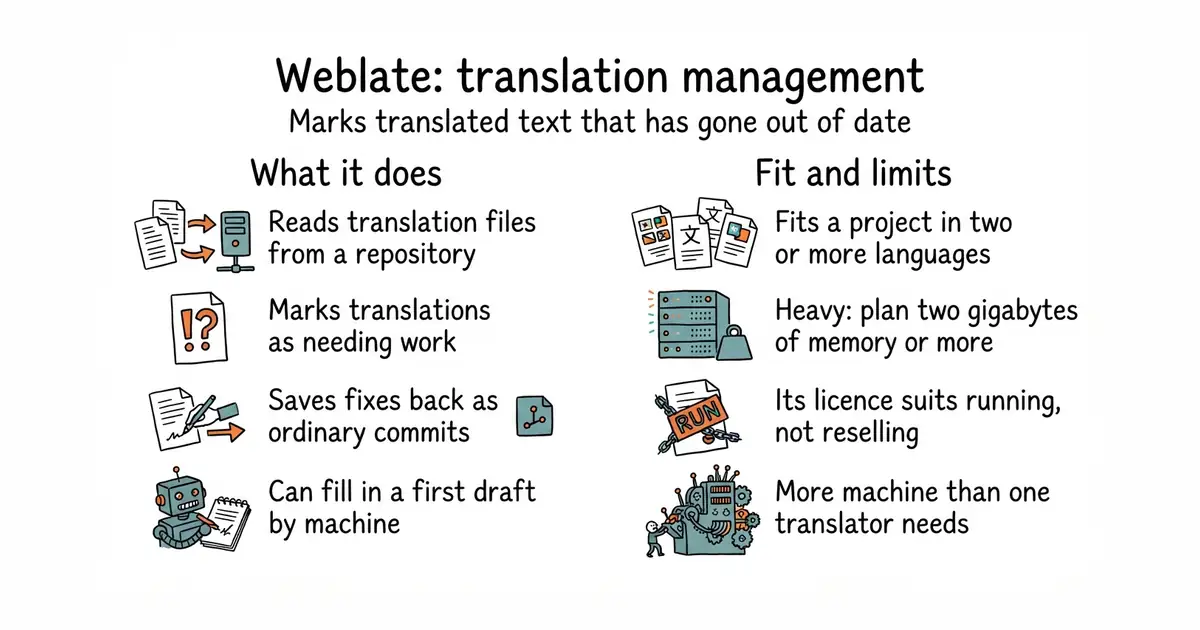
Weblate is a translation management system. It connects to a git repository, reads the translation files it finds there, and shows them in a web editor. Saved translations are written back as ordinary commits. When the source text changes, the matching translations are marked as needing work. It reads many file formats, keeps a record of who changed what, and runs checks for problems such as a missing placeholder. It can call a machine translation service to fill in a first draft that a person then corrects. Version 2026.10.1 was published on 9 October 2026. It does not translate a website's pages on its own: it manages translation files, so the text has to live in files it can read.
Why it matters
Who it suits. It suits a project in two or more languages whose translations are files in the repository, where somebody keeps forgetting which ones are stale. It suits anyone who pays a translator, because the translator gets a web screen and never touches the code. Skip it for one person handling two languages by hand, where a checklist and #3 are enough machine.
Verdict. The one feature worth the day is the automatic marking of stale translations, and nothing lighter on this page does it. Expect Django, PostgreSQL, Redis and a background worker, so plan two gigabytes of memory or more. GPL-3.0 means running it is fine and shipping a changed copy inside a closed product is not. tolgee/tolgee-platform is the lighter choice for the labels inside an application, and LibreTranslate/LibreTranslate can supply the first machine draft.
Summary (Key Points)from the README
Key features
- Privacy and control: Presented as a privacy-respecting, open-source localization platform that stays under the user's control.
- Workflow-oriented: Described as built around the user's translation workflow.
- Two ways to run it: Can be self-hosted or used as Hosted Weblate at weblate.org.
- Documentation: Lives in the docs directory of the source code and can also be read online.
- Optional commercial offerings: Professional support and cloud hosting are available alongside the free software.
- Accessibility commitment: A documented accessibility target and reporting guidance are provided in ACCESSIBILITY.md, with a dedicated issue template.
- Quality and compliance badges: The README shows CII Best Practices, REUSE status, translation status and Argos Visual Testing badges.
- License: Free software under the GNU General Public License v3 or later.
Ways to install
| Platform or method | What it needs | Effort |
|---|---|---|
| Self-hosted, from the source code | Setup instructions are referenced, but the README text does not state the requirements | Not stated in README |
| Hosted Weblate at weblate.org | Not stated in README | Not stated in README |
Important
- Setup details missing: The README refers to setup instructions, but the steps, requirements and commands are not in the text provided, so check the linked installation guide before starting.
- Hosting offerings: Professional support and cloud hosting are described as optional; the README gives no pricing or terms for them.
- License terms: Distributed under GPL v3 or later, without any warranty of merchantability or fitness for a particular purpose.
- Bug reporting: Feature requests and problems go to the project's issue channels, and accessibility problems have their own template.
Written by an AI model from the project’s README; not part of the review, and it can be wrong.
- It works from the git repository, so translations are ordinary commits and nothing lives where it cannot be backed up.
- It marks translations as needing work automatically when the source changes. That is the single feature most setups are missing.
- Actively maintained, with releases roughly monthly and the newest from 9 October 2026.
- It is heavy: Django, PostgreSQL, Redis and a worker process. Plan two gigabytes of memory or more.
- GPL-3.0 for the server. Running it is completely fine. Shipping a modified copy inside a closed product is not.
- For a single translator this is probably more machine than the job needs. Be honest about that before spending the day.
git clone https://github.com/WeblateOrg/docker-compose.git weblate-docker
cd weblate-docker
docker compose up -d