Edition No. 63 · 27 Oct 2026
The personal CRM with no AI in it
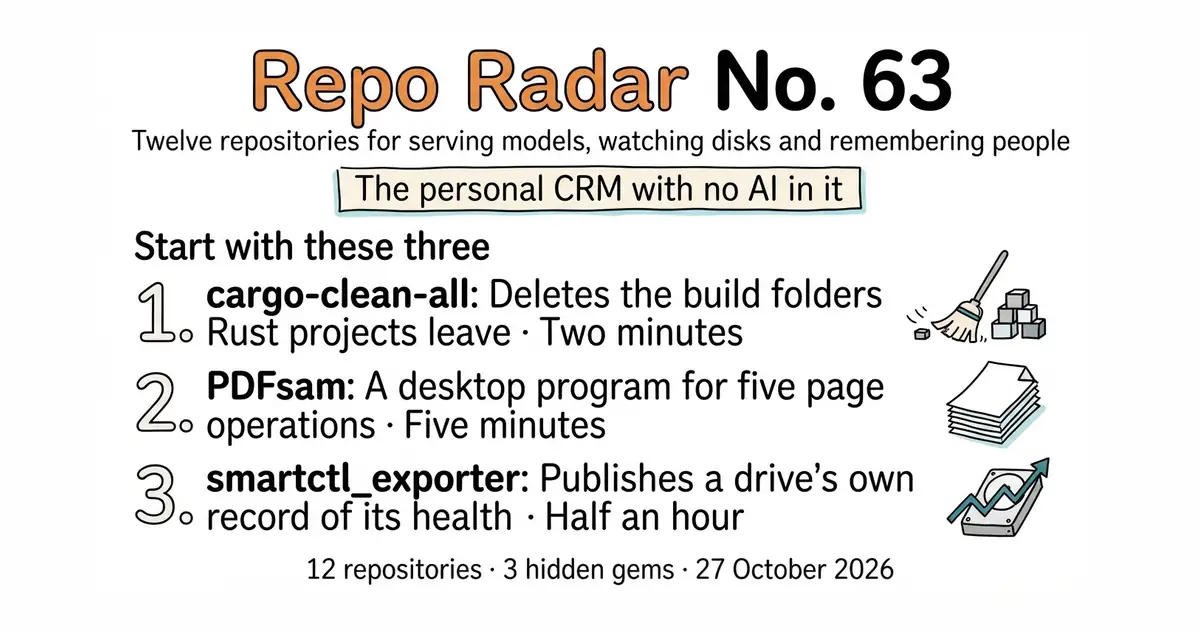
Two of the largest model-serving projects in the world, a free catalogue of three hundred thousand financial symbols, and a contact book that says plainly it will never add artificial intelligence.
A daily review of twelve open-source projects on GitHub, chosen for how good they are rather than for what they are about. Today: two of the largest model-serving projects in the world, a free list of three hundred thousand financial symbols, a note-keeping program for friends and family that says plainly it will never add artificial intelligence, and three very small tools that look after one computer.
We aim for twelve every day. Some candidates fall out while we check them — those are listed at the end, with the reason.
If you only do three things
- dnlmlr/cargo-clean-all — two minutes. If there are Rust projects on the disk, this finds every build folder, shows how many gigabytes they hold, and deletes the ones nobody has touched. A new version landed two days ago.
- torakiki/pdfsam — five minutes, and no terminal at all. A desktop program that splits, merges and rotates PDF files. Download the installer, open it, done.
- prometheus-community/smartctl_exporter — half an hour. Hard disks keep their own records of errors and wear. This publishes those records so a monitoring system can warn before a disk fails rather than after.
Every link in one place
| # | Repository | Project site | Stars | Licence |
|---|---|---|---|---|
| 1 | vllm-project/vllm | vllm.ai | 93.7k | Apache-2.0 |
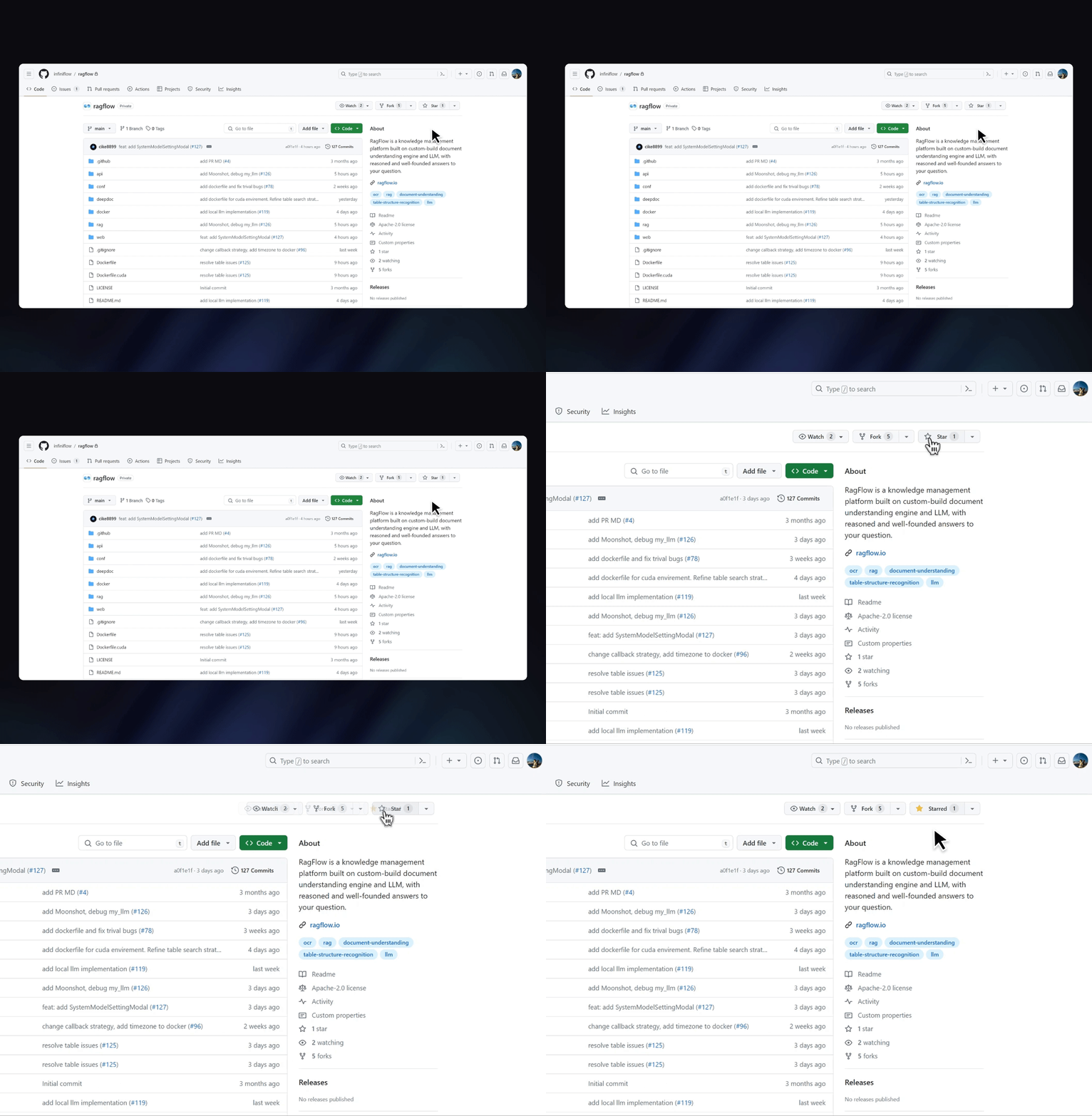
| 2 | infiniflow/ragflow | ragflow.io | 92.6k | Apache-2.0 |
| 3 | musistudio/claude-code-router | ccrdesk.top | 37.9k | MIT |
| 4 | AI4Finance-Foundation/FinRL | finrl.ai | 16,799 | MIT |
| 5 | JerBouma/FinanceDatabase | jeroenbouma.com | 8.7k | MIT |
| 6 | getmaxun/maxun | maxun.dev | 17.1k | AGPL-3.0 |
| 7 | monicahq/monica | docs.monicahq.com | 25,537 | AGPL-3.0 |
| 8 | prometheus-community/smartctl_exporter | none listed | 595 | Apache-2.0 |
| 9 | OpenSLO/oslo | none listed | 221 | Apache-2.0 |
| 10 | dnlmlr/cargo-clean-all | crates.io entry | 274 | MIT |
| 11 | TechnitiumSoftware/DnsServer | technitium.com/dns | 9.9k | GPL-3.0 |
| 12 | torakiki/pdfsam | pdfsam.org | 4.6k | AGPL-3.0 |
The personal CRM with no AI in it
Twelve repositories, checked and reviewed. Every version verified against the GitHub API and dated.

93.7k stars · Apache-2.0, named in the About sidebar · v0.32.0, read from /releases/latest as '18 October' with no year, which falls in the past and is therefore 2026 · Track this in Scout · Share this tool
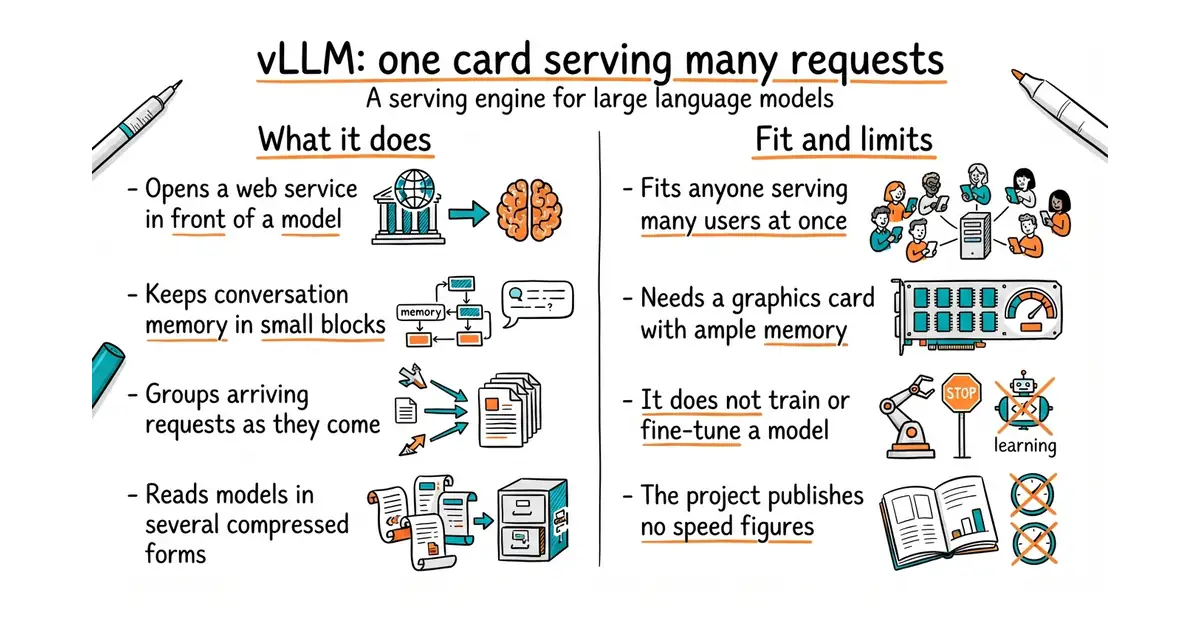
A serving engine that makes one graphics card answer many requests at once.
▶Repo detailsthe review · specs · pros & cons · install
What it does
It loads a model and opens a web service in front of it. That service speaks the same request format as the common paid services, so programs written against those can point at this instead. It keeps each conversation's working memory in small fixed blocks rather than one long reservation, which is what the project calls PagedAttention, and that is where most of the memory saving comes from. It groups arriving requests together as they come, instead of waiting for a batch to fill. It reads models in many compressed forms, including FP8, INT8, INT4 and GGUF, so a model can be made smaller before it is loaded. The project page claims support for more than 200 model shapes published on Hugging Face, and names more than 2,000 contributors. It runs on graphics cards from NVIDIA, AMD and Intel, on ordinary processors, and through add-ons on several other kinds of chip. It does not train a model, it does not fine-tune one, and it gives no chat window of its own — that is a separate program pointed at this one.
Why it matters
Who it suits. Anyone who has decided to run a model on hardware they control rather than paying for each question, and who expects more than one person to ask at a time. It also suits a research group that needs the same model answering many experiments in parallel. Skip it if only one person will ever use the model: ggml-org/llama.cpp is far easier to start and runs on an ordinary laptop.
Verdict. Worth the day it takes, if the premise holds. The premise is that the machine has a capable graphics card with a lot of memory, and that the cost of running it is already justified. The honest warning is that the project page gives no speed figures at all. Phrases like "state of the art throughput" are not measurements, so anyone choosing between this and sgl-project/sglang should measure both on the model they actually want. Releases are frequent, v0.32.0 arrived on 18 October 2026, and there are a great many settings to learn before the fast paths are switched on.
- It speaks the common request format, so existing code often works with one changed address.
- The hardware list is unusually wide, from several makes of graphics card down to plain processors.
- More than 200 model shapes, so a new model is usually supported within days.
- It needs a graphics card with plenty of memory, and the project states no minimum, so the only way to know is to try.
- No published speed figures, which is awkward for a project whose main claim is speed.
- Many settings, and the defaults are not the fast ones. Expect to read documentation.
 sgl-project/sglang
A serving framework for the same job, with more attention to controlling the shape of the answer.
Track this in Scout ggml-org/llama.cpp
Runs a model on one machine with no graphics card at all, much easier to start and much slower under load.
Track this in Scout
python3 -m venv venv
source venv/bin/activate
pip install uv
uv pip install vllm
vllm download-kernels

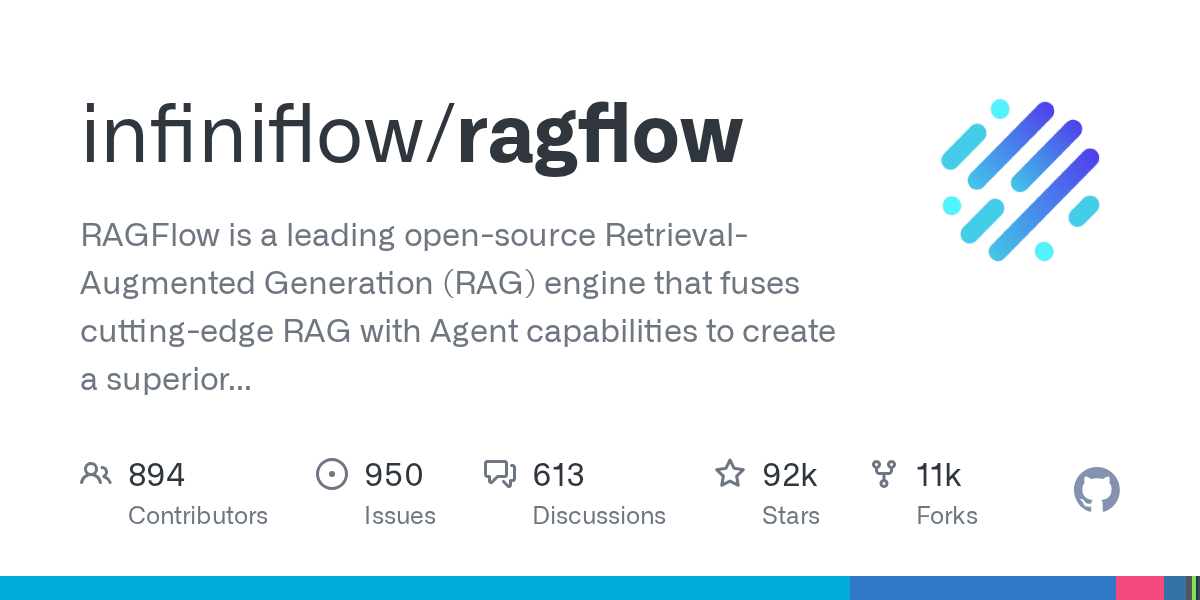
92.6k stars · Apache-2.0, named in the About sidebar · v1.0.0-rc2, read from /releases/latest as '16 October' with no year, which falls in the past and is therefore 2026 · Track this in Scout · Share this tool
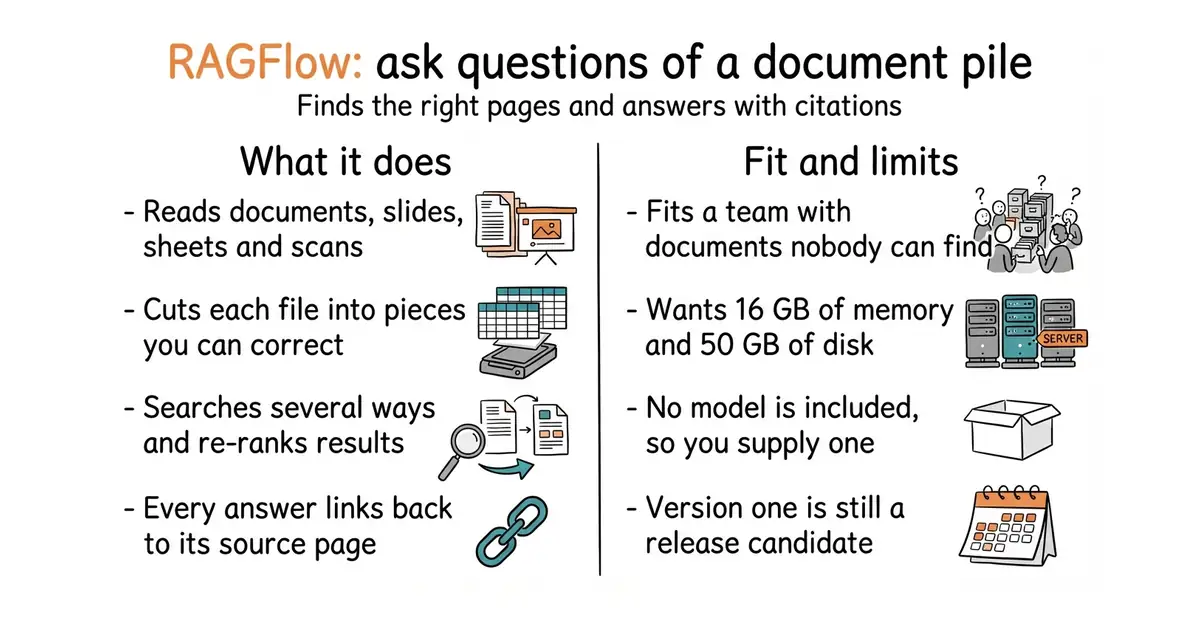
A question-answering system built on a document collection, with the sources shown beside every answer.
▶Repo detailsthe review · specs · pros & cons · install
What it does
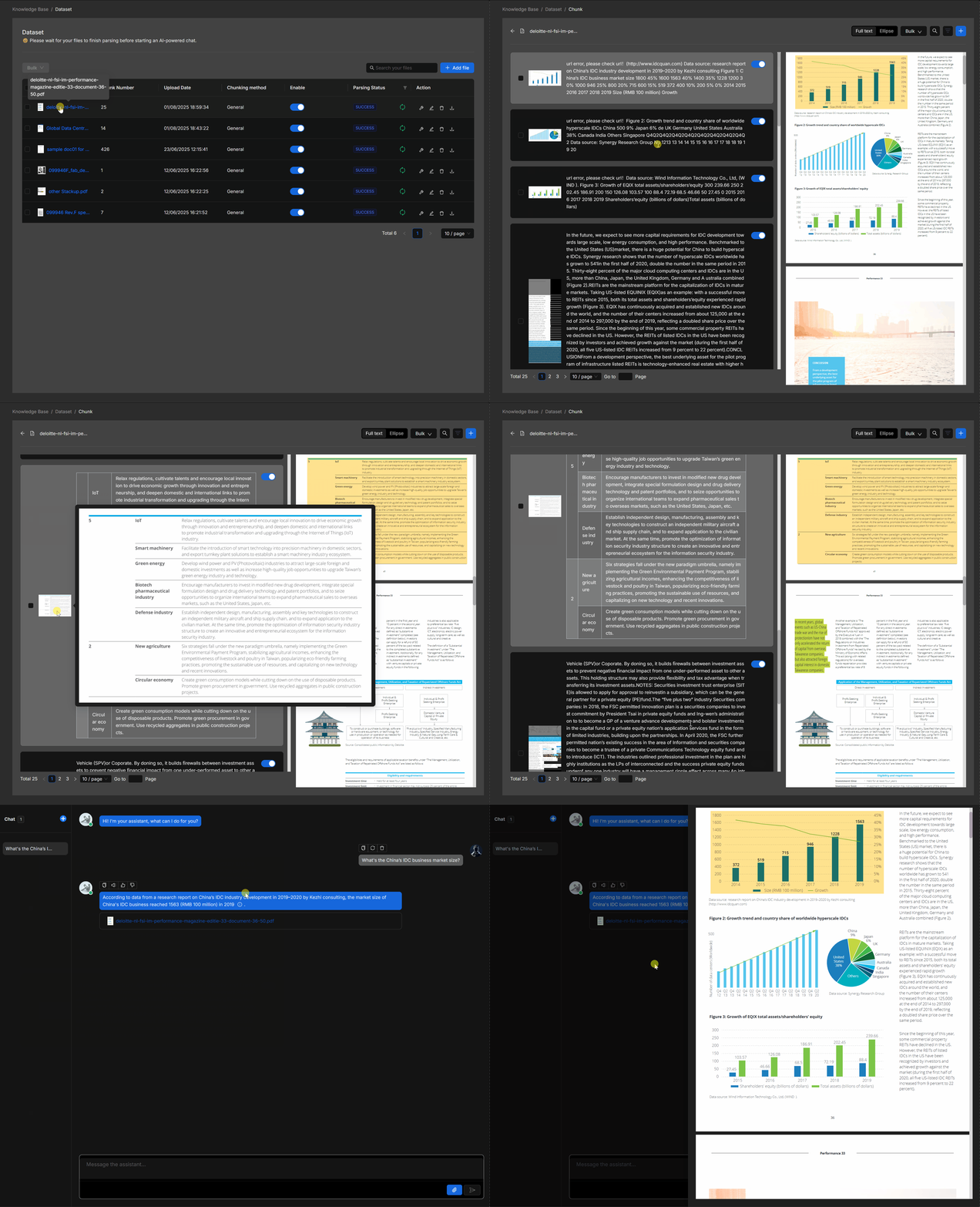
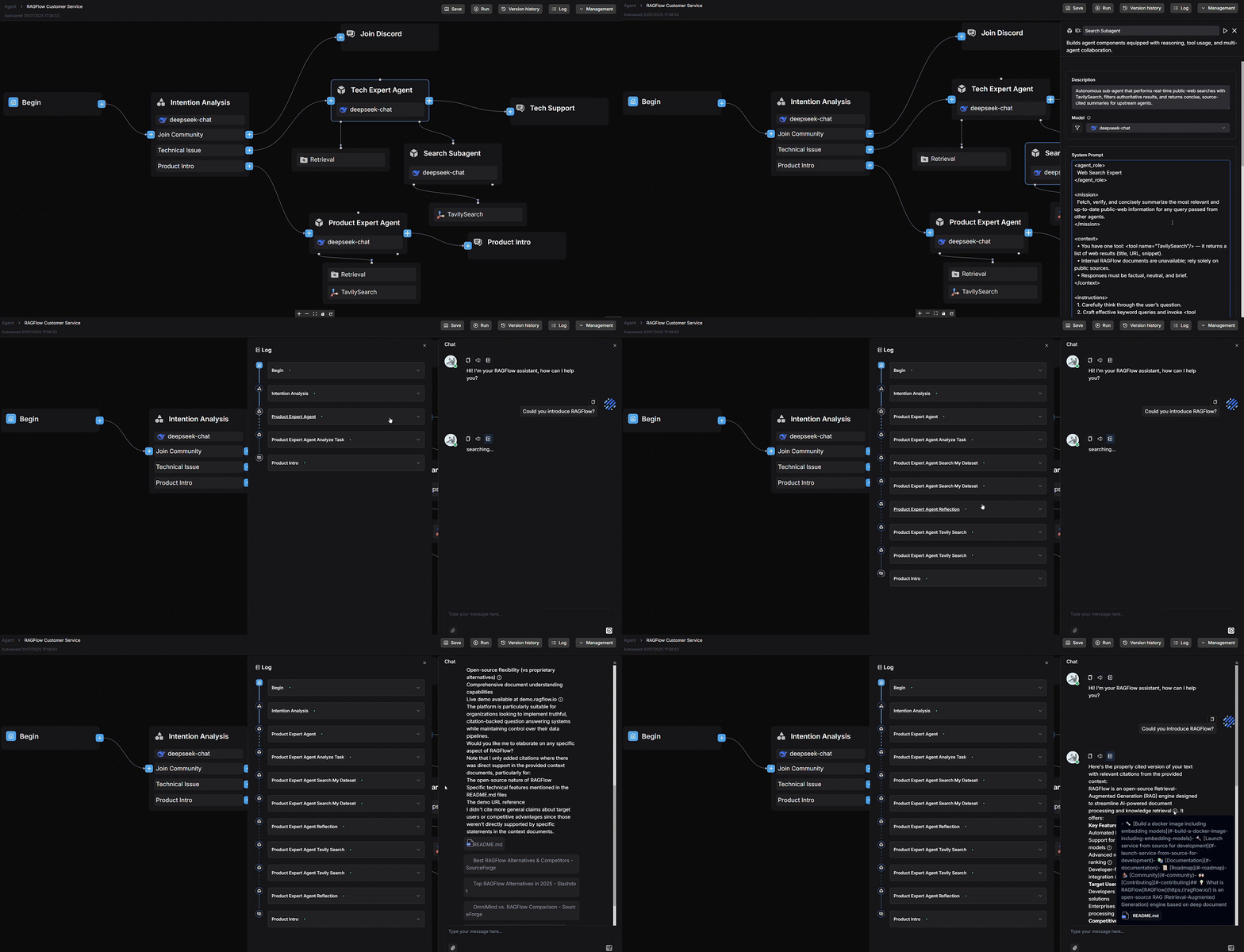
It reads Word files, slides, spreadsheets, plain text, images, PDFs and scanned pages, and it can also pull a website in through its sitemap. It cuts each document into pieces using templates chosen by document type, and it draws those pieces on screen so a person can correct a bad cut by hand. From the collection it builds extra structures for searching: wikis, graphs, trees, mind maps and timelines. When a question arrives it searches several ways at once, re-ranks the results together, and can go round again to check its own evidence, at four settings the project calls Low, Medium, High and Ultra. Every answer carries references back to the source. The suggested starting size for a machine is 4 processor cores, 16 GB of memory and 50 GB of free disk. It ships no model of its own, and it does not run on macOS.
Why it matters
Who it suits. A small team with a few thousand documents that nobody can find anything in: contracts, manuals, research papers, old reports. The visible chunking is the real draw, because most systems of this kind cut documents badly and never tell anyone. Skip it if the documents are few enough to search by hand, or if there is no machine with 16 GB of memory to spare.
Verdict. The most capable free system of its kind right now, and also the heaviest. Version 1.0 has not landed yet, only release candidates, the newest being v1.0.0-rc2 on 16 October 2026, so expect things to move under your feet. The missing macOS support matters more than it sounds, because it rules out the laptop most small teams would try it on first. If the goal is only to turn PDFs into clean text, datalab-to/marker does that one job and nothing else. If the goal is a workflow builder with many connectors, langgenius/dify is the broader tool and the weaker reader of documents.
- It shows how a document was cut up, and lets a person fix it.
- It reads scanned pages and images, not only text files.
- Answers carry citations back to the source page.
- 16 GB of memory and 50 GB of disk is the starting point, not the comfortable point.
- No macOS support, stated plainly on the project page.
- Still on release candidates for version 1.0, and you must supply a model and an API key yourself.
 datalab-to/marker
Converts documents to markdown and structured data; one careful step rather than a whole system.
Track this in Scout langgenius/dify
A platform for building answering workflows, wider in scope and weaker at reading hard documents.
Track this in Scout
sudo sysctl -w vm.max_map_count=262144
git clone https://github.com/infiniflow/ragflow.git
cd ragflow/docker
git checkout v1.0.0-rc2
docker compose -f docker-compose.yml up -d
curl -f http://localhost/api/v1/system/healthz

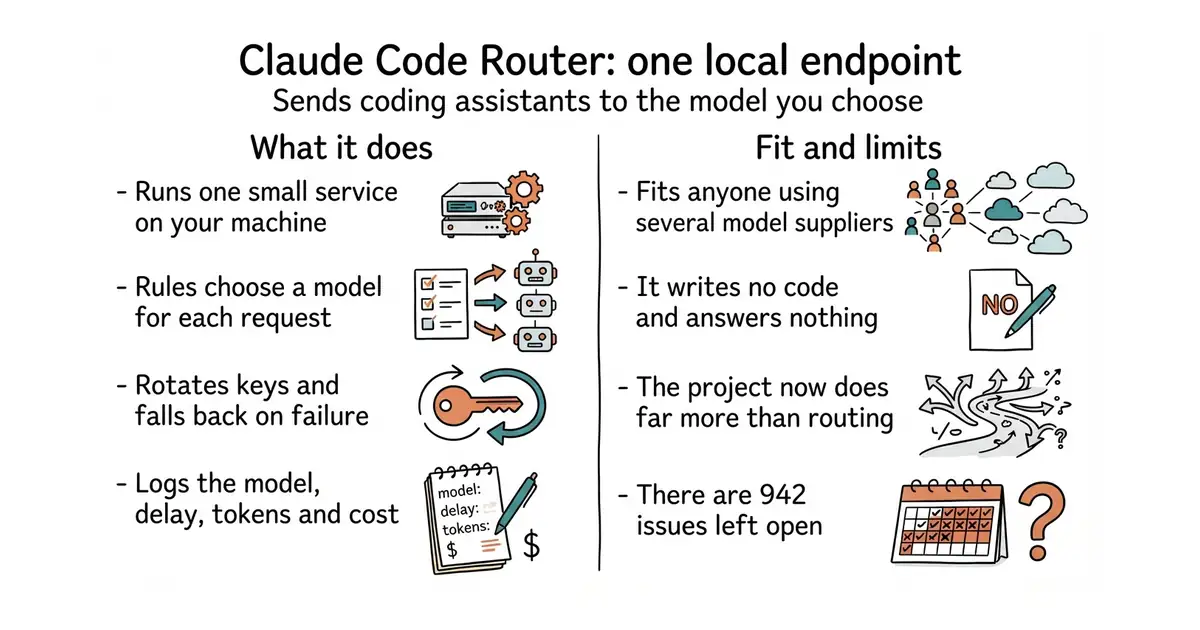
37.9k stars · MIT, named in the About sidebar · v3.1.3, confirmed from the npm registry entry for @musistudio/claude-code-router, published in October 2026 · Track this in Scout · Share this tool
One local address that many coding assistants can talk to, pointed at whichever model the operator chooses.
▶Repo detailsthe review · specs · pros & cons · install
What it does
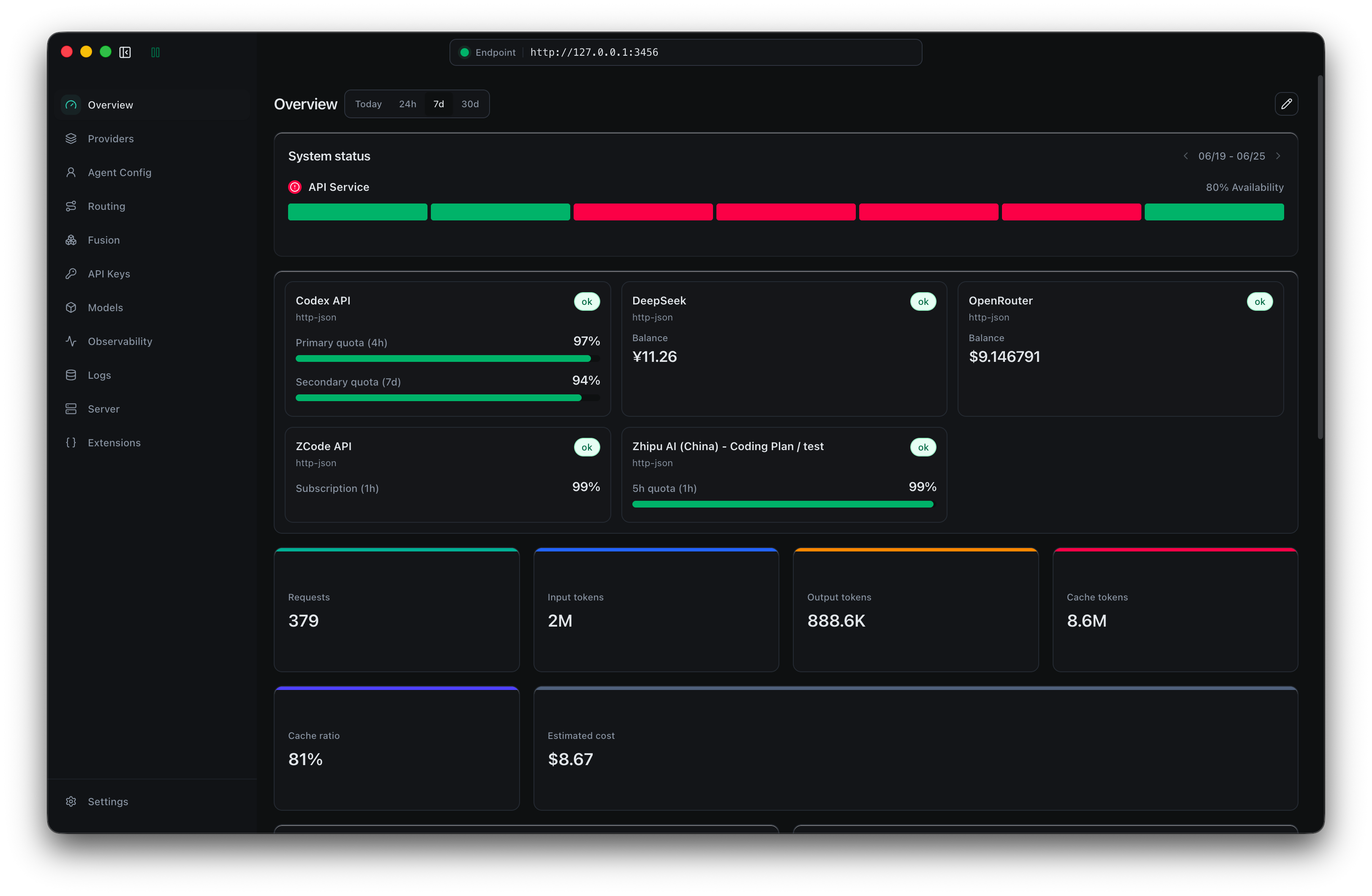
It runs a small service on the machine, by default on port 3456, and a management page on port 3458. Coding assistants are configured to send their requests to that address instead of to a supplier. It speaks several request formats on both sides, including the OpenAI chat and responses formats, the Anthropic messages format and Gemini, and it can forward to suppliers such as OpenRouter, DeepSeek, Mistral and Moonshot. Routing rules can read the headers and body of a request, so short completions and long reasoning can go to different models. It holds pools of credentials, rotates keys, retries, and falls back down an ordered list of models when one is unavailable. It records every request with the model chosen, the delay, the tokens used and an estimated cost. It issues its own keys with expiry dates and limits, so a shared instance can be handed out safely. It is not a model and it is not an assistant: nothing here writes code, and without at least one supplier key it does nothing at all.
Why it matters
Who it suits. Anyone using more than one coding assistant, or more than one model supplier, and tired of keeping keys in several places. It also suits anyone who wants to know what the month's model use actually cost, broken down by request. Skip it if there is one assistant and one supplier and the bill is already clear: this adds a moving part for no gain.
Verdict. The cost accounting is the part that earns its keep. Model spending is hard to see and easy to let run, and a log that names the model, the tokens and the estimated cost for every request changes behaviour. The scope is the worry. The project has grown far past routing into browser automation, plugins and relays through eight different chat platforms, which is a lot of ground for one project with 942 open issues. Node.js 22 or newer is required. If the need is a plain gateway in front of many models with nothing else attached, BerriAI/litellm and Portkey-AI/gateway are narrower and calmer choices.
- Per-request logs with model, delay, tokens and estimated cost.
- Ordered fallback models and key rotation, so one supplier failing is not a stoppage.
- Its own client keys with expiry and limits, which makes a shared instance practical.
- The project does a great deal besides routing, and 942 open issues suggest the breadth has a price.
- Needs Node.js 22 or newer, which is more recent than many systems ship.
- Packaging the Windows desktop build must happen on Windows, because of a compiled component.
 BerriAI/litellm
A gateway that calls a hundred or more model services in one format; a library and a proxy rather than a desktop control room.
Track this in Scout- Portkey-AI/gateway
Routes to a large catalogue of models with content checks attached; strong on guardrails, no agent features.
Track this in Scout
npm install -g @musistudio/claude-code-router
ccr ui




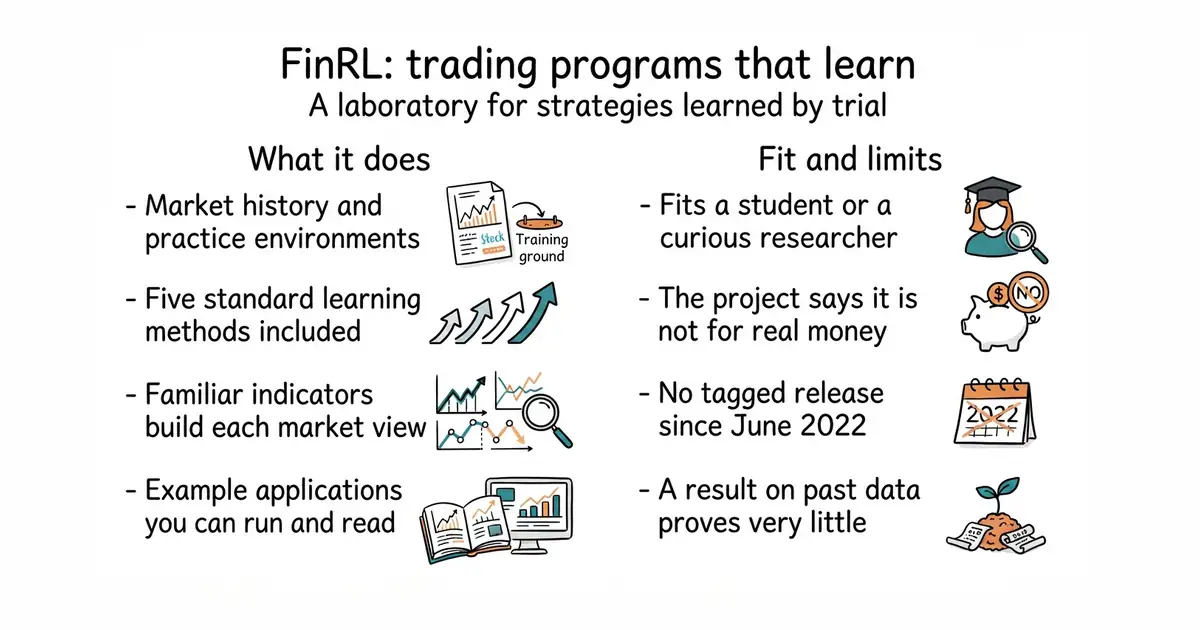
16,799 stars · MIT, named in the About sidebar · 0.3.5 from 25 June 2022 is the newest tagged release, and it is NOT a code date: the mirror at ungh.cc gives pushedAt 2026-10-23, four days before this edition · Track this in Scout · Share this tool
A framework for building and testing trading programs that learn from repeated attempts.
▶Repo detailsthe review · specs · pros & cons · install
What it does
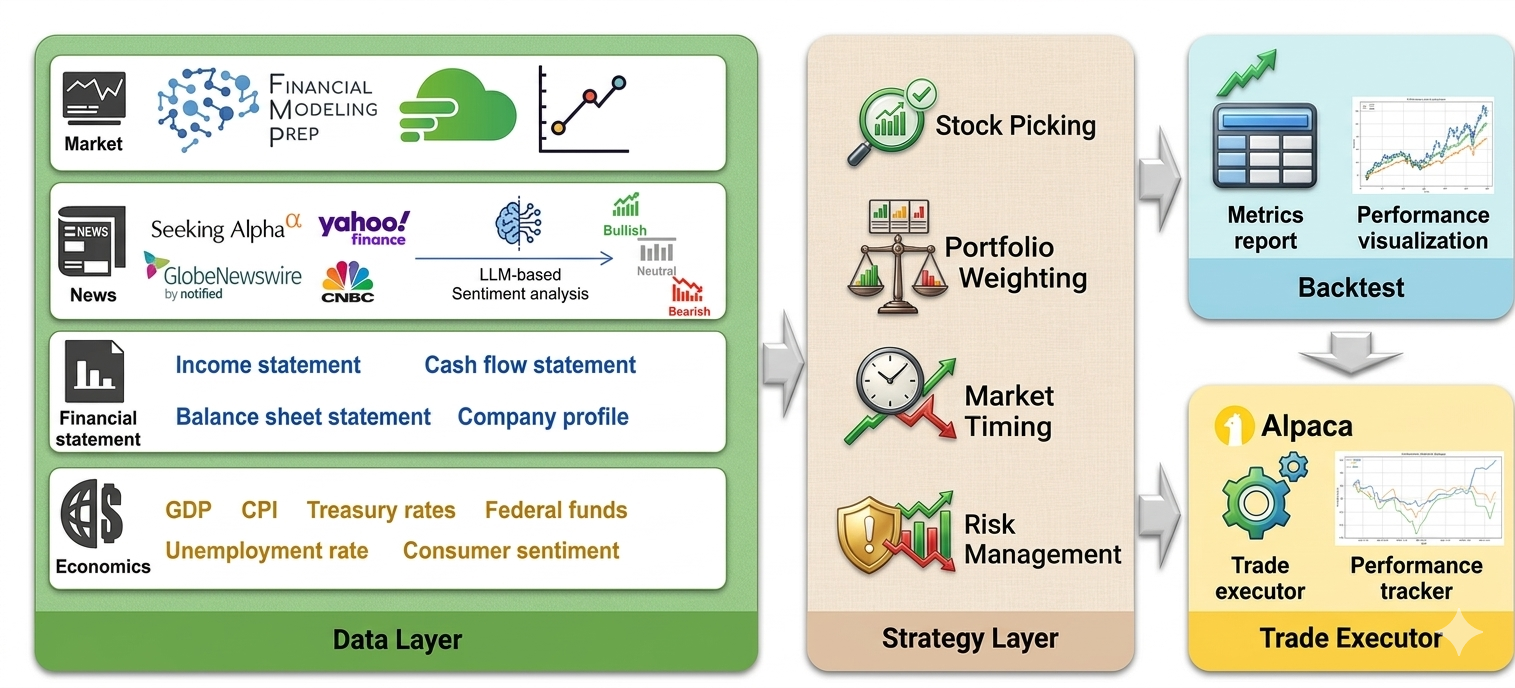
It is built in three layers: market environments, learning agents, and finished example applications. The environments carry data from several markets, including United States shares and exchange-traded funds, Chinese A-shares, cryptocurrency, Taiwanese securities and foreign exchange, with Alpaca listed for live United States trading. The learning methods come from a standard library and include A2C, DDPG, PPO, SAC and TD3. Each environment hands the program a view of the market built from familiar indicators, among them MACD, Bollinger bands, a 30-day RSI, a 30-day DX, and 30- and 60-day moving averages, plus a volatility index and a turbulence measure. The 2026 tutorial trains five agents on the thirty shares of a well-known United States index. There are 3,284 commits and 283 open issues. It is not a trading platform, it carries no broker connection beyond the basic one, and the project explicitly points anyone wanting production or live trading at its newer sibling repository instead.
Why it matters
Who it suits. Someone learning how these methods behave on market data, or a student with a dissertation to write. The value is that the wiring between data, environment and learning method is already done, which is normally weeks of fiddly work. Skip it entirely if the plan is to trade with real money: the project's own documentation sends that reader elsewhere, and ignoring that advice is the most expensive mistake available here.
Verdict. Treat it as a laboratory and it is excellent. Treat it as a product and it will disappoint, because that is not what it claims to be. The last tagged release is 0.3.5 from June 2022, which looks alarming until you check the code: the newest commit landed on 23 October 2026, four days before this was written. That gap between releases and code is common and it is not a sign of neglect. The real caution is intellectual rather than technical. A method that learns from history will fit that history, and a convincing result on past data says very little about tomorrow. freqtrade/freqtrade is the practical alternative for actually running a strategy, and it is far less interested in learning methods.
- Data, practice environment and learning methods arrive already connected.
- Several markets covered, not only United States shares.
- A current 2026 tutorial, with working examples on a familiar set of shares.
- 283 open issues, and the project itself directs serious users to a different repository.
- No tagged release since June 2022, so there is nothing stable to pin a version to.
- Results on past data are easy to produce and easy to misread. This is not investment advice, and the project says the same.
- AI4Finance-Foundation/ElegantRL
The learning library from the same group, general-purpose, with no financial parts attached.
Track this in Scout  freqtrade/freqtrade
A free crypto trading program, made for running strategies rather than for studying learning methods.
Track this in Scout
git clone https://github.com/AI4Finance-Foundation/FinRL.git
cd FinRL
python3 -m venv venv
source venv/bin/activate
pip install -e .



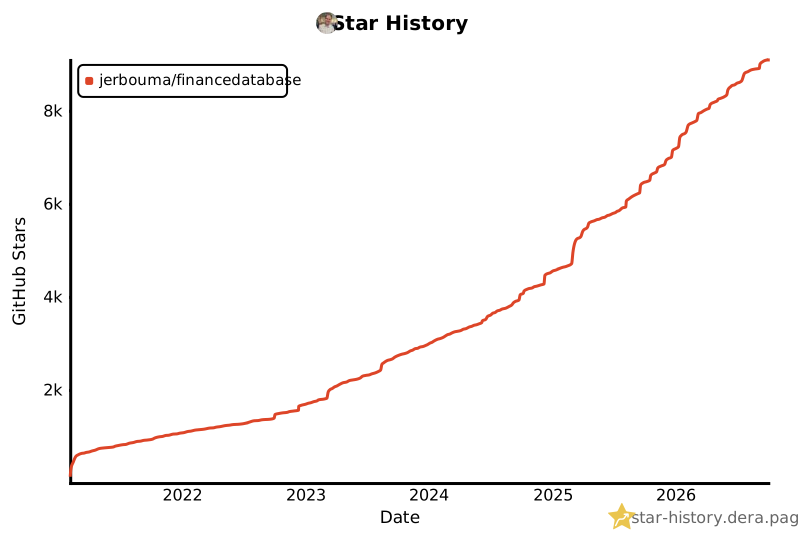
8.7k stars · MIT, named in the About sidebar · 2.5.1, read from /releases/latest as '12 Oct' with no year, which falls in the past and is therefore 2026 · Track this in Scout · Share this tool
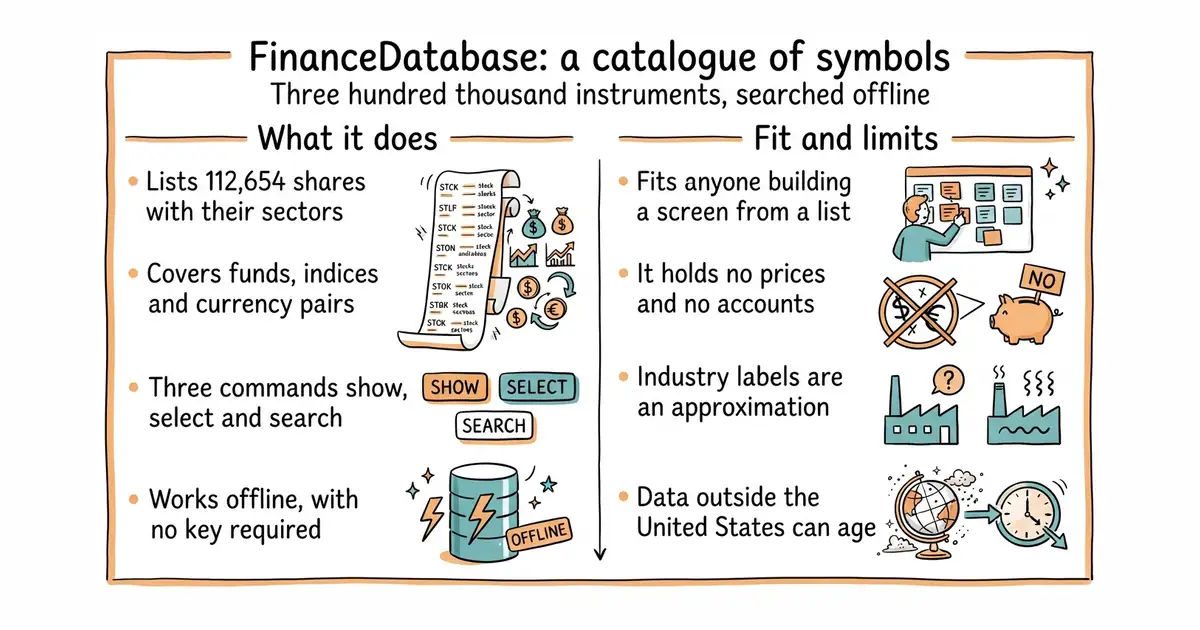
A free, offline catalogue of more than three hundred thousand financial symbols with their categories.
▶Repo detailsthe review · specs · pros & cons · install
What it does
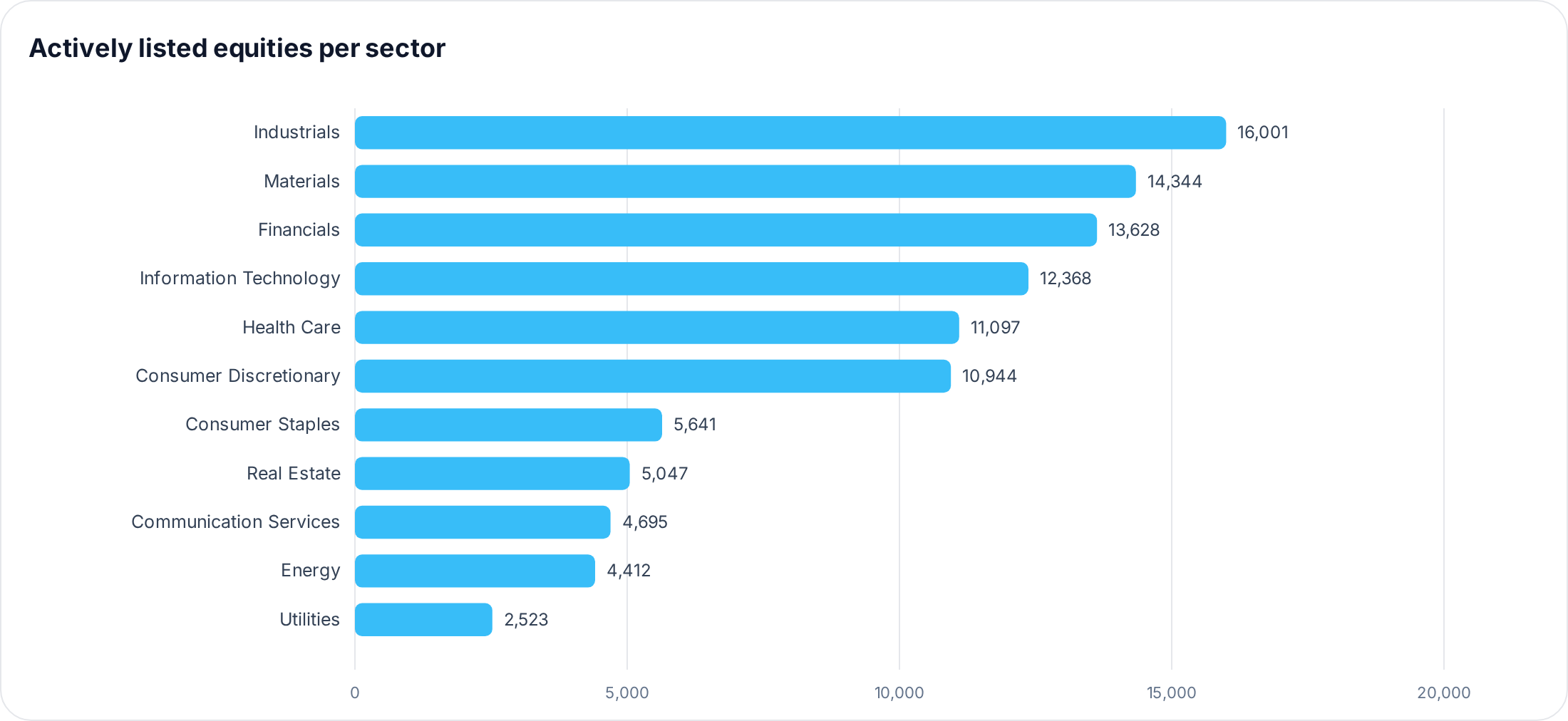
It installs as a Python package and brings its data with it, so no key and no internet connection are needed to search. It covers 112,654 shares across 11 sectors, 80 industries, 117 countries and 84 exchanges; 36,480 exchange-traded funds; 57,853 funds; 91,181 indices; 2,556 currency pairs; 3,367 cryptocurrencies; and 1,367 money-market instruments. Three commands do the work: show_options lists what values a field can take, select narrows by those values, and search looks for text. A to_toolkit call hands a selection to the author's companion analysis package. United States exchange data is refreshed weekly; everything else depends on contributions from the public. Delisted symbols are kept on purpose, for historical study. It is explicitly not a source of up-to-date company accounts or prices, and the project says so in those words.
Why it matters
Who it suits. Anyone writing a screen or a study who needs to start from a list rather than a guess: every fund in a family, every share in one industry in one country, every index on one exchange. It is also the quiet answer to a common annoyance, which is that price libraries expect you to already know the symbol. Skip it if the work only ever touches a handful of well-known tickers, since typing five symbols by hand is faster than installing anything.
Verdict. A genuinely useful piece of groundwork, and refreshingly honest about its limits. Three cautions. The industry classification is described by the author as a loose approximation of the standard scheme, so it is good enough for exploring and not good enough for a formal report. Some symbols in the list are holdings rather than tradeable instruments and will return nothing when passed to a price service. And non-United States data moves only when somebody contributes, so coverage outside the United States ages. The companion JerBouma/FinanceToolkit needs a third-party key whose free plan allows 250 requests a day on United States companies only, which is a real limit worth knowing before anything is built on it. Version 2.5.1 landed on 12 October 2026.
- Works offline with no key, because the data ships inside the package.
- Real coverage numbers, published per category rather than claimed in the round.
- Delisted symbols kept deliberately, which makes historical work possible.
- Industry labels are an approximation of the standard scheme, not the scheme itself.
- Coverage outside the United States depends on public contributions and can be stale.
- The companion analysis package needs a paid third-party service to be much use.
- JerBouma/FinanceToolkit
The same author's analysis package, which computes ratios and metrics and needs an external data key.
Track this in Scout  ranaroussi/yfinance
Downloads prices and fundamentals for a symbol you already know; the natural partner rather than a competitor.
Track this in Scout
python3 -m venv venv
source venv/bin/activate
pip install financedatabase -U


17.1k stars · AGPL-3.0, named in the About sidebar · v0.1.0, read from /releases/latest as '25 October' with no year, which falls in the past and is therefore 2026 · Track this in Scout · Share this tool
A point-and-click robot that copies lists out of websites and repeats the job on a schedule.
▶Repo detailsthe review · specs · pros & cons · install
What it does
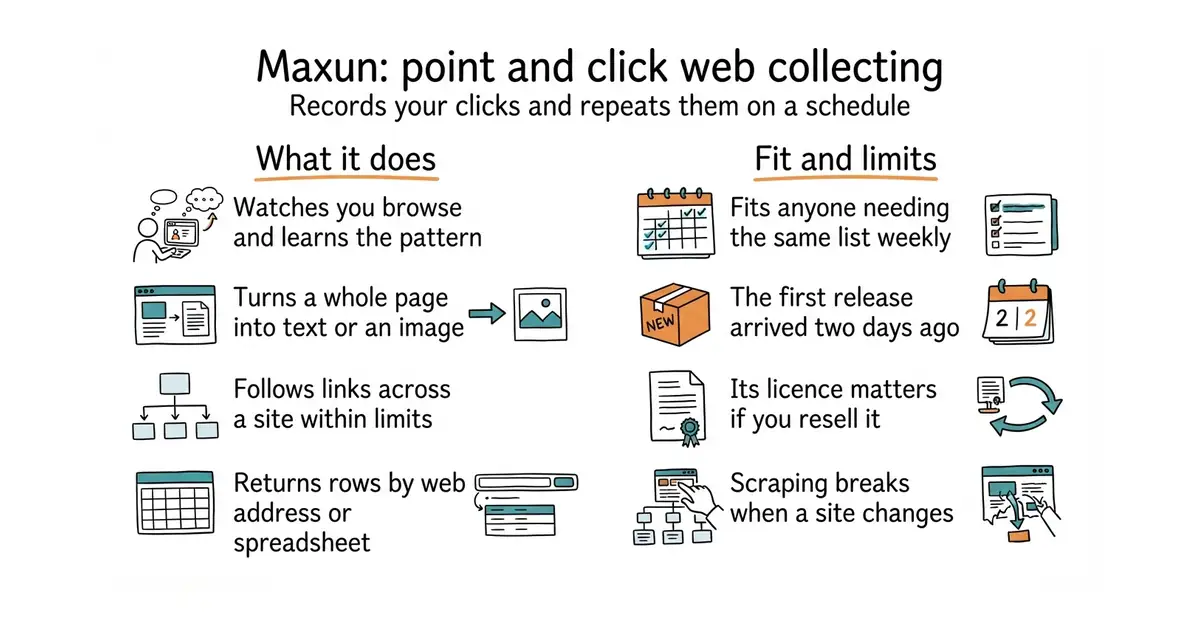
It offers four kinds of robot. Extract watches you browse and turns your clicks into a repeatable collector of structured data, and it can also take a description in plain language and work out the fields itself. Scrape turns a whole page into markdown or HTML and can take a screenshot. Crawl follows links across a site within limits you set. Search runs repeated web searches, with filters by time. It handles pagination and scrolling, runs on a schedule, and can log in to a site first. Results come back as a web address that returns data, or as rows pushed into Google Sheets or Airtable, or as markdown meant for a language model to read. There is also a command-line tool and a code library for people who want them. It is a collector and nothing else: it stores no analysis, draws no charts, and the project page makes claims about recovering from site layout changes without explaining how.
Why it matters
Who it suits. Anyone who needs the same list from the same site every week and has no interest in writing a scraper: prices, job postings, directory listings, competitor catalogues. The recorder is the feature that matters, because it removes the one step that normally requires a programmer. Skip it if the site has a published data service already, which is nearly always easier and always more polite.
Verdict. Promising, and early. Version v0.1.0 was tagged on 25 October 2026, two days before this was written, and a first release that low after 7,322 commits tells you the authors are not claiming stability yet. The licence deserves a moment: AGPL-3.0 means that if a modified copy is offered to other people over a network, the modified code must be offered too. For private use that is irrelevant; for anything built into a product sold to others it is central. Also expect scraping to break, whatever any project promises, because sites change and some actively object. apify/crawlee is the choice if writing code is acceptable, and dgtlmoon/changedetection.io is better if the question is only "has this page changed".
- Records a person's clicks and turns them into a repeatable robot, with no code.
- Sends results straight into Google Sheets or Airtable, which suits non-programmers.
- Handles logged-in pages, pagination and scrolling, which is where simple tools give up.
- First release is v0.1.0, dated two days ago. Treat it as early software.
- AGPL-3.0 is a real consideration for anything built into a product offered to other people.
- The claim that robots recover from layout changes is made with no detail behind it.
 apify/crawlee
A library for writing reliable crawlers, with far more control, and you must write the code.
Track this in Scout dgtlmoon/changedetection.io
Watches pages and tells you when they change; notification rather than collection.
Track this in Scout
mkdir maxun && cd maxun
openssl rand -base64 48      # use for JWT_SECRET
openssl rand -base64 48      # use for SESSION_SECRET
openssl rand -hex 32         # use for ENCRYPTION_KEY


25,537 stars · AGPL-3.0, named in the About sidebar · v4.1.2, read from /releases/latest and dated 4 May 2024; code is still landing, with the mirror at ungh.cc giving pushedAt 2026-09-24 on the next-generation branch · Track this in Scout · Share this tool
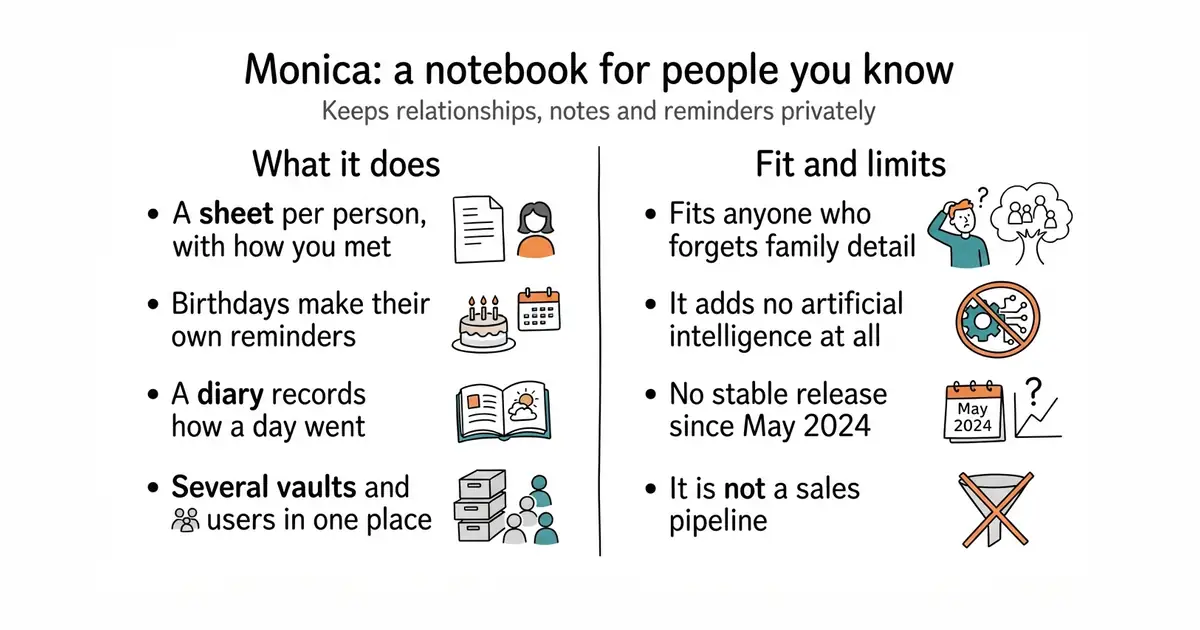
A private record of friends, family and contacts, with reminders and a diary.
▶Repo detailsthe review · specs · pros & cons · install
What it does
Each person gets a sheet holding contact details, addresses, how you met, their relationships to other people in the book, notes, tasks and past activities. Reminders can be set by hand, and birthdays generate their own. There is a diary, with a way to record how a day went. It also keeps pets, documents and photographs, labels and favourites. Several separate vaults can exist in one installation, with several users, and the interface is translated into 27 languages. Genders and activity types are definable rather than fixed, and the sections of a person's sheet can be rearranged. The project is firm about what it refuses to be: it is not a social network and says it never will be, it is not an assistant, it sends email only for reminders you set yourself, and it has no artificial intelligence or chat features built in.
Why it matters
Who it suits. Two quite different people. One is someone whose memory for family detail is poor and who minds about that. The other is a freelancer or consultant with a few hundred loose professional contacts and no wish to put them in a sales system. Skip it if the need is a sales pipeline with deals and stages: twentyhq/twenty and espocrm/espocrm are built for that and this is not.
Verdict. The refusals are the reason to take it seriously. In 2026 almost everything of this shape has had a chat assistant bolted on, usually by sending the contents somewhere else, and a project that keeps a list of people and declines to do that is making a deliberate choice about a sensitive pile of data. Two honest warnings. The last stable release is v4.1.2 from 4 May 2024, two and a half years ago, while development has moved to a next-generation branch where code landed on 24 September 2026. So the project is alive, but anyone installing it must decide between an old stable version and an unfinished new one, and there are 725 open issues. AGPL-3.0 applies, which only matters if a modified copy is offered to other people over a network.
- Designed for personal relationships rather than sales, which nothing else does well.
- Explicitly no artificial intelligence and no outbound email beyond your own reminders.
- Runs on a machine you control, with several vaults and users if needed.
- No stable release since May 2024, and the newer branch is not finished.
- 725 open issues, which is a lot for a project of this size.
- Setting it up means Docker and a mail setting before a single person can be added.
 twentyhq/twenty
A sales-focused contact system, with deals, pipelines and companies rather than friendships.
Track this in Scout espocrm/espocrm
A long-established open-source sales system, heavier, and aimed at a team.
Track this in Scout
docker run -p 8080:80 -e MAIL_MAILER=log ghcr.io/monicahq/monica-next:main



4.6k stars · AGPL-3.0, named in the About sidebar; the README records that versions before 3 were GPLv2 · v6.0.6, read from /releases/latest as '02 Oct' with no year, which falls in the past and is therefore 2026 · Track this in Scout · Share this tool
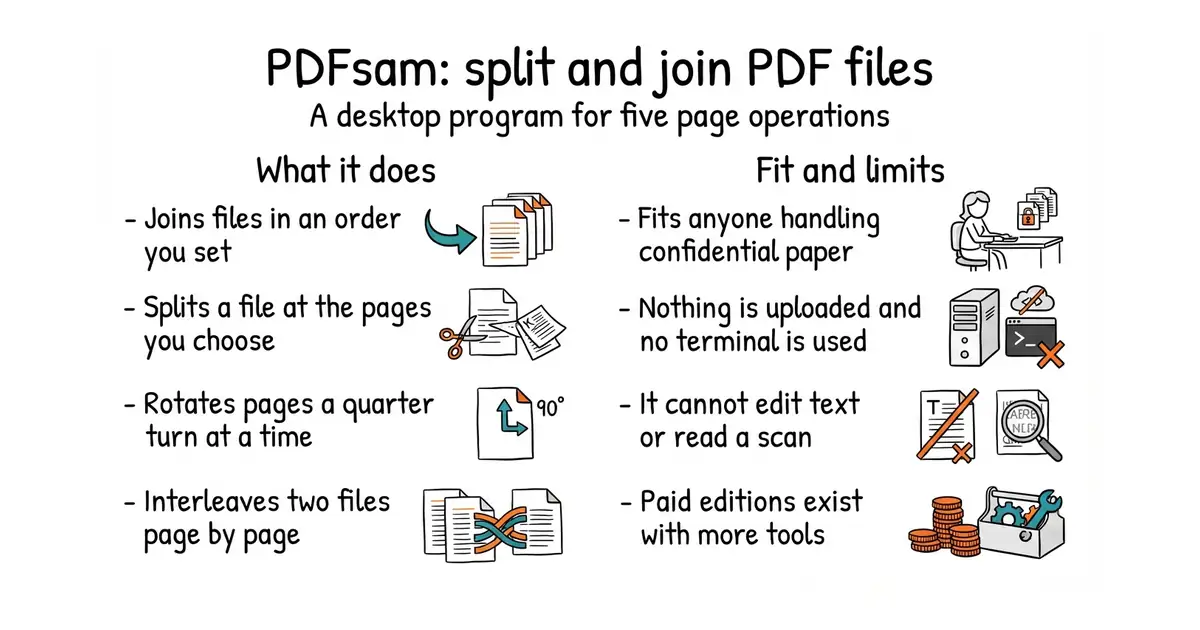
A desktop program to split, merge, mix, rotate and extract pages from PDF files.
▶Repo detailsthe review · specs · pros & cons · install
What it does
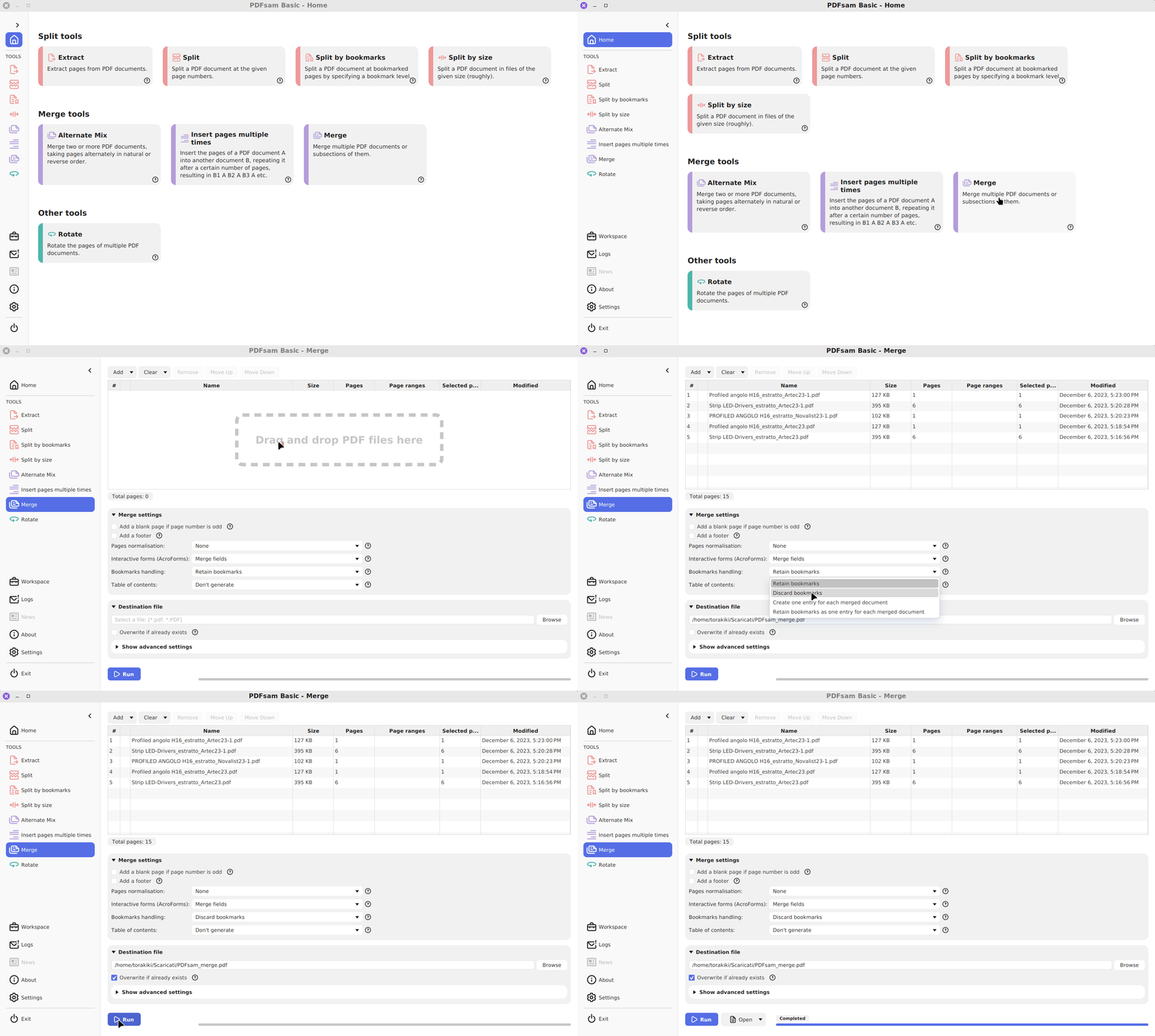
It opens as an ordinary desktop window and offers one tool per job. Merge joins files in an order you set. Split cuts a file at chosen pages, or every so many pages. Extract pulls out a page range into a new file. Rotate turns pages by a quarter turn at a time. Mix interleaves the pages of two files, which is what you need after scanning the fronts and backs of a stack of paper separately. It runs on Windows, macOS and Linux, and from version 4 onward the download includes the Java runtime it needs, so nothing has to be installed beside it. Version 6.0.6 was published on 2 October 2026. This repository holds the free version only: it does not edit text inside a page, it does not fill in forms, and it does not read a scanned page to find words in it.
Why it matters
Who it suits. Anyone who handles paper documents and does not want them leaving the building. Scanned contracts, signed forms, invoices from a shoebox: all of those arrive as the wrong PDF and need one of five operations. The whole point is that no file is uploaded to a website to be processed by a stranger, which is the normal alternative and a poor one for anything confidential. Skip it if the need is to search inside scanned pages, or to edit the words on them, because neither is on offer here.
Verdict. The easiest recommendation in today's twelve, and the only one that needs no terminal. It has been maintained for well over a decade, releases arrive steadily, and the job it does has not changed in that time, which is a virtue rather than a sign of neglect. Two things to know. The author also sells paid versions with more tools, so the website will show features that this free program does not have, and it pays to check which tier a feature belongs to before expecting it. AGPL-3.0 applies, which matters only to someone building it into software offered to other people. For a version that runs in a browser on a machine you control, Stirling-Tools/Stirling-PDF does far more and asks for Docker in return.
- Needs no terminal, no account and no internet connection.
- The download carries its own Java runtime, so there is nothing to install alongside it.
- Mixing two files page by page solves the scanned-both-sides problem that nothing else handles neatly.
- The author sells paid editions, so the website advertises tools this free program lacks.
- It cannot edit text on a page, fill in forms, or read words out of a scan.
- Being a desktop program, it cannot be put on a schedule or called from a script.
 Stirling-Tools/Stirling-PDF
A PDF workshop that runs in a browser on a machine you control, with many more tools, and Docker required.
Track this in Scout pdfarranger/pdfarranger
A small desktop program for merging, splitting, rotating and cropping pages, lighter, and best on Linux.
Track this in Scout
Open pdfsam.org , download the installer for the operating system in use, and run it.

595 stars · Apache-2.0, named in the About sidebar · v0.15.0, whose own heading reads '0.15.0 / 2026-09-01' while the release byline reads '07 Oct'; the first is the changelog date and the second the publication of the artefacts · Track this in Scout · Share this tool
It publishes a disk's own health figures so a monitoring system can watch them.
▶Repo detailsthe review · specs · pros & cons · install
What it does
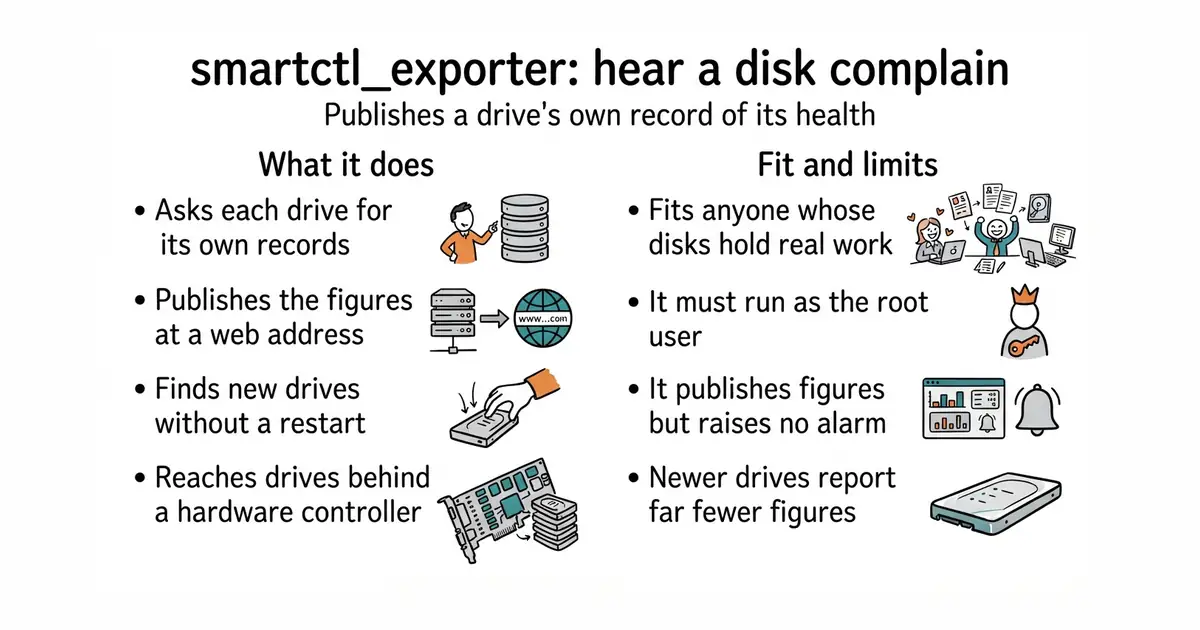
It runs smartctl, the command-line program that interrogates a drive, asks for its answer in a machine-readable form, and republishes the figures at a web address that a monitoring system reads on a timer. It needs smartmontools version 7.0 or later installed, because that is the version that can answer in that form. With no configuration it scans the machine for drives by itself, and it rescans on a timer so a newly fitted drive is picked up without a restart. Drives can also be named one by one, including those behind a hardware controller. The address it publishes on can be protected with a password and a certificate through a configuration file. The default port is 9633. It changes nothing and fixes nothing: it only forwards what the drive said, and the project closes requests to correct bad readings, directing them upstream to smartmontools instead.
Why it matters
Who it suits. Anyone running a machine with disks in it whose failure would hurt: a home file store, a small office server, a rented machine holding a database. The case for it is that disks usually give notice. Reallocated sectors climb, errors accumulate, and a drive that has been shouting for a month is still a surprise when it stops, simply because nobody read the record. Skip it if no monitoring system is in place, because this publishes numbers and does not alert on them: pair it with Prometheus and its alerting, or use AnalogJ/scrutiny instead, which brings its own screen.
Verdict. Worth half an hour, and one of the better returns on half an hour available. Three practical notes. It must run as the root user, because the commands that read a SATA drive are not available to anyone else, and that is why the example runs a privileged container. Solid-state NVMe drives and enterprise SCSI drives do not publish the same figures as older SATA drives, so expect fewer numbers from them. And the sensible alert is not on a single raw count but on a trend, because these counters are noisy and a one-off reading means little. Version 0.15.0 was published on 1 September 2026, with the release artefacts dated 7 October 2026.
- Finds the drives by itself and rescans on a timer, so new disks need no configuration.
- A single small program with one job, which is why it has not needed to change much.
- Covers drives behind hardware controllers, which many simpler tools cannot reach.
- Must run as the root user, which is a real decision on a shared machine.
- Publishes figures but raises no alarm, so a monitoring system is required alongside it.
- Modern NVMe and enterprise SCSI drives report far fewer figures than older SATA drives.
- smartmontools/smartmontools
The program underneath, required by this one, and able to run scheduled self-tests on its own.
Track this in Scout  AnalogJ/scrutiny
Drive monitoring with its own screen, history and realistic failure thresholds; the better pick when there is no monitoring system already.
Track this in Scout
docker run -d --privileged --user root -p 9633:9633 \
  prometheuscommunity/smartctl-exporter

221 stars · Apache-2.0, named in the About sidebar · v0.13.0, read from /releases/latest as 'June 29' with no year, which falls in the past and is therefore 2026 · Track this in Scout · Share this tool
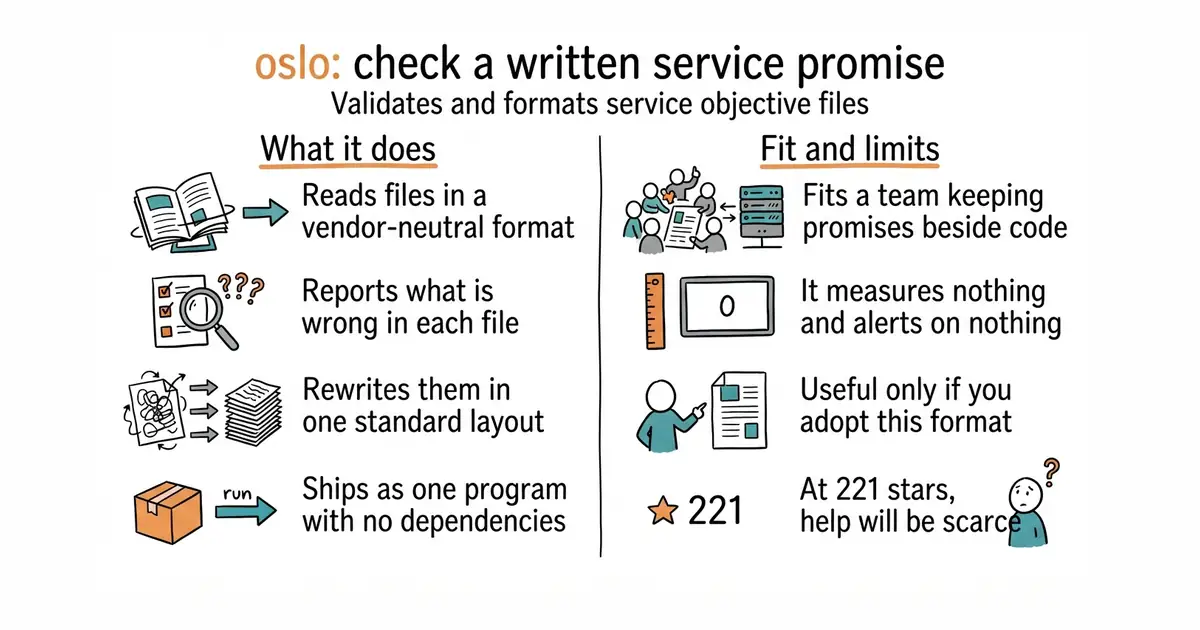
A command-line checker and formatter for files that state service level objectives.
▶Repo detailsthe review · specs · pros & cons · install
What it does
It reads files written in the OpenSLO format, which is a vendor-neutral way of writing down a service promise so that different monitoring products can read the same file. oslo validate checks one or more files and reports what is wrong. oslo fmt rewrites them in the standard layout, so that files written by different people look the same. It accepts several files in one command. It ships as a single compiled program with no dependencies, with 458 commits and 221 stars. Version 0.13.0 was published on 29 June 2026. It does not collect measurements, does not calculate whether a promise was kept, does not alert, and does not talk to any monitoring system: it reads a file and tells you whether that file is correct.
Why it matters
Who it suits. A small team that has started writing its reliability promises into files and keeping them beside the code, and that wants a check in the build so a malformed promise never reaches production. It also suits anyone comparing monitoring products, because writing the promises in a neutral format first means they do not have to be rewritten when the product changes. Skip it if no promises are written down yet, because the useful work is deciding what to promise, and a formatter cannot help with that.
Verdict. This is a narrow tool and it should be judged narrowly. As a step in a build it is exactly right: fast, single-purpose, and it fails loudly on a bad file. What it is not is a reason to adopt the format. The format earns its place only if two or more monitoring products in use can read it, and most teams have one. The 221 stars are a fair reflection of how few people need this, not of quality. Anyone who actually wants promises measured and alerted on should go to slok/sloth, which turns a written promise into working alert rules, or pyrra-dev/pyrra, which adds a screen showing how much of the allowance is left. This checks the paperwork; those two do the work.
- One compiled program, no dependencies, installable in a line and easy to put in a build.
- Formatting as well as checking, so files written by different hands end up identical.
- A neutral file format, so the promises survive a change of monitoring product.
- It measures nothing and alerts on nothing. It only reads files.
- Useful only to teams who have already adopted this particular format.
- 221 stars and a quiet pace, so expect little help if something is unclear.
 slok/sloth
Turns a written promise into working alert rules; the tool that does the measuring this one leaves alone.
Track this in Scout pyrra-dev/pyrra
Manages promises and shows how much of the error allowance is left; adds a screen, and is tied to one monitoring system.
Track this in Scout
go install github.com/OpenSLO/oslo/cmd/oslo@latest



274 stars · MIT, named in the About sidebar · 0.6.6, taken from the Rust package registry, which gives a publication time of 25 October 2026 — the repository page shows no releases at all · Track this in Scout · Share this tool
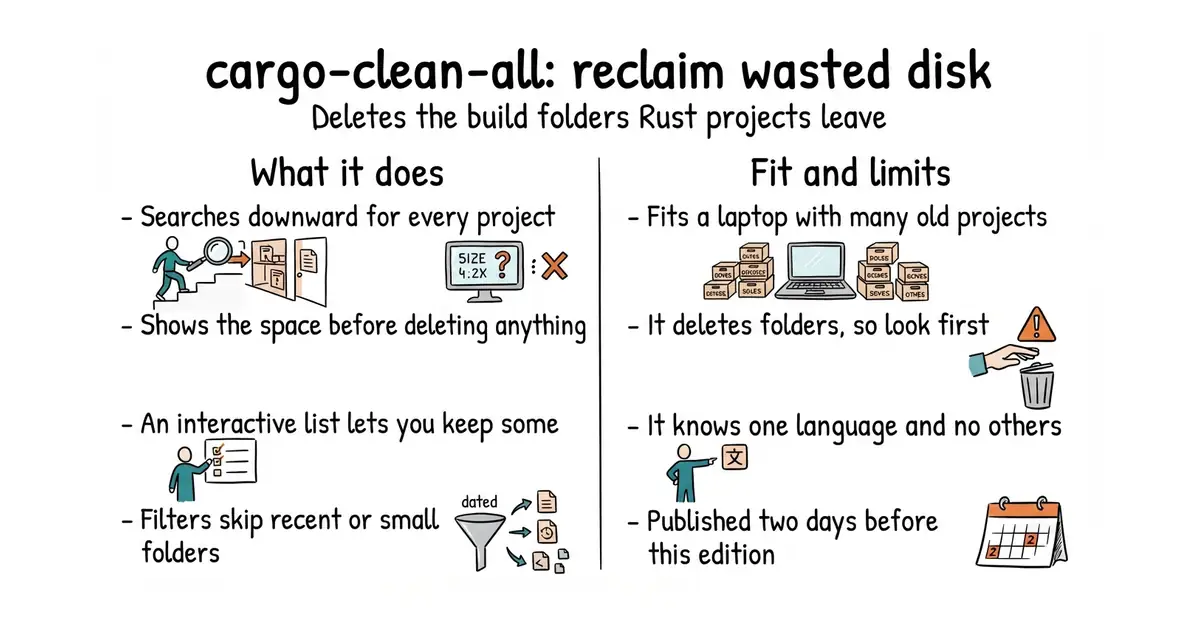
Finds every Rust build folder under a directory and deletes the ones nobody needs.
▶Repo detailsthe review · specs · pros & cons · install
What it does
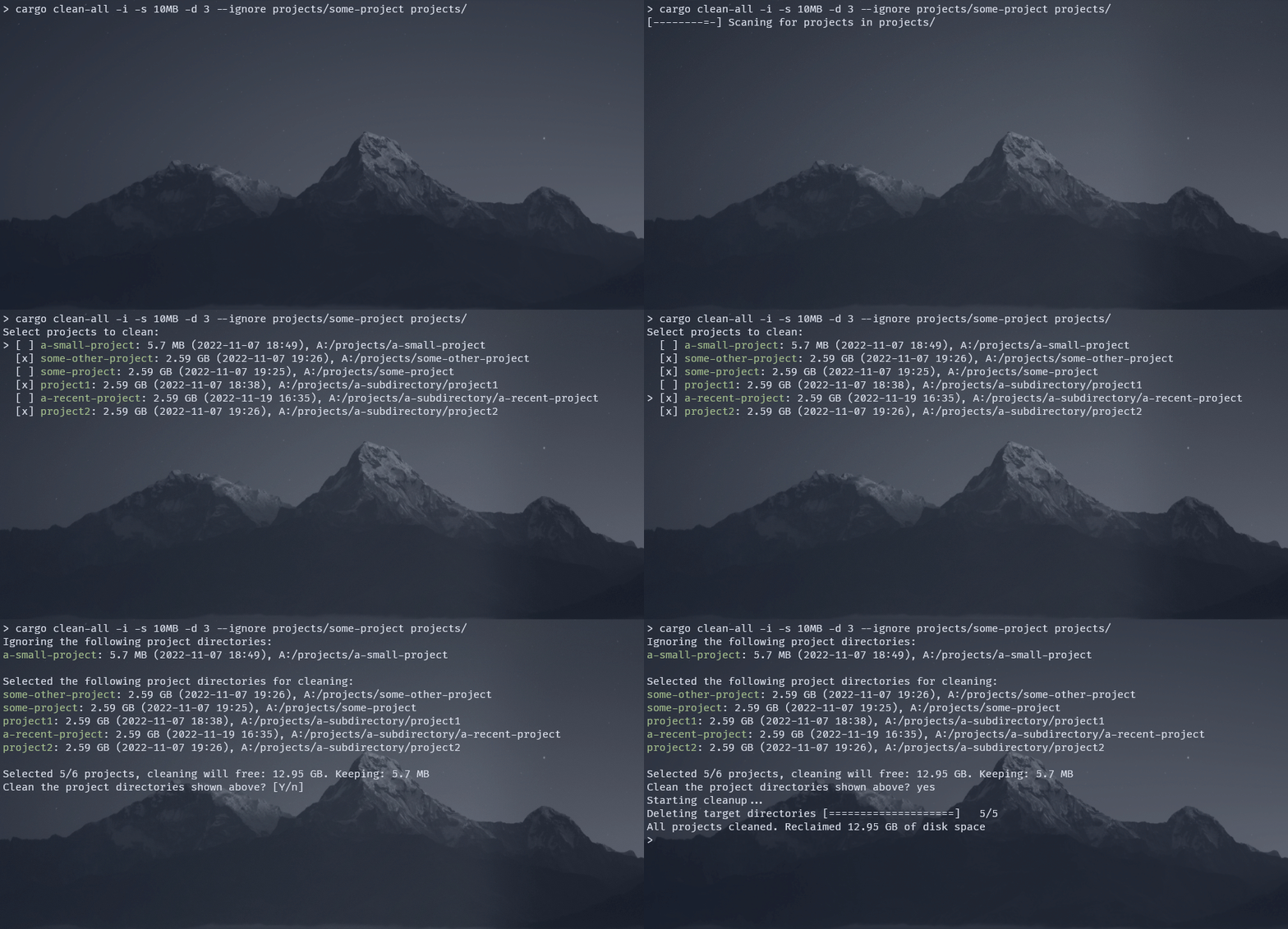
It installs as an extra command for Rust's own build tool and is run as cargo clean-all. Given a starting folder, it searches downward for Rust projects and reports the build folder of each with its size, so the total is visible before anything is removed. Interactive mode lists them and lets each one be deselected by hand. Filters do the same job without asking: --keep-days leaves alone anything compiled in the last so many days, --keep-size leaves alone anything below a given size, and --ignore skips named paths and can be repeated. It deletes the build folders directly rather than calling the official clean command, which is faster and is the project's deliberate choice. Version 0.6.6 was published to the package registry on 25 October 2026, two days before this was written. It only knows about Rust projects, and it cannot yet clean just the release or just the debug half of a folder, which the project's own comparison table records as not done yet.
Why it matters
Who it suits. Anyone with more than a few Rust projects on a machine, and particularly anyone on a laptop with a small disk. The reason this is worth two minutes rather than nothing is that the waste is invisible: nobody opens a project from March to see whether its build folder is still sitting there. Skip it if there are no Rust projects on the machine, in which case it will find nothing. For other languages, tbillington/kondo covers many at once.
Verdict. The best return on two minutes in today's twelve, with one caveat worth stating plainly: it deletes folders. Run it in interactive mode the first time, read the list, and only then let it loose with filters. The sensible standing habit is --keep-days 7, which never touches anything worked on in the last week. It is a 274-star project with no tagged releases on the repository page, which looks thin until you check the package registry and find version 0.6.6 published two days ago. The project also names its own alternative, holmgr/cargo-sweep, in its README, which is a good sign about the people behind it.
- Shows the total space to be recovered before it removes anything.
- Filters by age and by size, so it can be run unattended without fear.
- Published to the registry two days before this was written, so it is plainly maintained.
- It deletes folders. Use interactive mode first and read the list.
- Rust projects only. Other languages need a different tool.
- Cannot yet clean only the release or only the debug part of a build folder.
 holmgr/cargo-sweep
The older tool for the same job; it calls the official clean command, which is slower and more cautious.
Track this in Scout tbillington/kondo
Cleans build leftovers across many languages, with wider reach and less precise control.
Track this in Scout
cargo install cargo-clean-all

9.9k stars · GPL-3.0, named in the About sidebar · v15.6.2, read from /releases/latest as '17 October' with no year, which falls in the past and is therefore 2026; the project website names the same version · Track this in Scout · Share this tool
A name server you run yourself, with ad blocking and encrypted lookups built in.
▶Repo detailsthe review · specs · pros & cons · install
What it does
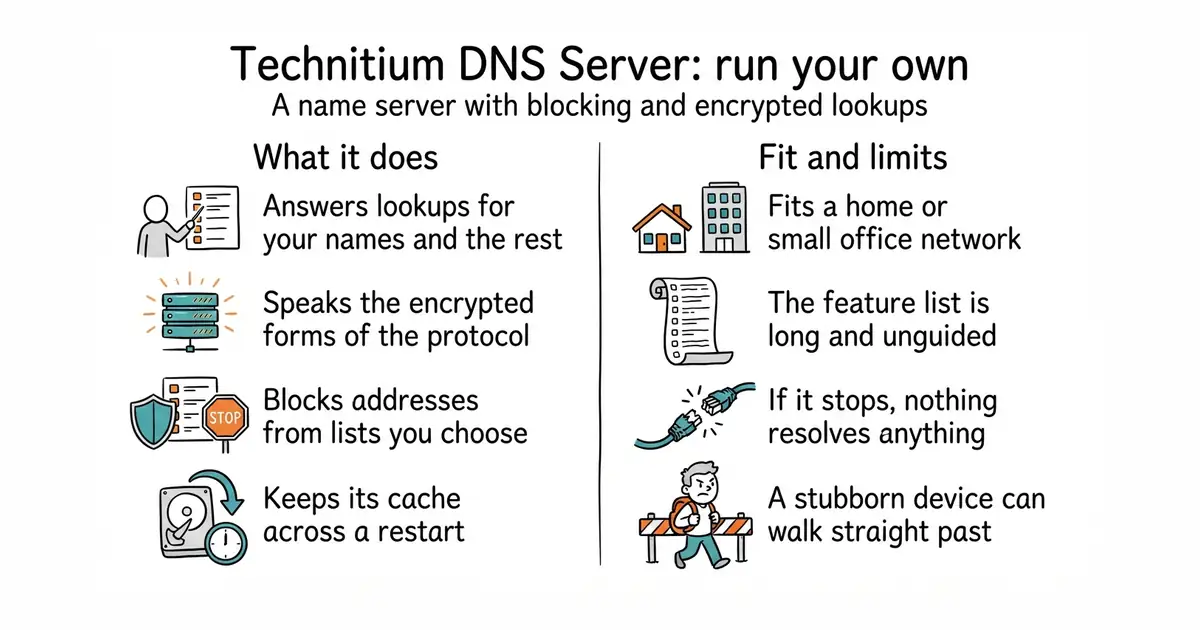
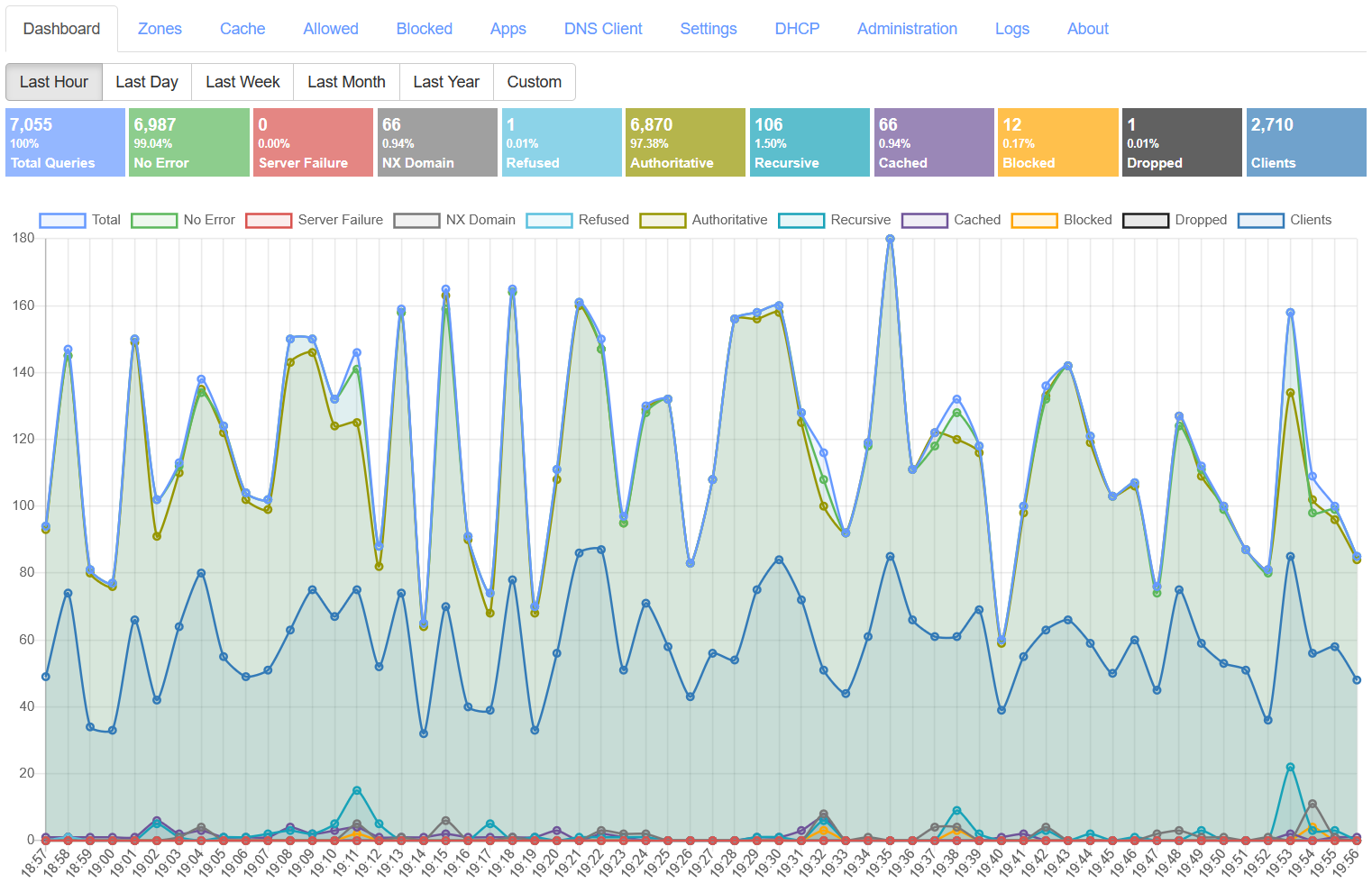
It answers name lookups for your own domains and also resolves the rest of the internet, with a web console and a programming interface for managing both. It speaks the encrypted forms of the protocol, DNS-over-TLS, DNS-over-HTTPS and DNS-over-QUIC, both as a server for devices and as a client when passing questions on, so lookups need not travel in plain view. It validates signed answers so a forged reply is rejected, and it can sign your own zones. Blocking works from lists of addresses fetched by web address, with extra protection against a trick where an advertising name is hidden behind a legitimate one. It holds primary, secondary, stub and forwarding zones, keeps its cache across restarts, and includes a small address-handing server for a local network. Access is controlled per user with roles, two-factor codes and single sign-on. It runs on Windows, macOS, Linux and a Raspberry Pi, and the project reports more than 100,000 lookups a second on a mid-range desktop processor. Version 15.6.2 arrived on 17 October 2026. It is not a firewall and it filters nothing but names: a device told to ignore it, or using a hard-coded server of its own, is not affected at all.
Why it matters
Who it suits. Someone running a home or small office network who wants advertising and tracking blocked on every device, including televisions and phones that will take no software. It also suits anyone running a few machines who needs private internal names, and anyone who would rather their lookups were not visible to an internet provider. Skip it if the only goal is blocking ads in a browser, which an extension does with no infrastructure at all.
Verdict. The most complete free name server of its kind, and it is complete to a fault: the feature list runs to dozens of entries and a first-time reader will not know which matter. Start with three things, which is blocking lists, an encrypted forwarder, and signed-answer validation, and leave the rest switched off. Two warnings. Blocking by name is easy to escape, and any device with its own built-in server set will walk straight past it, so a rule forcing lookups through this server is part of the job. And making the only name server on a network a thing you maintain yourself means that when it breaks, nothing on the network resolves anything. Run two, or keep a public server written down. pi-hole/pi-hole is the gentler introduction and AdguardTeam/AdGuardHome sits neatly between the two.
- Encrypted lookups in both directions, so questions need not travel in the clear.
- Blocks at the network level, which covers devices that accept no software.
- Runs on a Raspberry Pi as happily as on a server, and keeps its cache across restarts.
- An enormous feature list with no suggested starting point, which makes the first hour confusing.
- If it is the only name server on the network and it stops, nothing resolves anything.
- Name blocking is easy for a determined device or application to bypass.
 pi-hole/pi-hole
The best-known network ad blocker, far simpler, and much less of a real name server.
Track this in Scout AdguardTeam/AdGuardHome
Network-wide blocking of ads and trackers, easier than this and more capable than the simplest option.
Track this in Scout
curl -sSL https://download.technitium.com/dns/install.sh | sudo bash
Checked, and left out
Nothing to show for this edition. Recording the repositories that were checked and rejected began with Edition No. 4, and every edition from there on has the list.
Know a repository we should check?
Coming tomorrow