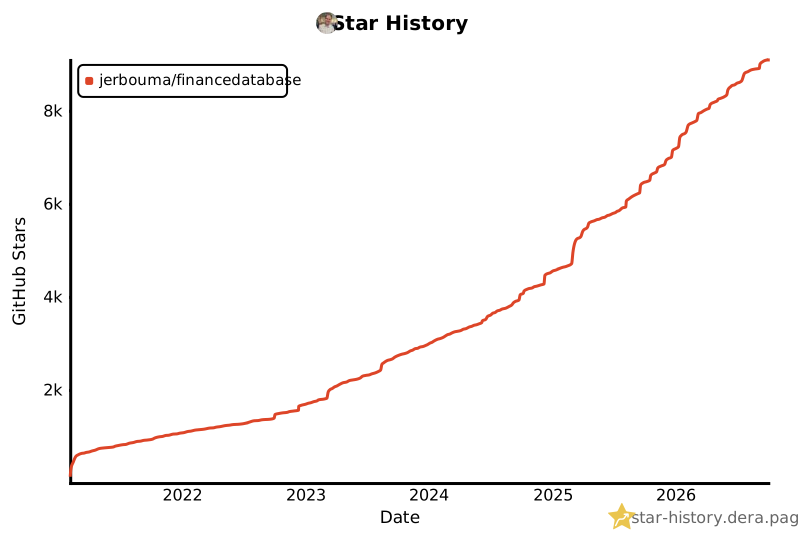
8.7k stars · MIT, named in the About sidebar · 2.5.1, read from /releases/latest as '12 Oct' with no year, which falls in the past and is therefore 2026 · Track this in Scout
A free, offline catalogue of more than three hundred thousand financial symbols with their categories.
Radar check
What we found when we opened it. Every bar is one fact, with its date.
Last code pushed 26 Oct 2026, one day before this check.
Latest release 2.5.1 on 12 Oct 2026.
Public since January 2021, a little over 5 years.
9,552 stars and 990 forks.
375 commits and 1 new issues in the last 90 days.
23 contributors. 79 pull requests merged in 90 days.
No security policy file says how to report a problem. No published security advisories.
How the bars are scored
- Alive. Days since the last code push: a week or less 100, a month 90, three months 70, six months 50, a year 30, eighteen months 15, older 0.
- Releases. Age of the latest GitHub release, on a similar scale; no bar when the project publishes no releases.
- Maturity. Age of the project: eight years 100, five 90, three 70, two 55, one 40, six months 25, younger 10.
- Adoption. Stars on a log scale: 100,000 stars is 100, 10,000 is 80, 1,000 is 60, 100 is 40.
- Activity. Commits in the last 90 days: 300 or more 100, 100 85, 30 65, 10 45, any 25.
- Community. People who have contributed: 100 or more 100, 30 80, 10 60, 5 40, 2 25, one 10.
- Security. A published security policy 80, none 40; published advisories are listed, not scored.
Checked by Repo Radar on 27 Oct 2026 from the repository on GitHub. Covered in Edition 63.
▶Repo detailsthe review · specs · pros & cons · install
What it does
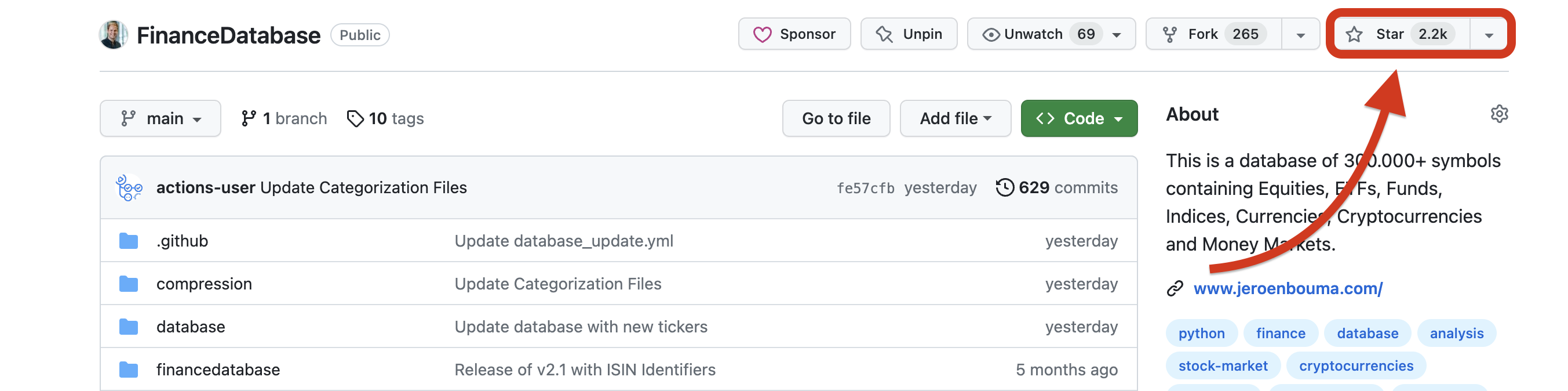
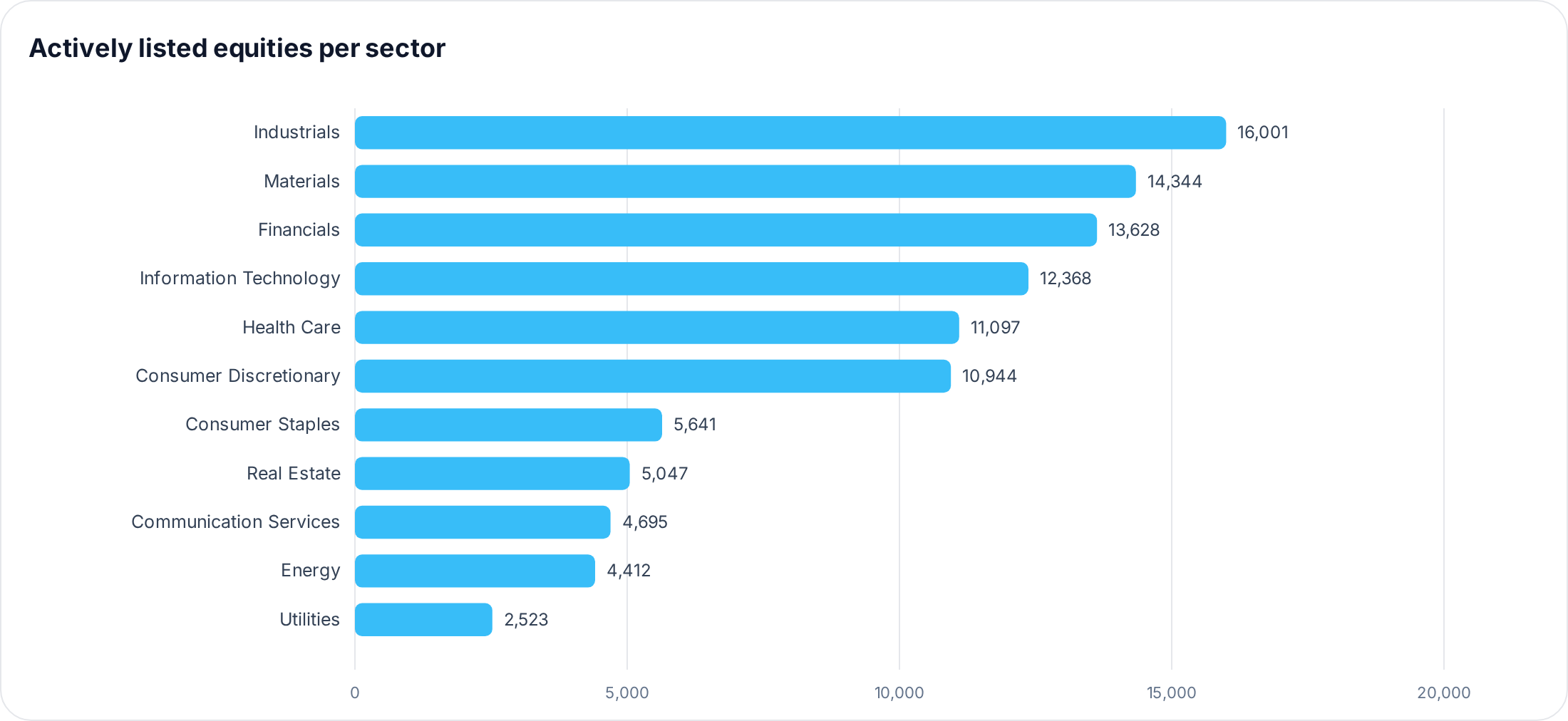
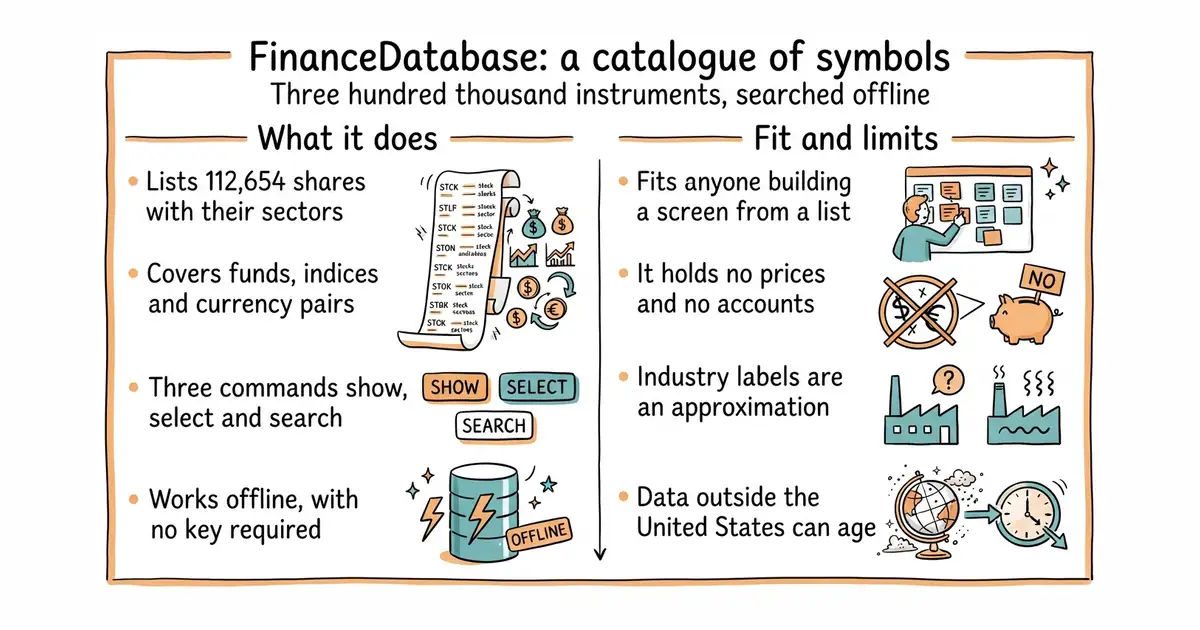
It installs as a Python package and brings its data with it, so no key and no internet connection are needed to search. It covers 112,654 shares across 11 sectors, 80 industries, 117 countries and 84 exchanges; 36,480 exchange-traded funds; 57,853 funds; 91,181 indices; 2,556 currency pairs; 3,367 cryptocurrencies; and 1,367 money-market instruments. Three commands do the work: show_options lists what values a field can take, select narrows by those values, and search looks for text. A to_toolkit call hands a selection to the author's companion analysis package. United States exchange data is refreshed weekly; everything else depends on contributions from the public. Delisted symbols are kept on purpose, for historical study. It is explicitly not a source of up-to-date company accounts or prices, and the project says so in those words.
Why it matters
Who it suits. Anyone writing a screen or a study who needs to start from a list rather than a guess: every fund in a family, every share in one industry in one country, every index on one exchange. It is also the quiet answer to a common annoyance, which is that price libraries expect you to already know the symbol. Skip it if the work only ever touches a handful of well-known tickers, since typing five symbols by hand is faster than installing anything.
Verdict. A genuinely useful piece of groundwork, and refreshingly honest about its limits. Three cautions. The industry classification is described by the author as a loose approximation of the standard scheme, so it is good enough for exploring and not good enough for a formal report. Some symbols in the list are holdings rather than tradeable instruments and will return nothing when passed to a price service. And non-United States data moves only when somebody contributes, so coverage outside the United States ages. The companion JerBouma/FinanceToolkit needs a third-party key whose free plan allows 250 requests a day on United States companies only, which is a real limit worth knowing before anything is built on it. Version 2.5.1 landed on 12 October 2026.
- Works offline with no key, because the data ships inside the package.
- Real coverage numbers, published per category rather than claimed in the round.
- Delisted symbols kept deliberately, which makes historical work possible.
- Industry labels are an approximation of the standard scheme, not the scheme itself.
- Coverage outside the United States depends on public contributions and can be stale.
- The companion analysis package needs a paid third-party service to be much use.
- JerBouma/FinanceToolkit
The same author's analysis package, which computes ratios and metrics and needs an external data key.
Track this in Scout  ranaroussi/yfinance
Downloads prices and fundamentals for a symbol you already know; the natural partner rather than a competitor.
Track this in Scout
python3 -m venv venv
source venv/bin/activate
pip install financedatabase -U