9.9k stars · GPL-3.0, named in the About sidebar · v15.6.2, read from /releases/latest as '17 October' with no year, which falls in the past and is therefore 2026; the project website names the same version · Track this in Scout
A name server you run yourself, with ad blocking and encrypted lookups built in.
Radar check
What we found when we opened it. Every bar is one fact, with its date.
Last code pushed 24 Oct 2026, 3 days before this check.
Latest release v15.6.2 on 17 Oct 2026.
Public since October 2017, a little over 8 years.
10,235 stars and 816 forks.
172 commits and 124 new issues in the last 90 days.
42 contributors. 12 pull requests merged in 90 days.
A security policy says how to report a problem. No published security advisories.
How the bars are scored
- Alive. Days since the last code push: a week or less 100, a month 90, three months 70, six months 50, a year 30, eighteen months 15, older 0.
- Releases. Age of the latest GitHub release, on a similar scale; no bar when the project publishes no releases.
- Maturity. Age of the project: eight years 100, five 90, three 70, two 55, one 40, six months 25, younger 10.
- Adoption. Stars on a log scale: 100,000 stars is 100, 10,000 is 80, 1,000 is 60, 100 is 40.
- Activity. Commits in the last 90 days: 300 or more 100, 100 85, 30 65, 10 45, any 25.
- Community. People who have contributed: 100 or more 100, 30 80, 10 60, 5 40, 2 25, one 10.
- Security. A published security policy 80, none 40; published advisories are listed, not scored.
Checked by Repo Radar on 27 Oct 2026 from the repository on GitHub. Covered in Edition 63.
▶Repo detailsthe review · specs · pros & cons · install
What it does
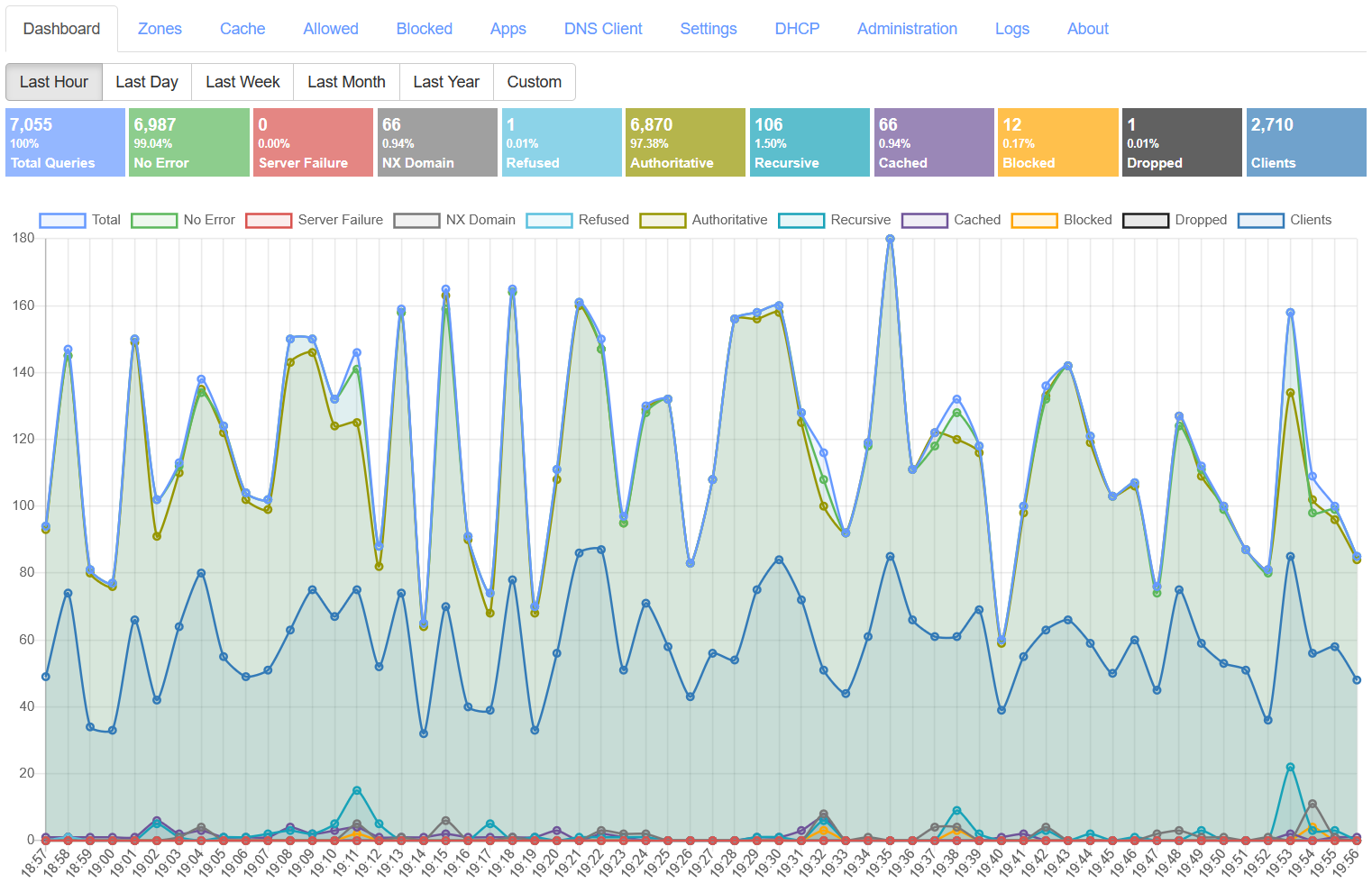
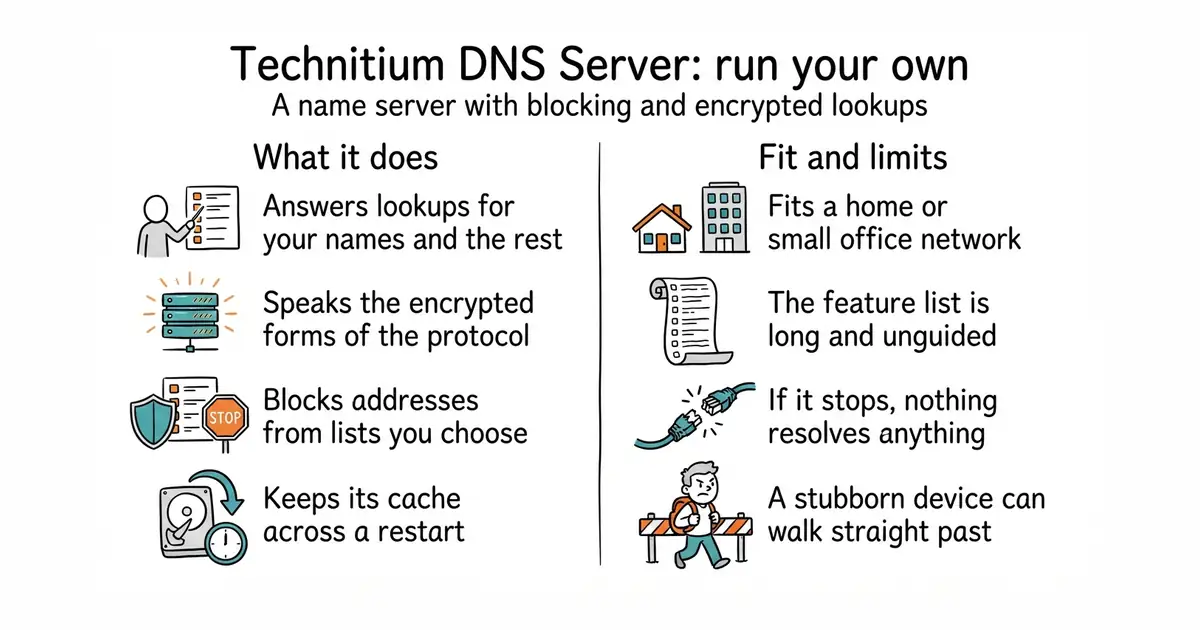
It answers name lookups for your own domains and also resolves the rest of the internet, with a web console and a programming interface for managing both. It speaks the encrypted forms of the protocol, DNS-over-TLS, DNS-over-HTTPS and DNS-over-QUIC, both as a server for devices and as a client when passing questions on, so lookups need not travel in plain view. It validates signed answers so a forged reply is rejected, and it can sign your own zones. Blocking works from lists of addresses fetched by web address, with extra protection against a trick where an advertising name is hidden behind a legitimate one. It holds primary, secondary, stub and forwarding zones, keeps its cache across restarts, and includes a small address-handing server for a local network. Access is controlled per user with roles, two-factor codes and single sign-on. It runs on Windows, macOS, Linux and a Raspberry Pi, and the project reports more than 100,000 lookups a second on a mid-range desktop processor. Version 15.6.2 arrived on 17 October 2026. It is not a firewall and it filters nothing but names: a device told to ignore it, or using a hard-coded server of its own, is not affected at all.
Why it matters
Who it suits. Someone running a home or small office network who wants advertising and tracking blocked on every device, including televisions and phones that will take no software. It also suits anyone running a few machines who needs private internal names, and anyone who would rather their lookups were not visible to an internet provider. Skip it if the only goal is blocking ads in a browser, which an extension does with no infrastructure at all.
Verdict. The most complete free name server of its kind, and it is complete to a fault: the feature list runs to dozens of entries and a first-time reader will not know which matter. Start with three things, which is blocking lists, an encrypted forwarder, and signed-answer validation, and leave the rest switched off. Two warnings. Blocking by name is easy to escape, and any device with its own built-in server set will walk straight past it, so a rule forcing lookups through this server is part of the job. And making the only name server on a network a thing you maintain yourself means that when it breaks, nothing on the network resolves anything. Run two, or keep a public server written down. pi-hole/pi-hole is the gentler introduction and AdguardTeam/AdGuardHome sits neatly between the two.
- Encrypted lookups in both directions, so questions need not travel in the clear.
- Blocks at the network level, which covers devices that accept no software.
- Runs on a Raspberry Pi as happily as on a server, and keeps its cache across restarts.
- An enormous feature list with no suggested starting point, which makes the first hour confusing.
- If it is the only name server on the network and it stops, nothing resolves anything.
- Name blocking is easy for a determined device or application to bypass.
 pi-hole/pi-hole
The best-known network ad blocker, far simpler, and much less of a real name server.
Track this in Scout AdguardTeam/AdGuardHome
Network-wide blocking of ads and trackers, easier than this and more capable than the simplest option.
Track this in Scout
curl -sSL https://download.technitium.com/dns/install.sh | sudo bash