595 stars · Apache-2.0, named in the About sidebar · v0.15.0, whose own heading reads '0.15.0 / 2026-09-01' while the release byline reads '07 Oct'; the first is the changelog date and the second the publication of the artefacts · Track this in Scout
It publishes a disk's own health figures so a monitoring system can watch them.
Radar check
What we found when we opened it. Every bar is one fact, with its date.
Last code pushed 14 Oct 2026, 13 days before this check.
Latest release v0.15.0 on 7 Oct 2026.
Public since August 2019, a little over 7 years.
604 stars and 138 forks.
25 commits and 7 new issues in the last 90 days.
39 contributors. 25 pull requests merged in 90 days.
A security policy says how to report a problem. No published security advisories.
How the bars are scored
- Alive. Days since the last code push: a week or less 100, a month 90, three months 70, six months 50, a year 30, eighteen months 15, older 0.
- Releases. Age of the latest GitHub release, on a similar scale; no bar when the project publishes no releases.
- Maturity. Age of the project: eight years 100, five 90, three 70, two 55, one 40, six months 25, younger 10.
- Adoption. Stars on a log scale: 100,000 stars is 100, 10,000 is 80, 1,000 is 60, 100 is 40.
- Activity. Commits in the last 90 days: 300 or more 100, 100 85, 30 65, 10 45, any 25.
- Community. People who have contributed: 100 or more 100, 30 80, 10 60, 5 40, 2 25, one 10.
- Security. A published security policy 80, none 40; published advisories are listed, not scored.
Checked by Repo Radar on 27 Oct 2026 from the repository on GitHub. Covered in Edition 63.
▶Repo detailsthe review · specs · pros & cons · install
What it does
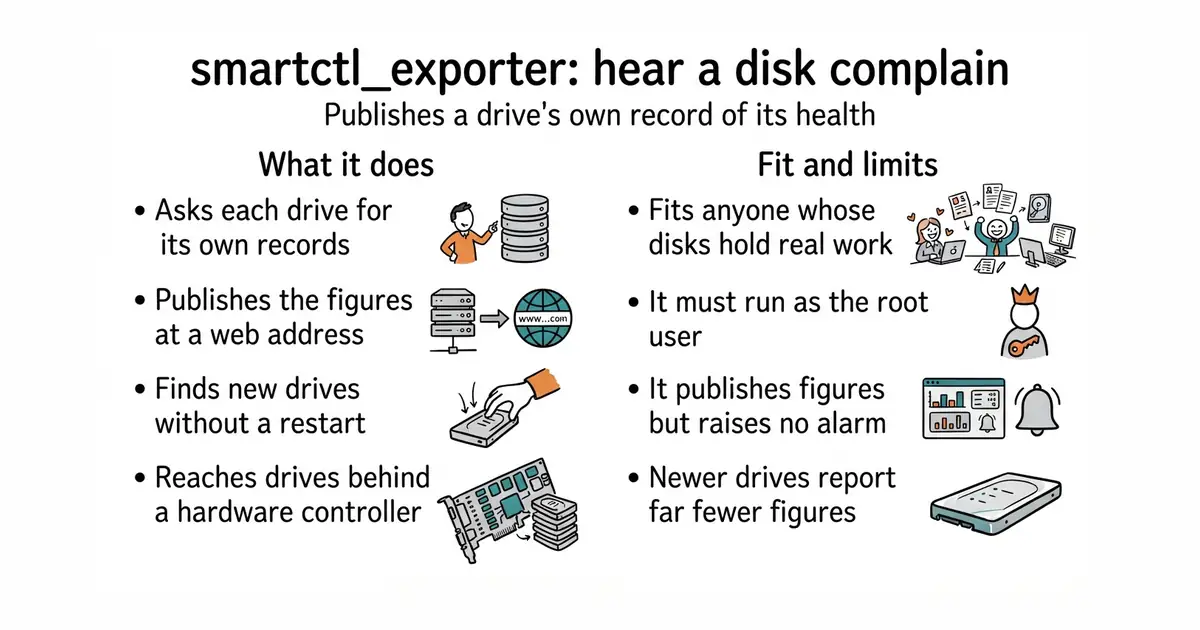
It runs smartctl, the command-line program that interrogates a drive, asks for its answer in a machine-readable form, and republishes the figures at a web address that a monitoring system reads on a timer. It needs smartmontools version 7.0 or later installed, because that is the version that can answer in that form. With no configuration it scans the machine for drives by itself, and it rescans on a timer so a newly fitted drive is picked up without a restart. Drives can also be named one by one, including those behind a hardware controller. The address it publishes on can be protected with a password and a certificate through a configuration file. The default port is 9633. It changes nothing and fixes nothing: it only forwards what the drive said, and the project closes requests to correct bad readings, directing them upstream to smartmontools instead.
Why it matters
Who it suits. Anyone running a machine with disks in it whose failure would hurt: a home file store, a small office server, a rented machine holding a database. The case for it is that disks usually give notice. Reallocated sectors climb, errors accumulate, and a drive that has been shouting for a month is still a surprise when it stops, simply because nobody read the record. Skip it if no monitoring system is in place, because this publishes numbers and does not alert on them: pair it with Prometheus and its alerting, or use AnalogJ/scrutiny instead, which brings its own screen.
Verdict. Worth half an hour, and one of the better returns on half an hour available. Three practical notes. It must run as the root user, because the commands that read a SATA drive are not available to anyone else, and that is why the example runs a privileged container. Solid-state NVMe drives and enterprise SCSI drives do not publish the same figures as older SATA drives, so expect fewer numbers from them. And the sensible alert is not on a single raw count but on a trend, because these counters are noisy and a one-off reading means little. Version 0.15.0 was published on 1 September 2026, with the release artefacts dated 7 October 2026.
- Finds the drives by itself and rescans on a timer, so new disks need no configuration.
- A single small program with one job, which is why it has not needed to change much.
- Covers drives behind hardware controllers, which many simpler tools cannot reach.
- Must run as the root user, which is a real decision on a shared machine.
- Publishes figures but raises no alarm, so a monitoring system is required alongside it.
- Modern NVMe and enterprise SCSI drives report far fewer figures than older SATA drives.
- smartmontools/smartmontools
The program underneath, required by this one, and able to run scheduled self-tests on its own.
Track this in Scout  AnalogJ/scrutiny
Drive monitoring with its own screen, history and realistic failure thresholds; the better pick when there is no monitoring system already.
Track this in Scout
docker run -d --privileged --user root -p 9633:9633 \
  prometheuscommunity/smartctl-exporter