16,799 stars · MIT, named in the About sidebar · 0.3.5 from 25 June 2022 is the newest tagged release, and it is NOT a code date: the mirror at ungh.cc gives pushedAt 2026-10-23, four days before this edition · Track this in Scout
A framework for building and testing trading programs that learn from repeated attempts.
Radar check
What we found when we opened it. Every bar is one fact, with its date.
Last code pushed 25 Oct 2026, 2 days before this check.
Latest release v0.3.8 on 20 Mar 2026.
Public since July 2020, a little over 6 years.
16,831 stars and 3,590 forks.
37 commits and 6 new issues in the last 90 days.
142 contributors. 15 pull requests merged in 90 days.
No security policy file says how to report a problem. No published security advisories.
How the bars are scored
- Alive. Days since the last code push: a week or less 100, a month 90, three months 70, six months 50, a year 30, eighteen months 15, older 0.
- Releases. Age of the latest GitHub release, on a similar scale; no bar when the project publishes no releases.
- Maturity. Age of the project: eight years 100, five 90, three 70, two 55, one 40, six months 25, younger 10.
- Adoption. Stars on a log scale: 100,000 stars is 100, 10,000 is 80, 1,000 is 60, 100 is 40.
- Activity. Commits in the last 90 days: 300 or more 100, 100 85, 30 65, 10 45, any 25.
- Community. People who have contributed: 100 or more 100, 30 80, 10 60, 5 40, 2 25, one 10.
- Security. A published security policy 80, none 40; published advisories are listed, not scored.
Checked by Repo Radar on 27 Oct 2026 from the repository on GitHub. Covered in Edition 63.
▶Repo detailsthe review · specs · pros & cons · install
What it does
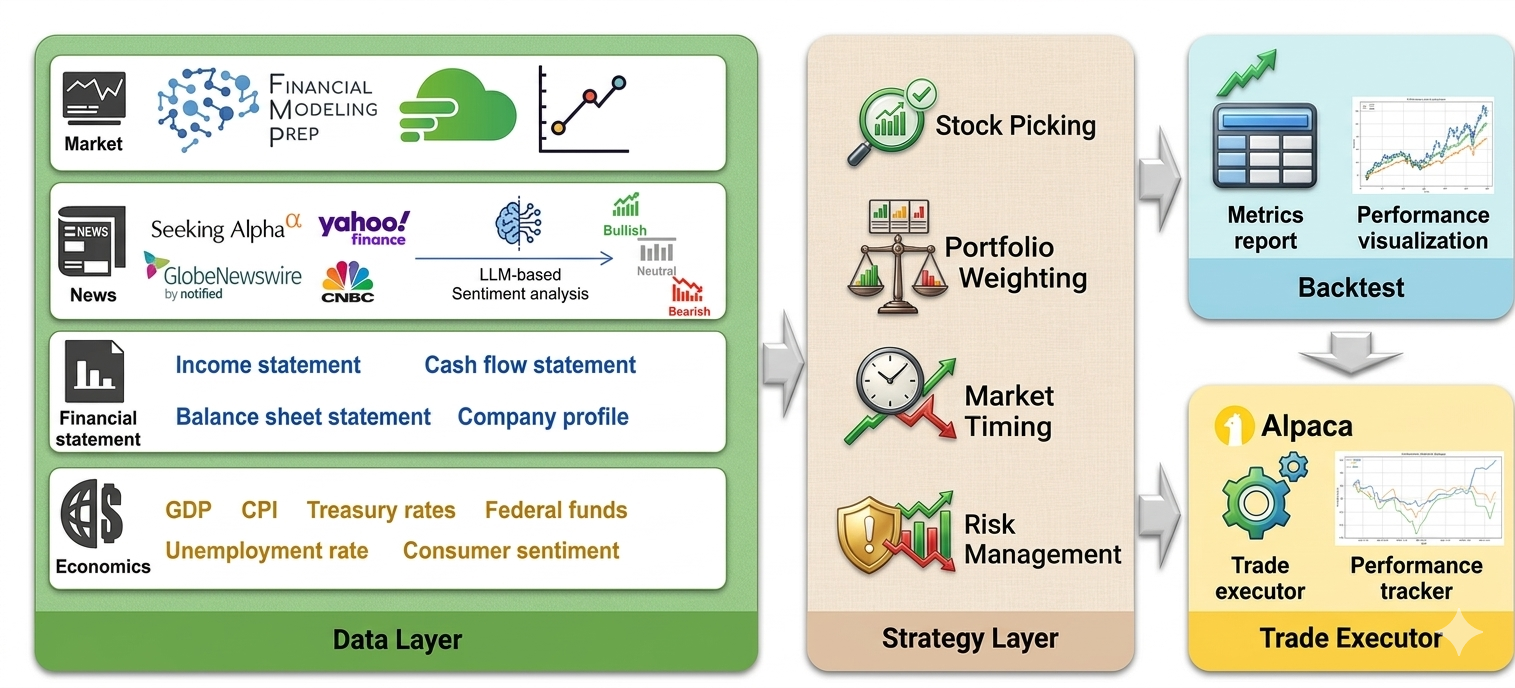
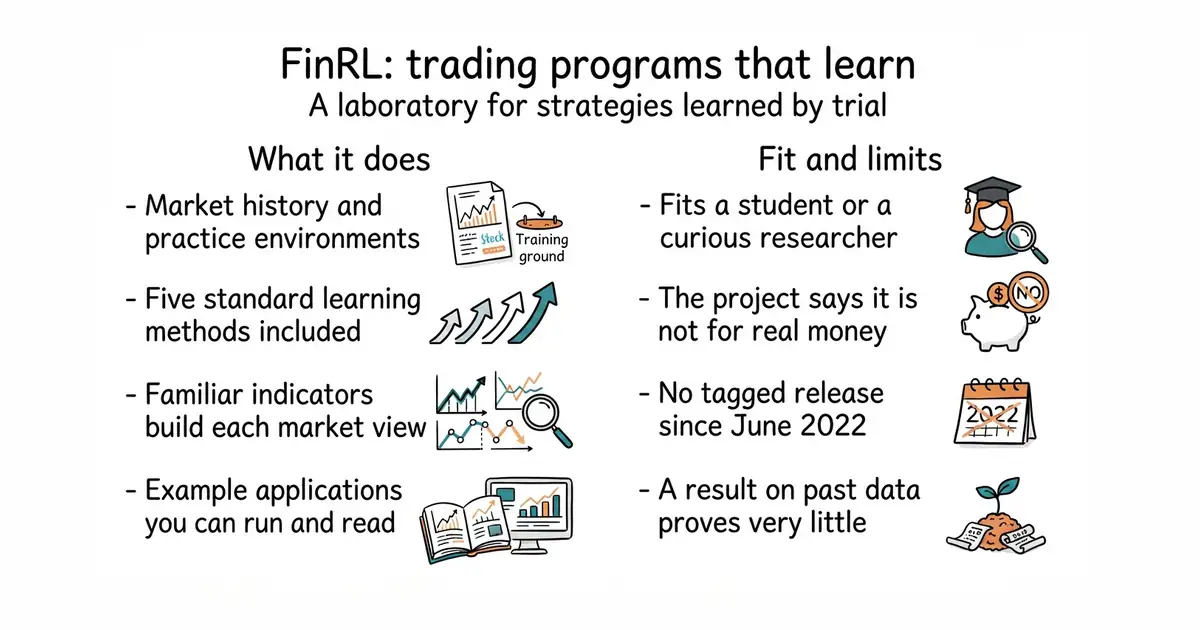
It is built in three layers: market environments, learning agents, and finished example applications. The environments carry data from several markets, including United States shares and exchange-traded funds, Chinese A-shares, cryptocurrency, Taiwanese securities and foreign exchange, with Alpaca listed for live United States trading. The learning methods come from a standard library and include A2C, DDPG, PPO, SAC and TD3. Each environment hands the program a view of the market built from familiar indicators, among them MACD, Bollinger bands, a 30-day RSI, a 30-day DX, and 30- and 60-day moving averages, plus a volatility index and a turbulence measure. The 2026 tutorial trains five agents on the thirty shares of a well-known United States index. There are 3,284 commits and 283 open issues. It is not a trading platform, it carries no broker connection beyond the basic one, and the project explicitly points anyone wanting production or live trading at its newer sibling repository instead.
Why it matters
Who it suits. Someone learning how these methods behave on market data, or a student with a dissertation to write. The value is that the wiring between data, environment and learning method is already done, which is normally weeks of fiddly work. Skip it entirely if the plan is to trade with real money: the project's own documentation sends that reader elsewhere, and ignoring that advice is the most expensive mistake available here.
Verdict. Treat it as a laboratory and it is excellent. Treat it as a product and it will disappoint, because that is not what it claims to be. The last tagged release is 0.3.5 from June 2022, which looks alarming until you check the code: the newest commit landed on 23 October 2026, four days before this was written. That gap between releases and code is common and it is not a sign of neglect. The real caution is intellectual rather than technical. A method that learns from history will fit that history, and a convincing result on past data says very little about tomorrow. freqtrade/freqtrade is the practical alternative for actually running a strategy, and it is far less interested in learning methods.
- Data, practice environment and learning methods arrive already connected.
- Several markets covered, not only United States shares.
- A current 2026 tutorial, with working examples on a familiar set of shares.
- 283 open issues, and the project itself directs serious users to a different repository.
- No tagged release since June 2022, so there is nothing stable to pin a version to.
- Results on past data are easy to produce and easy to misread. This is not investment advice, and the project says the same.
- AI4Finance-Foundation/ElegantRL
The learning library from the same group, general-purpose, with no financial parts attached.
Track this in Scout  freqtrade/freqtrade
A free crypto trading program, made for running strategies rather than for studying learning methods.
Track this in Scout
git clone https://github.com/AI4Finance-Foundation/FinRL.git
cd FinRL
python3 -m venv venv
source venv/bin/activate
pip install -e .