Edition No. 6 · 31 Aug 2026
Make it land
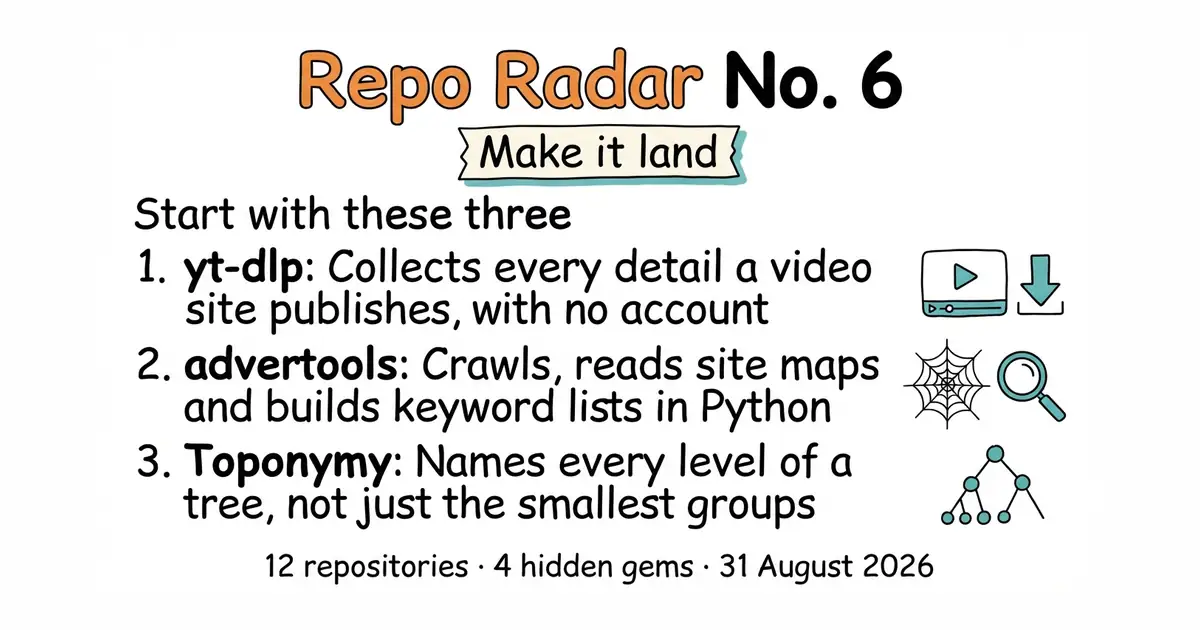
Five editions have built up things to say and places to say them.
Refreshed on 12 October 2026. The repositories are the ones first published; any that are no longer maintained are left out.
The first five editions collected ways to make things, and places to put them. This one is about the moment somebody arrives. What a page is actually made of. What evidence tells a writer what to put on it. And whether a map of a long conversation can be read at a glance.
Seven entries serve marketing, four sharpen a product, and one is the wildcard. Every repository below was opened again on Monday 12 October 2026. Star counts, licences, release numbers and release dates are what the pages showed on that day. All twelve are still being worked on, so all twelve are still here.
This edition, in numbers
| Repos | 12 |
| Hidden gems (<3k stars) | 4 |
| Marketing / product | 7 / 4 |
| New to the ledger | 11 |
| Repeats | 1 |
| Dropped on check | 6 |
If you only do three things
- Point yt-dlp (4) at five competing video channels tonight. One install command, no sign-up, no key, no daily limit. By bedtime every title, description, tag, upload date, thumbnail and subtitle file from those whole catalogues is a file on disk. Choices that are usually made on instinct become choices that can be looked up.
- Then install advertools (6). It is the one repeat in this edition. Entries 4 and 5 both end with a large pile of clean text, and this is the tool that turns such a pile into keyword lists, site comparisons and crawl reports. Handing over raw material without the tool that reads it would be unhelpful.
- Try toponymy (9) on one real conversation. It is the smallest change on this page that a reader would notice. Most clustering tools name a group of messages with a list of words, such as model, prompt, token, api. That reads like machine output. This library writes proper names instead, at every level of the tree.
Every link in one place
| # | Repository | Official site | Stars | Licence |
|---|---|---|---|---|
| 1 | GrapesJS/grapesjs | grapesjs.com | 26.3k | BSD-3-Clause |
| 2 | imgproxy/imgproxy | imgproxy.net | 11.1k | Apache-2.0 |
| 3 | axllent/mailpit | mailpit.axllent.org | 10.6k | MIT |
| 4 | yt-dlp/yt-dlp | pypi.org/project/yt-dlp | 196k | Unlicense |
| 5 | adbar/trafilatura | trafilatura.readthedocs.io | 6.8k | Apache-2.0 |
| 6 | eliasdabbas/advertools 💎 | advertools.readthedocs.io | 1.5k | MIT |
| 7 | aiogram/aiogram | aiogram.dev | 5.9k | MIT |
| 8 | HKUDS/LightRAG | arxiv.org/abs/2410.05779 | 39.8k | MIT |
| 9 | TutteInstitute/toponymy 💎 | github.com/TutteInstitute/toponymy | 102 | MIT |
| 10 | TutteInstitute/datamapplot 💎 | datamapplot.readthedocs.io | 1.0k | MIT |
| 11 | bashtage/arch 💎 | bashtage.github.io/arch | 1.6k | NCSA |
| 12 | marimo-team/marimo | marimo.io | 22.8k | Apache-2.0 |
Make it land
Twelve repositories, checked and reviewed. Every version verified against the GitHub API and dated.

26.2k stars · BSD-3-Clause · v0.23.6 (2026-08-26) · Track this in Scout · Share this tool
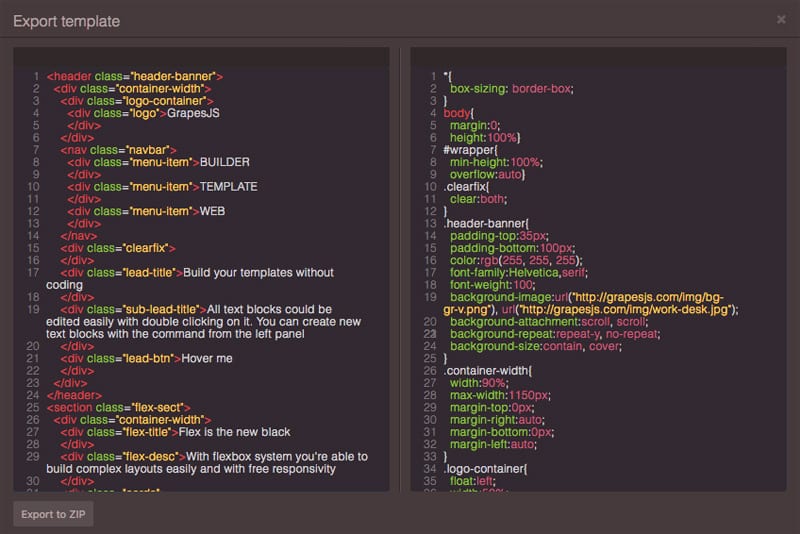
Drag-and-drop builder for landing pages and, through its newsletter preset, email-safe table HTML.
▶Repo detailsthe review · specs · pros & cons · install
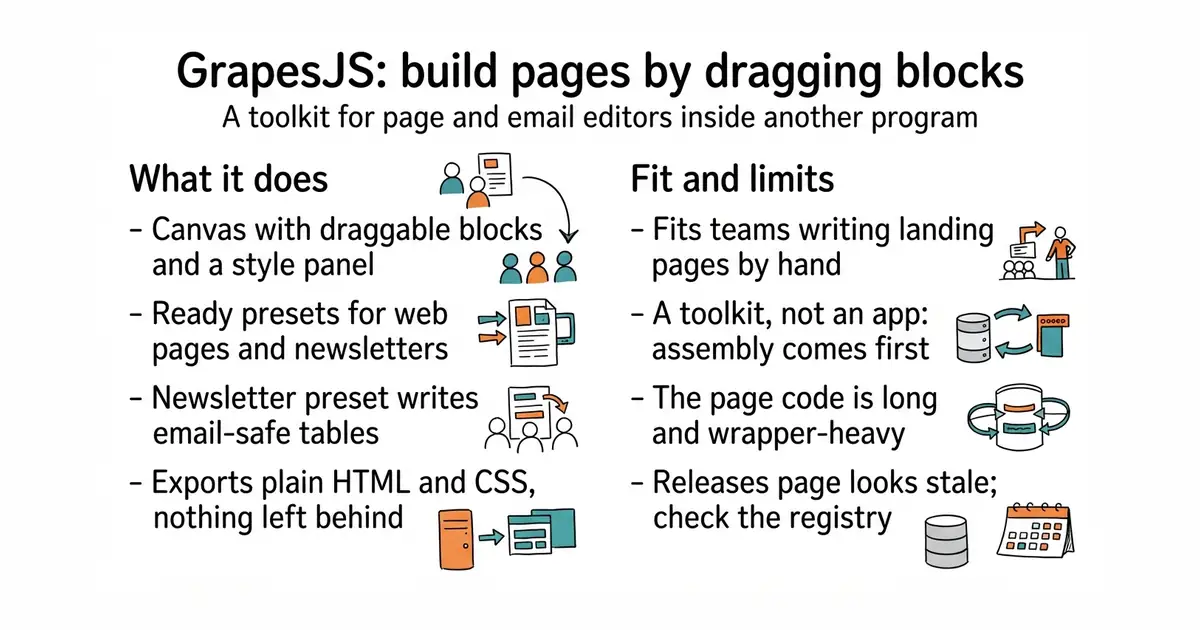
What it does
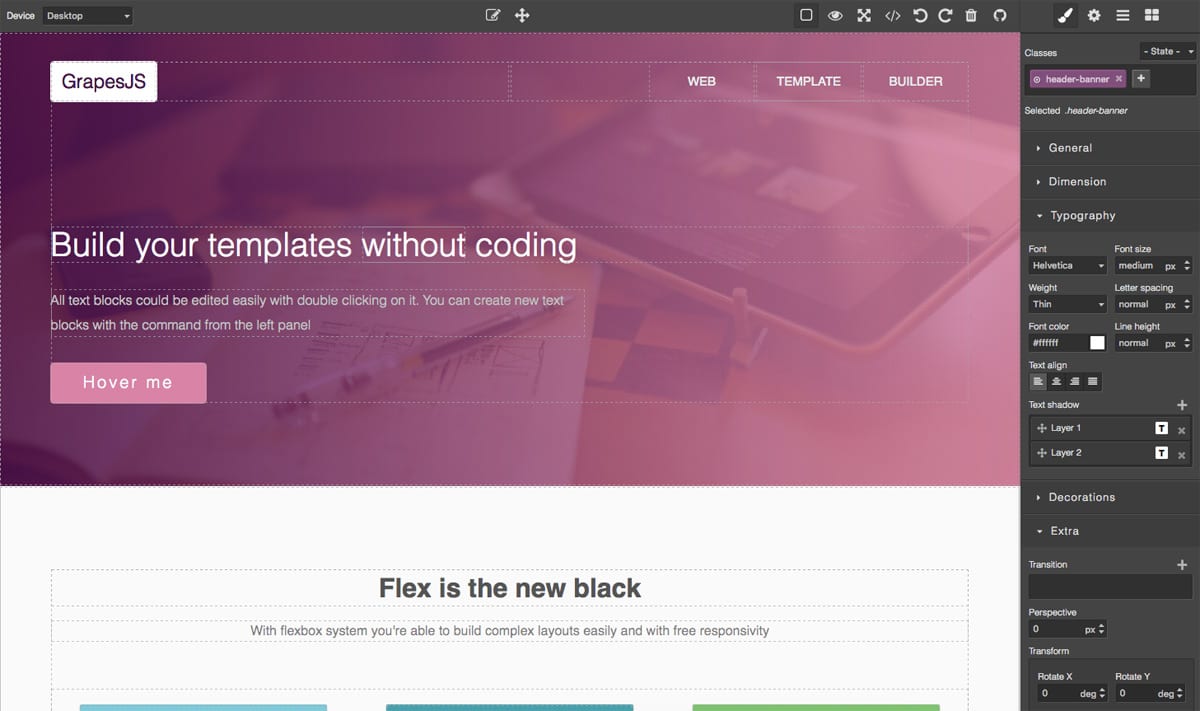
It gives a canvas, a set of draggable blocks, a panel for changing colours and spacing, a tree of the layers on the page, and a place to keep images. It comes with ready-made configurations, called presets: one for web pages and one for newsletters. The newsletter preset writes old-style table layout, which is the layout that mail programs still draw correctly. Everything it builds comes out as plain HTML and CSS, the two languages a browser reads, with nothing of the editor left behind. The latest release is v0.23.6, published on 26 August 2026, and the licence is BSD-3-Clause, which allows use inside a paid product. What it is not is a finished application. There is nothing to install and open; a working editor has to be assembled from the presets and plugins first, and it does not store or send anything itself.
Why it matters
Who it suits. Teams that write landing pages or newsletters by hand and are tired of it. It suits a product even better: if customers need to lay out their own pages or reports, this is an editor that can legally be built into a commercial product, which is unusual. Skip it if the need is one page a month, because assembling the editor costs more than writing that page.
Verdict. Worth an evening, and only if a visual editor will be used more than once. The honest cost is that first evening: presets, plugins and configuration before anything is usable. The code it writes is wrapper-heavy, so it is fine for email and worth tidying before it goes into a page that must load fast. One trap to know: the releases page on the code host looks out of date, and the package registry is where the real pace shows. puckeditor/puck is the better choice if the blocks must be existing React components.
- BSD-3-Clause, the most permissive licence in this edition, and safe inside a paid product.
- The newsletter preset writes email-safe table layout, which is the part people get wrong by hand.
- Output is plain HTML and CSS with nothing to run afterwards, so nothing built in it is trapped inside it.
- It is a toolkit, not an application. A usable editor has to be assembled first.
- The releases page on the code host looks stale; only the package registry shows the real pace.
- The page code it writes is long and full of extra wrappers, so a fast page needs it cleaned up.
Export the HTML and paste it into Listmonk's template, or into an Astro page beside the Starlight docs.
npm install grapesjs grapesjs-preset-newsletter

11k stars · Apache-2.0 · v4.0.14 (2026-08-24) · Track this in Scout · Share this tool
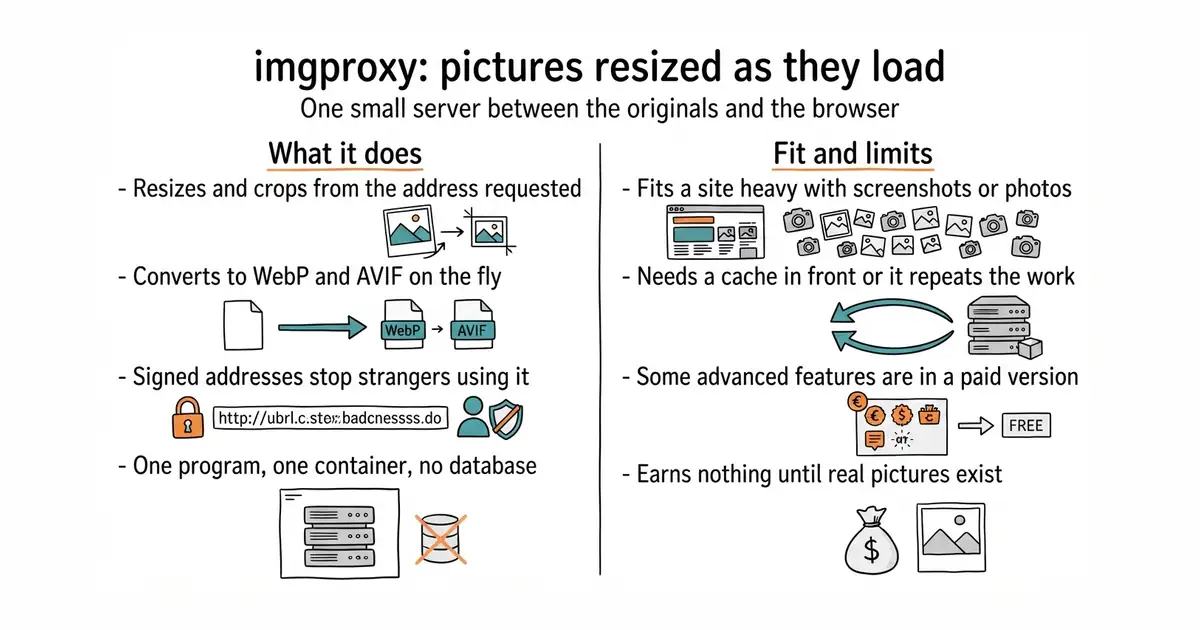
Signed-URL image server: resize, crop and convert to WebP/AVIF on the fly.
▶Repo detailsthe review · specs · pros & cons · install
What it does
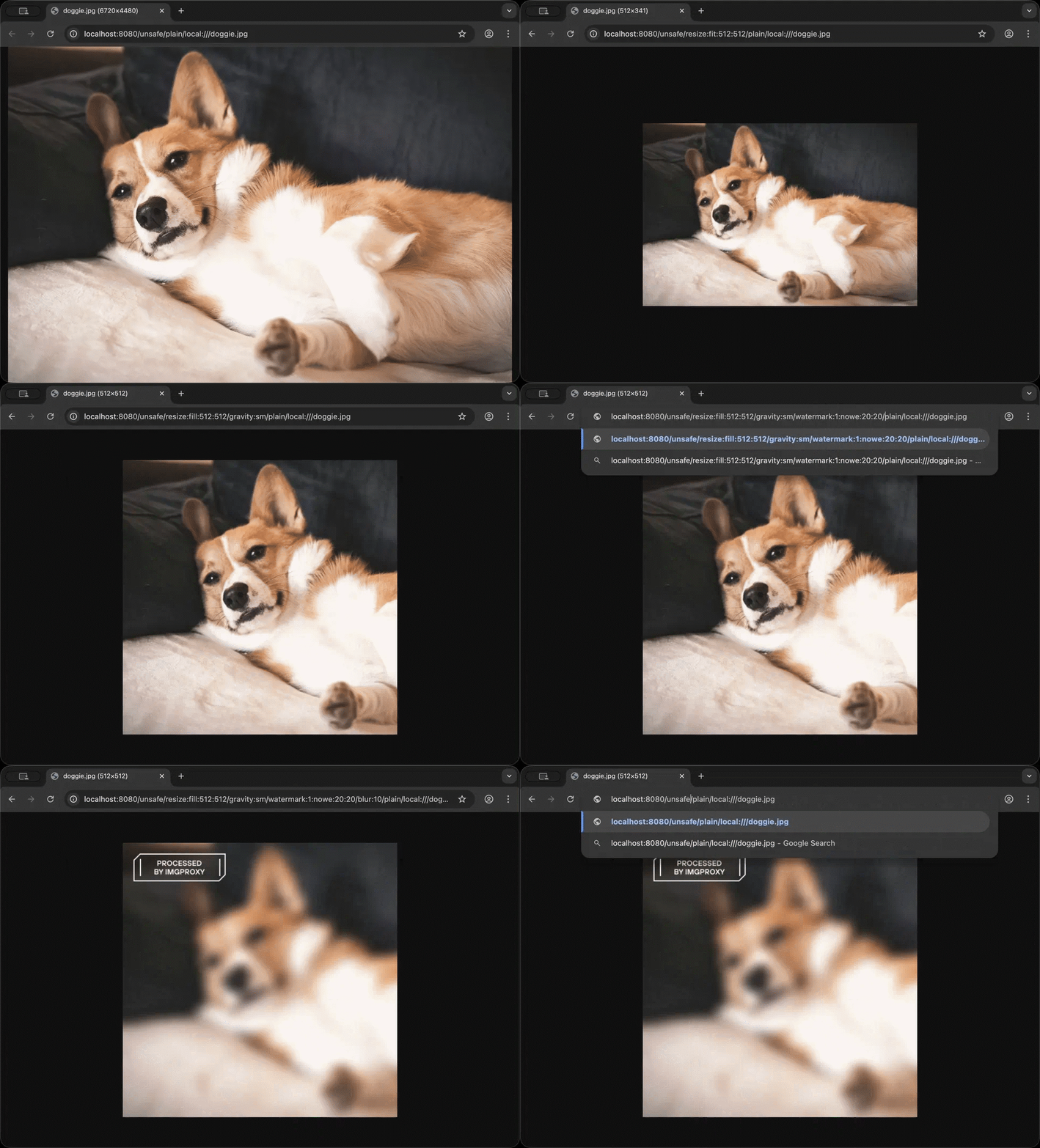
It runs as one program, or one container, with no database behind it. A page links to a picture through an address that spells out the size, the crop and the format wanted. The program fetches the original, does the work, and returns the result. It can convert to WebP and AVIF, the two modern picture formats that are much smaller than JPEG and PNG. Addresses can be signed with a secret key, so strangers cannot point it at any picture on the internet and get free processing. The licence is Apache-2.0 and the latest release is v4.0.17, from 30 September 2026. What it does not do is store anything: there is no cache of its own, so a caching layer in front of it is part of the job, and some of the more advanced processing is kept for a paid version.
Why it matters
Who it suits. Sites with many screenshots or photographs, where page weight is already a known problem. It suits anyone who generates a fresh set of images on every release even more, because resizing forty files by hand is the chore nobody keeps doing. Skip it if the site has a handful of pictures that never change, because a one-time conversion is simpler.
Verdict. Worth an hour once there is a real content site with real pictures on it, and not before. Converting to AVIF and WebP is the single largest page-weight saving available, and here it is a setting rather than a project. Two things to watch. Without a cache in front, it reprocesses on every single request, and that cost lands on the machine running it. And check the feature list against the paid version before depending on anything advanced. h2non/imaginary is the simpler alternative if signed addresses are not wanted.
- Apache-2.0, one small program, nothing metered and no per-picture charge.
- AVIF and WebP conversion is a setting, not a project, and it is the biggest weight saving on offer.
- Signed addresses stop strangers using the machine as a free image service.
- It earns nothing until a content site with real pictures exists.
- It needs a cache in front of it, or it repeats the same work on every request.
- There is a paid version, and a few advanced processing features live only there.
Astro and Starlight pages reference imgproxy URLs instead of raw files.
That matters for ranking, because Core Web Vitals feed into Google's assessment of the pages you most want to rank, and it matters for a Russian-speaking visitor on a slow connection who will simply leave.
docker run -p 8080:8080 -it ghcr.io/imgproxy/imgproxy:latest



10.3k stars · MIT · v1.31.1 (2026-09-05) · Track this in Scout · Share this tool
Fake SMTP server with a web inbox, spam score and HTML-compatibility report — read the campaign before subscribers do.
▶Repo detailsthe review · specs · pros & cons · install
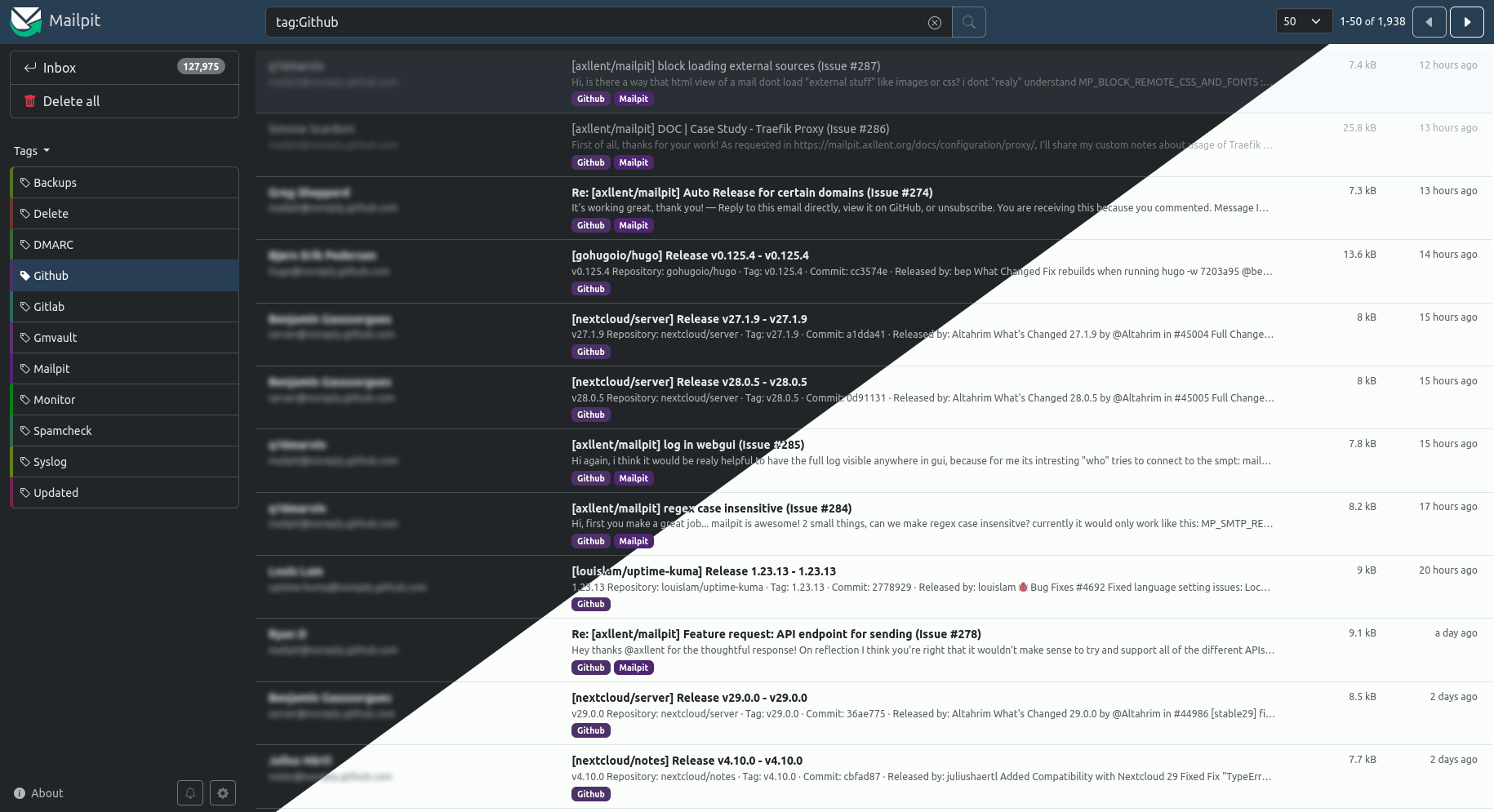
What it does
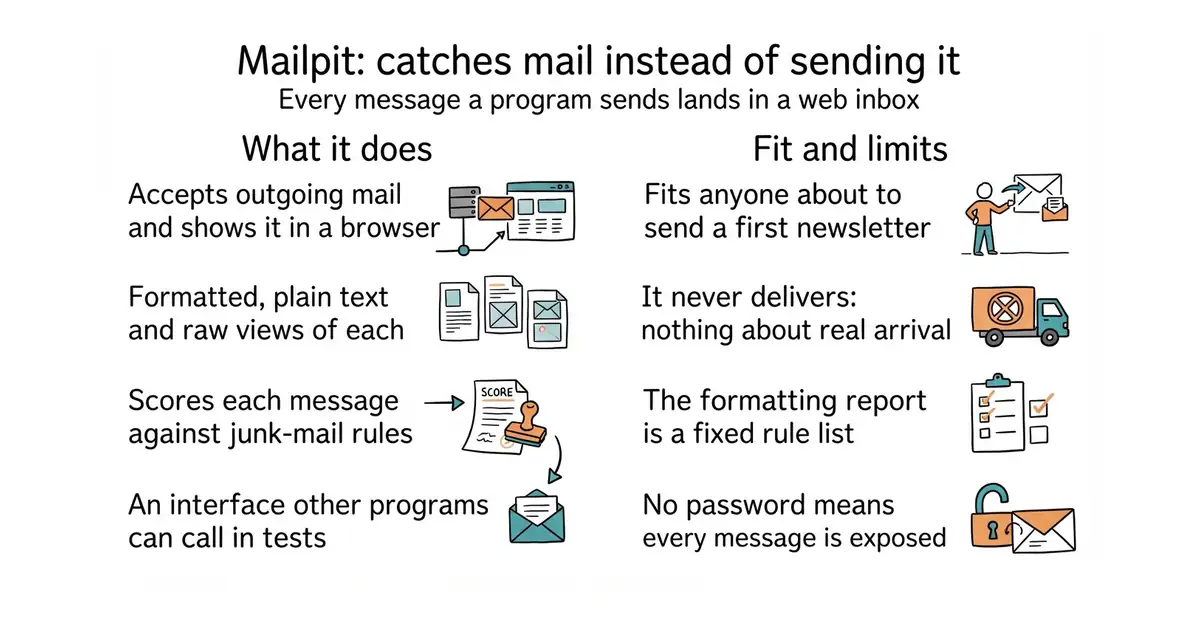
It runs one program that listens for outgoing mail. Any application pointed at it sends mail there instead of to the internet. Each message appears in a browser inbox, where the formatted version, the plain-text version and the raw message are all readable. It scores each message against junk-mail rules, and checks the formatting against a table of what real mail programs support. It also has an interface other programs can call, which makes it usable in automated tests. The licence is MIT and the latest release is v1.31.5, from 11 October 2026. What it does not do is deliver anything. It says nothing about whether real mail would arrive, so the records that prove a sender is genuine are still a separate job.
Why it matters
Who it suits. Anyone about to send a first newsletter to a real list. It also suits any team whose sign-up confirmations and password resets have never been read by a human, which is most teams, because that is the mail path that breaks quietly and costs sign-ups with no error anywhere. Skip it if nothing in the project sends mail at all.
Verdict. Worth half an hour, today, and it is the lowest-effort entry on this page. One container, no configuration, and the two things that cannot be eyeballed, the junk score and the formatting report, are built in. Two cautions. The formatting report is a fixed rule list, not a real copy of any mail program, so treat it as a strong hint. And left on a public machine with no password it would show every message it has caught, so keep it on a local machine or behind a login. rnwood/smtp4dev is the closest alternative.
- One program or one container, no configuration, MIT licence.
- The junk score and the formatting report cover the two things nobody can check by eye.
- It catches an application's own sign-up and reset mail, which is the path that fails silently.
- It never delivers anything, so it says nothing about whether real mail would arrive.
- The formatting report is a fixed rule list, not a real mail program.
- Left on a public machine without a password it exposes every caught message.
docker run -d --name mailpit -p 8025:8025 -p 1025:1025 axllent/mailpit

189.7k stars · Unlicense · 2026.08.19 (2026-08-19) · Track this in Scout · Share this tool
Whole-channel YouTube metadata as JSON — titles, tags, thumbnails, subtitles, upload dates — with no API key or quota.
▶Repo detailsthe review · specs · pros & cons · install
What it does
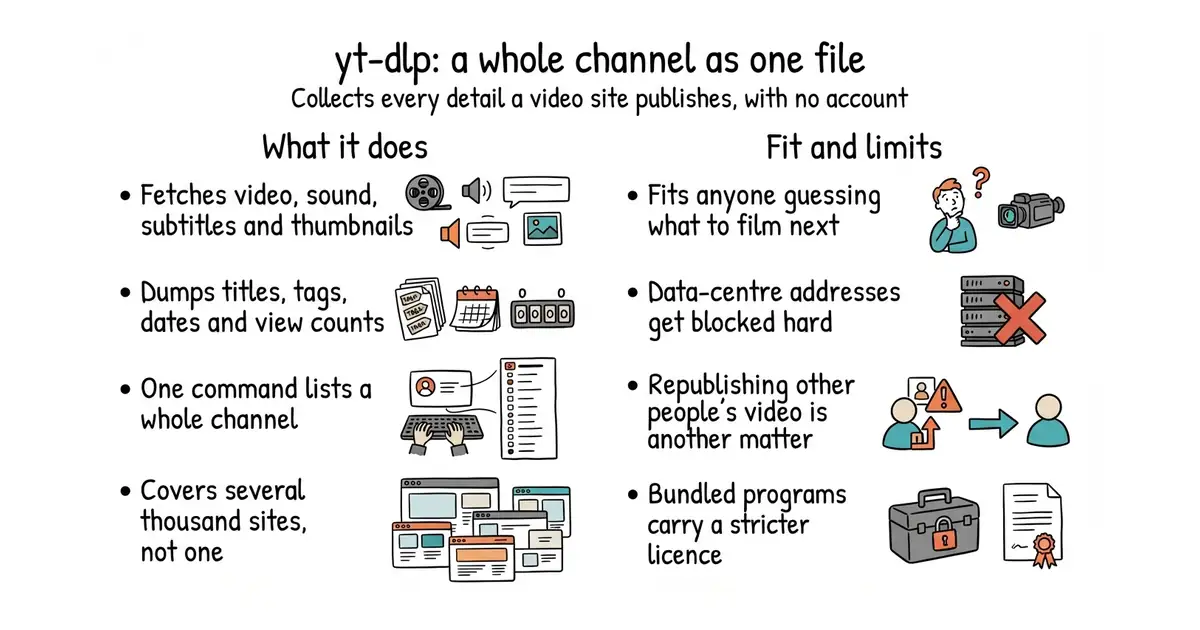
It takes a web address and fetches what is behind it: the video, the sound on its own, the subtitles, the thumbnail picture, or only the written details. Those details come out as structured data, one record per video, holding title, description, tags, chapters, length, upload date and view count. One command over a whole channel lists every video that channel ever published. It covers several thousand sites, not only the largest one. The latest release is 2026.08.19, published on 19 August 2026, and the code itself was last changed in late September 2026. The source is under the Unlicense, which places almost no conditions on use, though the ready-made bundled programs include code under the stricter GPLv3+. What it does not do is give any guarantee of access: video sites block machines in data centres hard, and nothing here hides that.
Why it matters
Who it suits. Anyone deciding what video to make next, and guessing. One evening of collecting gives a real table of what a whole field publishes, how often, and what it calls things. It also suits anyone who wants a copy of their own back catalogue, which is the backup almost nobody makes until something disappears. Skip it if the plan is to republish other people's video, because that is a different matter and not a legal one to be casual about.
Verdict. Worth one evening and it will keep paying afterwards. Run it from an ordinary computer, not a rented server, because rented addresses get blocked. The written details alone are a research file with no code to write: hand the file to an assistant and ask what a field covers badly. Use the plain package install rather than the bundled program if anything built with it might ever be shipped, because of the stricter licence on the bundle. jdepoix/youtube-transcript-api is the smaller tool when only the spoken words are wanted.
- No key, no sign-up and no daily limit, and the project is very unlikely to disappear.
- One command produces details, subtitles and thumbnails together, which covers titles, topics and design in one pass.
- The structured output is a research file in itself, with nothing to build.
- Video sites block data-centre addresses hard, so a rented server is the wrong place to run it.
- Collecting other people's video for private research is one thing; republishing it is another.
- The ready-made bundled programs carry a stricter licence than the source does.
source venv/bin/activate
pip install yt-dlp
# every video on a channel, one record per line
yt-dlp --flat-playlist --dump-json \
  "https://www.youtube.com/@SOMECHANNEL/videos" > channel.jsonl
# one video: details, subtitles and thumbnail, no video file
yt-dlp --skip-download --write-info-json --write-thumbnail \
  --write-subs --write-auto-subs --sub-langs "en,ru" "VIDEO_URL"

6.8k stars · Apache-2.0 · v2.2.0 (2026-07-31) · Track this in Scout · Share this tool
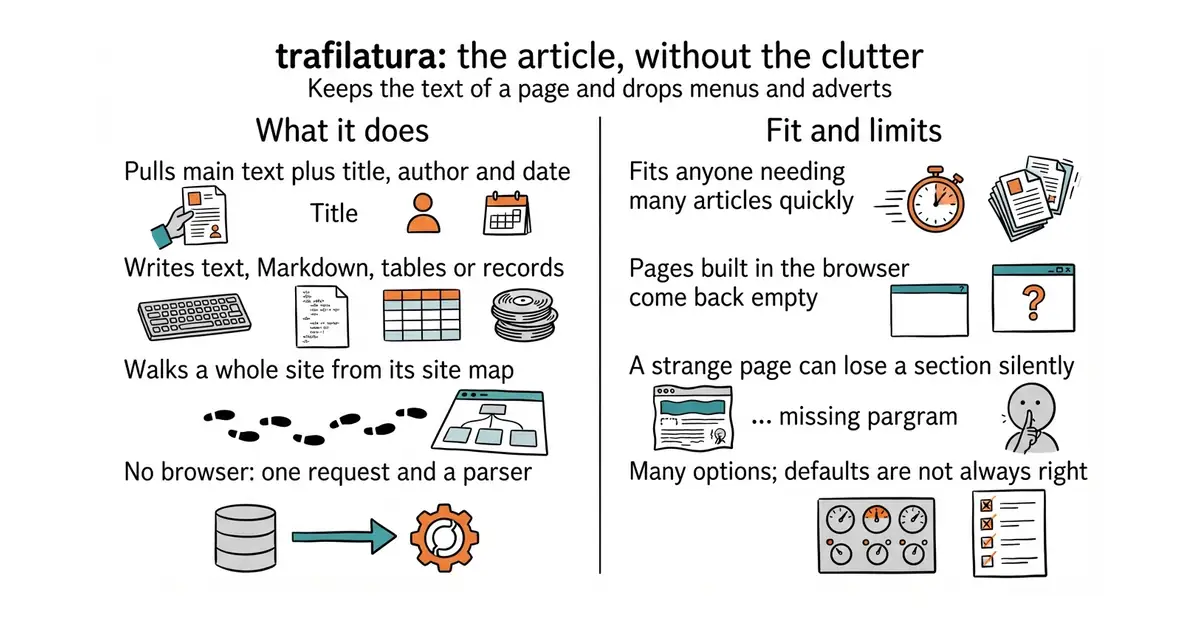
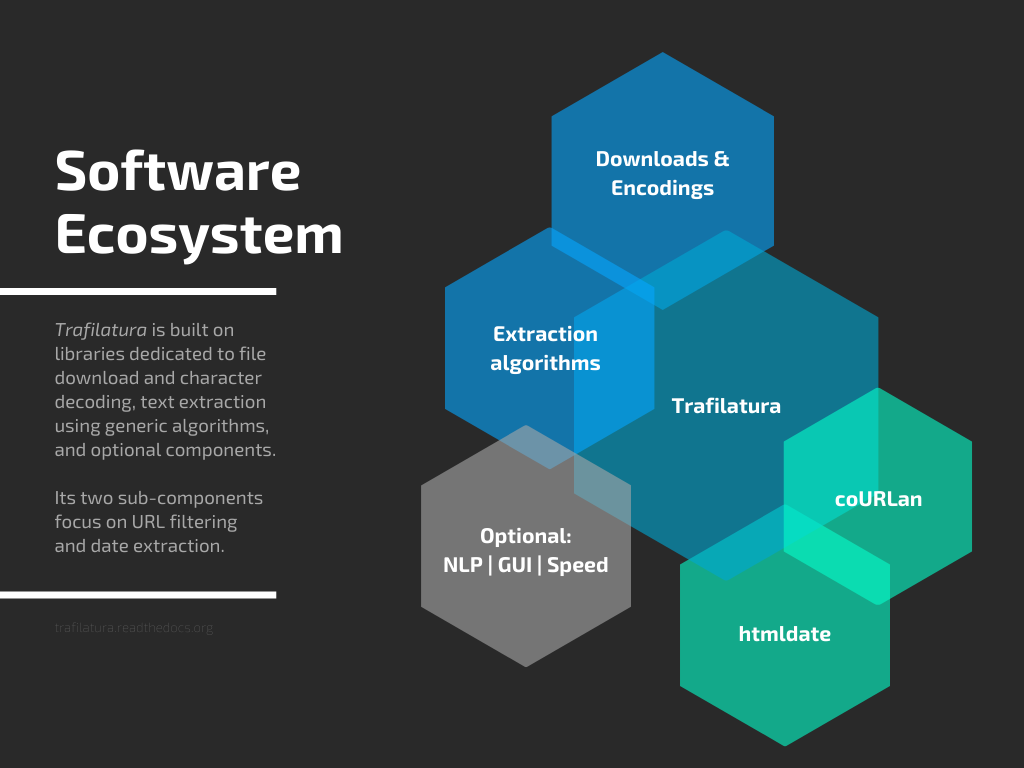
Extracts the actual article from any web page as clean Markdown, with no browser and negligible memory.
▶Repo detailsthe review · specs · pros & cons · install
What it does
It fetches a page and works out which part of it is the main text. It returns that text along with the details it can find: title, author, date and tags. Output can be plain text, Markdown, structured data or a table, which makes it easy to feed into something else. Given a site map or a feed, it walks a whole site and does the same thing to every page. It is much lighter than scraping tools that drive a browser, because it only makes a plain request and reads the result. The licence has been Apache-2.0 since v1.8.0, and the latest release is v2.3.1, from 6 October 2026. What it does not do is run a page's own code, so a page that assembles its article in the browser comes back empty.
Why it matters
Who it suits. Anyone who needs a lot of article text quickly and cleanly. Pointed at a competitor's site map, it returns everything that site has published as clean files, which turns a vague writing brief into a list of questions already answered and questions nobody has answered well. It also suits a product that takes text from a reader, because pasting a link is less work than uploading a file. Skip it if the target pages build themselves in the browser.
Verdict. Worth twenty minutes, and it is the cheapest way to get a text collection. It is light enough to run on a small busy machine, which matters, because browser-driven scrapers are not. Two limits to expect. Finding the article is a judgement the tool makes, so an unusual page can quietly lose a section without reporting an error. And the command has a great many options, so one sitting with the documentation is worth it before trusting the defaults. unclecode/crawl4ai is the tool to reach for when pages need a real browser.
- Apache-2.0 since v1.8.0, so it is safe inside a paid product; older versions and some copies are stricter.
- No browser at all, just a request and a parser, so it uses very little memory.
- It walks a whole site from a site map or a feed with one command.
- It does not run a page's own code, so pages that build themselves in the browser come back empty.
- Finding the article is a judgement, so a strange page can lose a section with no error.
- The command has many options and the defaults are not always what is wanted.
source venv/bin/activate
pip install trafilatura
# one page
trafilatura --markdown -u "https://example.com/some-article"
# a whole site, as Markdown files
trafilatura --sitemap "https://competitor.com/sitemap.xml" \
  --markdown -o ./corpus

1.4k stars · MIT · v0.18.0 on PyPI (2026-06-17) · Track this in Scout · Share this tool
Python toolkit built by a working SEO practitioner — crawling, sitemaps, SERP analysis, keyword generation.
▶Repo detailsthe review · specs · pros & cons · install
What it does
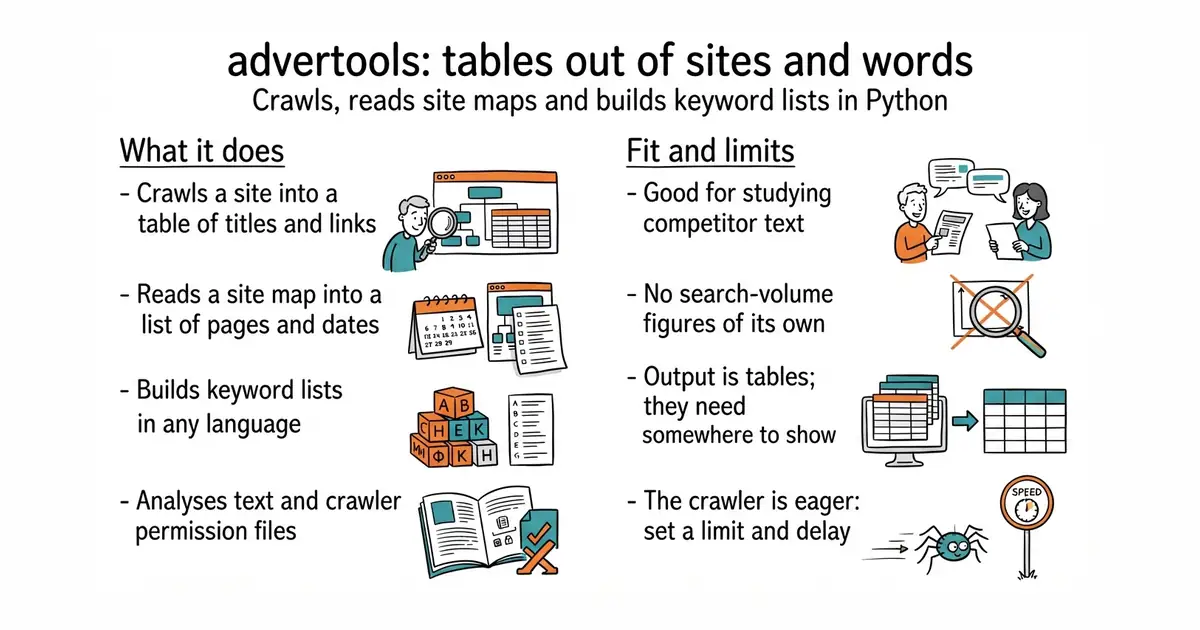
Its crawler walks a site and returns every page with its title, description, headings and links, so missing titles and duplicates show up as rows in a table. It reads a site map and returns the list of pages a site publishes, with dates, which shows what a competitor writes about and how often. It builds keyword combinations from a short list of words, in any language. It also parses the file that tells crawlers where they may go, and analyses text for word frequency. The latest release is 0.18.0, published on 17 June 2026, and the code was last changed at the end of that month. It is MIT licensed and pure Python. What it does not do is tell anyone how many people search for a word; there are no search-volume figures of its own anywhere in it.
Why it matters
Who it suits. Anyone holding a pile of competitor text and no way to count it. It suits Python projects especially, because it needs no new language, no server and no dashboard. Entries 4 and 5 in this edition both end in a pile of text, which is why this one is raised a second time: it was first published in Edition 1 on 21 August 2026 and is the only tool in the whole ledger that reads such a pile. Skip it if a hosted marketing dashboard is already paid for and used.
Verdict. Worth an afternoon, and the only entry here raised twice. Three things to know. It gives no search-volume data, so pair it with a free search console or a paid source for demand figures. Its output is tables, which need somewhere to be looked at, and that is a large part of why entry 12 is on this page. And its crawler is eager, so set a page limit and a delay before pointing it at anybody's site. The release pace is slow and steady rather than fast: one release in June 2026, after many years of the same.
- MIT, pure Python, and it drops into an existing project with no new language and no new service.
- Written by a working search-marketing specialist, so the functions are named after real tasks.
- Years of steady, unhurried releases rather than a burst of activity.
- No search-volume figures of its own, so demand has to come from somewhere else.
- Output is tables, which need a separate place to be read.
- The crawler is eager; without a page limit and a delay it will annoy a site owner.
source venv/bin/activate
pip install advertools

5.9k stars · MIT · v3.31.0 (2026-08-25) · Track this in Scout · Share this tool
Async Python framework for Telegram bots — the distribution surface a Russian-speaking audience is actually on.
▶Repo detailsthe review · specs · pros & cons · install
What it does
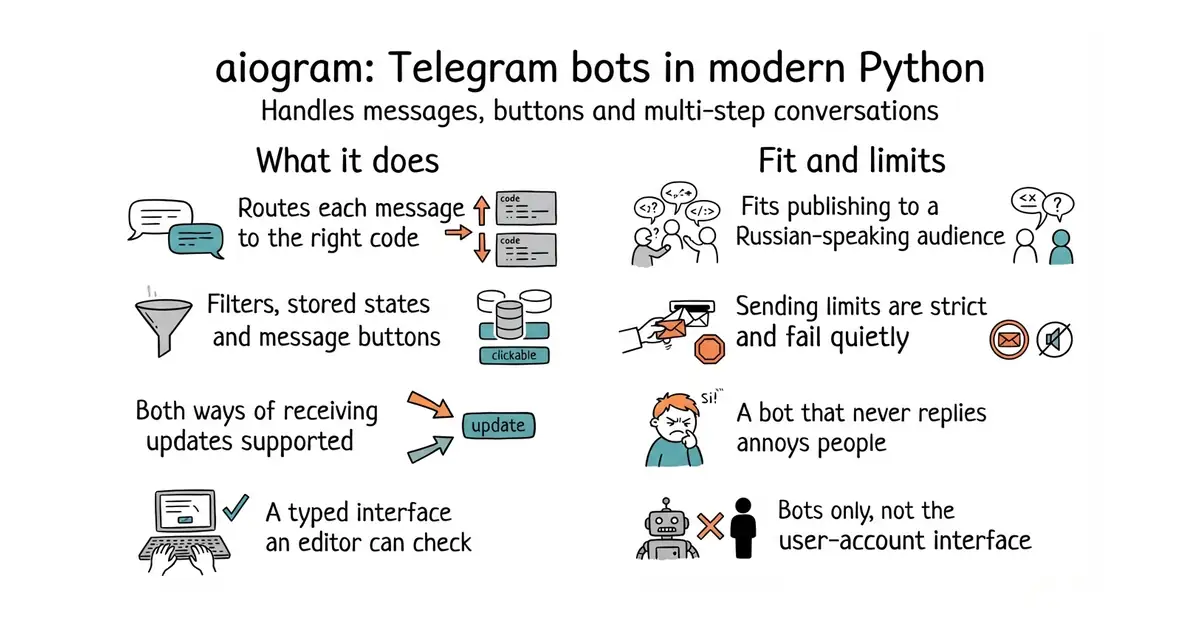
It receives each message, works out which piece of code should handle it, and sends a reply. It supports filters that pick messages by type or content, stored conversation states for multi-step forms, buttons attached to messages, and both ways of receiving updates that Telegram offers. The whole interface is typed, which means an editor can catch mistakes before the program runs, and it tracks the messaging service's own releases closely. Version 3 has been stable for years; the newest release is v3.31.0, from 25 August 2026, and the code was last changed on 11 October 2026. The licence is MIT. What it does not do is cover the other, lower-level way of talking to Telegram as a user account: this is for bots only.
Why it matters
Who it suits. Anyone publishing to a Russian-speaking technical audience, where a channel is the place people read. Two uses stand out. A posting bot pushes each new article or video to a channel automatically, which is the job most social-posting tools do badly for Telegram. A product bot is more interesting: somebody forwards a long chat export to it and gets a summary or a map back as a message, with no sign-up and no landing page. Skip it if nobody is willing to run a channel, because a channel that stops posting is worse than none.
Verdict. Worth a weekend if a channel is really going to happen, and nothing at all if it is not. The library is the easy part. Two warnings. Telegram's sending limits are strict and fail quietly, so a bulk post needs deliberate slowing down or messages simply vanish. And a bot is a conversation: one that never answers annoys people. python-telegram-bot/python-telegram-bot is the larger alternative with the same job.
- MIT, fully asynchronous, and written in the same style as most modern Python web code.
- A channel is a list of readers that nobody else can reprice or filter.
- The version 3 interface has been stable for years and the documentation is thorough.
- Sending limits are strict and fail quietly; a bulk post needs deliberate slowing down.
- A bot that never replies is worse than no bot, and replying is ongoing work.
- It covers bots only, not the lower-level user-account interface.
Install into the FastAPI virtual environment and run the bot as a second process beside the API — or, for the posting half, as a Procrastinate periodic task, since you now have a job queue.
source venv/bin/activate
pip install aiogram

39.5k stars · MIT · v1.5.7 (2026-09-02) · Track this in Scout · Share this tool
Entity-and-relationship graph over documents with local and global query modes — GraphRAG's structure at a fraction of the cost, stored in PostgreSQL.
▶Repo detailsthe review · specs · pros & cons · install
What it does
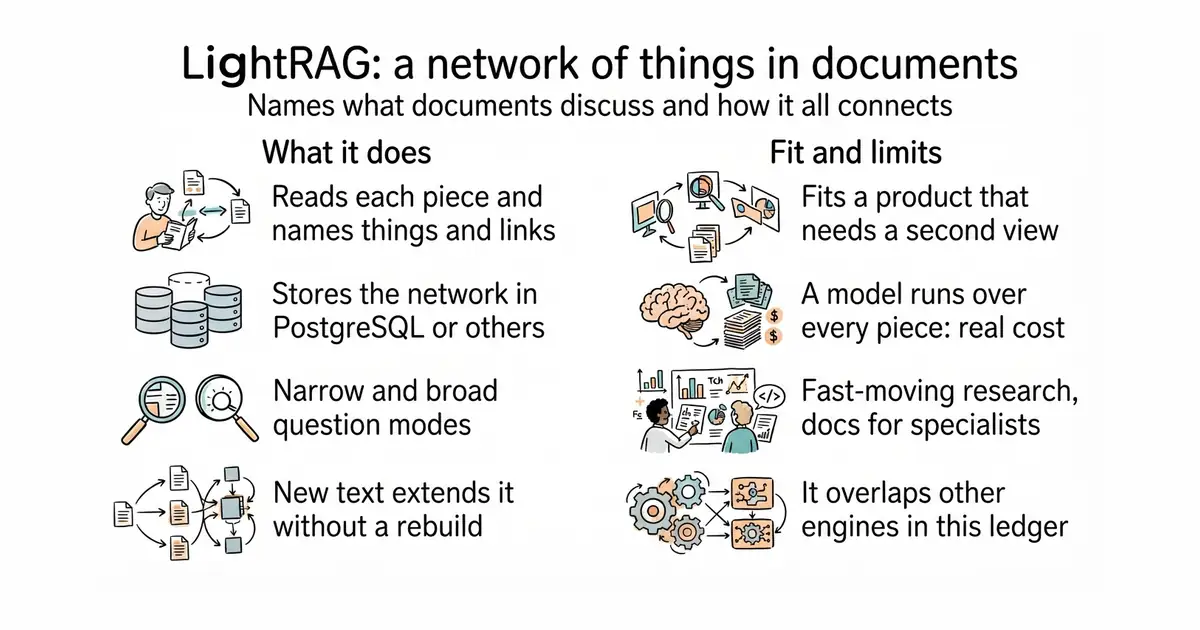
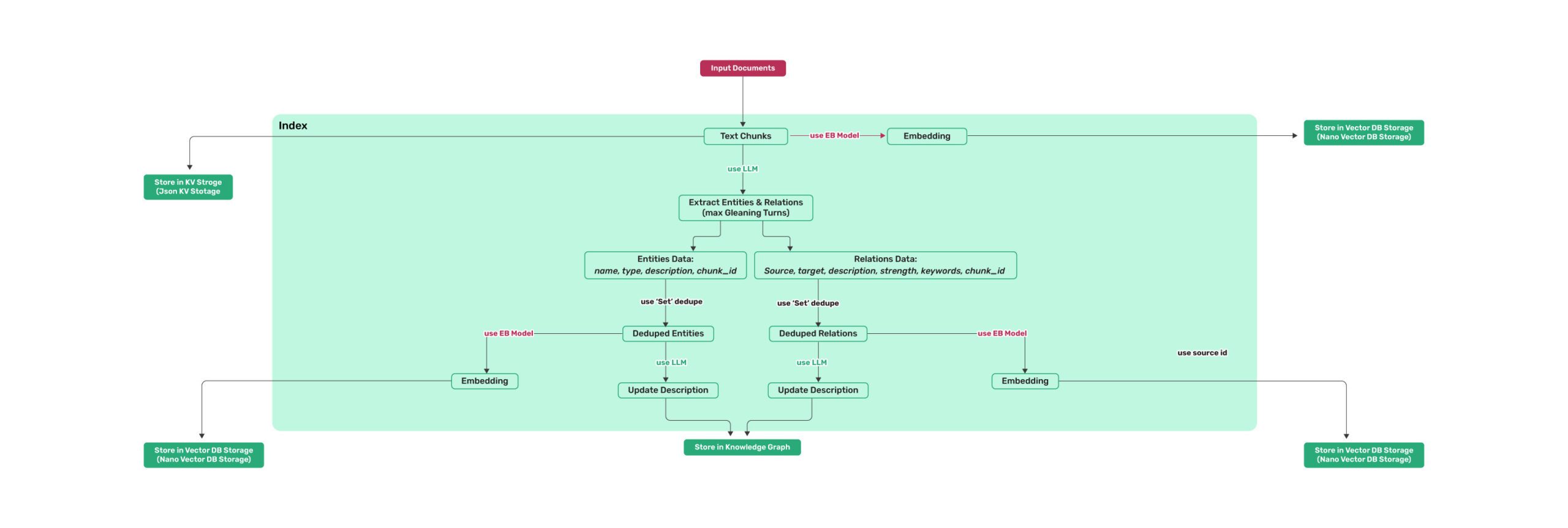
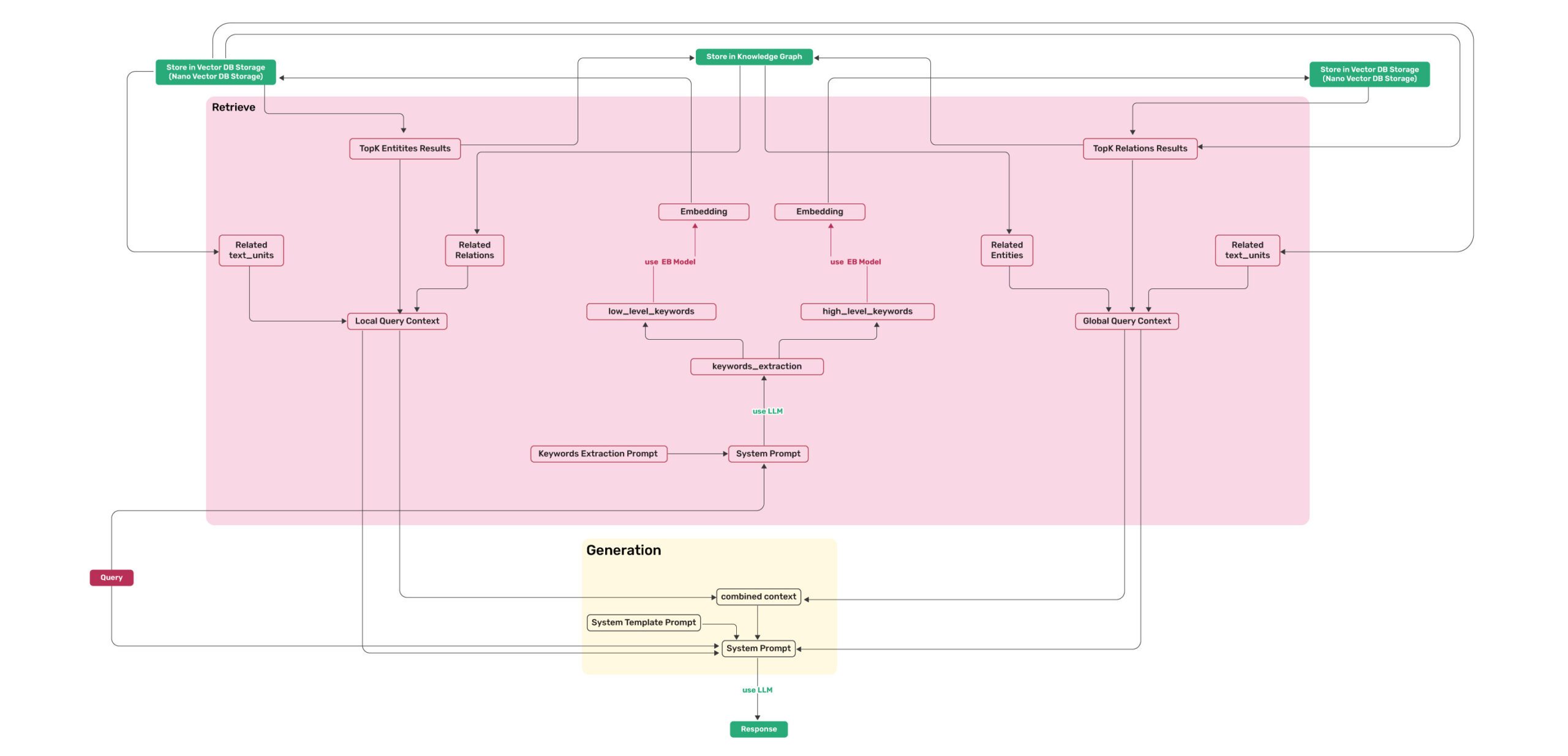
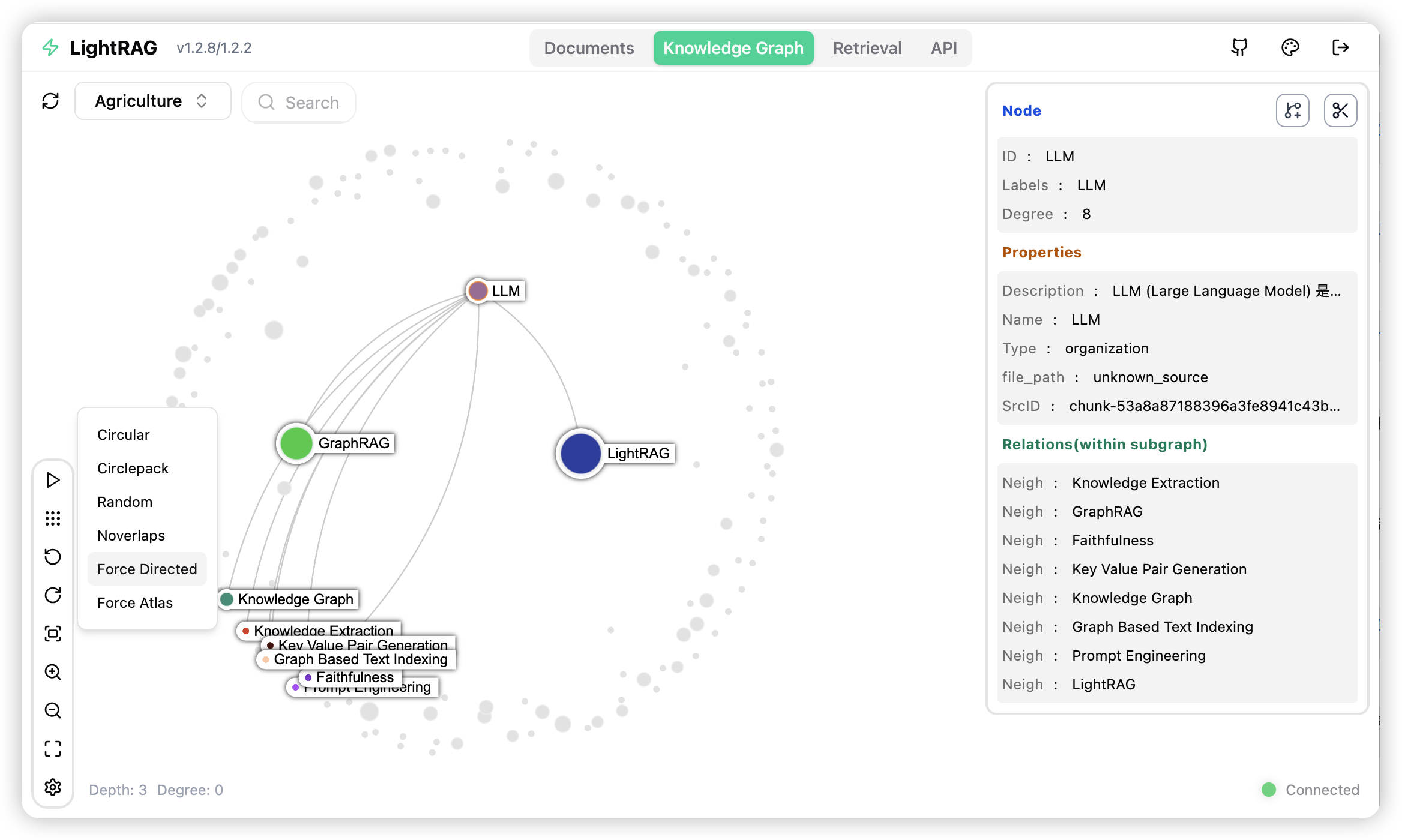
It reads each document in pieces, and for every piece it asks a language model to name the things in it and the links between them. Those names and links are stored as a network, in PostgreSQL, Neo4j, MongoDB or several other stores. Questions can be asked in two ways: narrow, about one named thing, or broad, about themes across everything. New text is added without reprocessing what is already there. It ships a server with a web page that draws the network. The licence is MIT and the newest release is v1.5.7, from 2 September 2026, with code changed later that month. What it does not avoid is cost: a model runs over every piece of every document, so a large first import is expensive.
Why it matters
Who it suits. Products that already search documents and want a second view of them: who and what is discussed, and how it connects, rather than which groups of messages exist. It suits teams who want to stay on one database, because the network can live in PostgreSQL next to everything else instead of in a second system to run and back up. Skip it if the collection is small enough that plain search already answers the questions.
Verdict. Worth a careful week, and worth a cost limit before the first large import rather than after the first bill. Cheaper than the best-known alternative is not the same as cheap. It is a fast-moving research project with a wide reach and documentation that assumes the reader already knows the field. One honest instruction: anyone now holding three candidate engines for the same job should run two of them over the same twenty conversations and delete the loser, because two engines is two things to debug at three in the morning. microsoft/graphrag is the heavier original of this idea.
- MIT, and it can keep the network in PostgreSQL rather than in a separate database.
- New text extends the network instead of forcing a full rebuild, which is the expensive part.
- Narrow and broad question modes match a drill-in view and a summary view directly.
- A model still runs over every piece of every document, so the first large import costs real money.
- A fast-moving research project with a wide reach and documentation written for specialists.
- It overlaps other tools in this ledger that do a similar job, and keeping two is a burden.
And its incremental insertion means adding new messages extends the graph instead of triggering a rebuild, which is what makes "map this conversation as it grows" a feature rather than a wish.
The PostgreSQL backend is the practical detail: the graph can live beside pgvector rather than in a Neo4j you would have to run, secure and back up separately.
source venv/bin/activate
pip install "lightrag-hku"



102 stars · MIT · release-0.5.4 (2026-09-04) · Track this in Scout · Share this tool
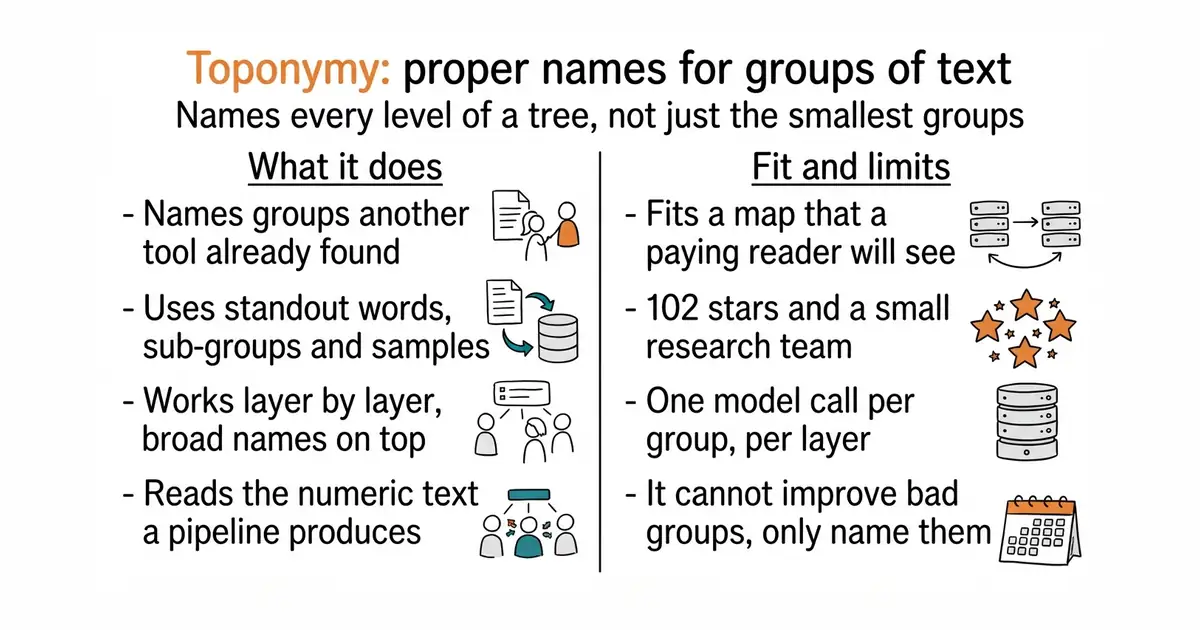
Names clusters at every level of a hierarchy using sub-cluster structure and sample documents rather than a bag of keywords.
▶Repo detailsthe review · specs · pros & cons · install
What it does
It takes groups of text that another tool has already found and produces a name for each one. It builds each name from evidence: the words that stand out in the group, the smaller groups inside it, and a sample of the actual documents. It does this layer by layer, so a parent name is broader than its children's names, which is what keeps a tree meaningful as a reader zooms in. It reads the numeric representations of text that a normal pipeline already produces. It comes from the Tutte Institute, the group that wrote the two algorithms most clustering tools are built on. The licence is MIT; the newest release is 0.5.4, from 4 September 2026, with code changed later that month. What it does not do is find the groups or improve them: bad groups get accurate names for bad groups.
Why it matters
Who it suits. Anyone shipping a map of a conversation or a document collection to a paying reader. Default names made of keywords, such as model, prompt, token, api, read as machine output and undo the value of the map. It also suits anyone who has tried to write these names by prompting a model directly and found that the parent name comes out no broader than its children. Skip it if the groups are never shown to anyone and only feed another program.
Verdict. Worth an afternoon, and it is the smallest change on this page that a reader would notice. Two honest cautions. It has 102 stars and a small research team behind it, so treat it as a technique that could be rewritten if it stops, not a dependency to build a business on. And it calls a model once per group per layer, so a deep tree has a real cost on every import, which is another reason for a spending limit in front of it. MaartenGr/KeyBERT is the cheap fallback that gives keywords rather than names.
- Built for the exact problem of naming a tree at several levels, which is the shape of a drill-in map.
- MIT, and it reads the numeric text representations an existing pipeline already produces.
- From the group behind the two algorithms most clustering tools rely on.
- 102 stars and a small research team, so it is a technique rather than a safe dependency.
- A model call per group per layer, so a deep tree costs real money on every import.
- It names groups and cannot improve them; the quality of the groups still decides everything.
Clustering gives you groups; the label on the group is what makes it a map instead of a blob diagram.
source venv/bin/activate
pip install toponymy


1k stars · MIT · release-0.7.3 (2026-05-31) · Track this in Scout · Share this tool
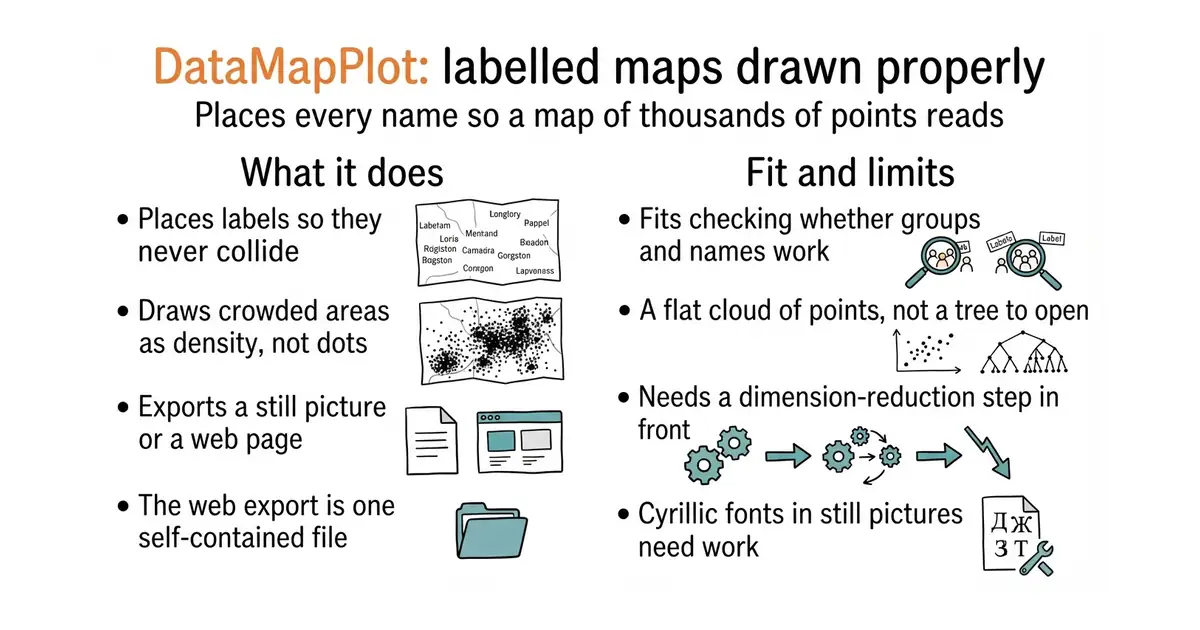
Labelled data maps with proper label placement — a diagnostic for cluster naming and a shareable marketing image.
▶Repo detailsthe review · specs · pros & cons · install
What it does
It takes two-dimensional coordinates and a label for each point and draws the map. Label placement is the part it does well: names are positioned so they do not collide, with lines back to the area they belong to. It handles dense regions by drawing them as density rather than as a mess of overlapping dots. It exports either a high-quality still picture or a single self-contained web page with search and hover built in. The licence is MIT, the newest release is 0.7.3, from 31 May 2026, and the code was last changed on 23 August 2026. What it does not do is reduce data to two dimensions, so a separate step has to do that first, and it draws a flat cloud of points rather than a tree that can be opened up.
Why it matters
Who it suits. Two different people, which is unusual. For anyone building a map, it is the fastest way to see whether the groups and their names are any good: one picture of one real conversation teaches more than reading a list of labels. For anyone explaining such a product, a properly labelled map of every question asked inside a 500-message thread is a single picture that explains the whole idea, which is the kind of picture a landing page or a video thumbnail usually lacks. Skip it if the interface is already built and the maps come out of it.
Verdict. Worth an hour, mostly as a checking tool. It is pure Python with no front-end work, which is what makes it an hour and not a week. Three things to expect. It needs a step in front of it that reduces the data to two dimensions, and that step gives different results each run unless its random seed is fixed. The still-picture path goes through a general plotting library, whose handling of Cyrillic fonts is where a fiddly hour will go. And it is a diagnostic and marketing picture, not the interactive drill-in view. apple/embedding-atlas is the interactive alternative.
- MIT, pure Python, and a finished picture or web page straight from a table.
- Label placement is the genuinely hard part of a map like this, and it is already solved.
- The web export is one self-contained file, so it drops into any site with no build step.
- It draws a flat cloud of points, not a tree to open up.
- It needs a dimension-reduction step in front of it, which is another dependency and gives different results each run.
- Still pictures go through a general plotting library, whose Cyrillic font handling needs work.
Same institute as 09, so the two are designed to sit next to each other.
source venv/bin/activate
pip install datamapplot

1.6k stars · NCSA · v8.0.0 (2025-10-21) · Track this in Scout · Share this tool
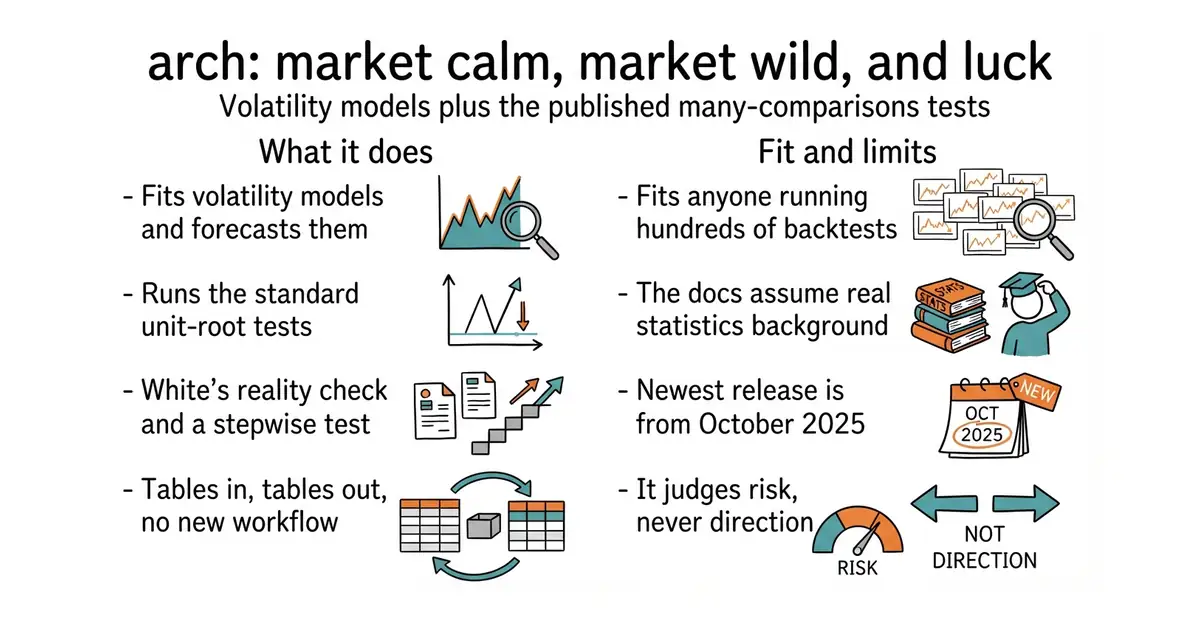
GARCH volatility models plus White's reality check and the Politis-Romano-Wolf stepwise test — regime filters, and a way to tell skill from search luck.
▶Repo detailsthe review · specs · pros & cons · install
What it does
It fits volatility models, the family of statistical models that describe how much a price moves and how that changes over time, and it forecasts that movement forward. It runs unit-root tests, the standard checks for whether a series drifts or returns to a level. It also has a resampling module that includes the published tests for the many-comparisons problem, including White's reality check and the Politis–Romano–Wolf stepwise test. Input and output are ordinary tables, so it fits into an existing pipeline without a new way of working. The newest release is v8.0.0, from 21 October 2025, but the code is being worked on steadily and was last changed on 8 October 2026. The licence is NCSA, a permissive licence in the style of MIT with a clause about not implying endorsement. What it does not do is say anything about direction: it measures risk and reliability, never which way a price will go.
Why it matters
Who it suits. Anyone running many backtests and ready to be honest about the result. Two concrete uses. Fit a volatility model, join its output to the trades, and the question "does this only work when the market is busier than usual?" can finally be answered, which is often where a mediocre rule becomes a usable one with a filter in front. And the reality check is the published test for whether a winner beat its benchmark by skill or by sheer number of attempts. Skip it if there is only one strategy and no intention of testing many.
Verdict. Worth a week, and it is the entry most likely to need a tutor rather than a typist, because the documentation assumes the reader knows what a conditional variance model is. The release number is the oldest on this page, from October 2025, but the code is clearly alive: the last change was four days ago. The licence is permissive, so it can ship inside a paid feature. statsmodels/statsmodels is the general library beside it, by the same maintainer.
- The standard, careful implementation, by a core maintainer of the main Python statistics library.
- A permissive licence, so it can ship inside a paid feature.
- Tables in, tables out, so it fits an existing backtest pipeline without changing how it works.
- Genuinely statistical software; the documentation assumes real background knowledge.
- The newest release is from October 2025, almost a year old, although the code is still changing weekly.
- It describes risk, never direction, so it will not find a strategy, only tell whether one is trustworthy.
A Procrastinate job fits a GARCH(1,1) over the price series and writes conditional volatility to a column beside the price bars, at which point every backtest gains a regime filter for free.
source venv/bin/activate
pip install arch

22.7k stars · Apache-2.0 · 0.24.0 (2026-08-17) · Track this in Scout · Share this tool
Reactive Python notebook stored as a plain .py file — no hidden execution order, and `marimo run` serves it as a web app.
▶Repo detailsthe review · specs · pros & cons · install
What it does
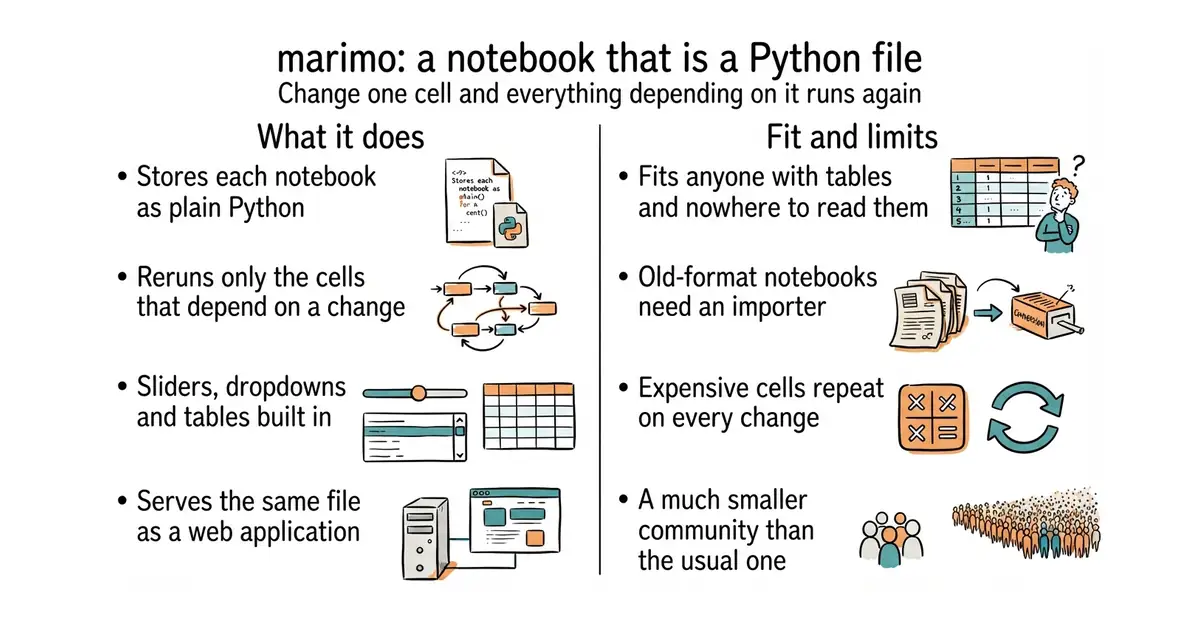
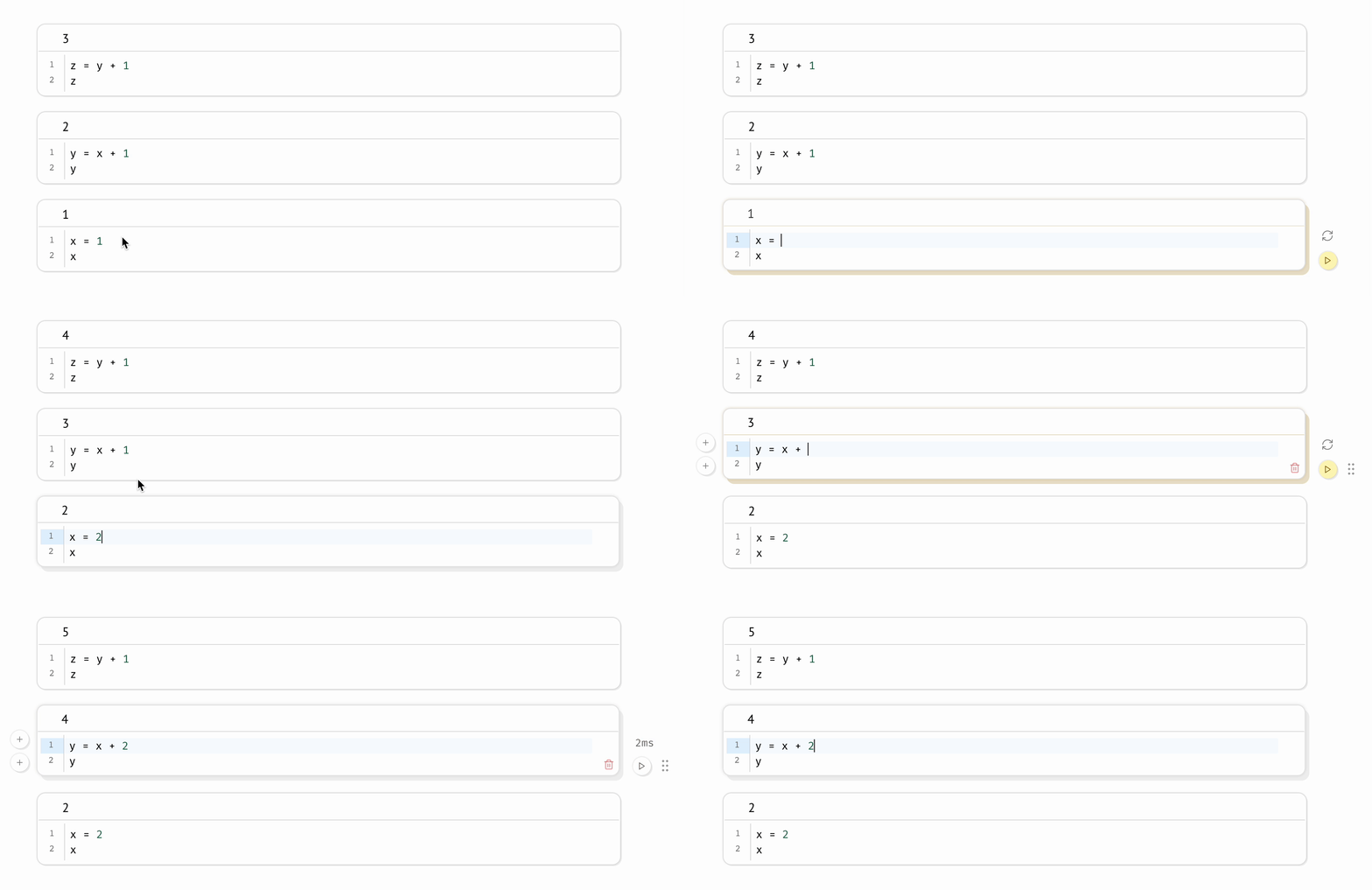
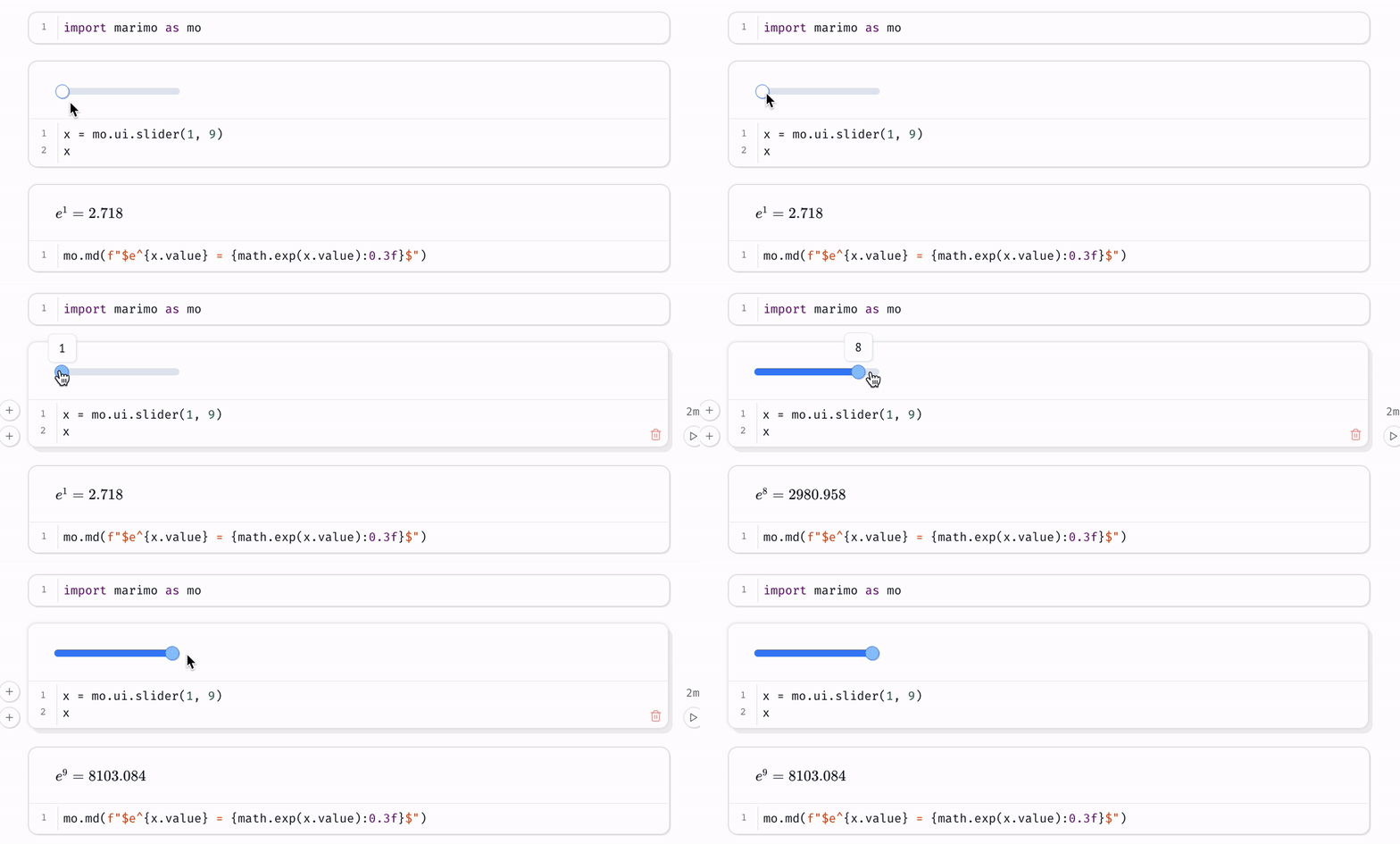
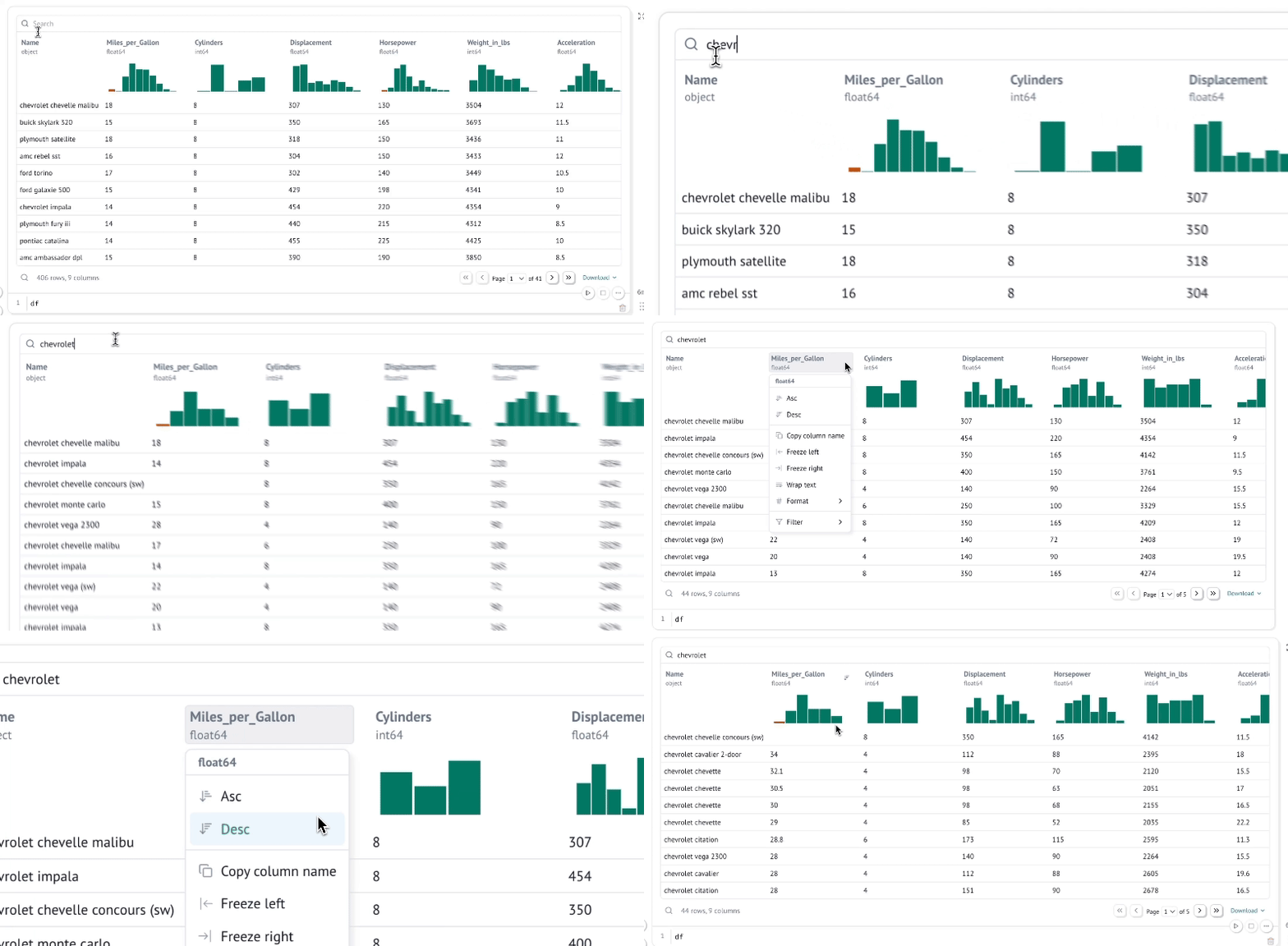
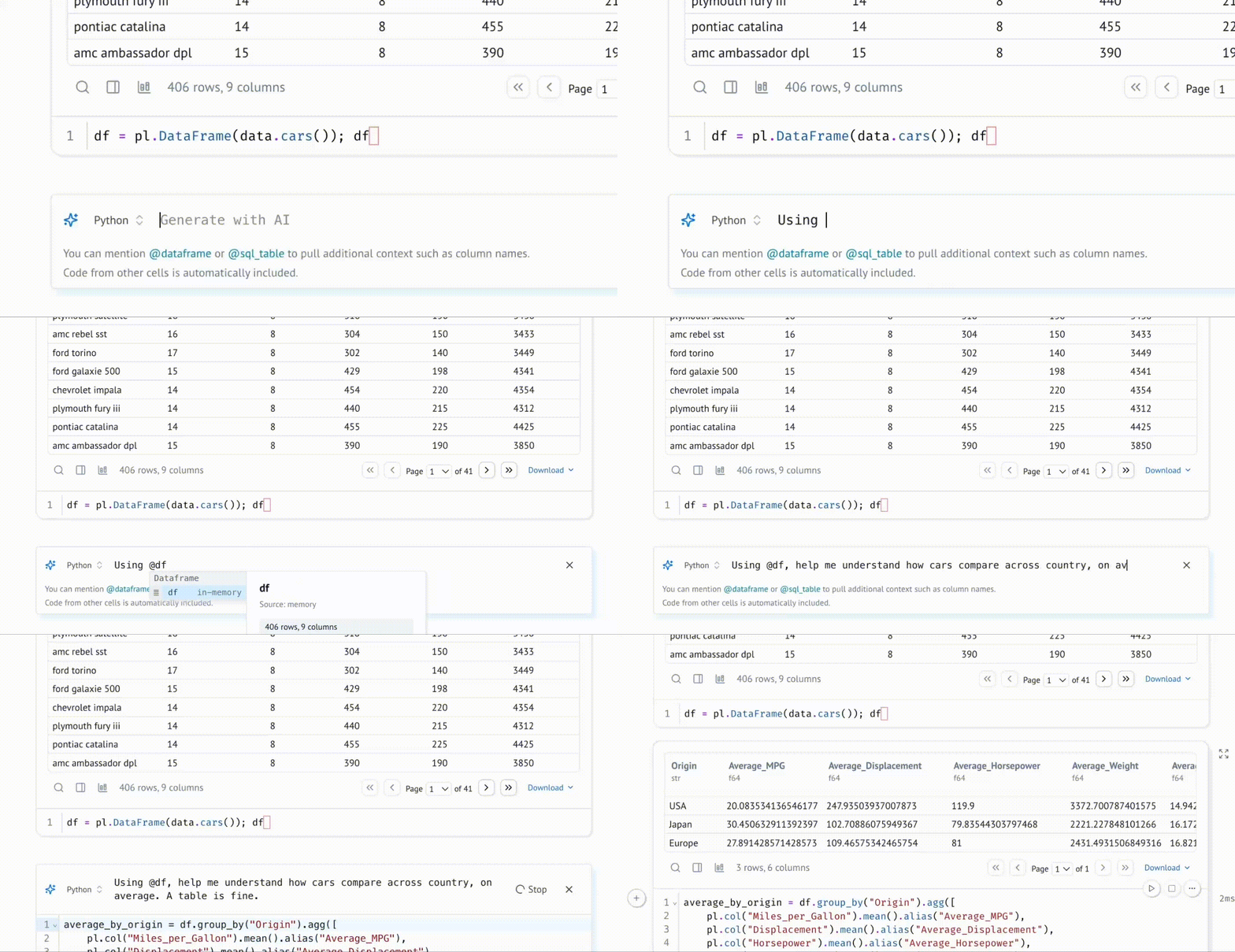
It stores each notebook as an ordinary Python file, not a special format, so the change history is readable and a program or an assistant can edit it like any other source file. When a cell changes, it works out which cells depend on that one and runs those, which removes the whole class of mistakes caused by running cells out of order. It has built-in interface elements, such as sliders, dropdown lists and tables, so a value can be dragged and the analysis rerun. The same file can be run as a plain script, or served as a web application with one command. It can also query data with SQL. The licence is Apache-2.0 and the newest release is 0.25.1, from 1 October 2026. What it does not do is run existing notebooks from the older format unchanged: there is an importer, and friction with it should be expected.
Why it matters
Who it suits. Anyone whose tools keep producing tables and who has nowhere good to look at them. Several entries in this ledger end that way: crawl tables, extracted features, volatility series, fold results. It also suits anyone whose answers carry money, because the usual notebook's hidden run order is the mistake that costs most there. And it suits anyone whose notebooks are edited by an assistant, because a plain code file is far easier to edit correctly than the usual packed format. Skip it if an existing notebook collection is large and working.
Verdict. Worth an evening, and the cheapest entry on this page to try. Two things to expect. Automatic rerunning means an expensive cell runs again whenever anything above it changes, so long jobs need caching or an explicit stop. And the surrounding community is much smaller than the usual notebook's, so most tutorials found elsewhere are written for the other one. The feature that earns the evening is the last one: the same file served as a web application turns a research notebook into an internal tool at no extra cost. streamlit/streamlit is the alternative if the goal is only the application.
- Notebooks are plain Python files: readable in a change history, reviewable, and easy for a program to edit.
- Automatic rerunning removes the wrong answers caused by running cells out of order.
- One command serves the same file as a web application, so a research notebook becomes an internal tool.
- It will not run existing notebooks in the older format unchanged; expect friction with the importer.
- Automatic rerunning means an expensive cell repeats whenever anything above it changes.
- A much smaller community, so most tutorials found elsewhere are written for the other kind of notebook.
source venv/bin/activate
pip install marimo
marimo edit analysis.py
Checked, and left out
These were opened for this edition and did not make it, with the reason.
motion-canvas/motion-canvas
motion-canvas/motion-canvas (18.6k, MIT) — last release 2024-12-14, past the dormancy line. Backlogged.
adityaarsharma/youtube-marketing-skills
adityaarsharma/youtube-marketing-skills (38, MIT) — YouTube growth toolkit as Claude Code skills; no releases and unreadable commit dates. Backlogged, worth re-checking.
puckeditor/puck
puckeditor/puck (13.2k, MIT, v0.23.0 2026-08-07) — alive, but overlaps GrapesJS, which also builds email. Backlogged.
tldraw/tldraw
tldraw/tldraw (49.8k) — not open source; requires a paid licence key in production. Backlogged with that caveat.
StJudeWasHere/seonaut
StJudeWasHere/seonaut (763, MIT) — checked a third time; still no releases and its Docker Hub repo 404s. Left in backlog.
arikchakma/maily.to
arikchakma/maily.to (3.8k, MIT) — re-checked, tag dates still unreadable, and now superseded for his purposes by GrapesJS's newsletter preset.
Know a repository we should check?