Overview
Summary
The useful answer before the supporting detail.
Pydantic Logfire is an AI observability platform for tracing, monitoring, and optimizing AI agents and applications S12. It is used by developers and technical teams to find problems in AI systems, prove fixes with evals, and ship changes without redeploying S60. Its main practical value is unified telemetry across LLM calls, evals, prompts, and infrastructure, with dashboards and alerts S60.
Product identity and positioning
Name, category, positioning, audience, and first-party claims.
- Identity: Pydantic Logfire, an AI observability platform from Pydantic S12.
- Core purpose: Helps developers trace, monitor, and optimize AI agents and applications S12.
- Intended users: Developers and technical teams building production AI systems S123.
- Product scope: A hosted observability platform with SDKs, dashboards, and alerts S60.
- Positioning: Built on OpenTelemetry, part of the Pydantic AI engineering stack S1 S12.
- Claimed distinction: Native SDKs for Python, TypeScript, and Rust, with standard OTel for everything else S60.
Use cases and audiences
Who the product serves and the jobs it is designed to handle.
| Audience | Practical use case |
|---|---|
| AI engineers | Trace agent runs from prompt through tool calls to debug and optimize S71. |
| DevOps/SREs | Monitor hosts, Kubernetes, and databases with pre-built dashboards S71. |
| Platform teams | Correlate traces, evals, and prompt versions in one queryable timeline S60. |
| Technical buyers | Evaluate and prove AI system changes with evals and rollouts S60. |
Traffic and search
Search summary
The useful answer before the supporting detail.
Pydantic is the AI engineering stack for teams building with AI. Observe with Logfire, evaluate with Pydantic Evals, build type-safe agents with Pydantic AI, and track LLM costs with AI Gateway. pydantic.dev: an estimated 412,620 total monthly visits and about 16,967 monthly organic visits across 3,173 ranking keywords. Scout crawled 15 pages and measured a technical health score of 96/100.
- Total traffic (modeled): 412,620 monthly visits across all channels.
- Organic search traffic (estimated): 16,967 monthly visits from search.
- Strongest sampled ranking: logfire at position 1.
- Leading page in the collected evidence: https://pydantic.dev/logfire.
- Closest measured organic competitor: github.com, appearing 3 times in the sampled first-page SERPs.
- Technical crawl: 15 pages, health score 96/100.
Website intelligence — Collected evidence
Company identity and positioning
| Page type | Evidence | Source |
|---|---|---|
| other | Pydantic is the AI engineering stack for teams building with AI. Observe with Logfire, evaluate with Pydantic Evals, build type-safe agents with Pydantic AI, and track LLM costs with AI Gateway. | https://pydantic.dev/ |
| other | From the team behind Pydantic Validation | https://pydantic.dev/ |
| other | Trusted across the Python ecosystem and by engineering teams building the systems people rely on. | https://pydantic.dev/ |
| other | cost spike caught before it burned through the team’s budget. | https://pydantic.dev/ |
| other | One trace gives every team a better decision | https://pydantic.dev/ |
| other | Built on OpenTelemetry, with first-party SDKs for Python, JavaScript and TypeScript, and Rust. Trace agent frameworks, application code, databases, and the infrastructure underneath them without rebuilding your application around an observability vendor. | https://pydantic.dev/ |
| other | Built on the tracing and OpenTelemetry ecosystem. | https://pydantic.dev/ |
| other | Pydantic did not start as a business idea. It started with a developer problem worth solving well. The team behind the validation library now brings the same obsession with clear APIs, useful defaults, and open standards to the whole AI engineering stack. | https://pydantic.dev/ |
| other | About Pydantic Work with us | https://pydantic.dev/ |
| features | For example, imagine an agent calls a model, gets a useful response, starts a tool call, and then the worker crashes. Without durable execution, Airflow’s normal retry restarts the task from the top and repeats the model request and any later side effects. With durable execution, the retry replays the run, reuses the cached result for the already-completed model request, and continues from the first operation that has not completed. | https://pydantic.dev/docs/ai/capabilities/durable_execution/airflow/ |
| features | This is useful for long-running agents and for runs where a repeated model request or external tool call would cost money, take time, or duplicate a side effect. | https://pydantic.dev/docs/ai/capabilities/durable_execution/airflow/ |
| features | The agent’s model and credentials come from an Airflow connection (the examples use `pydanticai_default`). See Pydantic AI connection for how to configure one. | https://pydantic.dev/docs/ai/capabilities/durable_execution/airflow/ |
Website intelligence — Scout synthesis
- First-party positioning: Pydantic positions itself as "The end-to-end AI engineering stack" and claims "Build agents you’ll actually ship to production" W1W3.
- First-party product focus: The homepage centers on Pydantic Logfire for tracing production agents, turning failures into eval cases, and improving shipped agents written in Python or TypeScript W4.
- First-party scale claim: The site states "1BN+ monthly downloads" and says Pydantic is "Trusted across the Python ecosystem" W10W11.
- First-party pricing message: Pricing is described as "Transparent pricing for AI teams" with "no hidden fees no surprise bills" W28W30.
- First-party customer proof points: The homepage cites Boosted.ai (12× faster issue resolution), GIC (150× faster trace queries), and Overjoy (caught a 20× cost spike) W13W15W17.
- Scout inference: The site is heavily oriented toward AI observability and durable execution, with a strong emphasis on production reliability and cost control, suggesting a target audience of AI engineering teams.
Domain performance
Modeled total traffic, six-month trend, engagement, countries, and domain identity.
Total website traffic
| Month | Modeled visits |
|---|---|
| 2026-04 | 537,611 |
| 2026-05 | 534,950 |
| 2026-06 | 555,944 |
| 2026-07 | 536,676 |
| 2026-08 | 454,378 |
| 2026-09 | 412,620 |
Top visitor countries
| Country | Name | Traffic share |
|---|---|---|
| US | United States | 20.7% |
| IN | India | 6.3% |
| VN | Vietnam | 6.0% |
| DE | Germany | 6.0% |
| GB | United Kingdom | 5.6% |
Domain identity
| Signal | Value |
|---|---|
| Registered | Apr 24, 2022 |
| Last changed | Mar 30, 2026 |
| Expires | Apr 24, 2027 |
| WHOIS server | — |
| DNSSEC | Signed |
| Nameservers | adi.ns.cloudflare.com, mario.ns.cloudflare.com |
Website capture
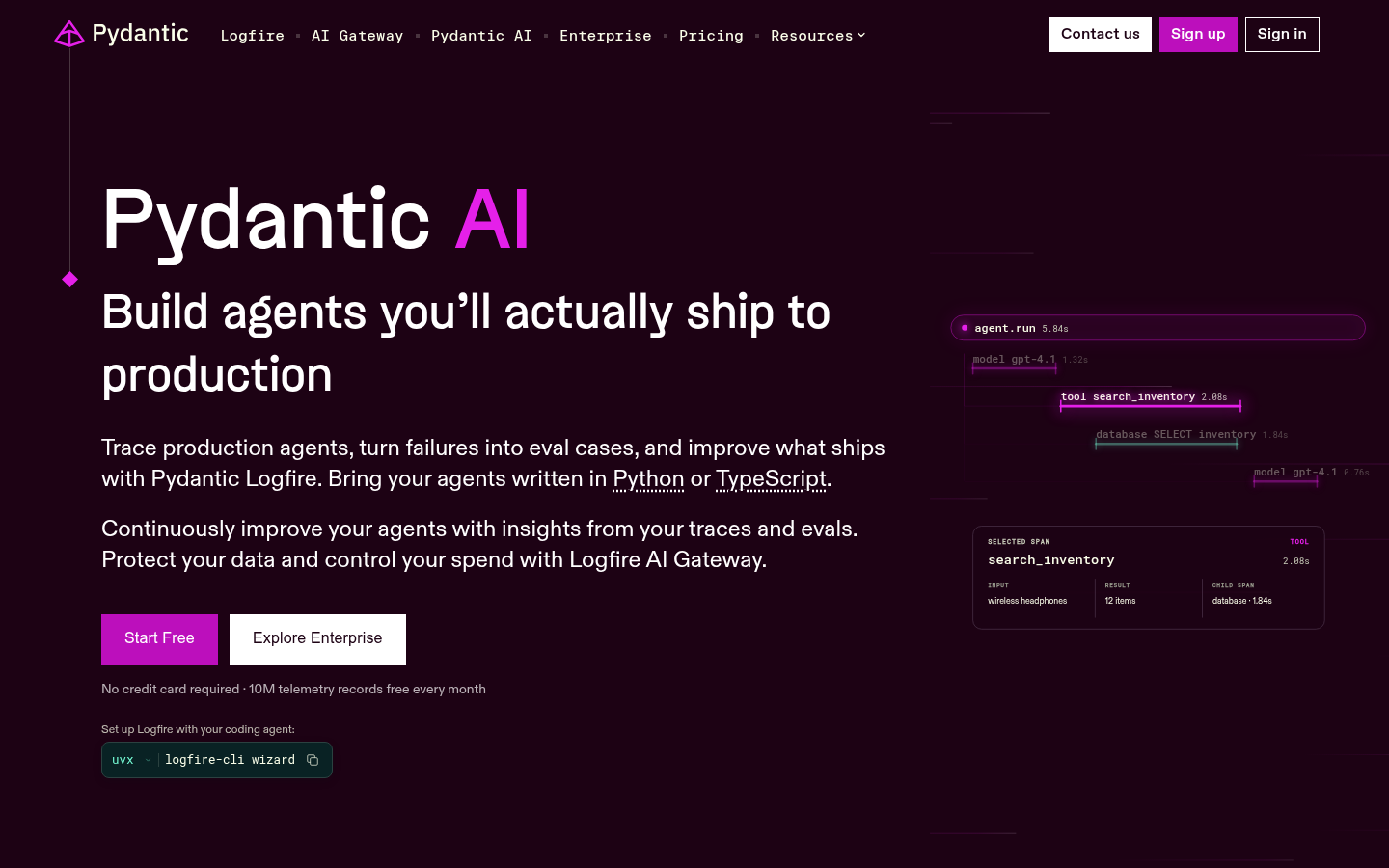
Organic keywords
Top keywords and an independent Google result page.
Top organic keywords
| Keyword | Volume | CPC | Estimated value |
|---|---|---|---|
| pydantic | 60,520 | $0.78 | $21,770 |
| pydantic ai | 17,090 | $3.46 | $12,930 |
| pydantic settings | 2,170 | $0.00 | $2,800 |
| pydanticai | 3,550 | $4.23 | $1,990 |
| typesafe jev | 76,380 | $0.00 | $1,550 |
Independent Google result page
Query: logfire
| Position | Title | URL | Description |
|---|---|---|---|
| 1 | Pydantic Logfire: AI Observability for LLMs, Apps & RAG | https://pydantic.dev/logfire | Pydantic Logfire: Production-grade AI & general observability built on OpenTelemetry. Works with Python, JavaScript/TypeScript, Rust, Go, Java, ... |
| 2 | pydantic/logfire: AI observability platform for production ... | https://github.com/pydantic/logfire | This repo contains the Python SDK for logfire and documentation; the server application for recording and displaying data is closed source. Using Logfire. This ... |
| 3 | Pricing and Plans for Pydantic Logfire | https://pydantic.dev/pricing | Covers 10 million logs, spans, and metrics every month. Additional records are $2 per million, or set a hard price cap to lock in your bill. |
| 4 | Pydantic Logfire is amazing : r/FastAPI | https://www.reddit.com/r/FastAPI/comments/1gbqj1r/pydantic_logfire_is_amazing/ | With Logfire, we're transparent: the SDK is open source (MIT licensed), but the platform itself is closed source. While we offer a generous free ... |
| 5 | Pydantic Logfire | AWS Marketplace | https://aws.amazon.com/marketplace/pp/prodview-fs7xpm5vdxube | Pydantic Logfire is a window into the inner workings of your application. Smooth to set up and easy to understand, with ready integrations for many popular ... |
| 6 | Logfire | liteLLM | https://docs.litellm.ai/docs/observability/logfire_integration | One API for every model, in your code or behind your own gateway. Get the latest LiteLLM updates. New model support, product launches, and release notes ... |
| 7 | Pydantic Logfire — Uncomplicated Observability | https://www.youtube.com/watch?v=FOweIXpw8jE | [EuroPython 2024 — Terrace 2B on 2024-07-11] Pydantic Logfire — Uncomplicated Observability by Samuel Colvin https://ep2024.europyt. |
| 8 | logfire - Rust | https://docs.rs/logfire | From the team behind Pydantic Validation, Pydantic Logfire is an observability platform built on the same belief as our open source library — that the most ... |
| 9 | Observability with Logfire and OpenTelemetry Collector | https://pydantic.dev/articles/logfire-opentelemetry-collector | Pydantic Logfire is a developer-centric observability platform built on OpenTelemetry standards. It provides: Automatic instrumentation for ... |
Important pages
Pages earning the most estimated search traffic in the sample.
Website intelligence — Collected evidence
Prioritized website intelligence pages
| Type | Page | Words | Change | URL |
|---|---|---|---|---|
| other | Pydantic \ | static | 935 | new |
| pricing | Pricing and Plans for Pydantic Logfire | 2,557 | new | https://pydantic.dev/pricing |
| pricing | Browser SDK \ | playwright | 632 | new |
| pricing | Cloudflare Workers Package \ | playwright | 672 | new |
| pricing | Node.js Package \ | playwright | 997 | new |
| pricing | Browser SDK \ | playwright | 632 | new |
| pricing | Cloudflare Workers Package \ | playwright | 672 | new |
| pricing | Node.js Package \ | playwright | 997 | new |
| features | Durable Execution with Apache Airflow \ | playwright | 1,241 | new |
| features | Durable Execution with DBOS \ | static | 4,059 | new |
| features | Durable Execution with Kitaru \ | static | 999 | new |
| features | Durable Execution \ | static | 286 | new |
| features | Durable Execution with Prefect \ | static | 4,061 | new |
| features | Durable Execution with Restate \ | static | 580 | new |
| features | Durable Execution with Temporal \ | static | 3,968 | new |
Features
| Page type | Evidence | Source |
|---|---|---|
| features | [Skip to content](#_top) | https://pydantic.dev/docs/ai/capabilities/durable_execution/airflow/ |
| features | [](https://pydantic.dev/)/ Docs Pydantic Docs | https://pydantic.dev/docs/ai/capabilities/durable_execution/airflow/ |
| features | Search CtrlK | https://pydantic.dev/docs/ai/capabilities/durable_execution/airflow/ |
| features | [](https://github.com/pydantic/pydantic-ai "pydantic/pydantic-ai on GitHub") | https://pydantic.dev/docs/ai/capabilities/durable_execution/airflow/ |
| features | Durable Execution with Apache Airflow | https://pydantic.dev/docs/ai/capabilities/durable_execution/airflow/ |
| features | Apache Airflow is a workflow orchestrator. Its Pydantic AI integration is provided by the `apache-airflow-providers-common-ai` package through `airflow.providers.common.ai`, rather than by `pydantic_ai.durable_exec`. | https://pydantic.dev/docs/ai/capabilities/durable_execution/airflow/ |
| features | Unlike the wrapper-object integrations on this page, Airflow’s durable unit is an Airflow task. You author a normal Pydantic AI agent and run it as a task; Airflow’s retry machinery plus a step-level cache resume the agent from its last completed model request or tool call instead of replaying the whole run. | https://pydantic.dev/docs/ai/capabilities/durable_execution/airflow/ |
| features | Durable Execution | https://pydantic.dev/docs/ai/capabilities/durable_execution/airflow/ |
| features | [](#durable-execution) | https://pydantic.dev/docs/ai/capabilities/durable_execution/airflow/ |
| features | When an agent runs as a durable Airflow task, Airflow records each completed model request and tool call as a cache entry. On a retry, Airflow replays these entries to skip completed work: each entry stores a fingerprint of the request that produced it, and if that fingerprint no longer matches (the conversation diverged since the previous attempt), the step re-runs live instead of returning a stale result. On Airflow 3.3 and above (with `apache-airflow-providers-common-ai` 0.7.0 or newer) the cache is Airflow’s own per-task-instance task state store, so it needs no storage configuration. It is cleared when the task succeeds, and any entries left by a run that ultimately fails are removed when the DAG run is deleted. On Airflow older than 3.3, or with `apache-airflow-providers-common-ai` older than 0.7.0, the cache instead lives in object storage (local, S3, GCS, or Azure) that you configure. | https://pydantic.dev/docs/ai/capabilities/durable_execution/airflow/ |
| features | For example, imagine an agent calls a model, gets a useful response, starts a tool call, and then the worker crashes. Without durable execution, Airflow’s normal retry restarts the task from the top and repeats the model request and any later side effects. With durable execution, the retry replays the run, reuses the cached result for the already-completed model request, and continues from the first operation that has not completed. | https://pydantic.dev/docs/ai/capabilities/durable_execution/airflow/ |
| features | This is useful for long-running agents and for runs where a repeated model request or external tool call would cost money, take time, or duplicate a side effect. | https://pydantic.dev/docs/ai/capabilities/durable_execution/airflow/ |
| features | Durable Agent | https://pydantic.dev/docs/ai/capabilities/durable_execution/airflow/ |
| features | [](#durable-agent) | https://pydantic.dev/docs/ai/capabilities/durable_execution/airflow/ |
| features | You make an agent durable by running it through Airflow’s `AgentOperator` (or the `@task.agent` decorator) with `durable=True`. Install the provider alongside Airflow: | https://pydantic.dev/docs/ai/capabilities/durable_execution/airflow/ |
| features | uv add "apache-airflow-providers-common-ai" | https://pydantic.dev/docs/ai/capabilities/durable_execution/airflow/ |
| features | The agent’s model and credentials come from an Airflow connection (the examples use `pydanticai_default`). See Pydantic AI connection for how to configure one. | https://pydantic.dev/docs/ai/capabilities/durable_execution/airflow/ |
| features | On Airflow 3.3 and above (with `apache-airflow-providers-common-ai` 0.7.0 or newer) durable execution needs no storage configuration. The step cache is kept in Airflow’s task state store, scoped to the task instance. By default these entries are stored in the Airflow metadata database. Values above `[state_store] max_value_storage_bytes` (64 KB by default) are not rejected for worker writes. They log a warning and are stored anyway, so a large tool result can land in the metadata database. To offload large payloads to external storage, set `[workers] state_store_backend`. | https://pydantic.dev/docs/ai/capabilities/durable_execution/airflow/ |
| features | Otherwise, on Airflow older than 3.3 or with `apache-airflow-providers-common-ai` older than 0.7.0, you need to give durable execution a place to store its step cache. Point `[common.ai] durable_cache_path` at an object-storage location: | https://pydantic.dev/docs/ai/capabilities/durable_execution/airflow/ |
| features | [common.ai]durable_cache_path = s3://my-bucket/airflow-agent-cache | https://pydantic.dev/docs/ai/capabilities/durable_execution/airflow/ |
Pricing and plans
| Page type | Evidence | Source |
|---|---|---|
| pricing | Transparent pricing for AI teams | https://pydantic.dev/pricing |
| pricing | Every plan includes $20 of free usage a month: 10 million spans, logs, or metrics. After that, $2 per million on Team and Growth. | https://pydantic.dev/pricing |
| pricing | Free, forever | https://pydantic.dev/pricing |
| pricing | Plan highlights | https://pydantic.dev/pricing |
| pricing | ✓10M telemetry records/month — hard-capped at $0 | https://pydantic.dev/pricing |
| pricing | $20/mo credit for records | https://pydantic.dev/pricing |
| pricing | Covers 10 million logs, spans, and metrics every month. Personal is hard-capped here — upgrade to Team for additional records. | https://pydantic.dev/pricing |
| pricing | Learn more | https://pydantic.dev/pricing |
| pricing | ✓10M records included · $2/M after | https://pydantic.dev/pricing |
| pricing | Covers 10 million logs, spans, and metrics every month. Additional records are $2 per million, or set a hard price cap to lock in your bill. | https://pydantic.dev/pricing |
| pricing | $0/1000 Scores | https://pydantic.dev/pricing |
| pricing | Evaluate your AI outputs for free — no per-score charges. | https://pydantic.dev/pricing |
| pricing | Admin or member seats for you & your core team. 5 seats included, $25/extra seat. | https://pydantic.dev/pricing |
| pricing | Learn more | https://pydantic.dev/pricing |
| pricing | Unsure after your first month? We'll refund you. And if you get hit with an unexpectedly large bill in your first month because of a spike in volume, we'll refund that too. | https://pydantic.dev/pricing |
| pricing | Multi-year retention | https://pydantic.dev/pricing |
| pricing | Contact Sales | https://pydantic.dev/pricing |
| pricing | \ | Free \ |
| pricing | \ | 1 \ |
| pricing | \ | Not allowed \ |
Integrations and supported platforms
No supporting public-page evidence was collected for this category.
Product and company updates
No supporting public-page evidence was collected for this category.
Website intelligence — Scout synthesis
- Homepage (`/`): Serves as the primary marketing page, presenting the AI engineering stack, Logfire value proposition, customer case studies, and a quick-start command (`uvx logfire-cli wizard`) W1W3W8W13W15W17.
- Pricing page (`/pricing`): Details plan tiers, free usage ($20/month credit covering 10M records), and feature breakdowns for Personal and Team plans W28W31W34W38W39.
- Documentation pages (`/docs/...`): Cover SDKs and integrations, including Browser SDK, Cloudflare Workers, Node.js, and durable execution with Apache Airflow and DBOS W51W76W99W195W219.
- Scout inference: The documentation section is extensive and likely a significant source of organic traffic for technical queries related to AI observability and durable execution.
Rank tracking
Persistent keyword baselines and position movement.
This analysis created the first position baseline at 2026-10-19T18:00:22.529Z. Movement appears after the next fresh analysis using the same location and language.
Features
Features and capabilities
Core functions and evidence-backed product capabilities.
| Capability | What it does |
|---|---|
| Tracing | Traces LLM calls, evals, prompts, feature flags, and gateway requests S60. |
| Dashboards & alerts | Provides out-of-the-box dashboards and alerts on any queryable metric S60. |
| Multi-language SDKs | Native SDKs for Python, TypeScript, and Rust; standard OpenTelemetry for other languages S60. |
| Cost tracking | Tracks LLM call costs and usage S60. |
| Agent monitoring | Monitors agents, services, and hosts with pre-built dashboards S71. |
| AI Gateway | Traces model calls without an SDK, with bring-your-own credentials S60 S71. |
| Evals | Evaluates AI outputs with no per-score charges S71. |
Integrations and ecosystem
Connected products, exports, APIs, and workflow compatibility.
| Integration or interface | Type | What it enables |
|---|---|---|
| OpenTelemetry | Integration | Standard OTel SDKs send telemetry to Logfire, covering any language S60. |
| Python SDK | SDK | Native instrumentation for Python applications S60. |
| TypeScript SDK | SDK | Native instrumentation for TypeScript applications S60. |
| Rust SDK | SDK | Native instrumentation for Rust applications S60. |
| Query API | API | Programmatic access to telemetry data, with daily request limits S71. |
| Audit log API | API | Access audit logs on Enterprise plans S71. |
| AI Gateway | Integration | Traces model calls without an SDK, supporting any OTel-instrumented framework S60 S71. |
Pricing
Pricing and plans
Published plans, free access, trials, credits, and pricing limitations.
| Plan or offer | Verified price and billing | Included | Limits |
|---|---|---|---|
| Personal | Free forever S71 | 10M records/month, 1 seat, 2 read-only guests, 3 projects S71 | Hard-capped at $0, 30-day retention S71 |
| Team | $49/month S71 | 10M records/month, 5 seats, 10 guests, 5 projects S71 | $2/M after included usage, credit card S71 |
| Growth | $249/month S71 | 10M records/month, unlimited seats, guests, projects S71 | $2/M after included usage, up to 90-day retention S71 |
| Enterprise Cloud | Custom S71 | Custom usage, unlimited seats, SSO, SCIM, audit log API S71 | Invoice, SLA, custom retention S71 |
| Enterprise Dedicated | Custom S71 | Single-tenant infrastructure, CMEK, VPC peering optional S71 | Invoice, SLA S71 |
| Enterprise Self-hosted | Custom S71 | On-prem deployment, full data control S71 | Invoice, on-prem S71 |
Competition
Competitive landscape
Domains competing for the same organic search demand.
Sampled competitors
| Competitor | First-page appearances | Sampled queries | Average position | Queries observed |
|---|---|---|---|---|
| github.com | 3 | 2 | 2.3 | logfire, basemodel |
| reddit.com | 2 | 2 | 6.5 | logfire, basemodel |
| youtube.com | 2 | 2 | 6.5 | logfire, basemodel |
| python.useinstructor.com | 1 | 1 | 2 | basemodel |
| vizlearn.in | 1 | 1 | 3 | basemodel |
| aws.amazon.com | 1 | 1 | 5 | logfire |
| stackoverflow.com | 1 | 1 | 5 | basemodel |
| docs.litellm.ai | 1 | 1 | 6 | logfire |
| fastapi.tiangolo.com | 1 | 1 | 7 | basemodel |
| docs.rs | 1 | 1 | 8 | logfire |
Website intelligence — Collected evidence
Customers, testimonials, and first-party review claims
No supporting public-page evidence was collected for this category.
Independent review sources discovered
No links to supported independent review platforms were discovered on the collected pages.
Website intelligence — Scout synthesis
- First-party differentiation: The homepage states "AI applications fail in production in ways existing tools can’t see" and contrasts with evals that "ignore production" W18W19.
- First-party integration claims: Logfire supports "Pydantic AI, LangChain, OpenAI SDK, anything OTel-instrumented" and "Supports all OTel SDKs" W40W41.
- First-party feature scope: Logfire covers AI observability, evals, application performance, and infrastructure in one record-based meter W29.
- Scout inference: The competitive positioning emphasizes unified tracing across the full stack (agent, model, APIs, database) as a differentiator against tools that only monitor service health W22.
Backlink profile
Authority and referring-domain signals.
Backlink comparison profile
- Domain rating: 83/100
- Backlinks: 213,004
- Referring domains: 9,832
- Dofollow backlinks: 75.0%
- Dofollow referring domains: 79.0%
Collection decision
The Scout search index remains intentionally excluded from automatic Scout analysis. This Scout traffic model profile costs 5 credits (0.5 cents) and is included in the first comparison run so its usefulness can be judged before the recurring collection is finalized.
AI visibility
Measured ChatGPT and Google AI mentions with cited sources.
AI-assistant referral traffic
- Estimated current generative-AI referral share: 1.5%
| Month | Traffic share | Source |
|---|---|---|
| — | — | All AI assistants |
| — | — | All AI assistants |
Website intelligence — Collected evidence
Site-stated AI capabilities
| Page type | Evidence | Source |
|---|---|---|
| other | Pydantic is the AI engineering stack for teams building with AI. Observe with Logfire, evaluate with Pydantic Evals, build type-safe agents with Pydantic AI, and track LLM costs with AI Gateway. | https://pydantic.dev/ |
| other | Pydantic did not start as a business idea. It started with a developer problem worth solving well. The team behind the validation library now brings the same obsession with clear APIs, useful defaults, and open standards to the whole AI engineering stack. | https://pydantic.dev/ |
| features | The agent’s model and credentials come from an Airflow connection (the examples use `pydanticai_default`). See Pydantic AI connection for how to configure one. | https://pydantic.dev/docs/ai/capabilities/durable_execution/airflow/ |
| features | On Airflow 3.3 and above (with `apache-airflow-providers-common-ai` 0.7.0 or newer) durable execution needs no storage configuration. The step cache is kept in Airflow’s task state store, scoped to the task instance. By default these entries are stored in the Airflow metadata database. Values above `[state_store] max_value_storage_bytes` (64 KB by default) are not rejected for worker writes. They log a warning and are stored anyway, so a large tool result can land in the metadata database. To offload large payloads to external storage, set `[workers] state_store_backend`. | https://pydantic.dev/docs/ai/capabilities/durable_execution/airflow/ |
| features | The agent’s retries are Airflow task retries: configure them with the task’s `retries` and `retry_delay`. On each retry the cached steps are replayed and the run continues from the first operation that has not completed. For the full reference, see the Airflow `AgentOperator` durable execution docs. | https://pydantic.dev/docs/ai/capabilities/durable_execution/airflow/ |
| features | `DBOSAgent` is the original wrapper-agent path for DBOS integration and will be removed in v3. New code should use the `DBOSDurability` capability shown above. | https://pydantic.dev/docs/ai/capabilities/durable_execution/dbos/ |
| features | `DynamicToolset`s, including those contributed by a `DynamicCapability`, are wrapped too and require a stable `id`. Tool discovery, argument validation, and calls run as `{name}__dynamic_toolset__{id}.get_tools`, `{name}__dynamic_toolset__{id}.validate_args`, and `{name}__dynamic_toolset__{id}.call_tool` steps. A tool’s `args_validator` runs in the `validate_args` step, which re-resolves the toolset like `call_tool`; a tool without one schedules no validation step. Validation runs before approval and deferral, so rejected arguments never reach an approver. All of the dynamic toolset’s I/O — including MCP communication — happens inside those steps, so it is checkpointed. When the factory is built with `per_run_step=False`, the run resolves the toolset once and each step reuses it, entering it the first time a step needs it and leaving it entered for the rest of the run. Building a toolset is not the same as connecting it — an `MCPToolset` opens nothing until it is entered — so connecting happens inside a step, where it is retried like any other step failure. The factory itself runs in workflow code and re-runs whenever that replays, so like the capability factory below it must be deterministic given the run’s `deps`: build the toolset in the factory and leave its I/O to the steps. This is the lifecycle a non-durable run gives the toolset, so a toolset’s own caching — such as `cache_tools` on an `MCPToolset` the factory returns — works as it does outside a workflow, instead of being discarded between steps. A `per_run_step=True` factory is re-resolved inside each step, as it asks to be. For a `DynamicCapability`, DBOS reuses the capability re | https://pydantic.dev/docs/ai/capabilities/durable_execution/dbos/ |
| features | To customize how a model string is built — a custom provider, or per-user credentials carried on the run’s `deps` — add a `ResolveModelId` capability before `DBOSDurability`: it gets first crack at every string, and the resolver runs again inside the step with the run’s actual `deps`, so it must be deterministic for a given `(model_id, deps)` and must not perform external I/O. | https://pydantic.dev/docs/ai/capabilities/durable_execution/dbos/ |
| features | Attach capabilities when the agent is constructed, so `DBOSDurability.for_agent()` can register their steps before the application starts. Passing `agent.run(capabilities=[...])` inside a workflow raises a `UserError`: a capability added that late has no registered steps for the toolsets it contributes or for its own `@durable_operation` methods. | https://pydantic.dev/docs/ai/capabilities/durable_execution/dbos/ |
| features | Capabilities that only observe the run are safe to attach per-run: their hooks read run state but don’t contribute tools, toolsets, or durable operations. `Instrumentation` is the built-in example and is exempt from the restriction. The current restriction is more conservative because third-party capabilities can’t yet declare that they only observe the run. Deriving this from the hooks a capability overrides is tracked in #5477; if you need a per-run capability inside a workflow, please share your use case there. Outside a workflow the durability capability is transparent, so per-run capabilities are fine there. | https://pydantic.dev/docs/ai/capabilities/durable_execution/dbos/ |
| features | For handlers with I/O side effects, pass `event_stream_handler=` to `DBOSDurability`. Model events are delivered live inside each model-request step, while each tool event is delivered in its own event-handler step. As with any DBOS step, a handler may run more than once if the workflow recovers before its step is checkpointed, so keep its side effects idempotent. | https://pydantic.dev/docs/ai/capabilities/durable_execution/dbos/ |
| features | Kitaru is a durable execution layer for AI agents. Its Pydantic AI adapter is provided by the `kitaru` package through `kitaru.adapters.pydantic_ai`, rather than by `pydantic_ai.durable_exec`. | https://pydantic.dev/docs/ai/capabilities/durable_execution/kitaru/ |
| features | When you call a `KitaruAgent`, your application still calls the underlying Pydantic AI agent. Kitaru starts or resumes a flow for that call. With the default `"calls"` checkpoint strategy, it records completed model requests, tool calls, MCP invocations, and human waits in Kitaru’s checkpoint storage. On recovery, Kitaru runs the Python function again until it reaches an operation that already has a checkpoint, returns the saved result for that operation, and then continues from the first operation that has not completed. | https://pydantic.dev/docs/ai/capabilities/durable_execution/kitaru/ |
| features | `KitaruAgent` does not replace the original agent object. With the default call-level checkpoint strategy, it delegates to that agent for the actual Pydantic AI run and records recoverable operations while the run is executing: | https://pydantic.dev/docs/ai/capabilities/durable_execution/kitaru/ |
| features | See the Kitaru Pydantic AI adapter guide for advanced checkpoint configuration. | https://pydantic.dev/docs/ai/capabilities/durable_execution/kitaru/ |
| features | Regular Pydantic AI tool bodies can also wait for human input, but sync tool-body waits need extra Kitaru configuration. If you need that pattern, follow the human-in-the-loop section of the Kitaru Pydantic AI adapter guide. | https://pydantic.dev/docs/ai/capabilities/durable_execution/kitaru/ |
| features | Pydantic AI allows you to build durable agents that can preserve their progress across transient API failures and application errors or restarts, and handle long-running, asynchronous, and human-in-the-loop workflows with production-grade reliability. Durable agents have full support for streaming and MCP, with the added benefit of fault tolerance. | https://pydantic.dev/docs/ai/capabilities/durable_execution/overview/ |
| features | Pydantic AI supports nine durable execution solutions, plus a builder for any other engine. Five are co-maintained by the Pydantic and vendor teams: | https://pydantic.dev/docs/ai/capabilities/durable_execution/overview/ |
| features | Each engine wraps every model request and tool call as its own durable unit, so attaching a second one, whether to the agent, for a single run, or through an agent spec, raises a `UserError` before either is bound. | https://pydantic.dev/docs/ai/capabilities/durable_execution/overview/ |
| features | Prefect is a workflow orchestration framework for building resilient data pipelines in Python, natively integrated with Pydantic AI. | https://pydantic.dev/docs/ai/capabilities/durable_execution/prefect/ |
These are first-party product claims, not independent measurements of AI-search visibility.
Website intelligence — Scout synthesis
- First-party AI-relevant content: The site includes dedicated documentation on "Durable Execution" with Apache Airflow and DBOS, covering agent retries, step caching, and human-in-the-loop review W195W197W198W220W221W239.
- First-party AI observability messaging: The homepage emphasizes tracing production agents, evals, and AI Gateway for data protection and spend control W4W5.
- First-party AI framework support: Docs mention Pydantic AI, LangChain, OpenAI SDK, and OTel-instrumented systems W40.
- Scout inference: The site is well-positioned for AI-related search queries around observability, durable execution, and agent production reliability.
Marketing opportunities
Actions calculated directly from the collected evidence.
| Opportunity | Recommended action | Evidence |
|---|---|---|
| Competitor gap | Review the sampled queries where github.com appears. | 3 first-page appearances across logfire, basemodel |
Website intelligence — Collected evidence
Website evidence gaps
- integrations: no usable public page was collected; verify whether the site publishes this evidence.
- customers: no usable public page was collected; verify whether the site publishes this evidence.
- reviews: no usable public page was collected; verify whether the site publishes this evidence.
- changes: no usable public page was collected; verify whether the site publishes this evidence.
- identity: no usable public page was collected; verify whether the site publishes this evidence.
- technical: no usable public page was collected; verify whether the site publishes this evidence.
Website intelligence — Scout synthesis
- First-party free tier: The homepage and pricing page both highlight "No credit card required · 10M telemetry records free every month" and a hard-capped $0 Personal plan W6W34W44.
- First-party quick-start: A one-line command (`uvx logfire-cli wizard`) lowers the barrier to trial W8.
- First-party case studies: Three named customer case studies (Boosted.ai, GIC, Overjoy) provide social proof and are linked from the homepage W13W15W17.
- First-party integration breadth: Docs cover TypeScript/Node.js, Cloudflare Workers, browser SDKs, and Airflow/DBOS durable execution, suggesting opportunities to target developer segments by framework W51W76W99W195W219.
- Scout inference: The combination of a generous free tier, quick setup, and named enterprise customers could support campaigns targeting AI engineering teams evaluating observability tools.
Trust and proof
Customers, proof, and reviews
Published proof, customer signals, and review evidence.
Independent reviews
| Platform | Page | How it was found | Note |
|---|---|---|---|
| pydantic.dev | vs LangSmith / Pydantic Docs | Grounded web search | Standards / 100% OpenTelemetry GenAI / Proprietary format ... / Data Retention / Configurable / 14 days (standard), 400 days (extended) / / Query Interface / SQL (Postgres-compatible) / Custom UI / / Framework Lock-in / Works with any |
Customer proof
No named customers, testimonials, or customer case studies were found.
Independent mentions
- pydantic/logfire — queries, Logfire gives you unparalleled visibility into your Python application's behavior ... and (for many) nothing new to learn. Using SQL also means you can ... - Pydantic Integration: Understand the data flowing through your Pydantic Validation
- The AI observability platform that sees your whole app — # The AI observability platform that sees your whole app ... Monitor your entire AI application stack, not just the LLM calls. See the model call, the agent's next step, the API request and the database query behind it in one trace. SDKs for Python, JavaScript/TypeScript and Rust, and OpenTelemetry for everything else. ... Most teams run one observability tool for the backend and a separate one for the LLM. Production problems hide in the seams between them: a slow vector search that delays cont
- Instrument and evaluate an agent, end to end — What you'll build: a tiny Pydantic AI support-question agent, instrumented so every run (the model call, the ... it used, the cost, and any tool calls) shows up in Logfire. ... a repeatable quality test, like a test suite for output that has no single
- Logfire LLMs and Providers view: per-model inventory and agent run analytics — The LLMs page is the per-model inventory of every LLM your application is calling. Each row shows calls, latency, tokens and cost for one (provider, model) pair, and the LLM detail page links into the trace for each individual call.
- docs/get-started/for-ai-engineers.md — , see how Logfire records the model's conversation, tool calls, tokens, ... 3. Read every LLM call, with tokens and cost: the LLMs and providers view breaks down which models you're calling, how many tokens each request used, and what it's costing you
- Pydantic Docs — Not just Python!Logfire lets you monitor, secure, and optimize agents written in Python, ... ### Pydantic Logfire Observability and governance for AI agents, LLMs, applications, services, and hosts. logfire.configure(); logfire.info('app started');
- Agent Frameworks — Pydantic Logfire is built on OpenTelemetry, so it can ingest traces from many artificial intelligence (AI) agent frameworks. Each guide either shows a verified integration or explains the framework's current limitation. Supported examples show four things:
- Pydantic Logfire Integrations — LlamaIndex, Mirascope, LiteLLM, Magentic - Web Frameworks: FastAPI, Django, Flask, Starlette, AIOHTTP, ASGI, WSGI ... , PyMongo, MySQL, SQLite3, Redis, BigQuery - HTTP Clients: HTTPX, Requests, AIOHTTP - Task Queues and Schedulers: Airflow, FastStream,
External links were grounded in one live web search. Search snippets are leads, not independently scraped page content; rejected links remain available in Review evidence.
Company, security, and trust
Ownership, policies, security signals, and public trust evidence.
| Signal | Finding | Source |
|---|---|---|
| Company and ownership | For more information or to get started, contact our team. | source |
| Contact and support | Not published on the collected pages. | — |
| Legal and privacy | Both. Logfire includes a full evaluation suite: build datasets from production traces, run experiments comparing a candidate against a baseline case by case, score with code assertions, LLM-as-a-judge rubrics, or human r | source |
| Security and compliance | Team and Growth Metered on volume, SSO, more retention | source |
| Uptime and status page | Pydantic Logfire Enterprise is available as a fully managed, SLA-backed cloud solution (with custom DPAs and HIPAA BAAs), or as a self-hosted option with full data control and auto-scalability. | source |
| Domain registered | 2022-04-24 | — |
| Domain expires | 2027-04-24 | — |
Not found on the collected pages: contact and support. This only means Scout did not find it on the pages it read; it says nothing about the company itself.
Documentation and product updates
Help resources, product guidance, and visible changes over time.
| Resource or update | Type | What is available | Date or freshness |
|---|---|---|---|
| Pydantic Docs - Validation, AI Agents, Logfire Observability | Documentation | Documentation for the Pydantic stack. Validate data with Pydantic Validation, build production AI agents with Pydantic AI, and monitor LLM calls, agent behavior, and costs with Pydantic Logfire. (source) | Not dated |
| Logfire vs LangSmith vs Langfuse vs Arize: AI Observability Pricing Compared | Guide | Guides, comparisons, pricing breakdowns, use cases, and how-to articles. (source) | Not dated |
| Pydantic Logfire Pricing is Changing | Guide | Logfire observability pricing changes effective Jan 2026. Free tier: 10M spans/month. New Team ($49) and Growth ($249) plans for scaling teams. (source) | Jan 2026 |
| Best AI observability platform 2026 / Pydantic Logfire | Guide | Guides, comparisons, pricing breakdowns, use cases, and how-to articles. (source) | Not dated |
| Best AI platform for building agents on Kubernetes in 2026 / Pydantic Logfire | Guide | Guides, comparisons, pricing breakdowns, use cases, and how-to articles. (source) | Not dated |
| Welcoming Bill Easton as Head of Product | Guide | Bill Easton joins Pydantic as Head of Product, bringing experience from Elastic, Amazon, and FastMCP to help shape the Pydantic Stack. (source) | Not dated |
| Feature flags for production AI | Guide | Pydantic Logfire brings feature flags to AI observability. Personalize production AI, control exposure, and measure results without redeploying. (source) | Not dated |
| Skills on steroids: on-demand capabilities in Pydantic AI | Guide | Pydantic AI (source) | Not dated |
Not found in the collected public sources: public roadmap, changelog or release notes, status page, separate help center or knowledge base.
Technical
Technical and delivery signals
Delivery model, platforms, API, data ownership, reliability claims and release activity.
| Signal | Finding | Source |
|---|---|---|
| Delivery model (cloud, self-hosted, desktop, browser extension) | Available as fully managed cloud, dedicated, or self-hosted S71. | S71 |
| Platforms and apps | Web-based platform; SDKs for Python, TypeScript, Rust S60. | S60 |
| API and extensibility (API, SDK, webhooks, MCP, plugins) | Query API and audit log API available on certain plans S71. | S71 |
| Data ownership and export | Self-hosted option provides full data control S71. | S71 |
| Performance and reliability claims | Not published on the collected pages. | — |
| Release activity | Not published on the collected pages. | — |
Measured infrastructure
Domain, certificate, and hosting signals, measured directly.
| Signal | Finding |
|---|---|
| Domain registered | 2022-04-24 — CloudFlare, Inc. |
| Domain expires | 2027-04-24 |
| TLS certificate | Google Trust Services, valid, expires 2026-12-31 |
| Security headers | HSTS, CSP, X-Content-Type-Options, X-Frame-Options, Referrer-Policy |
| Server header | cloudflare |
| Mail handled by | aspmx.l.google.com, alt1.aspmx.l.google.com |
| Nameservers | adi.ns.cloudflare.com, mario.ns.cloudflare.com |
Not measurable: wayback: rate limited by archive.org, ladder stopped after 1 probe(s). A gap here means the lookup was unavailable, not that the finding is negative.
Technical site audit
A bounded multi-page crawl with page-level issues and URLs.
Scout — Bounded technical crawl
- Pages crawled: 15 of 15 maximum
- Technical health: 96/100
- Critical issues: 0
- Warnings: 7
- Notices: 13
Issues
| Severity | Issue | Value | Affected URL |
|---|---|---|---|
| notice | Meta description length should be reviewed | 194 | https://pydantic.dev/ |
| notice | Images are missing alt text | 5 | https://pydantic.dev/ |
| notice | Meta description length should be reviewed | 250 | https://pydantic.dev/logfire |
| notice | Images are missing alt text | 4 | https://pydantic.dev/logfire |
| notice | Images are missing alt text | 14 | https://pydantic.dev/ai-gateway |
| warning | Title length should be reviewed | 72 | https://pydantic.dev/pydantic-ai |
| notice | Meta description length should be reviewed | 220 | https://pydantic.dev/pydantic-ai |
| notice | Page is marked noindex | — | https://pydantic.dev/signup |
| warning | Title length should be reviewed | 127 | https://pydantic.dev/case-studies/boostedai |
| warning | Title length should be reviewed | 102 | https://pydantic.dev/case-studies/gic |
| notice | Meta description length should be reviewed | 177 | https://pydantic.dev/case-studies/gic |
| warning | Title length should be reviewed | 78 | https://pydantic.dev/case-studies/overjoy |
| notice | Meta description length should be reviewed | 203 | https://pydantic.dev/case-studies/overjoy |
| notice | Meta description length should be reviewed | 286 | https://pydantic.dev/logfire/evals |
| warning | Title length should be reviewed | 81 | https://pydantic.dev/logfire/apm |
| notice | Meta description length should be reviewed | 187 | https://pydantic.dev/logfire/apm |
| warning | Title length should be reviewed | 67 | https://pydantic.dev/logfire/ai-gateway |
| notice | Meta description length should be reviewed | 255 | https://pydantic.dev/logfire/ai-gateway |
| warning | Title length should be reviewed | 66 | https://pydantic.dev/logfire/agent-governance |
| notice | Meta description length should be reviewed | 49 | https://pydantic.dev/logfire/agent-governance |
Crawled pages
| Status | Title | H1s | Words | Response | URL |
|---|---|---|---|---|---|
| 200 | Pydantic \ | The end-to-end AI engineering stack | 1 | 1010 | 119 ms |
| 200 | Pydantic Logfire: AI Observability for LLMs, Apps & RAG | 1 | 2788 | 179 ms | https://pydantic.dev/logfire |
| 200 | Enterprise AI Gateway: Unified Access to Major AI Models | 1 | 946 | 330 ms | https://pydantic.dev/ai-gateway |
| 200 | Pydantic AI: Type-Safe Python Framework for AI Agents & LLM Applications | 1 | 1960 | 165 ms | https://pydantic.dev/pydantic-ai |
| 200 | Pydantic for Enterprise \ | Build and Run Production AI | 1 | 1510 | 157 ms |
| 200 | Pricing and Plans for Pydantic Logfire | 1 | 3586 | 192 ms | https://pydantic.dev/pricing |
| 200 | Contact us | 1 | 545 | 75 ms | https://pydantic.dev/contact |
| 200 | Sign up for Logfire | 1 | 366 | 60 ms | https://pydantic.dev/signup |
| 200 | How Boosted.ai uses Pydantic Logfire to ensure reliability and scale across 50,000+ AI investment research workflows \ | Pydantic | 1 | 918 | 56 ms |
| 200 | How General Intelligence Company Achieved 150x Faster Query Execution with Pydantic Logfire \ | Pydantic | 1 | 2231 | 139 ms |
| 200 | How Overjoy cuts AI agent debugging time from half a day to minutes \ | Pydantic | 1 | 1614 | 54 ms |
| 200 | Agent Evaluation & LLM Evals \ | Pydantic Logfire | 1 | 2476 | 58 ms |
| 200 | Application Performance Monitoring (APM) & Distributed Tracing \ | Pydantic Logfire | 1 | 2299 | 235 ms |
| 200 | AI Gateway Controls: Spend Policies, DLP, Access Control \ | Pydantic | 1 | 2816 | 95 ms |
| 200 | Agent Governance: Spend Policies, DLP and Audit \ | Pydantic Logfire | 1 | 1267 | 59 ms |
This is a bounded Scout crawl. Core Web Vitals and Lighthouse scores are not claimed unless a dedicated performance audit is connected.
Search Console and Analytics
First-party search and behavioral data connection state.
Modeled acquisition channels
| Channel | Estimated share |
|---|---|
| direct | 40.4% |
| search | 42.0% |
| search organic | 41.7% |
| search paid | 0.3% |
| social | 3.5% |
| social organic | 3.2% |
| social paid | 0.3% |
| referrals | 11.6% |
| paid referrals | 0.0% |
| 0.9% | |
| gen ai | 1.5% |
| affiliate | 0.0% |
| other | 0.0% |
First-party connections
| Integration | Status | Data available after connection |
|---|---|---|
| Google Search Console | Not connected | Clicks, impressions, CTR, average position, queries, pages, countries, and devices |
| Google Analytics | Not connected | Organic sessions, engagement, landing pages, conversions, geography, and devices |
No first-party Search Console or Analytics numbers are shown until the site owner authorizes the corresponding Google account. Scout traffic model values above are modeled estimates, not private analytics totals.
Limits and method
Limitations and open questions
Known constraints and missing evidence from the collected pages.
The collected pages do not mention specific limitations or gaps. Pricing for Growth plan was not fully captured in the research allowance, but the pricing table shows $249/mo S71. External review profiles were not collected, so independent ratings are not established. Competitors are not named on the site except in comparison pages (e.g., Braintrust, Datadog) S60, but those are not detailed here.
Sources, method, and limitations
Evidence inventory, collection method, provider use, and constraints.
This report is based on 15 collected pages from pydantic.dev, including the Logfire homepage, pricing page, documentation, and job postings. Static and browser rendering rendering were used; external proof search was enabled but only one request was made, and no external review profiles were scraped. Claims are cited from the catalog; where evidence was sparse, this is noted. Pricing data was verified from the pricing page on 2026-10-19 S71.
- Documentationhttps://pydantic.dev/logfireVerified
- Official Websitehttps://pydantic.dev/aboutVerified
- Documentationhttps://pydantic.dev/docs/Verified
- Pricing Pagehttps://pydantic.dev/pricingVerified
- Pricing Pagehttps://pydantic.dev/articles/ai-observability-pricing-comparisonVerified
- Pricing Pagehttps://pydantic.dev/articles/logfire-pricing-changeVerified
- Official Websitehttps://pydantic.dev/articles/best-ai-observability-platformVerified
- Official Websitehttps://pydantic.dev/articles/best-ai-platform-agents-kubernetesVerified
- Official Websitehttps://pydantic.dev/articles/bill-easton-head-of-productVerified
- Official Websitehttps://pydantic.dev/articles/feature-flags-for-production-aiVerified
- Official Websitehttps://pydantic.dev/articles/pydantic-ai-capabilitiesVerified
- Official Websitehttps://pydantic.dev/jobs/pre-sales-solutions-engineerVerified
- Official Websitehttps://pydantic.dev/jobs/principal-product-manager-opentelemetryVerified
- Official Websitehttps://pydantic.dev/docs/ai/capabilities/caching/Verified
- Official Websitehttps://pydantic.dev/docs/ai/capabilities/compaction/Verified
- Articlehttps://github.com/pydantic/logfire/Verified
- Articlehttps://pydantic.dev/logfire/Verified
- Articlehttps://pydantic.dev/docs/logfire/cookbook/evaluate-an-agent/Verified
- Articlehttps://pydantic.dev/docs/logfire/observe/llms/Verified
- Articlehttps://github.com/pydantic/logfire/blob/main/docs/get-started/for-ai-engineers.mdVerified
- Articlehttps://pydantic.dev/docs/logfire/integrations/agent-frameworks/Verified
- Articlehttps://docs.pydantic.dev/logfire/integrations/Verified
- Review Sitehttps://pydantic.dev/docs/logfire/get-started/comparisons/langsmith/Verified
- Articlehttps://pydantic.dev/articles/why-logfireVerified