Overview
Summary
The useful answer before the supporting detail.
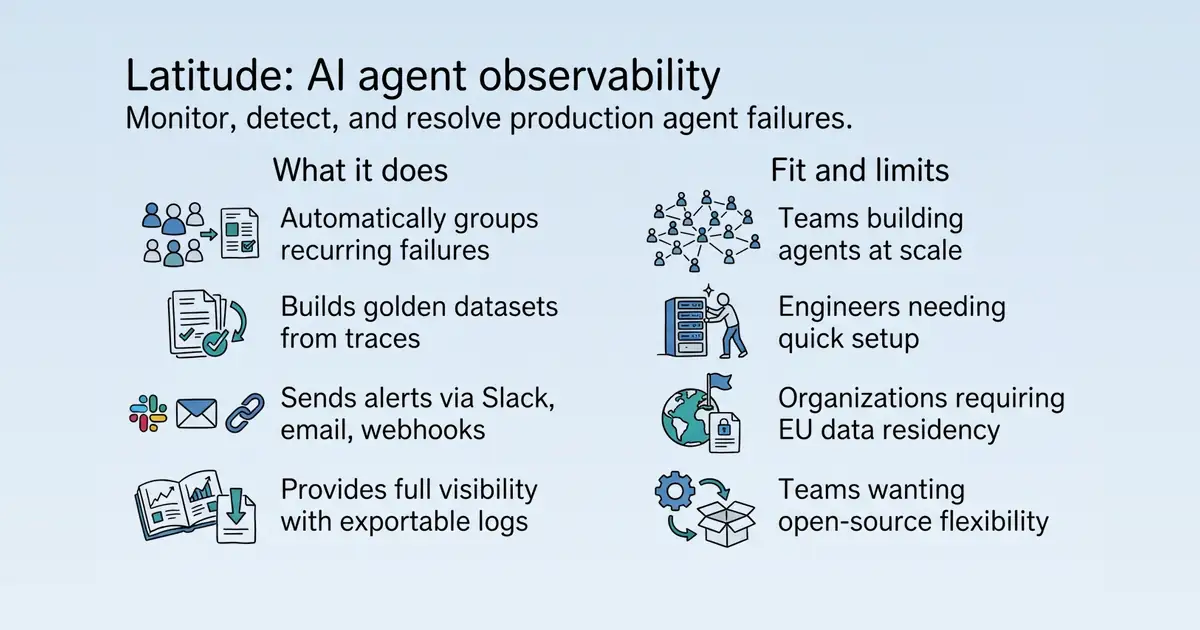
Latitude is an open-source AI agent monitoring platform that helps teams detect, prioritize, and resolve production agent failures S1. It is used by teams building agents at scale to gain visibility into agent behavior and act on issues before users complain S1. The platform provides automatic issue grouping, golden datasets, and integrations with Slack, email, and webhooks, enabling teams to improve agent reliability S1.
Product identity and positioning
Name, category, positioning, audience, and first-party claims.
- Identity: Latitude is an open-source AI agent observability and monitoring platform S1.
- Core purpose: It solves the problem of detecting and resolving production agent failures S1.
- Intended users: Teams building AI agents at scale S1.
- Product scope: Latitude is a monitoring platform, not a broader product family; it includes features like issue grouping, golden datasets, and alerts S1.
- Positioning: The vendor positions Latitude as "agent monitoring without the hassle" S1.
- Claimed distinction: Latitude claims to automatically group recurring failures and prioritize them, with trend and failing traces attached S1.
Use cases and audiences
Who the product serves and the jobs it is designed to handle.
| Audience | Practical use case |
|---|---|
| Teams building AI agents at scale | Monitor production agent behavior to detect and resolve failures S1. |
| Engineering teams | Set up Latitude in their project and discover what their agent is really doing in less than 5 minutes S1. |
| Teams needing compliance | Keep data in Europe with hosted data stored and processed on European servers S1. |
Traffic and search
Search summary
The useful answer before the supporting detail.
Open-source AI agent monitoring platform. Full observability into what. latitude.so: an estimated 69,500 total monthly visits and about 617 monthly organic visits across 611 ranking keywords. Scout crawled 15 pages and measured a technical health score of 96/100.
- Total traffic (modeled): 69,500 monthly visits across all channels.
- Organic search traffic (estimated): 617 monthly visits from search.
- Strongest sampled ranking: domain vocabulary at position 2.
- Leading page in the collected evidence: https://latitude.so/blog/iterative-prompt-refinement-step-by-step-guide.
- Closest measured organic competitor: arize.com, appearing 5 times in the sampled first-page SERPs.
- Technical crawl: 15 pages, health score 96/100.
Website intelligence — Collected evidence
Company identity and positioning
| Page type | Evidence | Source |
|---|---|---|
| other | Open-source AI agent monitoring platform. Full observability into what | https://latitude.so/ |
| other | Get started for free | https://latitude.so/ |
| other | Connect to Slack, email, or webhooks so your team can act before users complain. | https://latitude.so/ |
| other | Trusted by teams building agents at scale | https://latitude.so/ |
| other | Define a signal for any behavior you want to track — a failure mode, policy, or quality check — and Latitude detects it on every matching session. | https://latitude.so/ |
| other | Golden datasets built automatically from validated production traces. One per issue, versioned, ready to run evals or regression tests against. | https://latitude.so/ |
| other | Leave inline feedback on any trace, span, or output. Your team's judgment becomes structured signal you can search, cluster, and turn into evals. | https://latitude.so/ |
| other | built for agents | https://latitude.so/ |
| other | Your data is protected with industry-leading standards. We are SOC 2 certified and built to meet the requirements of the most security-conscious teams. | https://latitude.so/ |
| other | Independently audited controls for security, availability, and confidentiality. | https://latitude.so/ |
| features | Latitude is an open-source, MIT-licensed platform for monitoring and improving production AI agents. | https://latitude.so/product.md |
| features | It captures production agent telemetry, helps teams discover recurring failures, turns those failures into tracked signals, dispatches a customer-controlled coding agent with the relevant evidence, and verifies fixes using production-derived tests and continued monitoring. | https://latitude.so/product.md |
Domain performance
Modeled total traffic, six-month trend, engagement, countries, and domain identity.
Total website traffic
| Month | Modeled visits |
|---|---|
| 2026-04 | 58,751 |
| 2026-05 | 56,895 |
| 2026-06 | 69,415 |
| 2026-07 | 124,390 |
| 2026-08 | 101,285 |
| 2026-09 | 69,500 |
Top visitor countries
| Country | Name | Traffic share |
|---|---|---|
| US | United States | 12.7% |
| ES | Spain | 9.0% |
| IN | India | 6.3% |
| BR | Brazil | 5.7% |
| ID | Indonesia | 4.2% |
Domain identity
| Signal | Value |
|---|---|
| Registered | Jan 28, 2022 |
| Last changed | Dec 29, 2025 |
| Expires | Jan 28, 2027 |
| WHOIS server | whois.nic.so |
| DNSSEC | — |
| Nameservers | ns-1714.awsdns-22.co.uk, ns-1270.awsdns-30.org, ns-944.awsdns-54.net, ns-55.awsdns-06.com |
Website capture
Organic keywords
Top keywords and an independent Google result page.
Top organic keywords
| Keyword | Volume | CPC | Estimated value |
|---|---|---|---|
| latitude | 143,140 | $1.82 | $160 |
| calibratedclassifiercv temperature scaling | 130 | $0.00 | $120 |
| ai tone prompts | 100 | $0.00 | $100 |
| lang graph | 7,780 | $3.15 | $70 |
| llm model evaluation frameworks open source | 130 | $0.00 | $70 |
Independent Google result page
Query: domain vocabulary
| Position | Title | URL | Description |
|---|---|---|---|
| 1 | Domain Specific Vocabulary | Definition, Uses & Examples | https://study.com/academy/lesson/using-domain-specific-vocabulary-in-writing.html | Domain-specific vocabulary is a group of words that are used primarily, almost exclusively, in a specialized field, subject, or topic. |
| 2 | Teaching Domain Specific Vocabulary | https://teachingwithamountainview.com/teaching-domain-specific-vocabulary/ | Domain specific vocabulary refers to vocabulary terms that are specific to a topic of study. This is our precise, content-related vocabulary , species, ... |
| 3 | What Is Domain-Specific Vocabulary in ELA? | https://www.thethinkacademy.com/blog/edubriefs-ela-what-is-domain-specific-vocabulary-in-ela/ | domain-specific vocabulary refers to words and phrases used mainly within a particular subject area, topic, or field — the “domain.” |
| 4 | Domain Vocabulary - educery | https://educery.dev/educe/patterns/domain-vocabulary/ | Capture business elements, facts, relationships, policies, and procedures in a comprehensive domain vocabulary. |
| 5 | Domain - Definition, Meaning & Synonyms | https://www.vocabulary.com/dictionary/domain | domain · noun. a particular environment or walk of life · noun. territory over which rule or control is exercised · noun. people in general; especially a ... |
| 6 | Mastering Academic and Domain-Specific Vocabulary | https://www.youtube.com/watch?v=tGq1EHDivdI | Understanding academic and domain-specific vocabulary is essential for success in high school, college, and even your future career. |
| 7 | What is Domain-Specific Vocabulary? – 121 Examples | https://helpfulprofessor.com/domain-specific-vocabulary/ | Domain specific vocabulary is language that is used primarily within one area of knowledge. Examples of domains of knowledge include ... |
| 8 | domain vocabulary chapter 1-3 Flashcards | https://quizlet.com/1092870972/domain-vocabulary-chapter-1-3-flash-cards/ | Study with Quizlet and memorize flashcards containing terms like prosperity, malleability, court and more. |
| 9 | Domain Specific Vocabulary : Examples | https://www.turito.com/learn/english/domain-specific-vocabulary-grade-7 | Domain-Specific Vocabulary is the language that is used specifically within one area of knowledge but not others. Examples of 'domains' of ... |
Important pages
Pages earning the most estimated search traffic in the sample.
Website intelligence — Collected evidence
Prioritized website intelligence pages
| Type | Page | Words | Change | URL |
|---|---|---|---|---|
| other | AI Agent Observability & Monitoring - Latitude | 662 | new | https://latitude.so/ |
| pricing | Pricing - AI Agent Observability - Latitude | 689 | new | https://latitude.so/pricing |
| pricing | Untitled page | 1,165 | new | https://latitude.so/pricing.md |
| features | Untitled page | 1,477 | new | https://latitude.so/product.md |
| features | Agent evaluation tools compared: Why generic benchmarks fail production AI (2026) \ | static | 4,205 | new |
| features | Complete guide to AI product architecture for GenAI \ | static | 1,287 | new |
| features | Cross-domain model transfer: Challenges and solutions \ | static | 2,830 | new |
| features | Cross-platform testing vs. interoperability testing: Key differences \ | static | 2,977 | new |
| features | How to validate prompts for task-specific AI features \ | static | 3,290 | new |
| features | Latitude vs Humanloop: AI evaluation platform compared (2026) \ | static | 1,617 | new |
| features | Latitude vs Langfuse: Evaluation features compared (2026) \ | static | 1,572 | new |
| features | LLM metadata standards: Problems vs. solutions \ | static | 2,779 | new |
| features | Privacy risks in prompt data and solutions \ | static | 3,913 | new |
| features | LLM Evaluation for AI Agents \ | static | 466 | new |
Features
| Page type | Evidence | Source |
|---|---|---|
| features | \# Latitude product reference | https://latitude.so/product.md |
| features | Latitude is an open-source, MIT-licensed platform for monitoring and improving production AI agents. | https://latitude.so/product.md |
| features | It captures production agent telemetry, helps teams discover recurring failures, turns those failures into tracked signals, dispatches a customer-controlled coding agent with the relevant evidence, and verifies fixes using production-derived tests and continued monitoring. | https://latitude.so/product.md |
| features | Latitude Data S.L. develops and operates the project. | https://latitude.so/product.md |
| features | Intended users | https://latitude.so/product.md |
| features | Latitude is designed for teams that operate AI agents or AI-enabled product features in production. | https://latitude.so/product.md |
| features | Primary users include: | https://latitude.so/product.md |
| features | AI engineers | https://latitude.so/product.md |
| features | Software engineers responsible for AI features | https://latitude.so/product.md |
| features | Teams adding agent observability for the first time | https://latitude.so/product.md |
| features | Teams scaling an AI feature beyond an initial implementation | https://latitude.so/product.md |
| features | Teams investigating multi-step, tool-using, or multi-turn agent behavior | https://latitude.so/product.md |
| features | Teams that need managed cloud deployment or a self-hosted observability stack | https://latitude.so/product.md |
| features | Common use cases include: | https://latitude.so/product.md |
| features | Tracing LLM calls, tool calls, retrieval steps, and custom operations | https://latitude.so/product.md |
| features | Reviewing full multi-turn agent sessions | https://latitude.so/product.md |
| features | Searching production traffic by meaning, exact text, and metadata | https://latitude.so/product.md |
| features | Discovering recurring user goals, outcomes, friction, and capability gaps | https://latitude.so/product.md |
| features | Monitoring tool usage, errors, latency, tokens, and cost | https://latitude.so/product.md |
| features | Grouping repeated failures into signals with examples, impact, trends, and lifecycle states | https://latitude.so/product.md |
Pricing and plans
| Page type | Evidence | Source |
|---|---|---|
| pricing | Get started for free | https://latitude.so/pricing |
| pricing | 20K credits/month | https://latitude.so/pricing |
| pricing | 100K credits/month | https://latitude.so/pricing |
| pricing | Extra credits: $20 per 10K | https://latitude.so/pricing |
| pricing | Estimated credits / month | https://latitude.so/pricing |
| pricing | $99 Pro + ~$200 overage | https://latitude.so/pricing |
| pricing | Is there a free plan or free trial available? | https://latitude.so/pricing |
| pricing | Our free plan has no expiration, you can stay on it as long as it fits your needs. | https://latitude.so/pricing |
| pricing | Session intelligence automatically clusters all sessions by topic and detects relevant in-conversation moments — such as user frustration, hesitation, agent loops, and more. It runs automatically and is included in the pricing calculator estimate. | https://latitude.so/pricing |
| pricing | How accurate is the pricing calculator? | https://latitude.so/pricing |
| pricing | On Pro, usage beyond your included credits is billed as overage at $20 per 10K credits. | https://latitude.so/pricing |
| pricing | Can I upgrade, downgrade, or cancel my plan anytime? | https://latitude.so/pricing |
| pricing | Yes. You can change or cancel your plan at any time directly from your account settings, no commitment required. | https://latitude.so/pricing |
| pricing | ](./pricing) | https://latitude.so/pricing |
| pricing | canonical: https://latitude.so/pricing | https://latitude.so/pricing.md |
| pricing | Latitude Pricing | https://latitude.so/pricing.md |
| pricing | > Machine-readable pricing for \Latitude\ — an open-source (MIT), | https://latitude.so/pricing.md |
| pricing | > This file mirrors the human pricing page at https://latitude.so/pricing. If the two ever | https://latitude.so/pricing.md |
| pricing | Latitude has three cloud plans plus free self-hosting. Usage is metered in \*\*credits\*\*, | https://latitude.so/pricing.md |
| pricing | which reset at the start of each monthly billing period. Every plan includes \*\*unlimited | https://latitude.so/pricing.md |
Integrations and supported platforms
No supporting public-page evidence was collected for this category.
Product and company updates
No supporting public-page evidence was collected for this category.
Rank tracking
Persistent keyword baselines and position movement.
This analysis created the first position baseline at 2026-10-19T16:22:34.894Z. Movement appears after the next fresh analysis using the same location and language.
Features
Features and capabilities
Core functions and evidence-backed product capabilities.
| Capability | What it does |
|---|---|
| Automatic issue grouping | Recurring failures are grouped and prioritized automatically, with trend and failing traces attached S1. |
| Golden datasets | Golden datasets are built automatically from validated production traces S1. |
| Alerting | Get notified when a new issue is detected or an existing one escalates S1. |
| Session intelligence | Analyzes completed sessions to extract what the conversation was about, what happened, and where things got spicy S1. |
| Signal definition | Define a signal for any behavior you want to track — a failure mode, policy, or quality check — and Latitude detects it on every matching session S1. |
| Inline feedback | Leave inline feedback on any trace, span, or output S1. |
| Dataset management | Manage datasets for evaluation and testing S1. |
| Search and filters | Semantic search, exact text, and metadata filters combined S1. |
Integrations and ecosystem
Connected products, exports, APIs, and workflow compatibility.
| Integration or interface | Type | What it enables |
|---|---|---|
| Slack | Integration | Connect to Slack so your team can act before users complain S1. |
| Integration | Connect to email for notifications S1. | |
| Webhooks | Integration | Connect to webhooks for notifications S1. |
| MCP server | AI interface | Connect the Latitude MCP to run the whole loop without leaving your editor S1. |
| OpenTelemetry | Integration | Point your existing Open Telemetry pipeline at Latitude and traces show up S1. |
| SDK | SDK | Drop in our SDK and traces show up S1. |
Pricing
Pricing and plans
Published plans, free access, trials, credits, and pricing limitations.
| Plan or offer | Verified price and billing | Included | Limits |
|---|---|---|---|
| Free | $0 per month S28 | Traces and signals included; unlimited seats S28 | 30-day retention S28 |
| Pro | $99 per month S28 | Credits; unlimited seats S28 | 90-day retention; extra credits $20 per 10K S28 |
| Custom | Contact sales S28 | Custom credit volume; unlimited seats S28 | SAML SSO, custom retention S28 |
Competition
Competitive landscape
Domains competing for the same organic search demand.
Sampled competitors
| Competitor | First-page appearances | Sampled queries | Average position | Queries observed |
|---|---|---|---|---|
| arize.com | 5 | 1 | 3.8 | arize pricing |
| studypug.com | 1 | 1 | 1 | domain vocabulary |
| ilclassroom.com | 1 | 1 | 2 | domain vocabulary |
| colorincolorado.org | 1 | 1 | 3 | domain vocabulary |
| youtube.com | 1 | 1 | 4 | domain vocabulary |
| quizlet.com | 1 | 1 | 5 | domain vocabulary |
| vendr.com | 1 | 1 | 5 | arize pricing |
| researchgate.net | 1 | 1 | 6 | domain vocabulary |
| cekura.ai | 1 | 1 | 6 | arize pricing |
| brainly.com | 1 | 1 | 7 | domain vocabulary |
Website intelligence — Collected evidence
Customers, testimonials, and first-party review claims
No supporting public-page evidence was collected for this category.
Independent review sources discovered
No links to supported independent review platforms were discovered on the collected pages.
Backlink profile
Authority and referring-domain signals.
Backlink comparison profile
- Domain rating: 61/100
- Backlinks: 14,959
- Referring domains: 1,976
- Dofollow backlinks: 59.0%
- Dofollow referring domains: 55.0%
Collection decision
The Scout search index remains intentionally excluded from automatic Scout analysis. This Scout traffic model profile costs 5 credits (0.5 cents) and is included in the first comparison run so its usefulness can be judged before the recurring collection is finalized.
AI visibility
Measured ChatGPT and Google AI mentions with cited sources.
AI-assistant referral traffic
- Estimated current generative-AI referral share: 1.6%
Scout traffic model did not return a separate AI-referral trend series for this domain.
Website intelligence — Collected evidence
Site-stated AI capabilities
| Page type | Evidence | Source |
|---|---|---|
| other | Open-source AI agent monitoring platform. Full observability into what | https://latitude.so/ |
| features | Latitude is an open-source, MIT-licensed platform for monitoring and improving production AI agents. | https://latitude.so/product.md |
| features | Latitude is designed for teams that operate AI agents or AI-enabled product features in production. | https://latitude.so/product.md |
| features | Software engineers responsible for AI features | https://latitude.so/product.md |
| features | Teams scaling an AI feature beyond an initial implementation | https://latitude.so/product.md |
| features | Garak systematically red-teams LLM security vulnerabilities — a distinct, complementary evaluation dimension that traditional benchmarks also miss. | https://latitude.so/blog/agent-evaluation-tools-comparison-product-specific-vs-generic-benchmarks |
| features | Every AI team reaches the same moment eventually. Your agent scores well on every benchmark you’ve built. Your LLM-as-judge says outputs are high quality. Your eval suite is green. Then you deploy, and production tells a different story — failures that weren’t in any dataset, edge cases you didn’t anticipate, failure patterns that only emerge across conversation turns or through sequences of tool calls. | https://latitude.so/blog/agent-evaluation-tools-comparison-product-specific-vs-generic-benchmarks |
| features | The problem isn’t that you evaluated badly. It’s that you evaluated the wrong thing. Generic benchmarks and LLM evaluation tools were built for a fundamentally different system than the one you’re running. | https://latitude.so/blog/agent-evaluation-tools-comparison-product-specific-vs-generic-benchmarks |
| features | Most AI evaluation tooling was designed during the LLM completion era: one prompt, one response, one score. The evaluation surface was bounded and stable. You could write a golden dataset, score against it, and get a meaningful signal about quality. For simple LLM workflows, this still works. For production agents — systems that plan across multiple steps, invoke external tools, manage state across conversation turns, and follow non-deterministic execution paths — it doesn’t. | https://latitude.so/blog/agent-evaluation-tools-comparison-product-specific-vs-generic-benchmarks |
| features | This guide compares eight evaluation tools across criteria that specifically matter for agents. It includes purpose-built agent platforms, established LLM eval frameworks, and academic toolkits. The goal is to help you match your evaluation approach to the actual complexity of the system you’re building. | https://latitude.so/blog/agent-evaluation-tools-comparison-product-specific-vs-generic-benchmarks |
| features | For LLM evaluation, the unit of analysis is the individual request/response pair. Score it, aggregate scores, track trends. This is tractable because the failure mode — a poor completion given an input — is visible within the unit. | https://latitude.so/blog/agent-evaluation-tools-comparison-product-specific-vs-generic-benchmarks |
| features | Blog›Complete guide to AI product architecture for GenAI | https://latitude.so/blog/ai-product-architecture-guide-genai |
| features | Complete guide to AI product architecture for GenAI | https://latitude.so/blog/ai-product-architecture-guide-genai |
| features | Discover the 6 essential layers of AI product architecture for building effective generative AI systems. Learn best practices, tools, and strategies for success. | https://latitude.so/blog/ai-product-architecture-guide-genai |
| features | Artificial Intelligence (AI) and large language models (LLMs) are revolutionizing product development across industries. From enhancing user experiences to automating intricate processes, generative AI (GenAI) systems are positioning themselves as critical tools for solving complex business challenges. However, their success hinges on one crucial factor: a well-structured AI product architecture. | https://latitude.so/blog/ai-product-architecture-guide-genai |
| features | This article outlines the key principles, strategies, and components required to build effective AI product architectures for GenAI systems. Whether you’re a product manager striving to improve AI quality or a technical practitioner implementing LLM features, this guide offers actionable insights to help you create systems that are scalable, adaptable, and user-centric. | https://latitude.so/blog/ai-product-architecture-guide-genai |
| features | AI product architecture is more than just deploying a large language model and calling it a solution; it is a multi-layered blueprint that facilitates the design, development, and delivery of intelligent systems. To understand its significance, consider a traditional product architecture where deterministic workflows and fixed logic dominate. GenAI systems, by contrast, are probabilistic, context-aware, and adaptive, requiring a paradigm shift in how products are designed. | https://latitude.so/blog/ai-product-architecture-guide-genai |
| features | Observability and Governance : Monitoring AI behavior and ensuring it aligns with responsible AI principles is essential for long-term sustainability. | https://latitude.so/blog/ai-product-architecture-guide-genai |
| features | This is where users interact with the system, making it the starting point for all AI applications. A thoughtfully designed UX layer ensures intuitive navigation, supports diverse input formats (e.g., text, images, or audio), and fosters trust through transparency. | https://latitude.so/blog/ai-product-architecture-guide-genai |
| features | When transferring a large language model (LLM) to a new domain, the model often encounters data that it wasn’t originally built to handle. This mismatch leads to gradient interference , where the model’s existing knowledge clashes with the new information it needs to learn. Studies reveal that 67% of parameters in attention query and key projection matrices can experience this conflict during the adaptation process. Essentially, the model struggles to balance what it already knows with the demands of the new domain. | https://latitude.so/blog/cross-domain-model-transfer-challenges-solutions |
These are first-party product claims, not independent measurements of AI-search visibility.
Marketing opportunities
Actions calculated directly from the collected evidence.
| Opportunity | Recommended action | Evidence |
|---|---|---|
| Competitor gap | Review the sampled queries where arize.com appears. | 5 first-page appearances across arize pricing |
Website intelligence — Collected evidence
Website evidence gaps
- integrations: no usable public page was collected; verify whether the site publishes this evidence.
- customers: no usable public page was collected; verify whether the site publishes this evidence.
- reviews: no usable public page was collected; verify whether the site publishes this evidence.
- changes: no usable public page was collected; verify whether the site publishes this evidence.
- identity: no usable public page was collected; verify whether the site publishes this evidence.
- technical: no usable public page was collected; verify whether the site publishes this evidence.
Trust and proof
Customers, proof, and reviews
Published proof, customer signals, and review evidence.
Independent reviews
| Platform | Page | How it was found | Note |
|---|---|---|---|
| docs.latitude.so | How to use Latitude - Latitude Docs | Grounded web search | traces from your agent to Latitude. Each interaction becomes a trace of spans (LLM calls, tool calls, retrieval, and ... group into sessions. Send a `userId` and ... ` so you can also break activity down per user and review reliability, errors |
| docs.latitude.so | Self-Healing Agents - Latitude Docs | Grounded web search | A self-healing agent is one whose production failures reach a coding agent automatically, with the evidence attached ... and the fix lands as a pull request that a person reviews, backed by a regression test in your CI. |
Customer proof
No named customers, testimonials, or customer case studies were found.
Independent mentions
- Make your AI agents self-healing — ## Make your AI agents self-healing Latitude traces your agent in production, finds the failures, and dispatches your coding agent to fix them. ... your existing Open Telemetry pipeline at Latitude and traces show up. No proprietary format, no
- Overview - Latitude Docs — Latitude observability shows what your agent did in production. It captures the execution path for each interaction, including LLM calls, tool calls, retrieval steps, metadata, timing, token usage, cost, and errors. For the complete product vocabulary, see Core Concepts. This page focuses on the telemetry data you inspect in the Observability area. ... Latitude uses three telemetry levels: - Spans: individual operations such as LLM calls, tool invocations, retrieval steps, HTTP requests, or cust
- LLM Observability for AI Agents / Latitude — Capture real inputs, outputs, and context from live traffic to understand what your system is actually doing ... Capture real inputs, outputs, and context from live traffic. Understand what your system is actually doing, not what you expect it to do.
- Latitude Overview - Latitude Docs — Latitude is an open-source, MIT-licensed platform for improving production AI agents. It helps teams capture real agent traffic, understand what is going wrong, and turn repeated failures into tracked signals you can monitor and fix. The product is organized around the loop you work in every day: Observe, Understand, Refine. ... Latitude starts by collecting agent telemetry. Each interaction becomes a trace made of spans for LLM calls, tool calls, retrieval steps, and other instrumented work. Re
- Traces - Latitude Docs — - Root span name: The top-level operation name - Overall status: OK or error, derived from constituent spans - Total duration: End-to-end timing - Aggregated tokens: Total input and output tokens across
- Developer Quick Start - Latitude Docs — sidebar for provider- and framework-specific instructions. Once telemetry is connected, every LLM call, tool invocation, and agent step your application makes will appear as spans ... grouped into traces (single interactions) and sessions
- Latitude product reference — It captures production agent telemetry, helps teams discover recurring failures, turns those failures into tracked signals, dispatches a customer-controlled coding agent with the relevant evidence, and verifies fixes using production-derived tests and
- Core Concepts - Latitude Docs — watches a target, such as a signal, a saved search, a tool, or your raw traffic, and opens an incident when a condition is met. When an incident ... . Every project comes with system monitors that watch the signal lifecycle, and you can create your own.
External links were grounded in one live web search. Search snippets are leads, not independently scraped page content; rejected links remain available in Review evidence.
Company, security, and trust
Ownership, policies, security signals, and public trust evidence.
| Signal | Finding | Source |
|---|---|---|
| Company and ownership | Latitude also enables live evaluations of production logs, tracking metrics like safety, helpfulness, and hallucination rates in real-time. Using smaller, specialized language models (SLMs) for quality checks can cut eva | source |
| Contact and support | Not published on the collected pages. | — |
| Legal and privacy | Can I upgrade, downgrade, or cancel my plan anytime? | source |
| Security and compliance | Your data is protected with industry-leading standards. We are SOC 2 certified and built to meet the requirements of the most security-conscious teams. | source |
| Uptime and status page | Uptime and support SLA | source |
Not found on the collected pages: contact and support. This only means Scout did not find it on the pages it read; it says nothing about the company itself.
Documentation and product updates
Help resources, product guidance, and visible changes over time.
| Resource or update | Type | What is available | Date or freshness |
|---|---|---|---|
| Complete guide to AI product architecture for GenAI / Latitude | Guide | Guides, comparisons, pricing breakdowns, use cases, and how-to articles. (source) | Not dated |
| How to build scalable LLM features: A step-by-step guide / Latitude | Guide | Learn how to effectively build scalable LLM features using distributed systems, microservices, and optimization techniques for improved performance. (source) | Not dated |
| How to validate prompts for task-specific AI features / Latitude | Guide | Guides, comparisons, pricing breakdowns, use cases, and how-to articles. (source) | Not dated |
| Agent evaluation tools compared: Why generic benchmarks fail production AI (2026) / Latitude | Product update | Product update is publicly available. (source) | Not dated |
| Agent evaluation tools compared: Why generic benchmarks fail production AI (2026) / Latitude | Support | Public contact and support channel. (source) | Not dated |
| Complete guide to AI product architecture for GenAI / Latitude | Roadmap | Public product roadmap. (source) | Not dated |
Not found in the collected public sources: changelog or release notes, status page, separate help center or knowledge base.
Technical
Technical and delivery signals
Delivery model, platforms, API, data ownership, reliability claims and release activity.
| Signal | Finding | Source |
|---|---|---|
| Delivery model (cloud, self-hosted, desktop, browser extension) | Cloud for high volume products or deploy in your infrastructure S28. | S28 |
| Platforms and apps | Not published on the collected pages. | — |
| API and extensibility (API, SDK, webhooks, MCP, plugins) | Connect to Slack, email, or webhooks S1; MCP server available S1; SDK available S1. | S1 |
| Data ownership and export | Detailed, exportable activity and access logs S1. | S1 |
| Performance and reliability claims | Not published on the collected pages. | — |
| Release activity | Not published on the collected pages. | — |
Measured infrastructure
Domain, certificate, and hosting signals, measured directly.
| Signal | Finding |
|---|---|
| First archived | 2022-02-14 — web archive |
| TLS certificate | Let's Encrypt, valid, expires 2026-12-04 |
| Security headers | HSTS |
| Headers not served | CSP, X-Content-Type-Options, X-Frame-Options, Referrer-Policy |
| Server header | Vercel |
| Mail handled by | aspmx.l.google.com, alt2.aspmx.l.google.com |
| Nameservers | ns-55.awsdns-06.com, ns-944.awsdns-54.net |
Not measurable: rdap: no RDAP server published for .so. A gap here means the lookup was unavailable, not that the finding is negative.
Technical site audit
A bounded multi-page crawl with page-level issues and URLs.
Scout — Bounded technical crawl
- Pages crawled: 15 of 15 maximum
- Technical health: 96/100
- Critical issues: 0
- Warnings: 8
- Notices: 9
Issues
| Severity | Issue | Value | Affected URL |
|---|---|---|---|
| notice | Images are missing alt text | 4 | https://latitude.so/ |
| notice | Images are missing alt text | 2 | https://latitude.so/pricing |
| notice | Low visible word count | 145 | https://latitude.so/customers |
| notice | Meta description length should be reviewed | 11 | https://latitude.so/changelog |
| notice | Meta description length should be reviewed | 39 | https://latitude.so/terms |
| notice | Meta description length should be reviewed | 41 | https://latitude.so/privacy |
| warning | Title length should be reviewed | 92 | https://latitude.so/customers/heytavi |
| notice | Meta description length should be reviewed | 194 | https://latitude.so/customers/heytavi |
| notice | Meta description length should be reviewed | 237 | https://latitude.so/compare |
| warning | Title length should be reviewed | 67 | https://latitude.so/developers |
| notice | Meta description length should be reviewed | 234 | https://latitude.so/developers |
| warning | Page should have one primary H1 | 0 | https://latitude.so/changelog/agent-score |
| warning | Page should have one primary H1 | 0 | https://latitude.so/changelog/signals-from-saved-searches |
| warning | Page should have one primary H1 | 0 | https://latitude.so/changelog/cost-dashboard |
| warning | Page should have one primary H1 | 0 | https://latitude.so/changelog/pii-redaction |
| warning | Title length should be reviewed | 80 | https://latitude.so/changelog/trace-imports |
| warning | Page should have one primary H1 | 0 | https://latitude.so/changelog/trace-imports |
Crawled pages
| Status | Title | H1s | Words | Response | URL |
|---|---|---|---|---|---|
| 200 | AI Agent Observability & Monitoring - Latitude | 1 | 786 | 79 ms | https://latitude.so/ |
| 200 | Pricing - AI Agent Observability - Latitude | 1 | 303 | 109 ms | https://latitude.so/pricing |
| 200 | Customers \ | Latitude | 1 | 145 | 160 ms |
| 200 | Changelog \ | Latitude | 1 | 563 | 199 ms |
| 200 | Latitude Blog — Notes on Agent Engineering | 1 | 4450 | 254 ms | https://latitude.so/blog |
| 200 | Terms of Service - Latitude | 1 | 668 | 41 ms | https://latitude.so/terms |
| 200 | Privacy Policy - Latitude | 1 | 628 | 168 ms | https://latitude.so/privacy |
| 200 | How HeyTavi centralized debugging across dozens of personalised agent deployments \ | Latitude | 1 | 1187 | 129 ms |
| 200 | Latitude Alternatives & Competitor Comparisons (2026) | 1 | 546 | 157 ms | https://latitude.so/compare |
| 200 | Latitude Developer Resources — API, MCP Server, SDKs & OpenAPI Spec | 1 | 716 | 90 ms | https://latitude.so/developers |
| 200 | Agent Score \ | Latitude Changelog | 0 | 559 | 159 ms |
| 200 | Turn a saved search into a signal \ | Latitude Changelog | 0 | 262 | 182 ms |
| 200 | Cost \ | Latitude Changelog | 0 | 281 | 287 ms |
| 200 | PII redaction \ | Latitude Changelog | 0 | 287 | 288 ms |
| 200 | Import your traces from Langfuse, LangSmith, and Braintrust \ | Latitude Changelog | 0 | 261 | 289 ms |
This is a bounded Scout crawl. Core Web Vitals and Lighthouse scores are not claimed unless a dedicated performance audit is connected.
Search Console and Analytics
First-party search and behavioral data connection state.
Modeled acquisition channels
| Channel | Estimated share |
|---|---|
| direct | 20.4% |
| search | 5.7% |
| search organic | 5.3% |
| search paid | 0.3% |
| social | 63.7% |
| social organic | 3.7% |
| social paid | 60.0% |
| referrals | 7.5% |
| paid referrals | 0.0% |
| 1.2% | |
| gen ai | 1.6% |
| affiliate | 0.0% |
| other | 0.0% |
First-party connections
| Integration | Status | Data available after connection |
|---|---|---|
| Google Search Console | Not connected | Clicks, impressions, CTR, average position, queries, pages, countries, and devices |
| Google Analytics | Not connected | Organic sessions, engagement, landing pages, conversions, geography, and devices |
No first-party Search Console or Analytics numbers are shown until the site owner authorizes the corresponding Google account. Scout traffic model values above are modeled estimates, not private analytics totals.
Limits and method
Limitations and open questions
Known constraints and missing evidence from the collected pages.
The collected pages do not mention specific limitations or gaps. However, the pricing page indicates that the free plan has a 30-day retention limit S28, and the Pro plan has a 90-day retention limit S28. The site does not provide details on company ownership, contact information, or uptime status. The external proof search discovered a review profile, but its content was not collected.
Sources, method, and limitations
Evidence inventory, collection method, provider use, and constraints.
This report is based on 13 collected pages from latitude.so, including the homepage, pricing page, and blog posts. The collection used static and browser rendering rendering, with partial sitemap coverage. An external proof search was performed, but no first-party verification of external claims was obtained. The evidence catalog includes 178 items, but only a subset was used due to relevance and duplication. Limitations include incomplete coverage of the site (13 of 15 pages) and the absence of first-party customer reviews or detailed documentation.
- Official Websitehttps://latitude.so/Verified
- Pricing Pagehttps://latitude.so/pricingVerified
- Official Websitehttps://latitude.so/blog/agent-evaluation-tools-comparison-product-specific-vs-generic-benchmarksVerified
- Official Websitehttps://latitude.so/blog/ai-product-architecture-guide-genaiVerified
- Official Websitehttps://latitude.so/blog/common-llm-prompt-engineering-challenges-and-solutionsVerified
- Official Websitehttps://latitude.so/blog/cross-domain-model-transfer-challenges-solutionsVerified
- Official Websitehttps://latitude.so/blog/cross-platform-testing-vs-interoperability-testing-key-differencesVerified
- Official Websitehttps://latitude.so/blog/essential-checklist-for-deploying-llm-features-to-productionVerified
- Official Websitehttps://latitude.so/blog/how-to-build-scalable-llm-features-a-step-by-step-guideVerified
- Official Websitehttps://latitude.so/blog/how-to-validate-prompts-for-task-specific-ai-featuresVerified
- Official Websitehttps://latitude.so/blog/latitude-vs-humanloop-ai-evaluation-platform-comparedVerified
- Official Websitehttps://latitude.so/blog/latitude-vs-langfuse-evaluation-features-comparedVerified
- Official Websitehttps://latitude.so/blog/llm-metadata-standards-problems-vs-solutionsVerified
- Articlehttps://docs.latitude.so/observability/overviewVerified
- Articlehttps://latitude.so/solutions/llm-observabilityVerified
- Articlehttps://docs.latitude.so/getting-started/introductionVerified
- Review Sitehttps://docs.latitude.so/getting-started/how-to-use-latitudeVerified
- Articlehttps://docs.latitude.so/observability/tracesVerified
- Articlehttps://docs.latitude.so/getting-started/quick-start-devVerified
- Articlehttps://latitude.so/product.mdVerified
- Articlehttps://docs.latitude.so/getting-started/conceptsVerified
- Review Sitehttps://docs.latitude.so/getting-started/self-healing-agentsVerified