In simple English
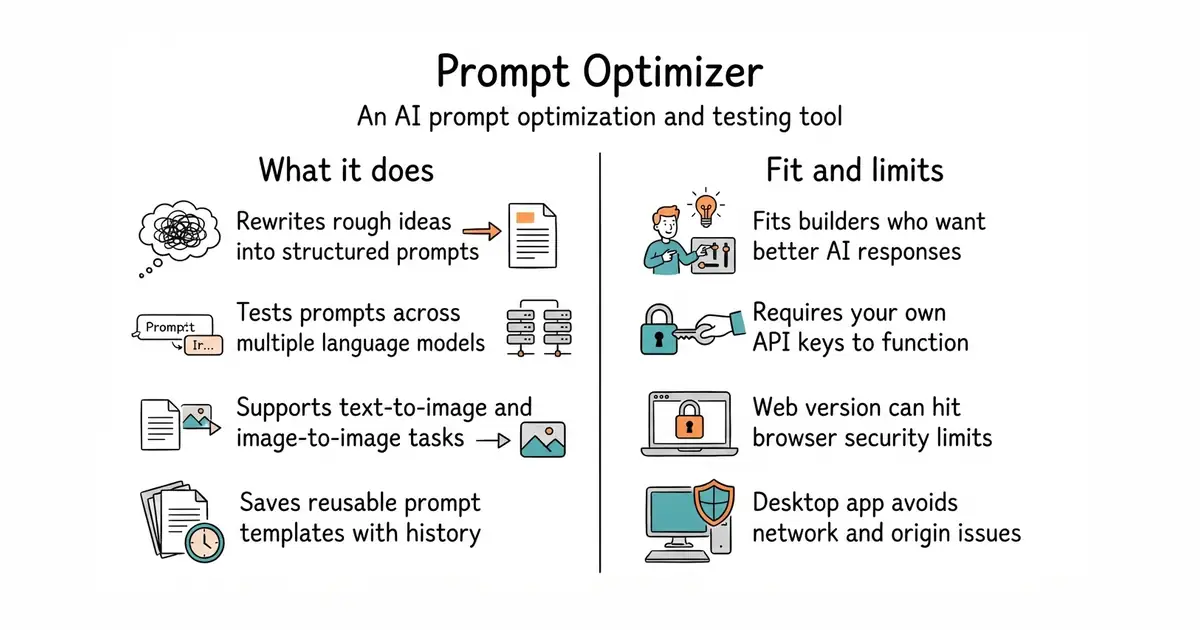
This tool helps you write better instructions for artificial intelligence. You type a rough idea, and it rewrites it into a clear, structured prompt that gets better results. You can run tests, compare outputs side by side, and save your favourite prompts in a library. It works in your web browser, as a desktop app, or on your own server. You need your own API keys from a provider like OpenAI or Gemini to make it work.
What it is
Prompt Optimizer (a web application, desktop app, and browser extension for refining, testing, and managing artificial intelligence prompts). It connects directly to popular language models and image generators to evaluate prompt improvements through multi-round iterations.
What it is good for
Solo builders who want to stop guessing how to talk to artificial intelligence and need a reliable way to turn rough ideas into precise, reusable prompt templates.
- Runs directly in your browser or desktop without routing your prompts through third-party servers.
- Supports text models, image generation models, and tool calling tests.
- Provides multiple ways to run it, including a web app, a desktop application, a Chrome extension, and Docker.
- Requires your own API keys from external artificial intelligence providers, which cost money as you use them.
- Web versions can hit browser security limits when connecting to local models or strict APIs.
- Licenced under AGPL-3.0, which has strict rules if you modify and host it as a public service.
manually rewriting and testing prompts in chat windows
Ollama

- ggml-org/llama.cpp132k stars
A C and C++ library and command-line tool for running language models locally.
- EleutherAI/lm-evaluation-harness14k stars
Runs standard question sets against a language model and reports the scores.
- mudler/LocalAI50k stars
Serves text, vision, speech, image and video models from one self-hosted service that imitates the paid interfaces.
docker run -d -p 8081:80 --restart unless-stopped --name prompt-optimizer linshen/prompt-optimizer