47,800 stars · MIT, read from the sidebar on 2026-10-16 · v4.11.0 (2026-10-02), read from /releases/latest; the release page's own development window of 2026-09-18 to 2026-10-02 settles the year · Track this in Scout
Serves text, vision, speech, image and video models from one self-hosted service that imitates the paid interfaces.
▶Repo detailsthe review · specs · pros & cons · install
What it does
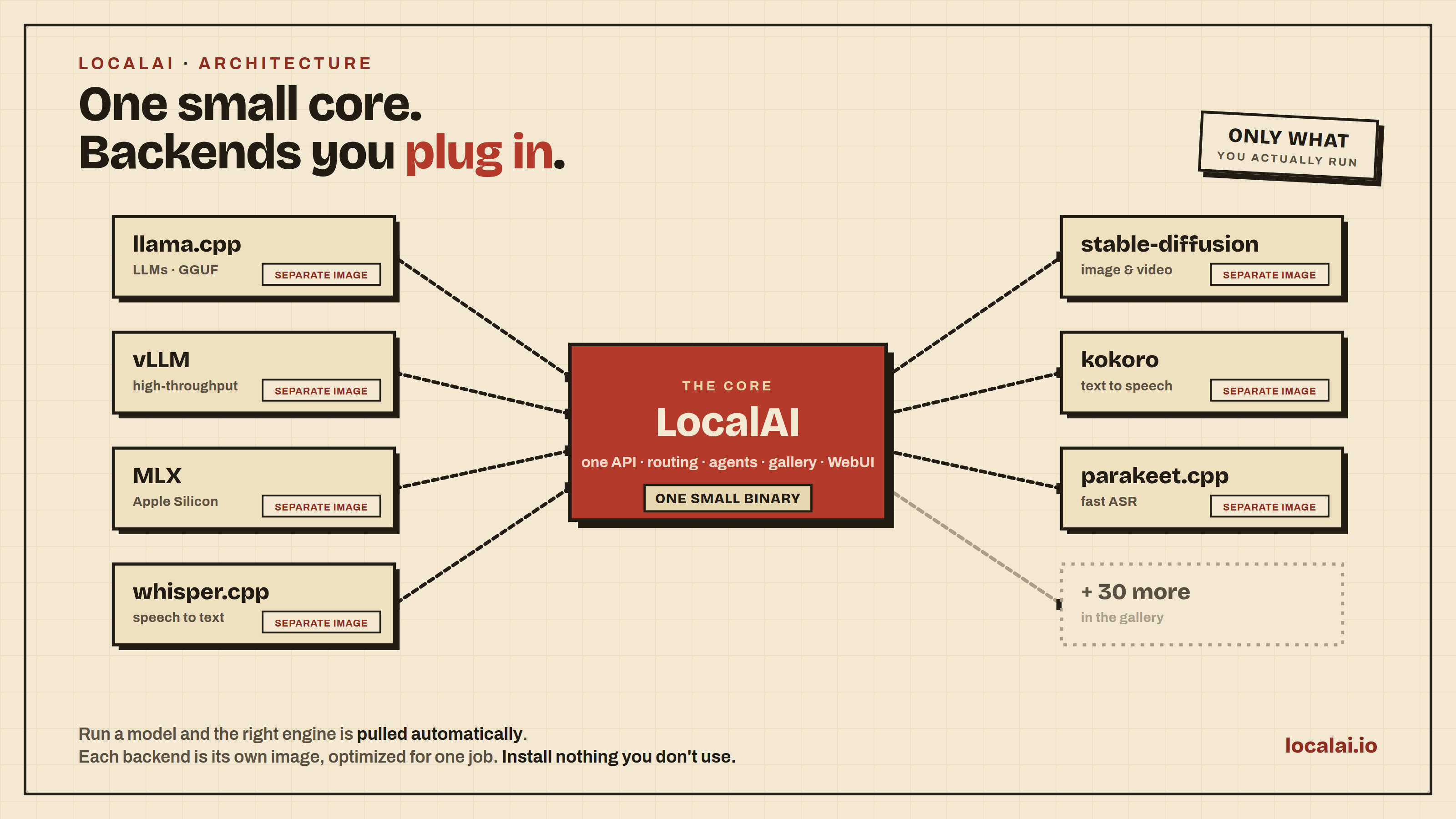
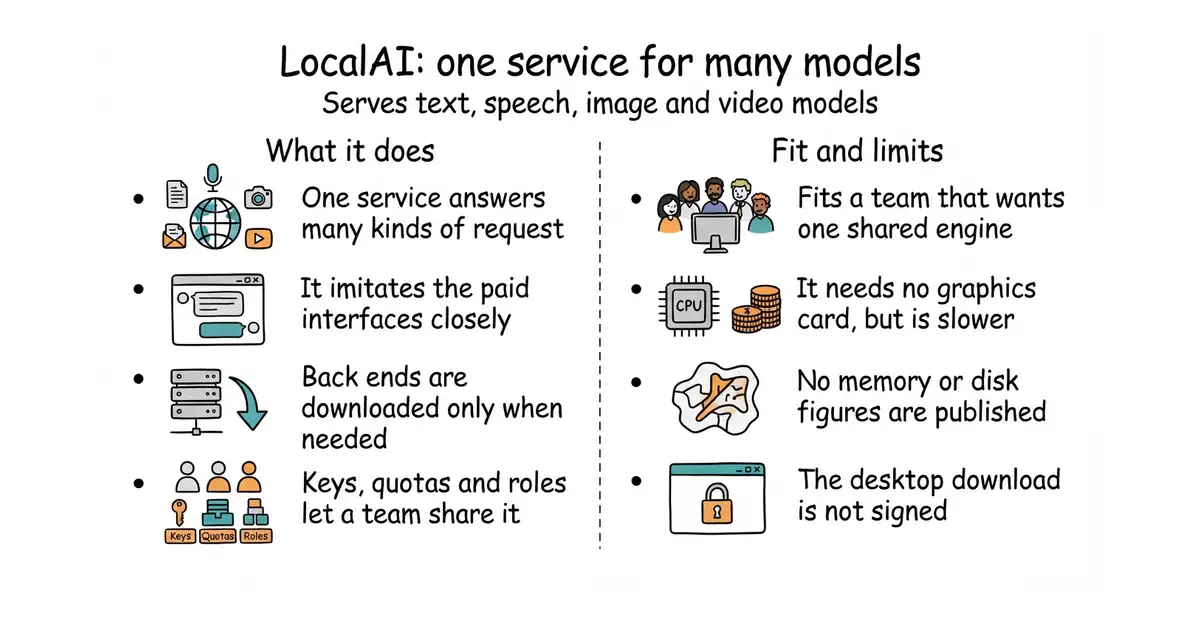
LocalAI is an engine rather than an application. It keeps a small core and pulls in a specialist back end only when a model needs one, so llama.cpp, vLLM, whisper.cpp and stable-diffusion are downloaded on demand rather than bundled. The same service answers requests shaped for OpenAI, Anthropic and ElevenLabs, which means existing software can be pointed at it without being rewritten. It supports several users with API keys, quotas and role-based access, so a small team can share one installation. It includes agents with tool use, retrieval over your own documents, and Model Context Protocol support. Models are loaded by name from a gallery, from Hugging Face, from Ollama, from a container registry or from a configuration file. The project states plainly that no graphics card is required and that data never leaves the infrastructure it runs on. It publishes no minimum memory or disk figures at all, which is the honest gap in its documentation. And it is the engine only: you still need something to talk to it, and the project's answer is its compatible API.
Why it matters
Who it suits. A small team that wants one shared place for models, rather than every person downloading their own. It suits anyone with existing code written against a paid API who wants to redirect it without a rewrite, which is the single strongest reason to choose this over entry 4. It suits mixed work, because text, speech and images come from the same service. Skip it if you want to type into a window and see an answer: that is entry 4, and this is the layer underneath.
Verdict. Worth an hour if Docker is already installed, and considerably more if it is not. Version 4.11.0 landed on 2 October 2026, and the project ships steadily. Two warnings are worth stating. The macOS download is not signed by Apple, and the README gives an xattr command to run afterwards to make it open at all; that is normal for small projects and it is still a step most people have never taken. The second is the missing hardware guidance. "No GPU required" is true and it is not the same as "fast": a large model on a processor alone answers at reading speed or slower, and the project gives no figures to plan with. Entry 4 does publish memory numbers, so read those and apply them here. Pairing the two is reasonable — Jan for a window to type into, LocalAI for everything else on the network.
- One service covers text, vision, speech, images and video, with back ends downloaded only when a model needs them.
- It answers requests shaped for OpenAI, Anthropic and ElevenLabs, so existing software usually works after changing one address.
- API keys, quotas and role-based access are built in, which makes it usable by more than one person.
- No minimum memory, disk or processor figures are published anywhere, so capacity planning is guesswork until you try it.
- The macOS build is unsigned and needs a terminal command before it will open.
- "No GPU required" is a statement about whether it runs, not about whether it is quick enough to be pleasant.
 janhq/jan
The desktop version of the same idea, with published memory requirements and a chat window.
Track this in Scout ollama/ollama
At 183,200 stars and MIT, far simpler and far more popular, but focused on text models rather than speech, images and video.
Track this in Scout
docker run -ti --name local-ai -p 8080:8080 localai/localai:latest