7,032 stars · Apache-2.0 · v0.35.0 (2026-09-05), read from /releases/latest; the page omits the year and the code date of 2026-10-16 settles it · Track this in Scout
A small DNS service for a home or office network that refuses to look up advertising and tracking addresses.
▶Repo detailsthe review · specs · pros & cons · install
What it does
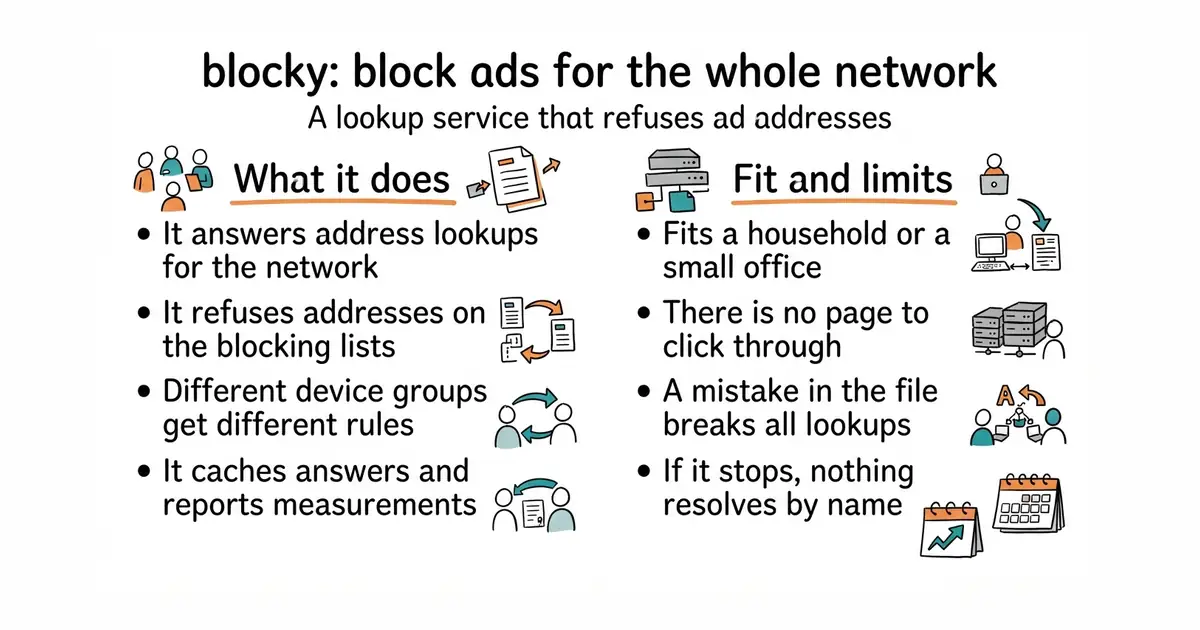
Blocky sits between the devices on a network and the wider internet and answers address lookups. It loads public blocking lists for advertising, malware and other categories, and it supports your own allow and deny lists, per group of devices, with patterns. It can block on the address asked for, on the alias behind it, or on the address returned. It caches answers and fetches popular ones in advance, and it can query several upstream services at once. It speaks the encrypted forms of the protocol, including DNS over HTTPS, DNS over TLS and DNS over QUIC, and it can check signatures with DNSSEC. It exports measurements for Prometheus with ready-made Grafana dashboards, and it can write a query log to a CSV file or to MySQL, MariaDB, PostgreSQL or Timescale. It runs on x86-64, ARM and MIPS, which covers a Raspberry Pi and an OpenWrt router. It collects nothing and sends nothing home, and it is stateless by default, needing no database and no temporary files. There is no web page to click through: the project documents a YAML configuration file, a command-line tool and a REST interface, and names no graphical interface.
Why it matters
Who it suits. Anyone who wants every device on a network cleaned up at once rather than installing a blocker on each one, and who is comfortable editing a configuration file. It suits a small office where televisions, printers and phones cannot run extensions. It suits people who want measurements, because the Prometheus and Grafana support is unusually complete for a project this size. Skip it if you want to click through a setup page: Pi-hole and AdGuard Home both have one and this does not.
Verdict. Worth an hour, and the hour is mostly spent on the configuration file and on pointing the router at it. Version 0.35.0 landed on 5 September 2026 and code was committed on the morning this was written, so the project is in good health. The honest comparison is unavoidable: AdguardTeam/AdGuardHome at 36,300 stars and pi-hole/pi-hole at 60,800 do the same job for far more people and both offer a web interface. Blocky's case is specific. It is a single Go binary with no database, it is stateless unless you turn logging on, it speaks every encrypted form of the protocol, and its per-group rules are better than either. That is a real argument for a technical household or a small office, and no argument at all for anyone who would rather click. One practical warning: anything that answers on port 53 becomes a single point of failure for the whole network, so configure a second upstream before you rely on it.
- One small binary, no database, no stored state unless you switch logging on, and nothing reported to anyone.
- Different blocking rules for different groups of devices, which neither of the better-known alternatives does as cleanly.
- Full support for the encrypted lookup protocols, plus Prometheus measurements and prepared Grafana dashboards.
- No graphical interface at all. Everything is a YAML file, and a mistake in it stops the network resolving addresses.
- The README gives no installation commands and sends you to a separate documentation site.
- A lookup service is a single point of failure. If it stops, every device on the network stops reaching anything by name.
 AdguardTeam/AdGuardHome
At 36,300 stars and GPL-3.0, the same network-wide blocking with a full web interface and a guided setup, which makes it the better first choice for most people.
Track this in Scout pi-hole/pi-hole
At 60,800 stars, the best-known project of this kind, with the largest community and the most written about it; its licence is not named in the repository sidebar.
Track this in Scout
docker run --name blocky -v /path/to/config.yml:/app/config.yml -p 4000:4000 -p 53:53/udp spx01/blocky