1.4k stars · Custom BSD-style 'beerware' text, per the PyPI project description; not a standard SPDX licence · 7.2.1 (2026-08-07), read from PyPI · Track this in Scout
A shared-expense list that works out the shortest set of payments to make everyone even.
▶Repo detailsthe review · specs · pros & cons · install
What it does
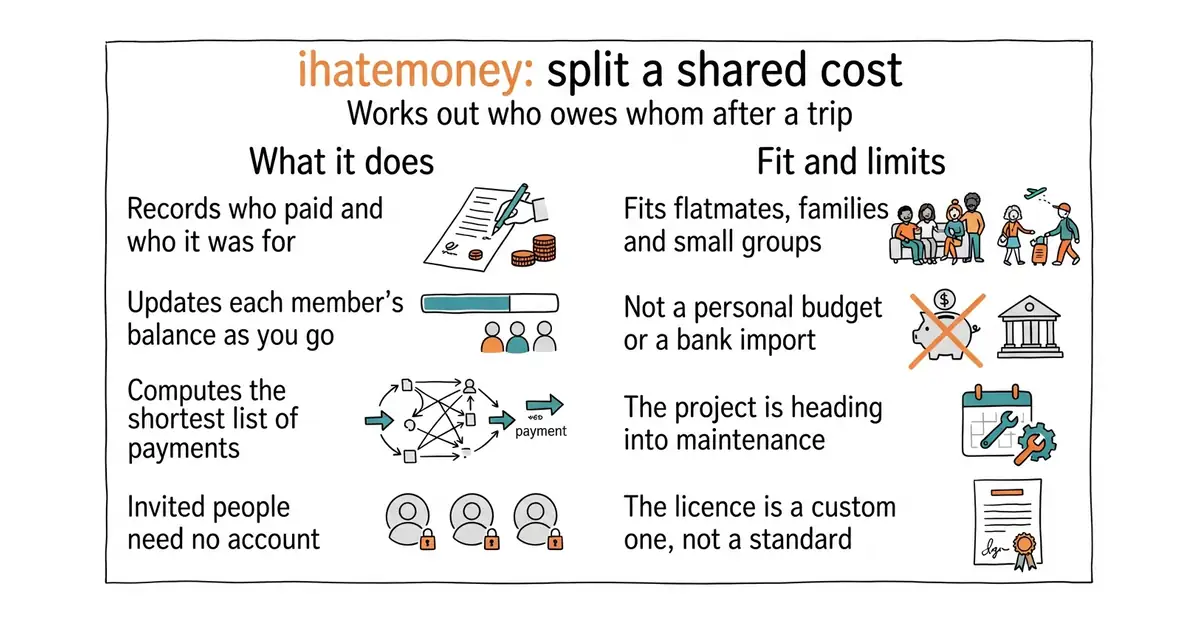
You create a project with a name and a password and share the link. Each person adds what they bought, when, and which members it was for, and the balance updates as you go. It then produces the settlement: the shortest list of payments that clears every debt. People you invite need no account, which is the detail that makes it get used — nobody signs up to settle a dinner. The current release is 7.2.1, published on 7 August 2026. It runs on Python 3.11 to 3.13 with SQLite, PostgreSQL or MariaDB 10.3.2 and newer behind it, and there is a Docker image. The maintainers say plainly that the project is moving towards maintenance mode, with stability chosen over new features, and that any proposal has to fit a goal of simplicity. It is not personal accounting: there is no budget, no bank import, and no report beyond the balances.
Why it matters
Who it suits. Flatmates, families, walking clubs, anyone who shares costs with people who will not install anything. It also suits a small office that splits lunch and does not want that data in a commercial app. Skip it if you want budgets, categories and charts of your own spending; that is a different tool, and entry 6 or Firefly III is closer.
Verdict. Twenty minutes to put up, and then it quietly works for years. Maintenance mode is a fair description rather than a warning: the problem it solves has not changed since 2011, and a release landed in August 2026. The no-account rule is the whole product, and it is why this beats a spreadsheet in practice. The obvious comparison is spliit-app/spliit at 2.9k stars and MIT, which was Edition 26 — a newer, better-looking take on the same idea. Choose ihatemoney for the long record and the lighter install, Spliit for the interface.
- Invited people need no account, so the thing actually gets used.
- It computes the settlement, not just the balances, which is the part people get wrong by hand.
- Tiny: SQLite is enough, and one Docker command runs it.
- The maintainers describe the project as heading into maintenance mode, so do not expect new features.
- No budgets, no bank import, no personal-finance reports — it does one job.
- The licence is a custom BSD-style "beerware" text rather than a standard one, which some companies will not accept.
 spliit-app/spliit
The same shared-expense job with a more modern interface, MIT licensed, built as a replacement for Splitwise.
Track this in Scout firefly-iii/firefly-iii
A full personal finance manager with budgets, categories and imports, AGPL-3.0, which answers the question ihatemoney deliberately does not.
Track this in Scout
docker run -d -p 8000:8000 ihatemoney/ihatemoney:latest