9,682 stars · Apache-2.0 (stated in the README and shown on the repository page) · 2.3.3 — 24 Jul 2026 on GitHub /releases/latest and 23 Jul 2026 on pkg.go.dev; the one-day difference is printed rather than resolved silently · Track this in Scout
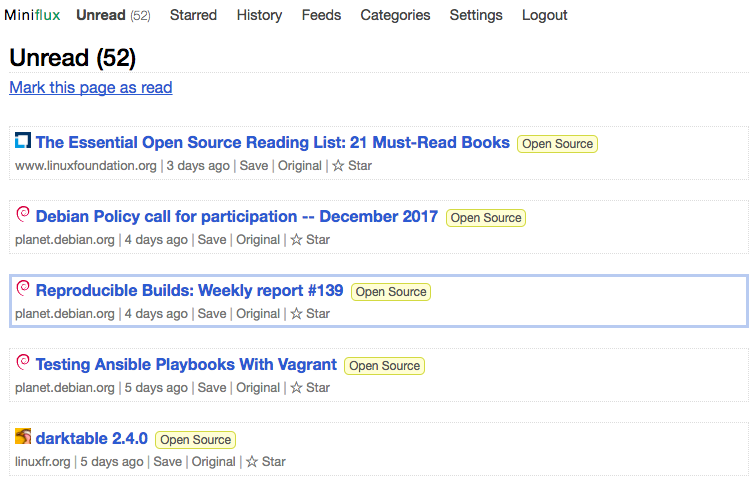
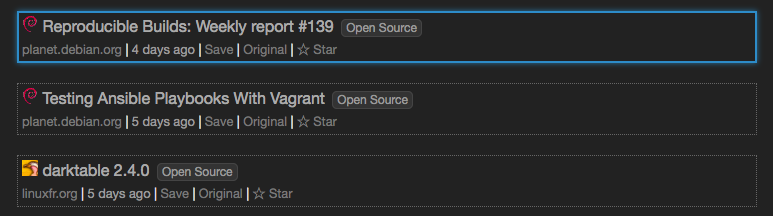
A feed reader you run yourself, built as one small program plus a PostgreSQL database.
▶Repo detailsthe review · specs · pros & cons · install
What it is
A reader for RSS, Atom and JSON Feed, which are the standard formats a website uses to publish a machine-readable list of its new articles. It is written in Go and ships as one static file, meaning the whole program is a single download with nothing to install alongside it.
What it is good for. Anyone who wants to follow fifty sites without fifty browser tabs, and anyone who has noticed that a social feed shows them a fraction of what they asked to see. It suits people who care about being tracked: it strips trackers out of article content and can fetch the full text of an article itself. It is also the right size for a small machine, which matters if you are paying for it monthly.
- Plain Apache-2.0, which is permissive and puts no condition on how you use it.
- Its own README states that it uses "a couple of MB of memory and a negligible amount of CPU, even with several hundreds of feeds." That is a published figure, not a claim about being lightweight.
- Official Debian and RPM packages, pre-built binaries and container images on three registries, so there is an install route for almost any machine.
- PostgreSQL only. Its README says so plainly. There is no SQLite option, so a database server is part of the job even for one person.
- It is deliberately plain. There are no recommendations, no social features and no clever grouping, and some people want those.
- Release 2.3.3 is dated 24 July 2026 on GitHub and 23 July 2026 on the Go package index. The one-day difference is almost certainly a time-zone edge, and we print it rather than pick one silently. The newest code is 12 September 2026.
- FreshRSS/FreshRSS
15,838 stars, a PHP application with more features and more settings, and it will run on ordinary shared web hosting where this one will not.
Track this in Scout - nkanaev/yarr
3,920 stars and one downloaded file with the database inside it, so it is far easier to start and does not scale to many readers.
Track this in Scout  rss-bridge/rss-bridge
Covered in Edition 28. It solves the other half of the problem by making a feed for a site that removed its own, then you read it in something like this.
Track this in Scout
docker run -d \
  -p 80:8080 \
  --name miniflux \
  -e "DATABASE_URL=postgres://miniflux:*password*@*dbhost*/miniflux?sslmode=disable" \
  -e "RUN_MIGRATIONS=1" \
  -e "CREATE_ADMIN=1" \
  -e "ADMIN_USERNAME=*username*" \
  -e "ADMIN_PASSWORD=*password*" \
  docker.io/miniflux/miniflux:latest