49,178 stars · MIT · v0.9.7 (2025-08-15) · Track this in Scout
A Python research workbench for machine-learning experiments on market data.
▶Repo detailsthe review · specs · pros & cons · install
What it is
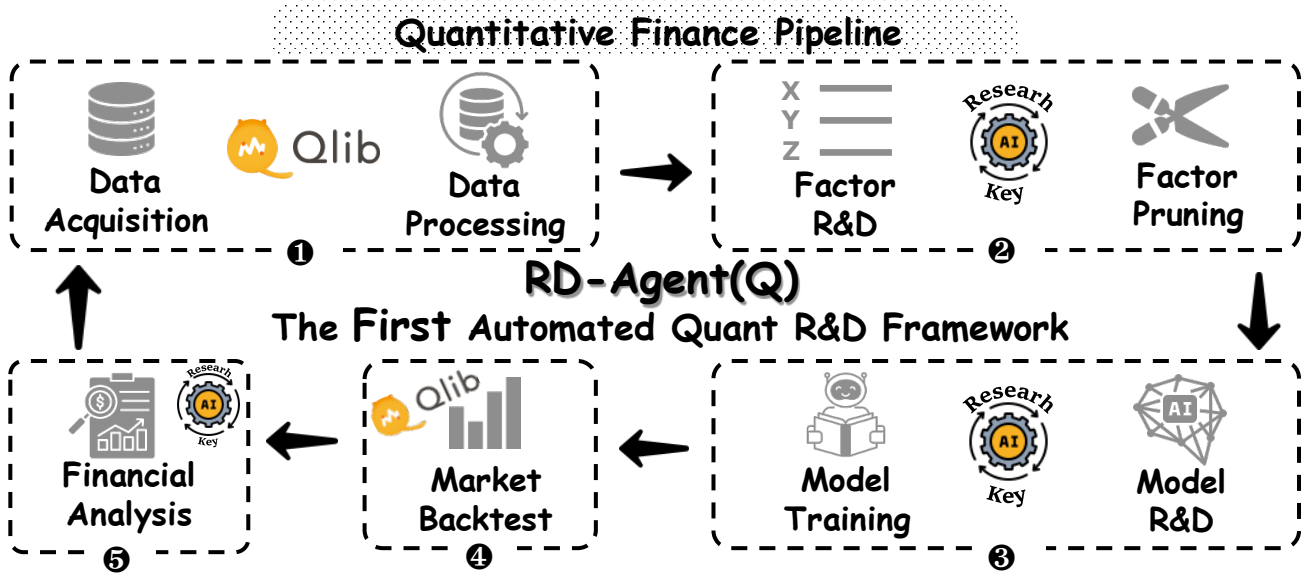
Qlib is a set of Python components that cover the whole path from stored price history to a scored prediction, with a collection of ready-made models to compare. Microsoft publishes it, under a plain MIT licence.
What it is good for. Someone with Python experience who wants to test a prediction idea properly rather than by eye — with separate training and testing periods and a fair comparison against other models. The value is the discipline it imposes, not the models themselves.
- 49,178 stars, created in August 2020, with code pushed on 5 October 2026 — the day before this edition.
- MIT licence, read from the file at
main/LICENSE, plain and unmodified, holder named as "Copyright (c) Microsoft Corporation." - It supplies the scaffolding that most people building this themselves get wrong: proper separation of training and testing periods, and a comparable scoring of several models at once.
- The newest release is about fourteen months old. Version 0.9.7 is dated 15 August 2025 — the release page prints only "15 Aug", with no year, and we settled it against both the project's own release records and the Python package index, which gives 0.9.7 as 15 August 2025. Code is pushed almost daily, so installing the published package gives something materially older than the repository.
- The readme file states the official datasets are temporarily unavailable and points to community-provided alternatives instead. So the first tutorial can stop dead, and the fallback is market data of uncertain origin.
- There is nothing to open. Setting it up means creating a Python environment, compiling parts of it, fetching data separately and writing scripts. The project publishes no memory, disk or processor figure anywhere. Nothing here is advice about money, and a model that scores well on past prices is not evidence about future ones.
- AI4Finance-Foundation/FinRL
Also a Python framework for machine-learning trading strategies, but built around learning by trial and aimed at teaching.
Track this in Scout  freqtrade/freqtrade
Also builds, tests and runs strategies, covered in Edition 29, but as a ready-to-run bot and cryptocurrency only.
Track this in Scout- quantopian/zipline
Tests trading algorithms against historical prices in Python, but has taken no new code since 13 February 2024.
Track this in Scout
# Needs: Python 3.8 to 3.12. The project recommends the conda environment tool.
conda create -n qlib python=3.11 -y
conda activate qlib
# On an Apple-silicon Mac only, first:  brew install libomp
pip install pyqlib
# Market data has to be fetched separately:
python -m qlib.cli.data qlib_data --target_dir ~/.qlib/qlib_data/cn_data --region cn