570 stars · GPL-2.0, linked from both the README and the About sidebar on 2026-10-14 · 1.13.8 (2026-09-11). The release page printed '11 Sep' with no year and ungh's releases endpoints failed on every attempt, so the year is settled only by the code date of 2026-10-12 being later · Track this in Scout
Self-hosted double-entry accounting with ordering, invoicing, stock and timecards, built on PostgreSQL.
▶Repo detailsthe review · specs · pros & cons · install
What it does
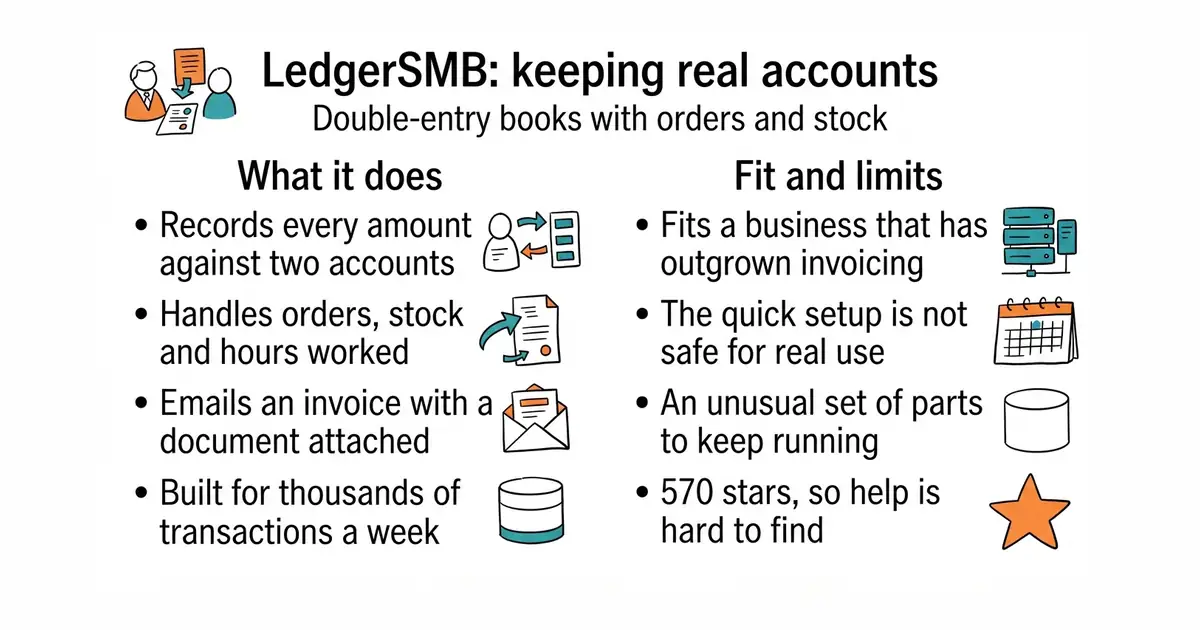
You keep accounts in the double-entry way, where every transaction is recorded against two accounts. Around that it adds the things a small business actually does: quotations, orders, invoices, projects, timecards for hours worked, stock management and shipping. It can send orders and invoices to customers by email with a PDF attached, and requests for quotation to suppliers. Everything customers see comes from templates, and the output formats are PDF, CSV, HTML and the open office document format. The data lives in PostgreSQL. The project states what size of business it is for: thousands of transactions a week. The stable release is 1.13.8, from 11 September 2026, and code landed on 12 October 2026. Version 1.14 is in development and asks for Perl 5.38 or newer and PostgreSQL 14 or newer. What it does not do is run well without a web server in front of it. The project says so plainly, and also says that the Docker Compose quick start is not enough for real use because it has no secure connections.
Why it matters
Who it suits. A small business that has outgrown invoicing software and needs real accounts, with an accountant who will ask for a trial balance rather than a list of payments. It fits best where somebody is comfortable with PostgreSQL, because the database is where the data really lives and the installation assumes you know that. Skip it if you only send invoices, because entry 7 above does that with a fraction of the setup, and skip it if a modern interface matters to you.
Verdict. The most capable free accounting system in today's twelve and the least fashionable, and 570 stars understates it badly. Two things give the real picture of its health. Its supported-browser table lists current browser versions, which means somebody is testing it against today's browsers rather than 2019's. And the README contains a warning that is unusual and worth repeating: do not use unofficial or AI-generated Docker Compose examples, only the project's own. Weigh the stack honestly — Perl 5.38, PostgreSQL 14, and a web server for anything real. frappe/books at 5,000 stars is the friendlier choice for a small business wanting double-entry accounting with a modern interface and offline use, under AGPL-3.0, and Edition 29 covered it. gnucash/gnucash at 4,300 stars is the desktop answer for one person keeping books on their own machine, and Edition 40 covered it. This is the one to pick when several people need the same accounts at once and the business also has orders and stock.
- Real double-entry accounting, plus ordering, stock, timecards and shipping in one system.
- Invoices and orders go out by email with a PDF attached, and templates control every customer-facing document.
- The project states the size of business it is built for, which almost nothing else here does.
- Perl 5.38 and PostgreSQL 14 for the development version, which is an unusual stack to maintain.
- The published Docker Compose quick start has no secure connections and is not for production.
- 570 stars, so searching for help with a specific problem will mostly find the project's own documentation.
 frappe/books
Double-entry accounting for a small business with a modern interface and offline use, at 5,000 stars, under AGPL-3.0; Edition 29 covered it.
Track this in Scout gnucash/gnucash
Desktop double-entry accounting for one person, at 4,300 stars, with no licence named in its sidebar; Edition 40 covered it.
Track this in Scout
wget https://raw.githubusercontent.com/ledgersmb/ledgersmb-docker/1.13/docker-compose.yml
docker-compose up -d