7.7k stars · BSD 3-Clause, per the README badge and LICENSE.TXT; the About sidebar names none · v1.44, 13 October 2026, confirmed on GitHub and PyPI the same day · Track this in Scout
The long-established free library for pricing and risk-managing financial instruments.
▶Repo detailsthe review · specs · pros & cons · install
What it does
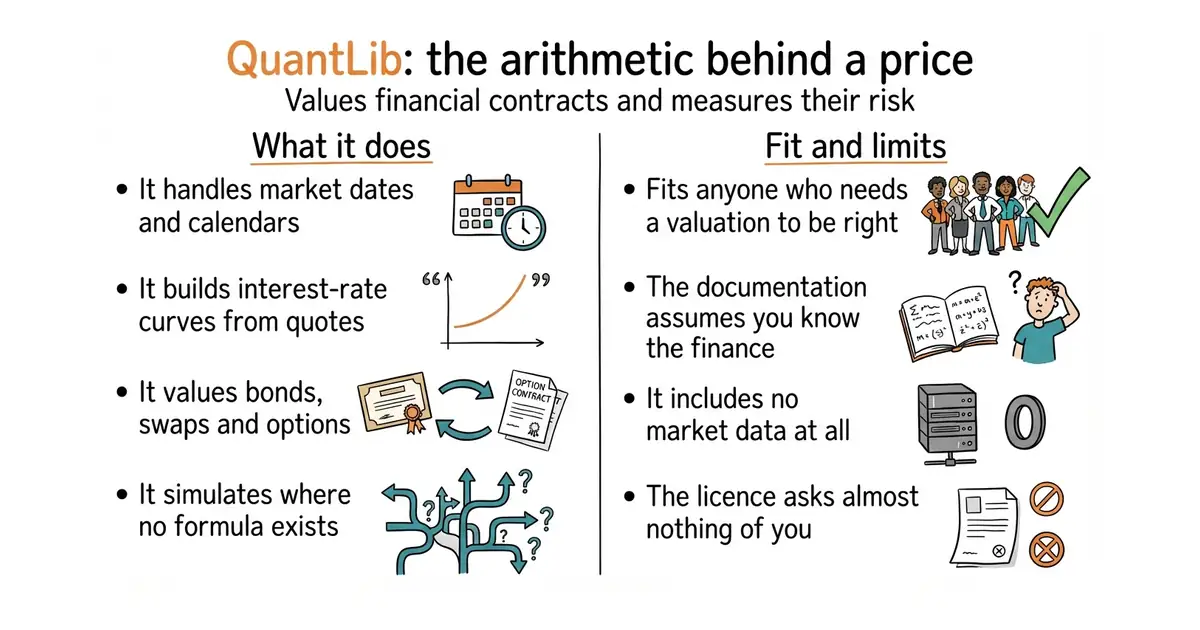
QuantLib is a framework for quantitative finance, aimed at modelling, trading and risk management. It provides the building blocks that pricing depends on: date and calendar handling for dozens of markets, day-count conventions, interest-rate curves built from quoted instruments, volatility surfaces, and the numerical machinery — trees, finite differences and Monte Carlo simulation — that values instruments with no closed formula. On top of those sit the instruments themselves, covering bonds, swaps, options, credit products and currency contracts. The core is C++, and pip install QuantLib gives the official Python bindings. Version 1.44 was released on 13 October 2026 on both GitHub and PyPI, and it drops the Boost versions of any and optional in favour of the standard library's, and removes features deprecated in 1.39. It is a library, not an application: there is no interface, no data feed and no market data included, and you supply every price it works from.
Why it matters
Who it suits. Anyone who needs a valuation to be right rather than roughly right. That means a small fund, a treasury function, a risk analyst, or a developer asked to value a book of instruments without writing the date arithmetic and curve bootstrapping from scratch. The date and calendar handling alone justifies it, because market conventions are tedious, varied and easy to get subtly wrong. Skip it if you are backtesting a signal on daily closing prices, where a dataframe library is the right tool and this is enormous overkill.
Verdict. Worth the effort, with eyes open about the effort. The library is thorough and the BSD 3-Clause licence asks almost nothing, which makes it unusual among serious financial software. The cost is the learning curve: the documentation assumes you know the finance, the C++ is from an older school, and the Python bindings follow the C++ structure rather than feeling like Python. Start with pip install QuantLib and one worked example from the project site rather than building the C++ library. For a smaller and more approachable Python library covering similar ground, domokane/FinancePy is the better first stop.
- BSD 3-Clause, which is about as permissive as a licence gets, on software of this seriousness.
- Market conventions, calendars and curve building are handled properly, which is the part that is tedious to write and easy to get wrong.
- Still released on a regular rhythm: version 1.44 arrived on 13 October 2026, on GitHub and PyPI the same day.
- Steep. The documentation assumes financial knowledge, and the examples are the real teaching material.
- The Python bindings mirror the C++ design rather than reading like Python, which makes short scripts verbose.
- No data of any kind is included, so you need your own prices before anything can be valued.
 domokane/FinancePy
A pure Python library for pricing and risk-managing derivatives, far easier to start with and far smaller in scope.
Track this in Scout cuemacro/finmarketpy
Aimed at backtesting and market analysis rather than instrument pricing.
Track this in Scout pmorissette/ffn
A library of financial functions for performance measurement and return analysis, which is the other half of the job.
Track this in Scout
python3 -m venv venv
source venv/bin/activate
pip install QuantLib