717 stars · MIT, named in the About sidebar · 5.1.0, 2 February 2026, confirmed on GitHub and PyPI · Track this in Scout
A small Python package that downloads a United States company's official filings to a local folder.
▶Repo detailsthe review · specs · pros & cons · install
What it does
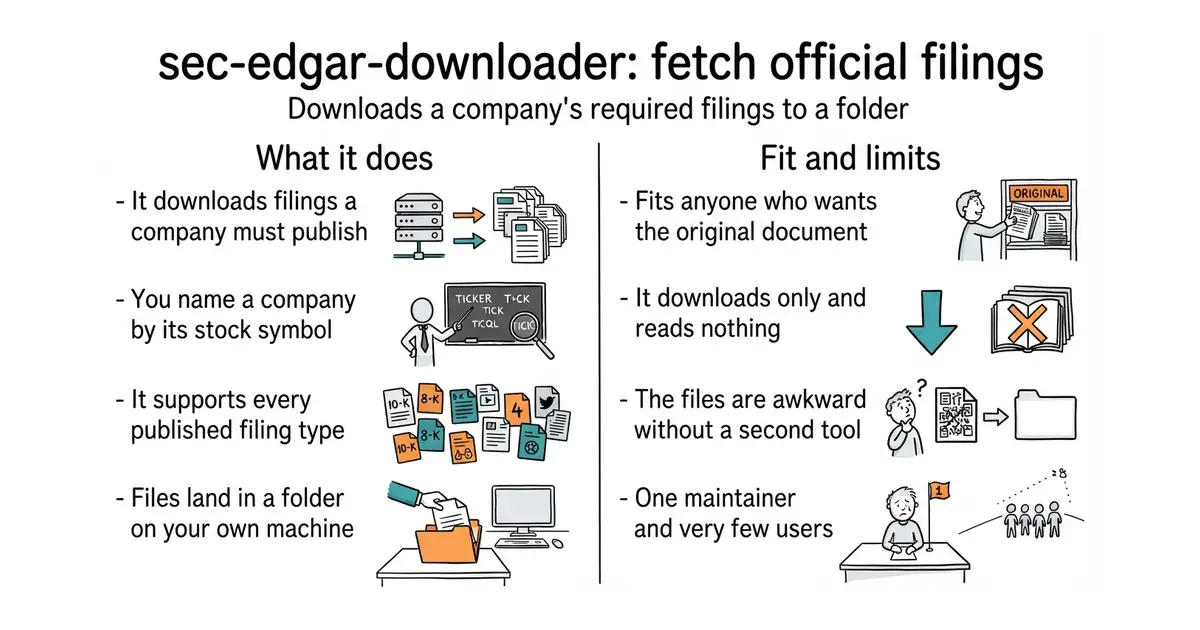
The package downloads company filings from the EDGAR database, which is the archive the United States Securities and Exchange Commission publishes. You identify a company either by its stock ticker or by its Central Index Key, the number the regulator assigns it. The README says it supports all filing types, and lists many of them, including the yearly 10-K, the quarterly 10-Q, the event notice 8-K, the fund holdings report 13F-HR and the ownership notice SC 13G. Filings arrive as files in a folder you choose, in the form the regulator published them. The package requires you to supply a company name and an email address, which it uses to build the identifying header the regulator's fair-access policy asks for. Version 5.1.0 was released on 2 February 2026, confirmed on both GitHub and PyPI. What it does not do is read the documents: there is no parsing, no extraction of sections, and no conversion into tables.
Why it matters
Who it suits. Anyone who wants the primary documents rather than a summary of them. That covers a researcher building a text corpus, an analyst who wants to read what a company actually filed, and anyone automating a check across a list of companies. The narrow scope is the feature: because it only downloads, there is very little to go wrong and very little to learn. Skip it if what you want is the numbers already extracted into a table, because then you want a parsing library instead.
Verdict. Install it, and keep it. A minute to set up, MIT licensed, 717 stars, and it does exactly what it says. The right way to use it is as the first step of two: this fetches, and something else reads. For the reading step, dgunning/edgartools turns filings into typed objects and tables, and it is the natural partner. Edition 51 covered sec-edgar/sec-edgar, which does the same download job with a different interface; between the two, pick on which API reads better to you, because both are maintained and both are small.
- One job, done plainly, with an interface you can learn in five minutes.
- MIT licensed, with real documentation on Read the Docs rather than a README alone.
- Makes the identifying header mandatory, which satisfies the regulator's fair-access policy without extra work.
- It downloads only. Nothing is parsed, extracted or turned into a table.
- Filings arrive in the regulator's own formats, which are awkward to read without a second tool.
- 717 stars and a single maintainer, so support is whatever the issue tracker provides.

 dgunning/edgartools
The complementary tool: it parses filings into typed objects and tables rather than fetching raw files.
Track this in Scout- lefterisloukas/edgar-crawler
Downloads filings and also extracts named sections into structured JSON, but its currency could not be proven on 18 October 2026.
Track this in Scout
python3 -m venv venv
source venv/bin/activate
pip install sec-edgar-downloader