1.4k stars · MIT · @nuxtjs/seo 6.0.1, read from registry.npmjs.org; the repository publishes no GitHub releases · Track this in Scout
Seven search-engine and answer-engine modules for Nuxt sites, installed as one package.
▶Repo detailsthe review · specs · pros & cons · install
What it does
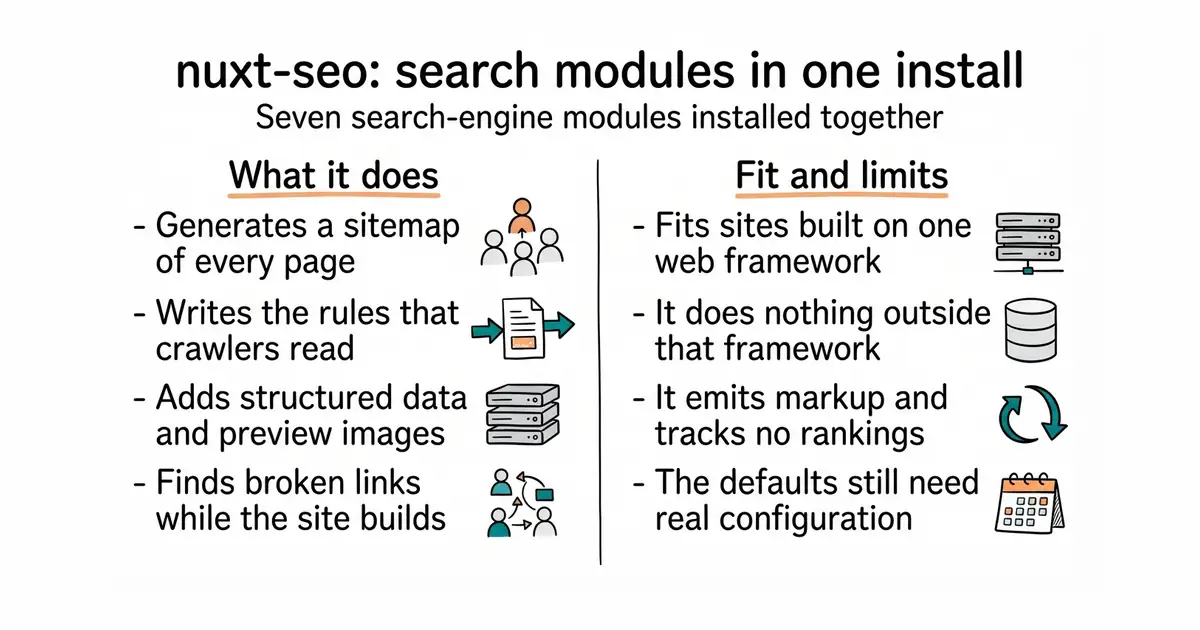
Nuxt is a framework for building websites in JavaScript; this installs into one. The single package @nuxtjs/seo pulls in seven modules: robots directives for crawlers, an automatically generated sitemap, Schema.org structured data, preview images for social links, default meta tags and canonical addresses, a build-time broken-link checker, and a shared site configuration that the other six read. Each one also works alone. The project covers answer-engine optimisation as well as the search-engine kind, meaning the markup AI assistants read when they cite a page. The current package version is 6.0.1 and code landed on 14 October 2026, under the MIT licence. Two companion modules are named but not bundled: one for llms.txt and markdown endpoints, one for keeping assets alive across deployments. It is not a crawler and not a rank tracker: it changes what a site emits, and tells you nothing about where that site ranks.
Why it matters
Who it suits. Anyone whose site is built with Nuxt and who has been meaning to sort out sitemaps and preview images for six months. It is also the quickest route to structured data for a small team with no search specialist. Skip it entirely if the site is not a Nuxt site — none of this applies, and there is no general version.
Verdict. Ten minutes for something that would otherwise be a week of small chores, provided you are on the right framework. The honest limit is that narrowness: it is excellent and it is useless outside Nuxt. For measuring rather than emitting, harlan-zw/unlighthouse at 4.9k stars and MIT, by the same author, was Edition 2, and every-app/open-seo at 23.9k stars and MIT, also Edition 2, covers keyword research and rank tracking. The llms.txt idea the companion module implements was Edition 2 as well, through AnswerDotAI/llms-txt.
- One install replaces seven separate decisions, and the modules share one configuration.
- The broken-link check runs at build time, so a dead link fails the build instead of the reader.
- MIT, with code landing three days ago and an unusually good documentation site.
- Nuxt only. Outside that framework it does nothing at all.
- Seven modules switched on at once will change what a site emits in ways you should check before deploying.
- Generated preview images and structured data need real configuration to be useful; the defaults are a starting point.
 harlan-zw/unlighthouse
Runs Google Lighthouse across every page of a site and reports the results in one interface, MIT, for measuring rather than emitting.
Track this in Scout every-app/open-seo
Keyword research, rank tracking, competitor data, backlinks and site audits, MIT, with an interface for AI agents to read the same data.
Track this in Scout
npx nuxi module add seo