In simple English
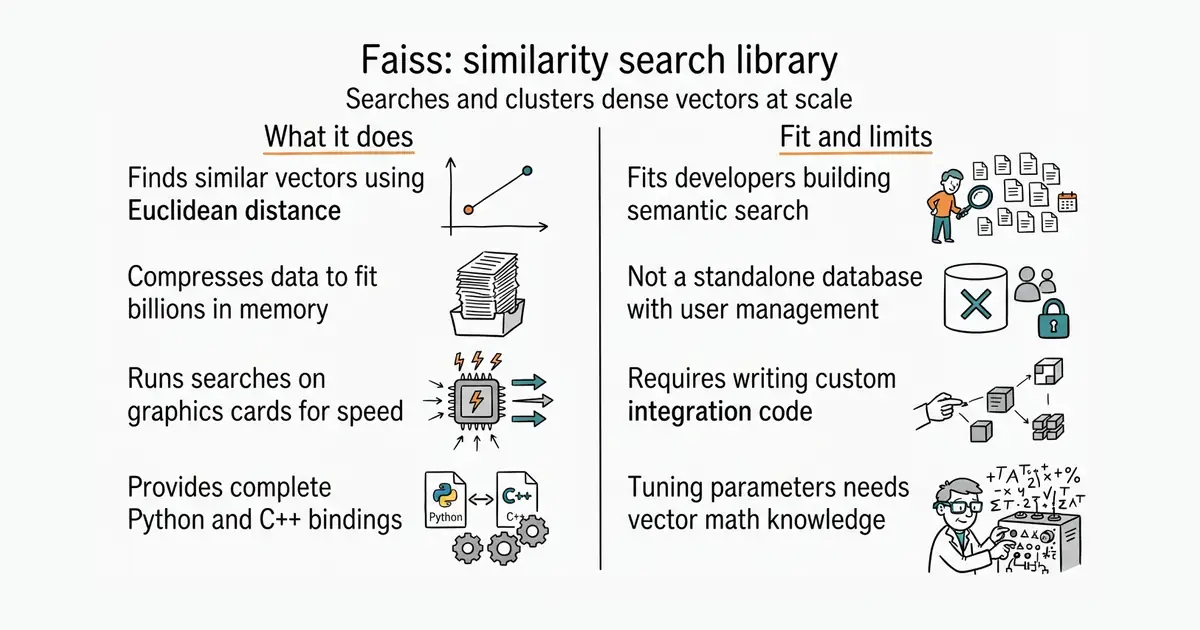
This library helps you search through massive lists of numbers very quickly. You give it mathematical representations of text or images, and it finds the ones that match your query. It handles billions of items on a single server without running out of memory. You can run it on standard processors or speed it up using a graphics card. It is free to use under an MIT licence.
What it is
Faiss is a C++ library with Python bindings designed for similarity search and clustering of dense vectors. It provides various indexing structures and compression methods to trade off search speed, precision, and memory usage.
What it is good for
Solo builders who need to build semantic search engines, recommendation systems, or Retrieval-Augmented Generation (RAG) pipelines over large datasets.
- Searches through billions of vectors efficiently on a single server.
- Includes GPU acceleration for much faster search and indexing.
- Provides simple Python wrappers for easy integration into existing scripts.
- Requires writing code in Python or C++ to integrate into your project.
- Advanced GPU indexing needs compatible graphics hardware and drivers.
- Tuning index parameters requires a solid understanding of vector mathematics.
Slow brute-force list scanning and custom nearest-neighbor loops
LangChain or LlamaIndex for building search and question-answering systems
- qdrant/qdrant35k stars
A vector database written in Rust that provides similarity search with a built-in server.
- milvus-io/milvus46k stars
A distributed vector database built to scale similarity search to massive datasets.


- ggml-org/llama.cpp132k stars
A C and C++ library and command-line tool for running language models locally.
- EleutherAI/lm-evaluation-harness14k stars
Runs standard question sets against a language model and reports the scores.
- mudler/LocalAI50k stars
Serves text, vision, speech, image and video models from one self-hosted service that imitates the paid interfaces.
pip install faiss-cpu