21,896 stars · Apache-2.0 outside src/pro, Functional Source License 1.1 (Apache-2.0 future licence) inside src/pro. Stated in the README only: the sidebar links to a licence file without naming it. · v1.19.0 (2026-10-12), read from /releases/latest; the page omits the year and the code date of 2026-10-13 settles it · Track this in Scout
A desktop program that builds a web application from a written description, running locally with keys the user supplies.
▶Repo detailsthe review · specs · pros & cons · install
What it does
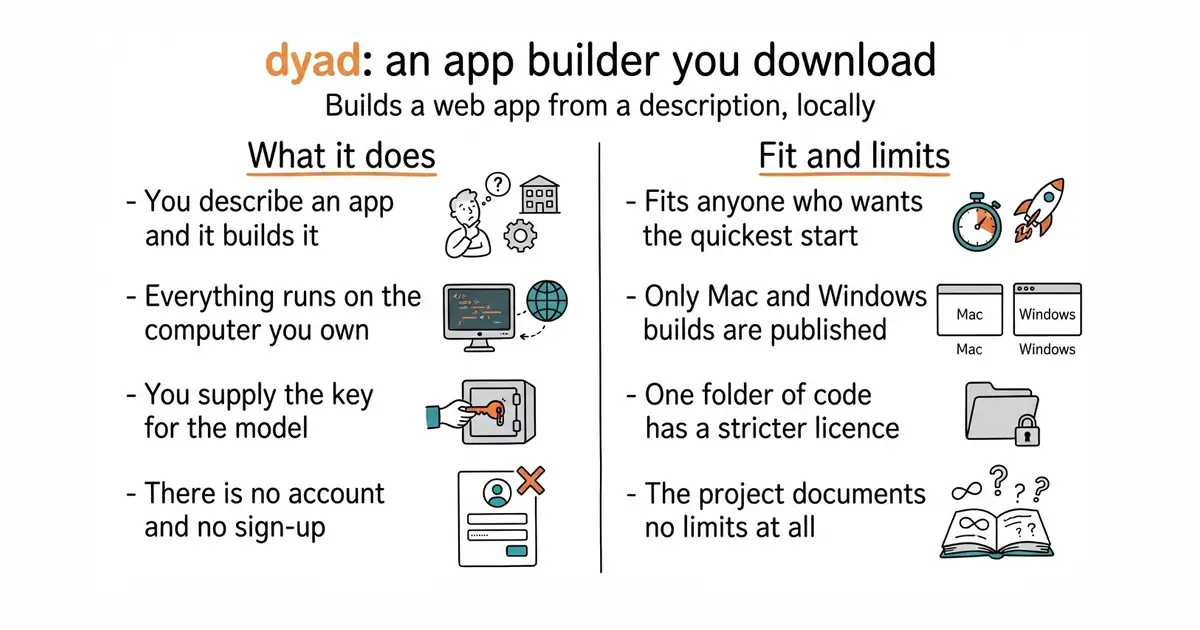
Dyad is a downloadable application for Mac and Windows. You describe the application you want, and it writes and runs the project on the machine in front of you. The project describes itself as an alternative to the hosted services Lovable, v0, Replit and Bolt, and the difference it names is where the work happens: locally, not on somebody's servers. There is no sign-up step, and the project says so first. You bring your own API keys, so the model choice and the bill are both yours. Releases come quickly: version 1.19.0 landed on 12 October 2026, and code was committed the day after. The project's own description stops there, and so does this entry. The page lists no limitations, gives no build-from-source steps, and names Mac and Windows only, so Linux users are not catered for by the published downloads.
Why it matters
Who it suits. Anyone who wants to try building an application by describing it, and who does not want to spend an evening installing a development environment first. It suits someone cautious about a hosted builder, because nothing leaves the machine except the conversation with the model provider. It suits a Mac or Windows user; Linux users should look at entry 1. Skip it if you need the finished thing to run on a server with no screen, because this is a desktop program rather than a service.
Verdict. The quickest way into this category, and the one to try first if you are only going to try one. Ten minutes from download to first attempt. Watch the licence, which is split and is not stated in the usual place: the sidebar links to a licence file without naming it, and the README explains that everything outside the src/pro folder is Apache 2.0, while the code inside src/pro is under the Functional Source License 1.1. That is a source-available licence, not an open-source one. It converts to Apache 2.0 later, but until then the paid part of the product is carved out of the free one. Compare with stackblitz-labs/bolt.diy above, where the whole project is MIT and the restriction sits in a dependency instead.
- A plain download with no account, no sign-up and no server to arrange.
- Everything runs locally except the conversation with the model, so the generated code never passes through a third party's product.
- Frequent releases, with a new version and fresh code in the same week this was checked.
- The licence is split, and the split is explained only inside the README. A folder of the code is under a source-available licence rather than an open-source one.
- Published downloads cover Mac and Windows. Linux is not listed.
- The README documents nothing about requirements, limits or building from source, so the only way to find the edges is to hit them.
 stackblitz-labs/bolt.diy
The same job in a browser workspace you run yourself, with more than 22 model providers listed and a sandbox that needs a commercial licence for business use.
Track this in Scout cloudflare/vibesdk
The same job again, but built to be hosted for other people rather than used by one person.
Track this in Scout
Download the build for Mac or Windows from dyad.sh and open it.