5,409 stars · MIT · v1.5.0 (2026-02-06), read from /releases/latest; its own changelog header dates the version 2026-02-03 · Track this in Scout
An open platform for running an application-building service, built end to end on one company's infrastructure.
▶Repo detailsthe review · specs · pros & cons · install
What it does
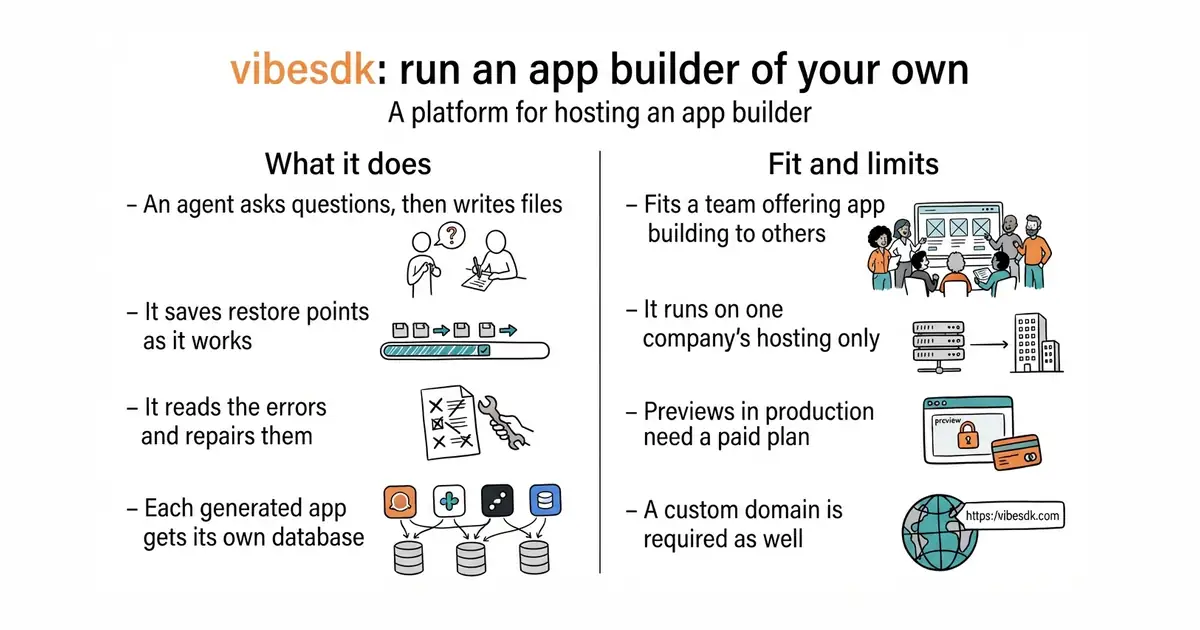
vibesdk is a complete platform, not a single tool. A person describes the application they want, and an agent asks clarifying questions, edits files in a workspace, saves restore points as it goes, deploys a preview, reads the browser's error console and fixes what it finds. Every generated application gets its own small SQLite database, and the whole thing can be exported. The repository carries a one-click deploy button for Cloudflare Workers, and a local development path using Bun. It has been public since 25 August 2025 and had code committed on 22 September 2026, although its newest tagged release, v1.5.0, is from February 2026. It is tied to one company's infrastructure by design, and it says so: it runs on Cloudflare Workers, it uses Cloudflare's AI Gateway for model credentials, and the production checklist names a paid Workers plan, Workers for Platforms access, a custom domain with wildcard DNS and possibly Advanced Certificate Manager. It is not a product you sign into, and shell access inside the generated workspace is switched off deliberately.
Why it matters
Who it suits. A small team that wants to offer app-building as a feature of something they already sell, and that is already comfortable on Cloudflare. It also suits anyone who simply wants to read how a serious agent loop is put together, because the whole thing is MIT-licensed and the code is the documentation. Skip it if you want to build one application for yourself: entries 1 and 2 do that in minutes, and this takes an afternoon of account setup before anything appears.
Verdict. The most interesting of the three to read and the least practical to run. Treat the free licence and the real cost as separate questions, because they are. MIT means the code can be copied, changed and sold. It does not mean the thing runs for nothing: the README's own production list starts with a paid Workers plan and a custom domain, and model usage is billed on top. At 5,409 stars it is also the smallest of the three, and the eight-month gap between its newest release and its newest code means the tagged versions are not a good guide to what the project is doing. If the hosting lock-in is the problem rather than the idea, stackblitz-labs/bolt.diy runs anywhere Node.js does.
- A complete, readable example of an agent that plans, edits, previews, reads its own errors and repairs them, published MIT by a large company.
- Each generated application is isolated, with its own SQLite storage, and the whole workspace can be exported.
- A genuine one-click deploy path, which is rare for something this large.
- Production needs a paid Workers plan and Workers for Platforms access before previews work at all, plus a domain with wildcard DNS.
- It only runs on one company's infrastructure. There is no path to a plain Linux server.
- The newest tagged release is from February 2026 while the code moved in September, so version numbers tell you very little here.
 stackblitz-labs/bolt.diy
The same agent idea without the hosting tie, runnable on any machine with Node.js, though its browser sandbox carries its own commercial licence.
Track this in Scout dyad-sh/dyad
The same idea as a single desktop download, for one person rather than a service with many users.
Track this in Scout
git clone https://github.com/cloudflare/vibesdk.git
cd vibesdk
bun install
bun run setup
bun run dev