8,933 stars · MIT, read from /blob/master/LICENSE.txt on 2026-09-28 after both /blob/main/LICENSE and /blob/master/LICENSE failed; plain, copyright "(c) 2014-2026 Andrew Kane, 2008-2014 Heroku (initial queries)" · no GitHub releases at all - a determination, not a gap, confirmed on /releases/latest and by ungh; the gem pghero 4.0.1 (2026-08-15) is the version to trust, matching CHANGELOG.md and rubygems exactly · Track this in Scout
A web dashboard for PostgreSQL that names the slow queries, the missing indexes, the unused ones, table sizes, connections and locks.
▶Repo detailsthe review · specs · pros & cons · install
What it is
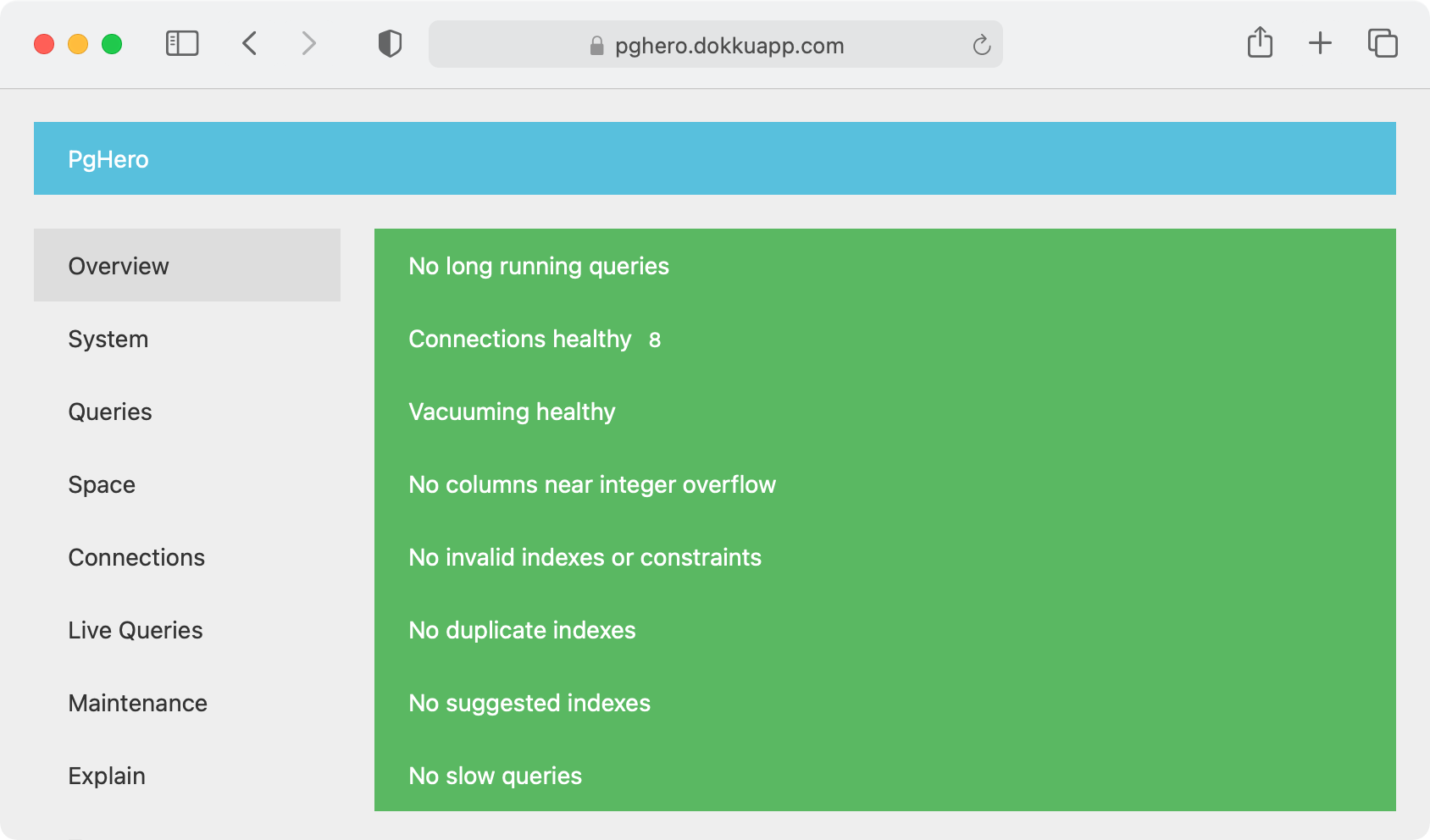
A performance dashboard for PostgreSQL. It reads the database's own statistics and presents slow queries, index suggestions, table sizes, connections, locks and unused indexes on one page. It runs either as a standalone container or mounted inside a Ruby on Rails application.
What it is good for. Anyone running PostgreSQL without a monitoring bill. The usual alternative is paying a hosted service or reading log files by hand. This sits between those: one container, a read-only database user, and a page that answers "why is it slow" in about a minute. It has been in production at Instacart for years, so it is not a weekend project.
- One command and a database address gives a working dashboard on port 8080. Nothing to build, nothing to compile.
- Suggested indexes, not just slow queries. It names the index to create, which is the part that usually takes expertise.
- Mature and well tended. Version 4.0.1, released 15 August 2026, nearly twenty million downloads of the package, and only three open issues.
- It has no password by default. The project's own guide says to secure the dashboard in production. Anyone who opens port 8080 on a public machine has published the shape of their database and its slowest queries. Set
PGHERO_USERNAMEandPGHERO_PASSWORD, or put something in front of it. - The most useful part needs a database restart. Query statistics come from the
pg_stat_statementsextension, which means editingpostgresql.conf, restarting PostgreSQL, and runningCREATE EXTENSIONas a superuser. On a managed database you do not control, that may not be possible at all. - Version 4.0 dropped several things: PostgreSQL below 14, and also the Linux distribution packages, so that installation route no longer exists. It is Docker or the Ruby package now. There are also no GitHub releases at all, so there is no release feed to follow — the changelog file and the package registry are where the news is.
 darold/pgbadger
4,065 stars, code on 15 September 2026, covered in Edition 18; it reads PostgreSQL log files and writes one static report, so it needs no connection and no extension, but it is not a live dashboard.
Track this in Scout cybertec-postgresql/pgwatch
866 stars, code on 27 August 2026, covered in Edition 26; a full monitoring stack with a collector, a time-series store and Grafana, built for many servers, so far more moving parts.
Track this in Scout- powa-team/powa-web
84 stars, code on 26 September 2026; only the web half of the PoWA project, so it also requires installing the powa extension in the database itself.
Track this in Scout
docker run -ti \
  -e DATABASE_URL=postgres://user:password@hostname:5432/dbname \
  -e PGHERO_USERNAME=admin -e PGHERO_PASSWORD=choose-something-long \
  -p 8080:8080 ankane/pghero