Radar check
What we found when we opened it. Every bar is one fact, with its date.
Last code pushed 14 Oct 2026, 12 days before this check.
Latest release v0.2.10 on 14 Oct 2026.
Public since October 2026, 1 months.
0 stars and 0 forks.
27 commits and 0 new issues in the last 90 days.
1 contributor. No pull requests merged in 90 days; changes go in directly. A small team carries it.
No security policy file says how to report a problem. No published security advisories.
How the bars are scored
- Alive. Days since the last code push: a week or less 100, a month 90, three months 70, six months 50, a year 30, eighteen months 15, older 0.
- Releases. Age of the latest GitHub release, on a similar scale; no bar when the project publishes no releases.
- Maturity. Age of the project: eight years 100, five 90, three 70, two 55, one 40, six months 25, younger 10.
- Adoption. Stars on a log scale: 100,000 stars is 100, 10,000 is 80, 1,000 is 60, 100 is 40.
- Activity. Commits in the last 90 days: 300 or more 100, 100 85, 30 65, 10 45, any 25.
- Community. People who have contributed: 100 or more 100, 30 80, 10 60, 5 40, 2 25, one 10.
- Security. A published security policy 80, none 40; published advisories are listed, not scored.
Checked by Repo Radar on 26 Oct 2026 from the repository on GitHub.
In simple English
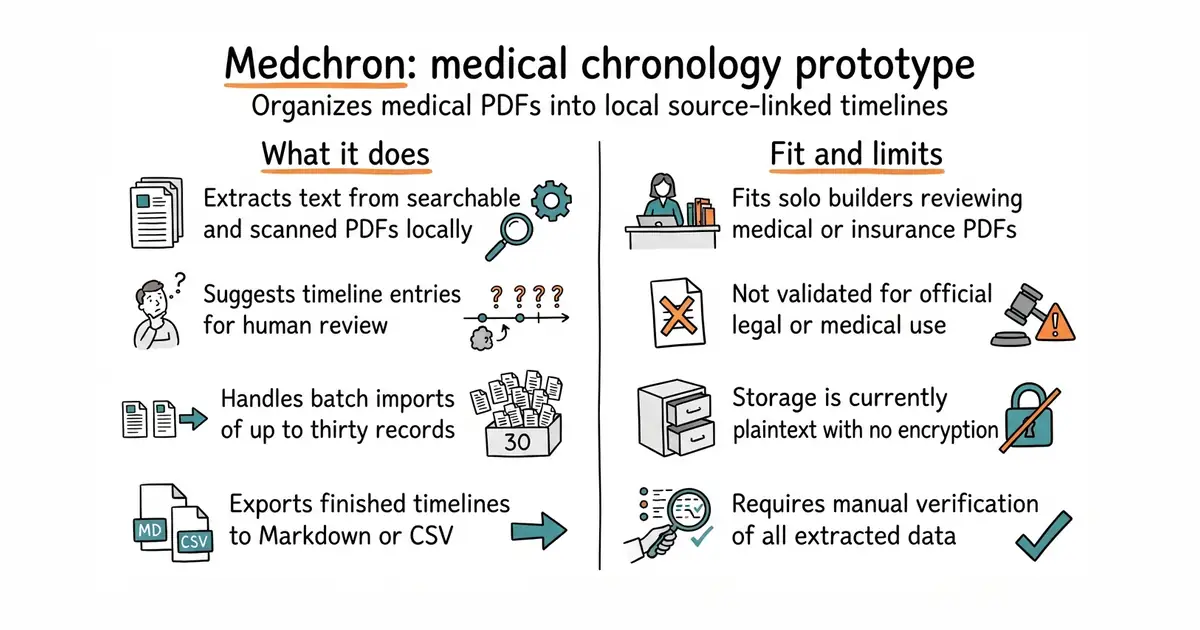
This tool helps you organize medical and insurance records into a timeline. It runs entirely on your own computer, so your data stays private. You can import up to thirty PDF files at once and extract text using built-in optical character recognition. It suggests chronology entries automatically, but you must check every entry by hand. The software is free to download and use.
What it is
A local-first medical chronology prototype written in Rust that extracts timelines from PDFs and opens a browser interface for human review. It stores case data locally in JSON format without requiring cloud services.
What it is good for
Lawyers, researchers, or solo builders who need to organize large batches of medical or insurance PDF documents into source-linked timelines without sending sensitive data to cloud artificial intelligence services.
- Runs completely offline on your computer without cloud artificial intelligence.
- Includes synthetic demonstration records so you can test it immediately.
- Exports your completed chronologies to comma-separated values or Markdown files.
- Requires technical steps to install system dependencies like Tesseract and Poppler if building from source.
- Storage is currently unencrypted plaintext, so it lacks built-in data security.
- This is an early prototype and is not validated for legal or medical production use.
manual PDF review and spreadsheet chronology building
Poppler
- docusealco/docuseal19k stars
Document signing you run yourself, with a record of who signed and when.
- Future-Scholars/paperlib2.3k stars
A desktop library for research papers that fills in the details itself.
- mozilla/pdf.js54k stars
A PDF reader written in JavaScript that renders documents inside a web page with no plugin.
sudo apt install tesseract-ocr tesseract-ocr-eng poppler-utils
cargo run --bin medchron