18.8k stars · AGPL-3.0 with added terms · 3.3.3 (2026-10-19) · Track this in Scout
Document signing you run yourself, with a record of who signed and when.
▶Repo detailsthe review · specs · pros & cons · install
What it does
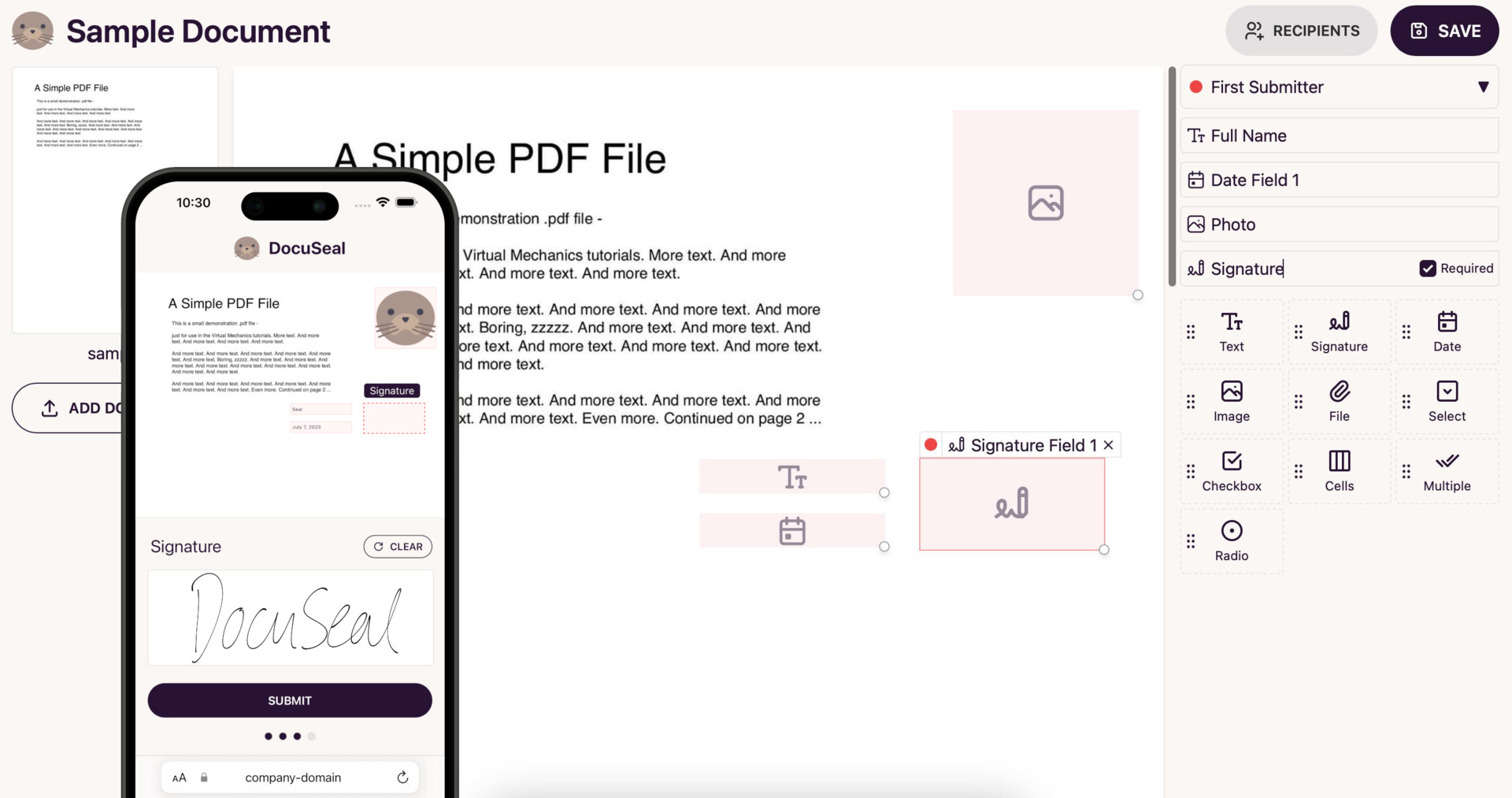
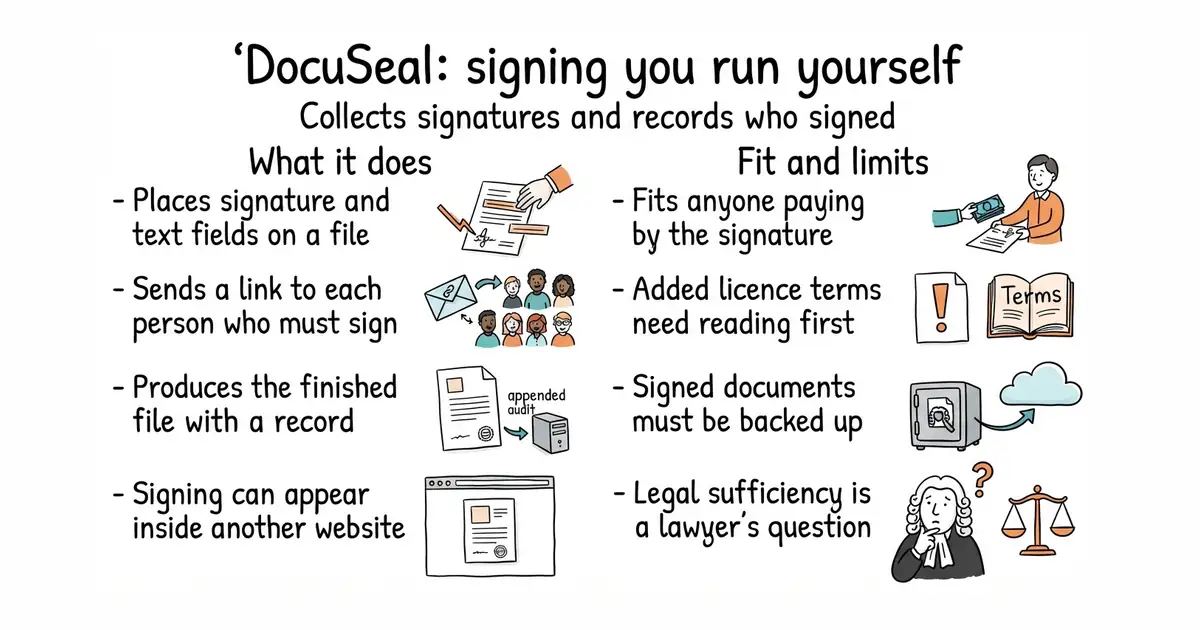
It turns a PDF into a form by letting you place fields on it: signature, initials, text, date, number, checkbox, file upload and more. A document with fields becomes a template that can be reused and sent to many people. Signers get a link, fill in their fields in the browser, and the completed PDF is produced with the fields filled and an audit record attached. Several signers can be ordered, so one person signs after another. It handles notification emails, reminders and a verifiable record of each completion, and it offers an interface for other software to create and send documents. There is an embedding mode so the signing step can appear inside another website. It is not a legal service: it produces signed documents and an audit trail, and whether that satisfies a particular country's rules is a question for a lawyer, not for software. This report is not a lawyer either.
Why it matters
Who it suits. Anyone sending more than a handful of documents for signature a month, where a per-signature bill has started to sting, and who would rather hold the signed documents themselves. It also suits anyone who needs signing inside their own website rather than on somebody else's domain. Skip it if the volume is two contracts a year, because running the software costs more attention than the bill it replaces.
Verdict. Worth half an hour, and the licence is the part to read first. It is AGPL-3.0 with additional terms under section 7(b), which in practice means the branding and attribution conditions have to be respected; running it unchanged for one organisation's own documents is exactly what it is for, and building a product on top of it needs the terms read properly. The software itself is current: version 3.3.3 was released on 19 October 2026 and code was pushed the same day. One practical warning. Signed documents are the kind of thing that must still exist in seven years, so the backup of the data folder is not optional, and it is the first thing to set up rather than the last. The nearest alternatives are both AGPL-3.0 and both good: documenso/documenso is more polished and aimed at teams, and OpenSignLabs/OpenSign is closer in spirit and a little rougher.
- A full signing flow, including reusable templates, ordered signers and reminders.
- An embedding mode, so the signing step can live inside another website.
- Replaces a per-signature bill entirely, and the signed documents stay in one place.
- AGPL-3.0 with added terms, which needs reading before building anything on top of it.
- The signed documents have to be backed up properly, and that is now somebody's job.
- Whether a signature is legally sufficient is a question about law, not about this software.
 documenso/documenso
AGPL-3.0, the same job with a more polished interface and more attention to teams and permissions; it is heavier to run and its hosted service is the company's focus.
Track this in Scout OpenSignLabs/OpenSign
AGPL-3.0, the same job again with templates and audit trails, a little rougher in places, and worth comparing because the three differ mostly in interface rather than in capability.
Track this in Scout
docker run --name docuseal \
  -p 3000:3000 \
  -v "$(pwd)/docuseal:/data" \
  docusealco/docuseal