Radar check
What we found when we opened it. Every bar is one fact, with its date.
Last code pushed 30 Sep 2026, 27 days before this check.
Latest release v3.10.0 on 30 Sep 2026.
Public since October 2025, about 1 year.
15,240 stars and 1,545 forks.
92 commits and 6 new issues in the last 90 days.
50 contributors. 21 pull requests merged in 90 days.
No security policy file says how to report a problem. No published security advisories.
How the bars are scored
- Alive. Days since the last code push: a week or less 100, a month 90, three months 70, six months 50, a year 30, eighteen months 15, older 0.
- Releases. Age of the latest GitHub release, on a similar scale; no bar when the project publishes no releases.
- Maturity. Age of the project: eight years 100, five 90, three 70, two 55, one 40, six months 25, younger 10.
- Adoption. Stars on a log scale: 100,000 stars is 100, 10,000 is 80, 1,000 is 60, 100 is 40.
- Activity. Commits in the last 90 days: 300 or more 100, 100 85, 30 65, 10 45, any 25.
- Community. People who have contributed: 100 or more 100, 30 80, 10 60, 5 40, 2 25, one 10.
- Security. A published security policy 80, none 40; published advisories are listed, not scored.
Checked by Repo Radar on 28 Oct 2026 from the repository on GitHub.
In simple English
This tool turns raw manuals, code folders, and videos into ready-to-use skill files for artificial intelligence. You point it at a website or a folder, and it extracts the text and code examples. It formats everything neatly so your coding assistant actually understands your chosen frameworks. You can run it on your own computer for free, though processing large video files takes extra hardware time. It saves you days of copying and pasting documentation by hand.
What it is
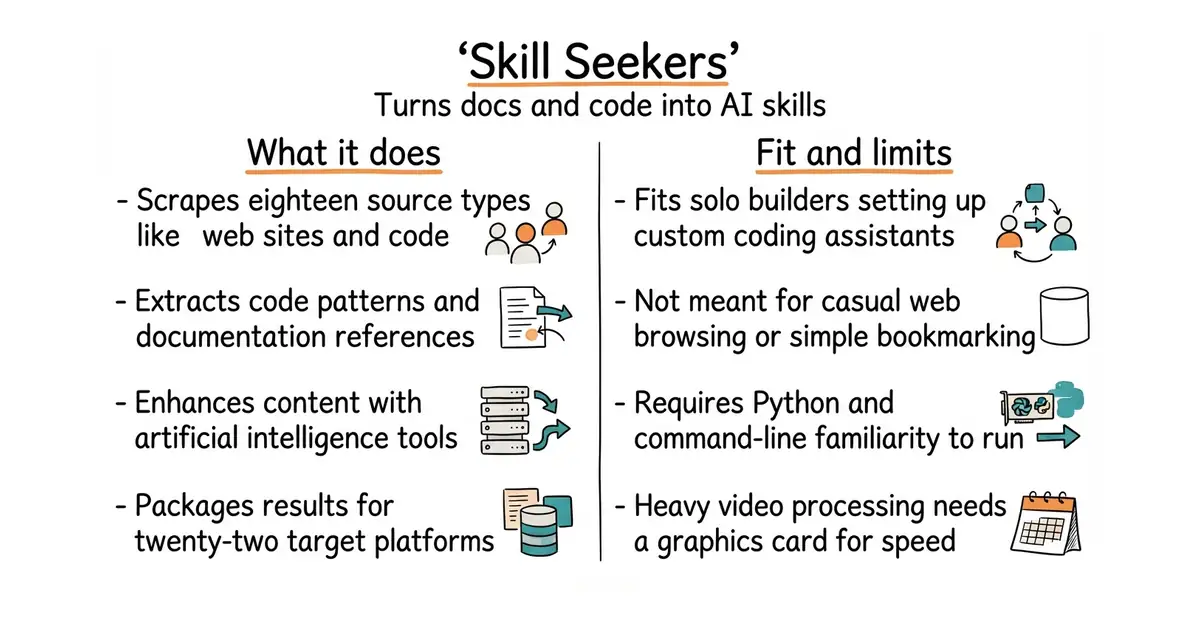
A Python command-line utility and MCP server that ingests eighteen different source types and exports them into twenty-two distinct formats. It prepares knowledge packages for platforms such as Claude, LangChain, Cursor, and LlamaIndex.
What it is good for
Solo developers who want to feed accurate, up-to-date framework documentation directly into their AI coding assistants without spending hours setting up context files manually.
Summary (Key Points)from the README
Key features
- Source coverage: Turns 18 source types, including docs sites, GitHub repos, PDFs, Word, EPUB, Jupyter, OpenAPI, videos, Confluence, Notion and Slack/Discord exports, into structured skills.
- Export targets: One prepared dataset can be packaged for 22 targets: 12 LLM platforms, 8 RAG and vector stores, and 2 others.
- AI enhancement: Runs through API mode (Anthropic, Google Gemini, OpenAI, Moonshot/Kimi, MiniMax) or LOCAL mode with agents such as Claude Code and Codex, and `--enhance-level` sets depth from 0 to 3.
- Codebase analysis: The C3.x pipeline adds 10 GoF pattern detectors across 9 languages, test-derived usage examples, AI-written how-to guides and architecture overviews.
- Project scan: `scan` has an AI agent read manifests, README, Dockerfile/CI and sampled imports, then emits one config per detected framework.
- Multi-source merging: One config can combine documentation, GitHub, PDFs and videos into a single knowledge asset, with conflict detection.
- Search index (opt-in): `--index` adds a stdlib-only SQLite FTS5 index so an agent can locate content before reading large Markdown files.
- MCP server: A FastMCP server exposes 40 tools for Claude Code, Cursor, Windsurf, VS Code with Cline, and IntelliJ IDEA.
- Agent installation: `install-agent` places skills into 19 AI coding agents, with a `--dry-run` option.
- Quality and sync: Quality scoring has a threshold gate, and doc-change detection supports scheduled re-scrapes and notifications.
Ways to install
| Platform or method | What it needs | Effort |
|---|---|---|
| pip (`pip install skill-seekers`, with optional extras) | Python 3.10+ and Git | One command; extras add LLM, MCP, video and other support |
| Homebrew tap | macOS | Not detailed in the README |
| GitHub Action (skill-seekers-action) | A GitHub CI/CD setup | Not detailed in the README |
| Claude Code plugin (skill-seekers-plugin) | Claude Code | Not detailed in the README |
Important
- Python and Git: Python 3.10+ and Git are listed as prerequisites.
- API costs: API mode calls paid model providers, whereas LOCAL mode avoids API costs but requires a supported local agent.
- Upload needs a key: Uploading to Claude requires `ANTHROPIC_API_KEY`; without it, you must upload the zip manually.
- Video setup: Video support needs the `video` extra, and GPU-aware visual dependencies need `video-full` followed by `create --setup`.
- Time estimates: The "15–45 minutes" and "99% faster" figures are the README's own claims, and the performance table gives only rough ranges.
- Huge doc sets: For 10K–40K+ pages, the README directs you to the `stream` approach and the Large Documentation guide.
- Readability metrics: English readability metrics are provisional and informational only, and they never affect the quality score.
- Version note: The README describes v3.9.0 changes, including HTML fallback parsing and env-driven CORS across all three servers.
Written by an AI model from the project’s README; not part of the review, and it can be wrong.
- Ingests eighteen different input types including websites, codebases, PDFs, and videos.
- Exports structured packages to twenty-two target platforms like Claude and LangChain.
- Includes a local Model Context Protocol server with forty built-in tools.
- Requires Python 3.10 or newer and a working terminal environment.
- Full video transcription and optical character recognition need extra GPU libraries.
- Large documentation sites can take up to an hour to scrape and process completely.
manual copying of documentation files into AI context windows
Claude Code or Cursor
- cursor/cursor33k stars
Cursor is an AI code editor that can read local context files generated by this tool.
- langchain-ai/langchain149k stars
LangChain is a framework for building applications with large language models that accepts the output chunks produced here.


- vllm-project/vllm96k stars
A serving engine that makes one graphics card answer many requests at once.
- infiniflow/ragflow93k stars
A question-answering system built on a document collection, with the sources shown beside every answer.
- basicmachines-co/basic-memory4.3k stars
Gives an AI assistant a memory that is stored as plain text files you can read.
python3 -m venv venv
source venv/bin/activate
pip install skill-seekers