4.3k stars · AGPL-3.0 · v0.24.1 (2026-10-23) · Track this in Scout
Gives an AI assistant a memory that is stored as plain text files you can read.
▶Repo detailsthe review · specs · pros & cons · install
What it does
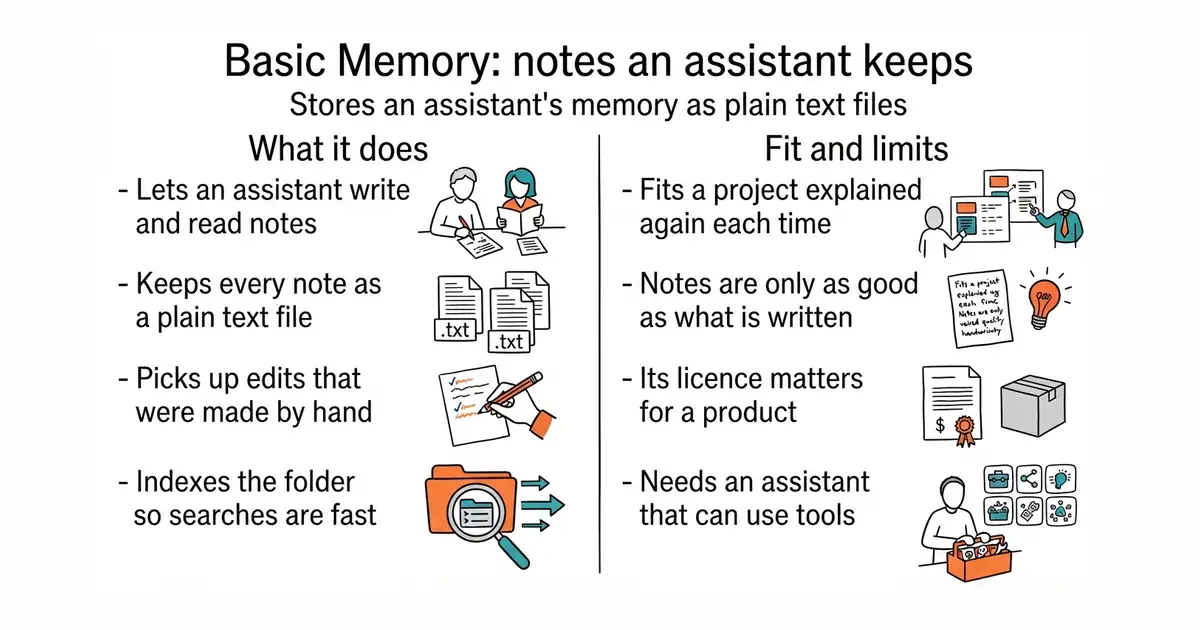
It runs as a small local service and speaks the Model Context Protocol, which is a standard way for an assistant to use outside tools. Through it, the assistant can write notes and read them back later. Those notes are Markdown files — plain text with simple marks for headings and links — in a folder you pick, and the links between them form a graph the assistant can follow. The same files can be edited by hand, and edits made by hand are picked up. It indexes the folder into a local database so searches are fast, and it supports several separate projects. Version 0.24.1 was published on 23 October 2026. It does not host anything and does not call an AI model itself: it is the memory, and the assistant is whatever is connected to it.
Why it matters
Who it suits. Anyone who has an ongoing project and keeps re-explaining it to an assistant at the start of every conversation. The plain-text storage is the reason to choose this over the alternatives: the memory can be inspected, corrected and committed like any other file. Skip it if the assistant in use cannot connect to outside tools, and skip it if the conversations are one-off questions with no shared context.
Verdict. Worth twenty minutes if the same project comes up repeatedly, and the design decision is the whole appeal. Keeping memory as files you can read means you can see what was remembered and delete what was wrong, which is not true of the hosted alternatives. It is current — version 0.24.1 was published the day before this edition — and it is AGPL-3.0, which is worth noting if the plan is to embed it in something else. Two warnings. The quality of the memory depends on the assistant deciding to write useful notes, so expect to prune the folder by hand at first. And an AGPL-3.0 licence on a local tool is harmless for personal use and a real question for a product. The better-known alternatives are hosted-first: mem0ai/mem0 is far more widely used and stores memory in a database rather than in files, and topoteretes/cognee builds a knowledge graph from documents and code as well as conversations.
- The memory is plain text in a folder, so it can be read, corrected and version-controlled.
- Edits made by hand are picked up, so the notes are genuinely two-way.
- Runs locally and calls no model itself, so nothing is sent anywhere by this tool.
- The notes are only as good as what the assistant chooses to write, so pruning is needed.
- AGPL-3.0, which matters if the intention is to build a product around it.
- Needs an assistant that can connect to outside tools, which not all can.
 mem0ai/mem0
Apache-2.0, the same idea with far more users and a hosted option, storing memory in a database rather than in readable files; it is the safer choice for a product and the worse one for inspecting what was remembered.
Track this in Scout- topoteretes/cognee
Apache-2.0, builds a knowledge graph from documents, code and conversations rather than from notes alone, which is more capable and more work to set up.
Track this in Scout
python3 -m venv venv
source venv/bin/activate
pip install basic-memory
basic-memory --help