Radar check
What we found when we opened it. Every bar is one fact, with its date.
Last code pushed 26 Sep 2026, 29 days before this check.
No releases published on GitHub; the code date above is the one to trust.
Public since August 2022, a little over 4 years.
21,247 stars and 2,441 forks.
1 commits and 13 new issues in the last 90 days.
26 contributors. No pull requests merged in 90 days; changes go in directly.
No security policy file says how to report a problem. No published security advisories.
How the bars are scored
- Alive. Days since the last code push: a week or less 100, a month 90, three months 70, six months 50, a year 30, eighteen months 15, older 0.
- Releases. Age of the latest GitHub release, on a similar scale; no bar when the project publishes no releases.
- Maturity. Age of the project: eight years 100, five 90, three 70, two 55, one 40, six months 25, younger 10.
- Adoption. Stars on a log scale: 100,000 stars is 100, 10,000 is 80, 1,000 is 60, 100 is 40.
- Activity. Commits in the last 90 days: 300 or more 100, 100 85, 30 65, 10 45, any 25.
- Community. People who have contributed: 100 or more 100, 30 80, 10 60, 5 40, 2 25, one 10.
- Security. A published security policy 80, none 40; published advisories are listed, not scored.
Checked by Repo Radar on 26 Oct 2026 from the repository on GitHub.
In simple English
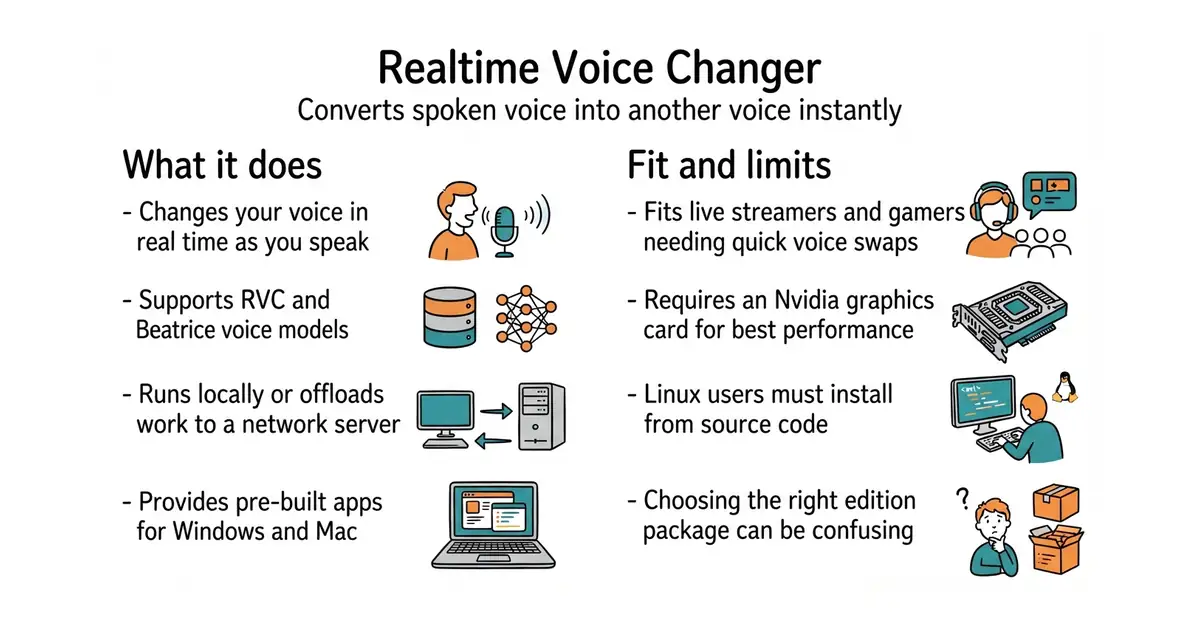
This program changes your voice as you speak into your microphone. It uses artificial intelligence to make you sound like someone else with almost no delay. You can use it during live streams, video calls, and voice chats in games. Pre-built packages are available for Windows and Mac computers, while Linux users need to run it from source code. It is free to use, but running the best voice models needs a powerful graphics card.
What it is
A real-time voice conversion tool that runs locally on your computer or on a separate server. It supports multiple voice models including RVC (Retrieval-based Voice Conversion, a method that maps your voice characteristics to another speaker using a small audio sample) and Beatrice.
What it is good for
Content creators and gamers who want to disguise their voice or sound like a specific character during live broadcasts without noticeable lag.
- Converts voices with very little delay as you speak.
- Works with popular voice models like RVC and Beatrice.
- Can run on a separate server to save your main gaming computer from heavy loads.
- Requires a strong graphics card with Nvidia CUDA support for the best voice models.
- Linux installation requires manual steps using the command line.
- Many different edition packages exist, which makes choosing the right download confusing.
manual post-recording audio dubbing and voice modulation plugins
OBS Studio
- RVC-Project/Retrieval-based-Voice-Conversion-WebUI39k stars
Focuses on training and converting voices using the same core retrieval method but with a web interface.

- spotify/pedalboard6.4k stars
Applies audio effects to recordings from Python, including studio plug-ins, without calling another program.
- iver56/audiomentations2.3k stars
Spoils sound recordings on purpose, 39 ways, so a model trained on them copes with real rooms.
- shaka-project/shaka-packager2.6k stars
Cuts a video file into the pieces and index files that a browser needs in order to stream it.
Download the pre-built application package for your operating system from the Hugging Face repository linked in the project description.