
2324 stars · MIT (named in the About sidebar, confirmed by the Python package index) · v0.43.1 (2025-09-13), shown on /releases/latest as '13 Sep' with no year and settled from the Python package index - thirteen months old, with five commits unreleased on main · Track this in Scout
Spoils sound recordings on purpose, thirty-nine ways, so a model trained on them copes with real rooms.
Radar check
What we found when we opened it. Every bar is one fact, with its date.
Last code pushed 13 Apr 2026, 6 months before this check.
Latest release v0.43.1 on 13 Sep 2025.
Public since February 2019, a little over 7 years.
2,324 stars and 228 forks.
0 commits and 0 new issues in the last 90 days.
34 contributors. No pull requests merged in 90 days; changes go in directly.
No security policy file says how to report a problem. No published security advisories.
How the bars are scored
- Alive. Days since the last code push: a week or less 100, a month 90, three months 70, six months 50, a year 30, eighteen months 15, older 0.
- Releases. Age of the latest GitHub release, on a similar scale; no bar when the project publishes no releases.
- Maturity. Age of the project: eight years 100, five 90, three 70, two 55, one 40, six months 25, younger 10.
- Adoption. Stars on a log scale: 100,000 stars is 100, 10,000 is 80, 1,000 is 60, 100 is 40.
- Activity. Commits in the last 90 days: 300 or more 100, 100 85, 30 65, 10 45, any 25.
- Community. People who have contributed: 100 or more 100, 30 80, 10 60, 5 40, 2 25, one 10.
- Security. A published security policy 80, none 40; published advisories are listed, not scored.
Checked by Repo Radar on 25 Oct 2026 from the repository on GitHub. Covered in Edition 61.
▶Repo detailsthe review · specs · pros & cons · install
What it does
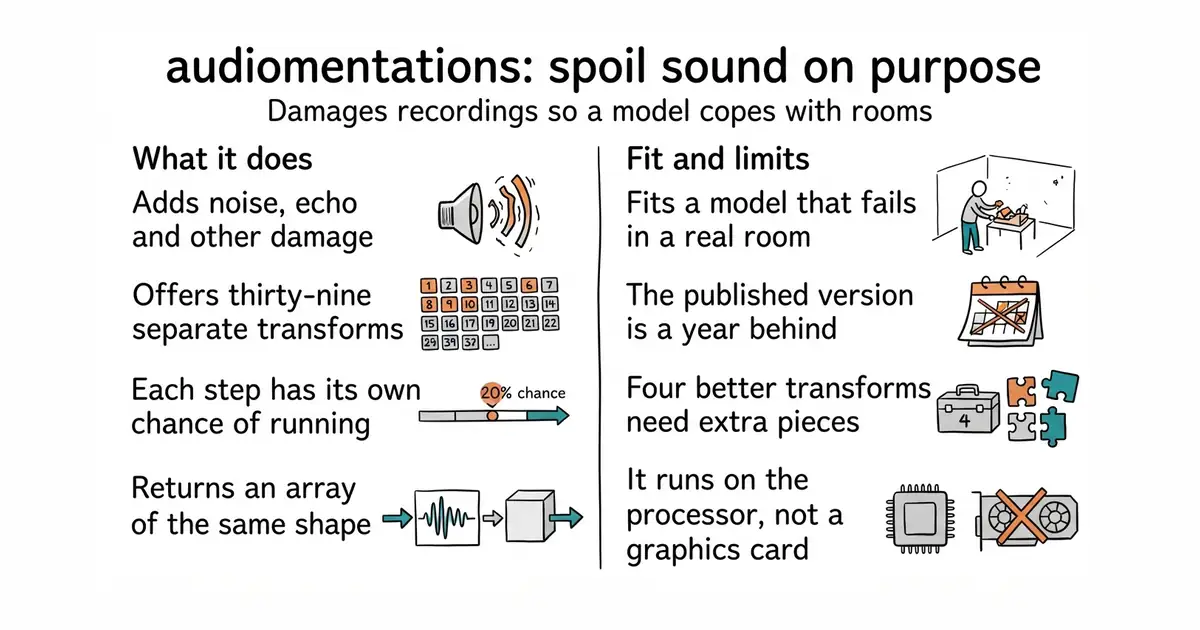
It takes an array of numbers representing a recording, as 32-bit values between minus one and one, and returns an array of the same shape with the damage applied. There are 39 transforms, covering added noise, filters, pitch shifting, time stretching, loudness normalisation, MP3 compression, room simulation and limiting. They are composed in groups: run all of them, pick one at random, or pick some, each with its own probability. The design deliberately mirrors the well-known image equivalent, so anyone who has done this with pictures will recognise the shape immediately. It plugs into either of the two main training frameworks. It runs on the processor only, and the documentation sends anyone wanting a graphics card to a sibling project. Two of the transforms, the ones that mix in background noise, still refuse multi-channel audio.
Why it matters
Who it suits. Anyone training a model on sound who is getting good test numbers and bad real-world ones. It fits someone who has already done this with images, because the shape of the code is intentionally the same. Skip it if the training set is already recorded in the conditions it will be used in, and skip it if the pipeline is on a graphics card, because this one is not.
Verdict. Twenty minutes, and the honest headline is the gap between its two clocks. Code was last pushed on 13 April 2026, six months ago, but the newest published version is 0.43.1 from 13 September 2025 — thirteen months old. So an ordinary install is well behind the code, with five changes sitting unreleased. Nothing is wrong with the project; it is simply not cutting releases often. Two things to plan for. The plain install quietly leaves out several of the more interesting transforms: the limiter, the loudness normaliser, the MP3 compressor and the room simulator each need an extra piece, and some of them need the ffmpeg media tool installed on the machine as well. And because everything happens on the processor, heavy augmentation competes with the training loop itself, which is the usual reason people move to the graphics-card sibling, asteroid-team/torch-audiomentations — a move that means rewriting the pipeline. The licence is plain MIT, which is the clearest advantage it has over entry 8 above.
- 39 transforms with probabilities, so every training copy is different.
- Plain MIT, so it can sit inside a closed product without a legal question.
- The shape of the code is borrowed from the image equivalent, so it is familiar immediately.
- The published version is thirteen months old while the code moved six months ago.
- The basic install leaves out four of the better transforms, and some need a media tool installed.
- Processor only, so heavy use competes with training and a graphics card means switching libraries.
 spotify/pedalboard
GPL-3.0, 6,252 stars, entry 8 of the same edition; applies audio effects from Python and can host studio plug-ins, which this one cannot, at the cost of a licence that rules out closed products.
Track this in Scout- asteroid-team/torch-audiomentations
MIT, 1.2k stars; the same idea on a graphics card, with each transform written as a layer that can sit inside the model itself.
Track this in Scout - facebookresearch/WavAugment
MIT, 687 stars; the same spoiling job aimed narrowly at self-supervised speech research, with a much shorter list of transforms.
Track this in Scout
python3 -m venv venv
source venv/bin/activate
pip install audiomentations
pip install "audiomentations[extras]"