10,400 read from the page; ungh's eleven-week-old snapshot gives 10,251 stars · Apache-2.0, read from /blob/master/LICENSE, standard and unmodified, and THE COPYRIGHT HOLDER PLACEHOLDER IS UNFILLED. No second licence file, yet a 'Reloader Enterprise' section in the README sells signed CVE-free images with an SBOM, SLA-backed support, artifact provenance and an escalation path, with no pricing published and no licence file to match. · chart-v2.2.18 of 2026-09-30, the release page reading '30 Sep' with no year and SETTLED BY ARTIFACT HUB'S JSON API, which gives that chart a ts of 1790749039 — a second source new to this archive. The release marked Latest is a HELM CHART tag, not an application release: Artifact Hub records chart 2.2.18 as carrying app_version v1.4.22, so the current stable application is v1.4.22 of 9 September 2026, with a v2.0.0-beta.1 line in pre-release. pkg.go.dev is behind at v1.4.19 of 1 July 2026. · Track this in Scout
A Kubernetes controller that triggers a rolling update when a ConfigMap or Secret a workload uses is changed.
▶Repo detailsthe review · specs · pros & cons · install
What it does
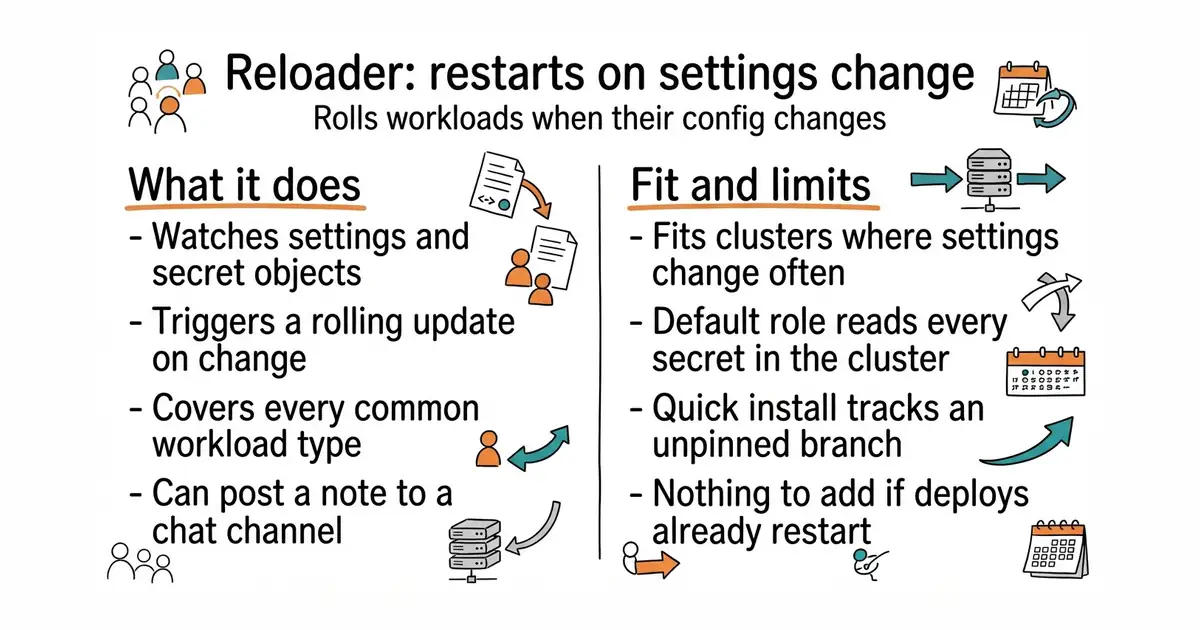
It runs as a controller inside the cluster — a small program that watches objects and reacts to them. It watches ConfigMaps (settings files) and Secrets (passwords and keys). When one changes, it finds the workloads that reference it, or the ones that opted in with an annotation, and triggers a rolling update: new copies start, old copies stop, and the service stays up. It covers Deployments, StatefulSets, DaemonSets, DeploymentConfigs and Argo Rollouts. It can also send a note to a webhook, Slack, Teams or Google Chat when it acts. With the CSI integration switched on it also watches secrets arriving from an external store. Its own documentation is unusually honest about where it stops: it reacts to CSI status changes, not to direct updates in the external store; only one resource type can be ignored at a time; and the auto and search annotations cannot be combined.
Why it matters
Who it suits. Anyone running applications on Kubernetes where configuration changes more often than code does — feature switches, rotated credentials, tuning values. It is most useful where several teams change settings and nobody owns the job of restarting things afterwards. Skip it if your deployment pipeline already redeploys on every settings change, because then the restart is already happening.
Verdict. A small, well-documented tool that removes a whole category of "it still has the old value" confusion, and it has been maintained since 2018. Before installing it, read the permissions it asks for: the shipped manifest creates a cluster-wide role that can read every Secret and every ConfigMap in every namespace. That is how it does its job, and it is also a very large amount of trust for one small program. Note too that the kubectl and kustomize install commands both pull from the project's master branch rather than a fixed release, so what you install changes over time; take a release file instead. wave-k8s/wave at 777 stars does the same job with a narrower footprint if the permission grant troubles you.
- Covers every common Kubernetes workload type, including Argo Rollouts.
- The documentation lists its own limits plainly, which is rarer than it should be.
- Defaults are modest: 150m of processor and 512Mi of memory as limits.
- The default install grants read access to every Secret in the cluster, in every namespace.
- The quick install commands track the
masterbranch, so they are not pinned to a release. - The default strategy edits pod templates, which deployment tooling may then report as unexpected drift; the project suggests switching to the annotations strategy instead.
- wave-k8s/wave
The closest match, at 777 stars, with code on 9 September 2026; it rolls workloads on the same events with a smaller surface.
Track this in Scout - kiwigrid/k8s-sidecar
Writes labelled ConfigMaps into a folder inside a running pod, at 768 stars, with code on 8 October 2026; a different answer to the same problem.
Track this in Scout - jimmidyson/configmap-reload
The oldest and simplest of the three, at 1,085 stars, with code on 24 August 2026; it signals one process rather than rolling a workload.
Track this in Scout
helm repo add stakater https://stakater.github.io/stakater-charts
helm repo update
helm install reloader stakater/reloader