7,649 stars · MIT read from main/LICENSE.md — NOT at /LICENSE, which 404s; the real filename was found by enumerating the repository's files through the mirror. Holder FILLED IN: 'Copyright (c) 2009 Samuel Clay, NewsBlur'. No added conditions. · v0.2.2 (2026-08-11), and it covers only the CLI, not the server, which publishes no tags. Settled against the package page for newsblur-cli, which prints 'Released: Aug 11, 2026'. · Track this in Scout
A feed reader that learns which stories are wanted and hides the rest, running since 2009 and self-hostable.
▶Repo detailsthe review · specs · pros & cons · install
What it does
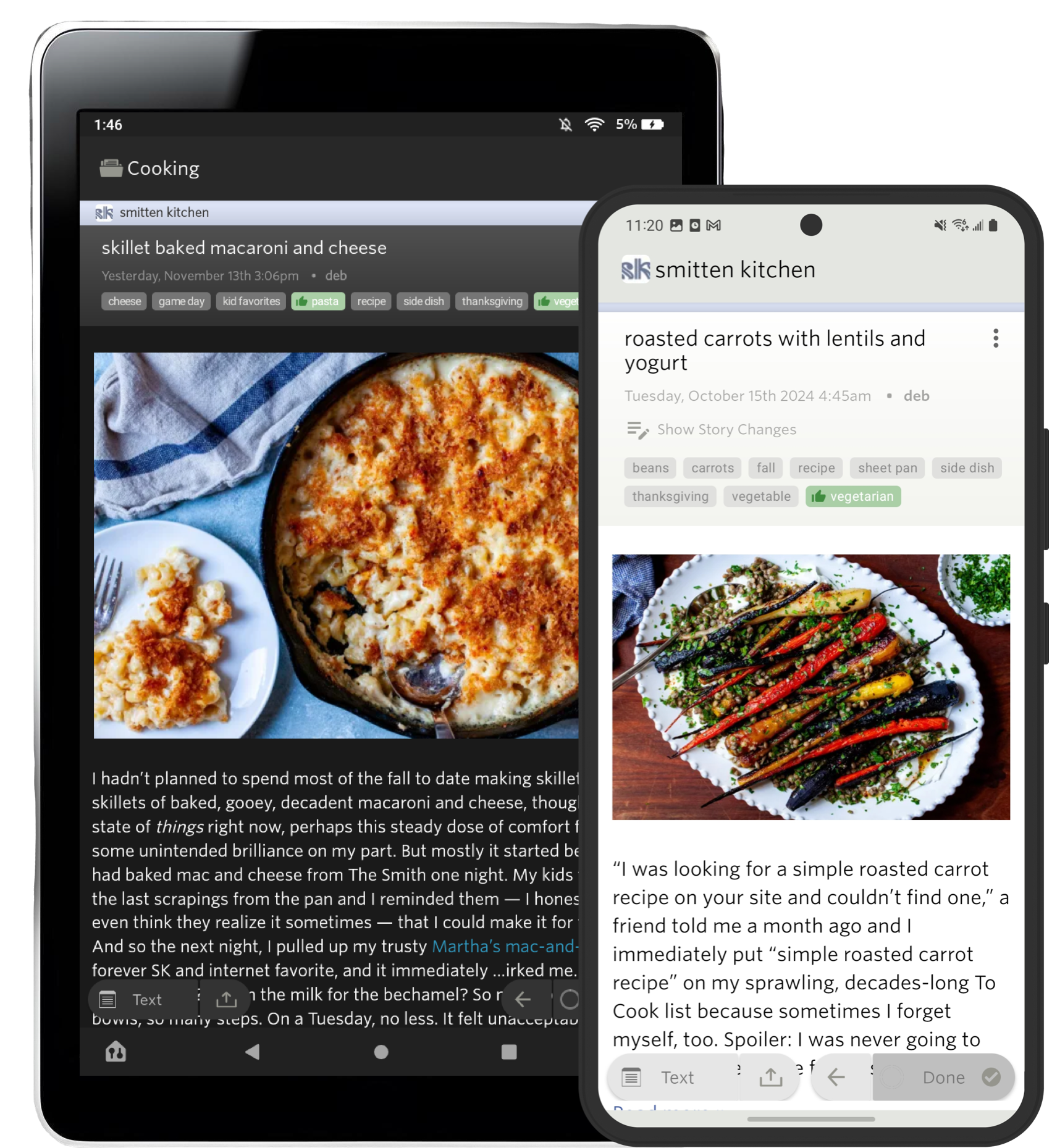
NewsBlur collects articles from feeds and shows each one beside the publisher's original page rather than only as stripped text, expanding feeds that only publish a summary into the full article. Its distinguishing feature is training: thumb an author, a tag or a word in a headline up or down, and a classifier then highlights or hides matching stories, with a slider running from heavily filtered to completely unfiltered. Stories arrive as they are published rather than on a slow timer, and it notices when an article is quietly edited after publication, which is a genuinely rare feature. It searches the full text, supports custom tags and saved searches, reads email newsletters and follows video channels as though they were feeds, and shares stories to a per-person public page. There are four reading layouts, a dark mode, and native applications for phones and desktops, plus support in several third-party readers. Underneath it is a Python web application with a browser front end, backed by PostgreSQL for accounts and subscriptions, MongoDB for stories and read state, Redis for assembly and caching, optional Elasticsearch for search, a task queue for fetching, and two small services for text extraction and image proxying. The hosted free tier is capped at 64 feeds. Its agent interface requires a paid subscription, and the artificial-intelligence features and related-story discovery do nothing without a paid model key. Search is absent unless you also run Elasticsearch.
Why it matters
Who it suits. Anyone who follows more feeds than they can read and wants software to do the first pass of sorting — that is what the training is for, and nothing else in this category does it as seriously. It also suits anyone who wants their reading history to stay on hardware they control. Skip it if you want something small: this is the heaviest install in this edition by a wide margin, and the project's own README says the hosted service is the right choice for most people.
What people say. The oldest source is also the best and it is fifteen years out of date, which is itself worth knowing. Nathan Willis reviewed it at Linux.com on 23 November 2011 and was both admiring and sharp: he praised the rating and statistics engines as a level of machine learning other free readers did not attempt, and called the install instructions "on the sparse side", the database setup "non-trivial", and the whole thing "probably overkill" for one person. Several of his specific complaints no longer apply, because the stack has been rebuilt around containers since. The useful current source is a distribution rather than a review: the F-Droid package record for com.newsblur shows a reproducible build of version 15.0.5 "Added on Oct 05, 2026", confirming both the licence and that the mobile application is still being built; F-Droid is independently operated and sells nothing. One current article exists, feeder.co's comparison updated 27 September 2026, and it is published by a company selling a directly competing reader — it says so itself in the page — so we list it only as a price reference and not as an assessment. No current, credible, authored review of NewsBlur exists that we could find.
Verdict. Pay for the hosted version unless self-hosting is the point. That is the project's own advice and it is correct: running this yourself means PostgreSQL, MongoDB, Redis, Elasticsearch, a load balancer, a web server and two Node services, and the project publishes no memory or disk figure for any of it. If you do self-host, read this next. The shipped development compose file has a PostgreSQL password of newsblur, a hardcoded agent-interface secret, Elasticsearch security switched off and no Redis password — and every single port, databases included, is published on every network interface rather than only through the proxy. On top of that the documented self-hosting defaults turn on automatic premium for new accounts, enable new users automatically, and switch the signup challenge off. In other words, an install left as documented is an open-signup service with your databases exposed. Fix those four things before it touches a public address. If you want something light instead, miniflux/v2 is one Go binary, and FreshRSS/FreshRSS is a PHP application that several people can share.
- The training actually works and nothing else in this category attempts it seriously: highlight and hide rules per feed, with a slider from filtered to raw.
- Real features other readers lack — original-page view, full-text expansion of truncated feeds, detection of stories silently edited after publication, saved searches, and newsletters and video channels treated as feeds.
- MIT read from the file (at
LICENSE.md, notLICENSE) with the copyright holder named, no added conditions, and code pushed the day before this edition, corroborated by an independent reproducible build five days earlier.
- The documented self-hosted defaults are unsafe as published: a PostgreSQL password of
newsblur, a shipped agent-interface secret, Elasticsearch authentication off, no Redis password, and every port — PostgreSQL, MongoDB, Redis, Elasticsearch included — published on every interface. Plus automatic premium, automatic account enabling and no signup challenge. - Seven services to run and no memory, processor or disk figure published anywhere for any of them. The first visit requires typing a phrase into the browser to get past a self-signed certificate.
- The agent interface needs a paid subscription, the machine-learning extras need a paid model key, and search needs Elasticsearch running. The hosted free tier stops at 64 feeds.
 miniflux/v2
Deliberately minimal: one Go binary and a database, no training and no social layer, and far lighter to run.
Track this in Scout FreshRSS/FreshRSS
A multi-person aggregator with tags and scraping on a PHP and MySQL stack rather than seven services, with no learning features.
Track this in Scout- nkanaev/yarr
A single small binary for one person on a desktop or small machine, with no social or machine-learning features at all.
Track this in Scout
git clone https://github.com/samuelclay/NewsBlur.git
cd NewsBlur
make