2.9k stars · Apache-2.0 · v0.89.4 (2026-09-01) · Track this in Rising ↗
'Fast business intelligence tool for humans and agents' — self-hosted, would sit next to Evidence (Ed.8 #6).
Radar check
What we found when we opened it. Every bar is one fact, with its date.
Last code pushed 27 Oct 2026, the same day before this check.
Latest release v0.90.8 on 26 Oct 2026.
Public since December 2021, a little over 4 years.
2,968 stars and 205 forks.
247 commits and 10 new issues in the last 90 days.
59 contributors. 242 pull requests merged in 90 days.
No security policy file says how to report a problem. No published security advisories.
How the bars are scored
- Alive. Days since the last code push: a week or less 100, a month 90, three months 70, six months 50, a year 30, eighteen months 15, older 0.
- Releases. Age of the latest GitHub release, on a similar scale; no bar when the project publishes no releases.
- Maturity. Age of the project: eight years 100, five 90, three 70, two 55, one 40, six months 25, younger 10.
- Adoption. Stars on a log scale: 100,000 stars is 100, 10,000 is 80, 1,000 is 60, 100 is 40.
- Activity. Commits in the last 90 days: 300 or more 100, 100 85, 30 65, 10 45, any 25.
- Community. People who have contributed: 100 or more 100, 30 80, 10 60, 5 40, 2 25, one 10.
- Security. A published security policy 80, none 40; published advisories are listed, not scored.
Checked by Repo Radar on 27 Oct 2026 from the repository on GitHub. Covered in Edition 16.
▶Repo detailsthe review · specs · pros & cons · install
What it does
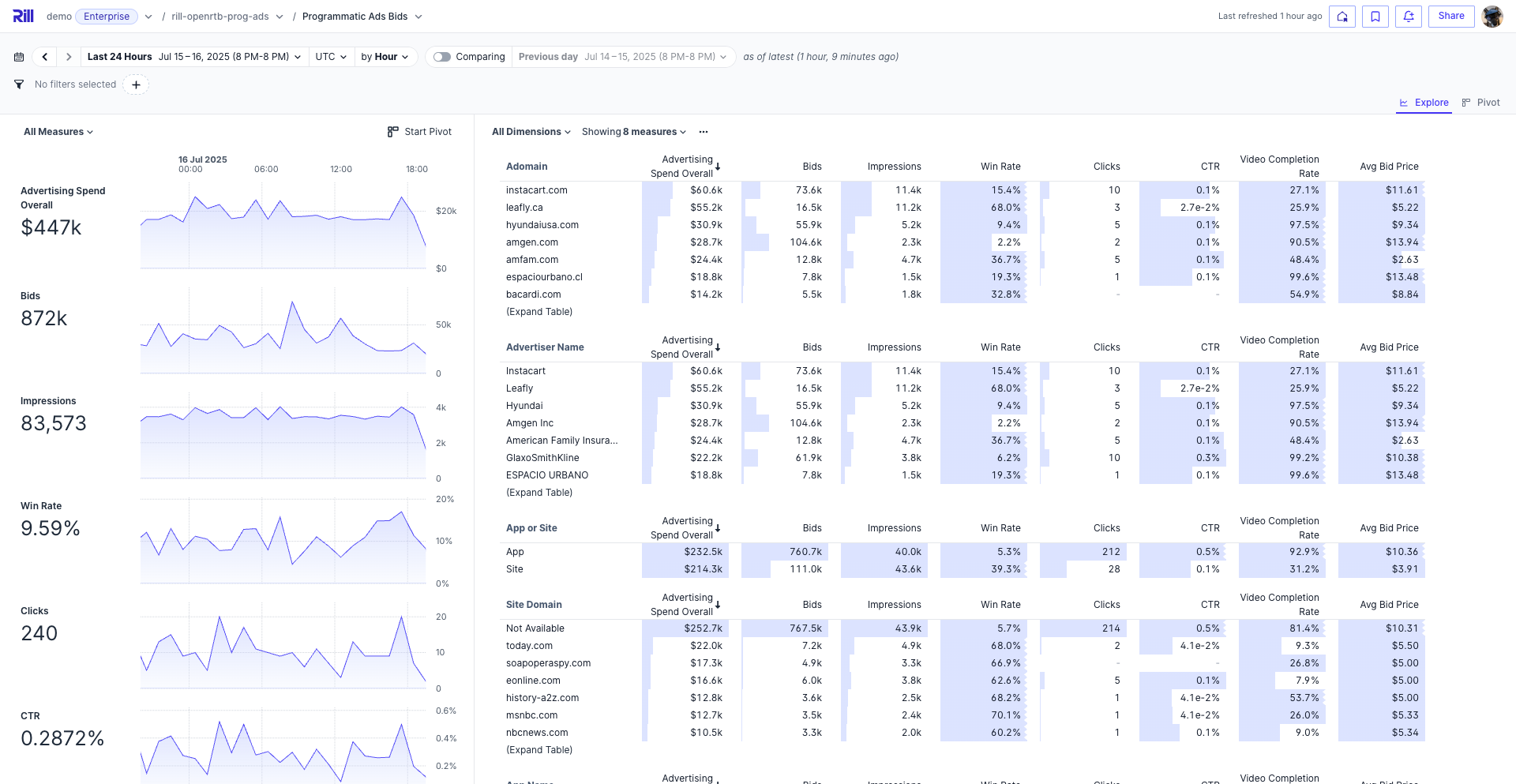
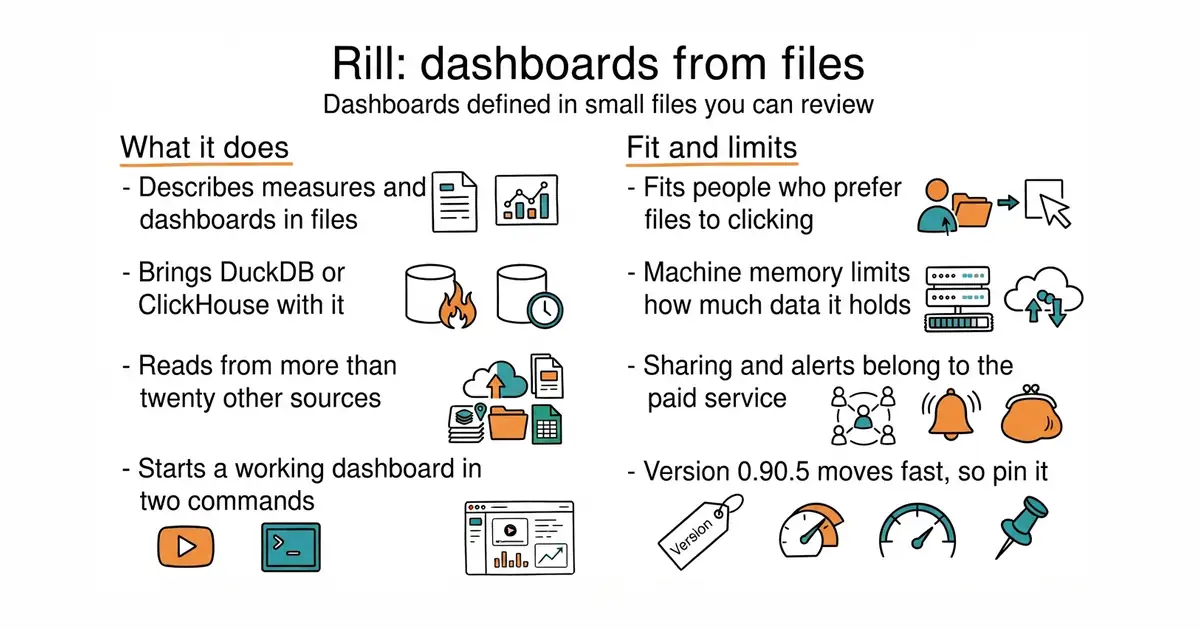
Rill is a business intelligence tool where data models, measures and dashboards are described in YAML and SQL files inside a project folder. It ships with a fast query engine, either DuckDB or ClickHouse, so there is nothing to set up before the first chart appears. Two commands take you from nothing to a working dashboard in a browser. It can also connect to engines that are already running, including ClickHouse Cloud, Druid, Pinot and MotherDuck, and it reads from S3, Google Cloud Storage, databases and more than twenty other sources. It has a layer where a measure is defined once and used everywhere, and it supports rules that limit which rows a person can see. Sharing, deployment, alerts and conversational use are features of Rill Cloud, the paid hosted product, rather than of the free tool. The project names no limitations of its own, and the honest one is that the engine runs inside the tool, so the machine's memory sets the ceiling on how much data it can hold.
Why it matters
Who it suits. It fits anyone with data in files or a database and no good way to look at it, and anyone who would rather review a dashboard change as text than as somebody's description of what they clicked. Two commands to a working chart is unusual in this category, where most tools want a warehouse first. Daily figures, test results and transaction records are the shape it likes. Skip it if clicking a chart together is genuinely preferred, and skip it if the data is far larger than the machine's memory.
Verdict. Worth an hour, and the file-based definitions are the reason to pick it over a click-together tool: a measure written in a file can still be explained in six months. Two things to watch. It is at version 0.90.5 and moves quickly, so pin the version you install. And this is the free half of a paid product, so check which features you need before building on it — the README names several that belong to the hosted service. evidence-dev/evidence is the closest free alternative with the same file-based idea, and worth comparing before committing.
Summary (Key Points)from the README
Key features
- Semantic layer: Dimensions, measures, and time grains are defined once in YAML and turned into SQL at query time against the OLAP engine.
- Agent authoring: BI-as-code (YAML + SQL) lets coding agents such as Claude Code and Cursor write projects, dashboards, and security policies end-to-end.
- Conversational BI: Business users can query metrics in natural language, and the MCP server connects Claude, ChatGPT, or other AI agents to the semantic layer.
- OLAP engine choice: Managed ClickHouse or DuckDB is included, and external engines such as ClickHouse Cloud, Druid, Pinot, and MotherDuck can be connected.
- Connectors: S3, GCS, databases, and 20+ other sources feed SQL models that can be transformed and joined.
- Incremental ingestion: Each run loads only new data, so large datasets stay current without full refreshes.
- Data profiling: Column statistics and distributions are shown instantly during local development.
- Row access policies: Data access can be controlled per user or per group.
- Deploy and automate: Git-backed, versioned deployments are pushed with `rill deploy` or triggered automatically by connecting a repo for CI/CD.
- Alerts, reports, and APIs: Threshold alerts can be defined in code or in the UI, and metrics can be exposed via REST or embedded dashboards.
Important
- Performance claims: The README promises sub-second queries "at any scale" and cites ClickHouse for billions of rows, but it gives no benchmarks, so results will depend on your data and setup.
- Engine trade-off: DuckDB is positioned for smaller datasets and fast iteration, while ClickHouse is positioned for billions of rows; choose based on data volume.
- Cloud-only features: Deployment, the MCP server, Conversational BI, custom APIs, embedding, and alerts and reports are listed under Rill Cloud, not the local Rill Developer.
- Agent dependence: The agent-driven workflow assumes you use coding agents such as Claude Code or Cursor, and the README does not describe how it behaves without them.
- Pricing and licensing: The README does not state cloud pricing, plan limits, or the software license, so check these before adopting it.
Written by an AI model from the project’s README; not part of the review, and it can be wrong.
- Two commands from nothing to a working dashboard. No warehouse, no server and no account.
- It brings DuckDB or ClickHouse with it, and can also connect to more than twenty other sources.
- The dashboard is text in a project folder, so it can be reviewed, compared between versions and copied to another project.
- The engine runs inside the tool, so the machine's memory limits how much data it can hold. No minimum is published.
- This is the free half of a paid product. Sharing, deployment, alerts and conversational use belong to the hosted service.
- It is at version 0.90.5 and moves quickly. Pin the version you install.
curl https://rill.sh | sh
rill start my-project