5,419 stars · Apache-2.0 (read from /blob/main/LICENSE; stock unmodified text, and the boilerplate copyright line is left as the [yyyy] [name of copyright owner] template, so no holder is named) · v0.21.0 (2026-10-02, year confirmed by pkg.go.dev) · Track this in Scout
Links a few servers into one private network and runs containers across them, with no central controller.
▶Repo detailsthe review · specs · pros & cons · install
What it is
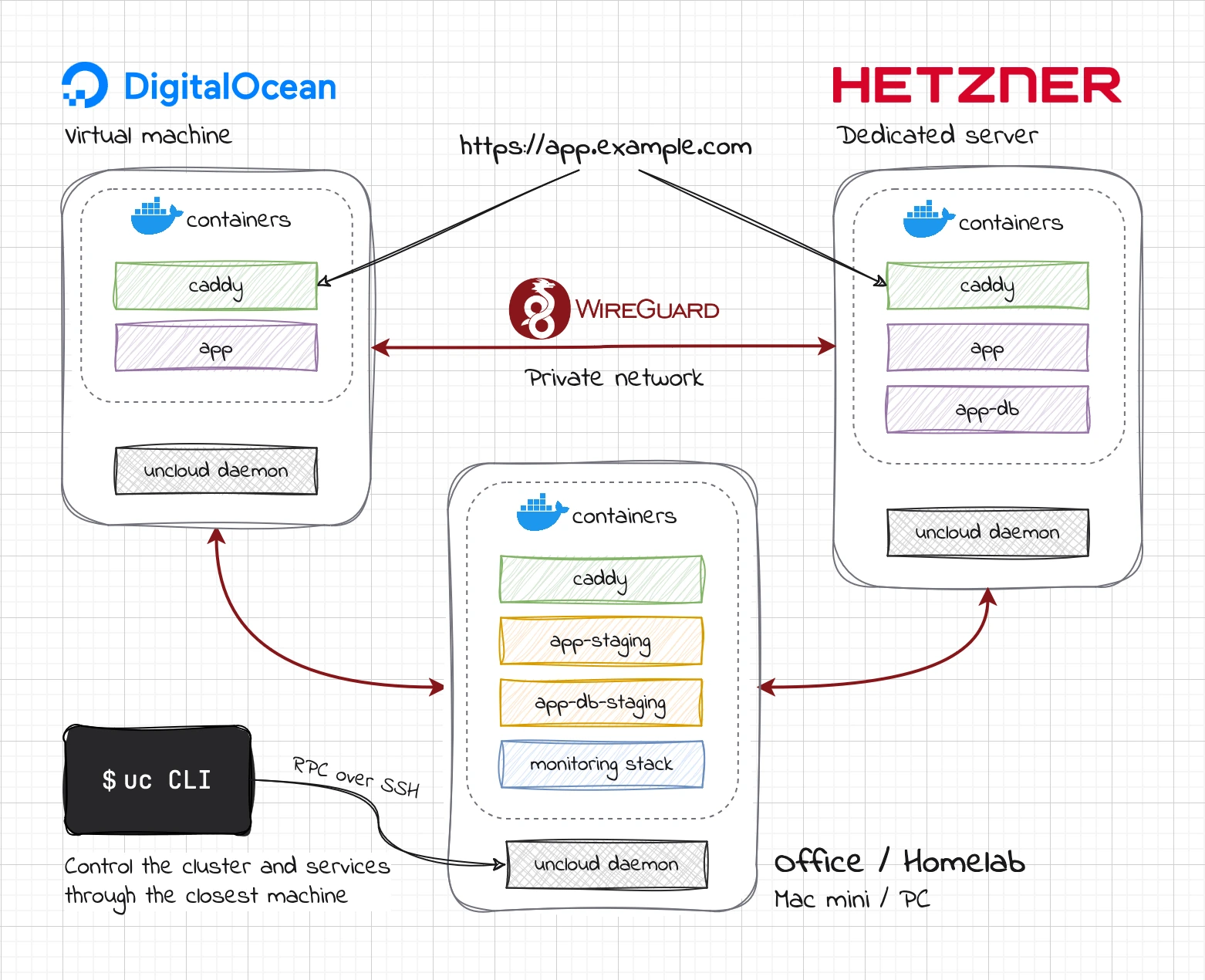
Uncloud is a command-line tool written in Go. It builds an encrypted private network between your machines using WireGuard, which is a common way of making separate computers behave as if they were on the same local network, and then runs containers on them with names that resolve automatically and web traffic handled by Caddy.
What it is good for. Anyone whose single server has become the thing they are afraid of. One machine means one power cut, one disk, one reboot. Uncloud is for the step after that — two or three ordinary machines, possibly at different providers, treated as one place to put things — without the weight of Kubernetes, which is the industry standard cluster manager and takes weeks to learn properly.
- There is no controller to run and keep alive. The machines agree among themselves, so there is no single box whose failure stops everything.
- It reads the same
composefiles most people already have, so an application described for one machine can usually move across without being rewritten. - Machines at different hosting companies, or a machine at home and a machine in a data centre, can sit in the same private network.
- It is openly before version 1.0 and still changing in ways that break things. Version 0.21.0, released on 2 October 2026, moved the file the tool talks to from one path to another.
- The documented install pipes a script straight from the internet into a shell, which means running code you have not read. There is also no screen: it is a command line and YAML files only.
- No memory, processor or disk figure is published, and no minimum version of Go or of the container software is named. When something breaks you own four moving parts at once — the container software, WireGuard, Caddy and the agreement layer between machines — with 66 waiting problems and no company behind it.
- k3s-io/k3s
The same job of running containers across several machines, but it is real Kubernetes with the central controller and the standard client, which is precisely the weight uncloud avoids.
Track this in Scout - hashicorp/nomad
The same job of placing work on a pool of machines and it scales past ten thousand of them, but it is a server-and-client cluster with its own job format, and its Business Source License 1.1 is not open source.
Track this in Scout  coollabsio/coolify
Also manages applications across several machines you can log in to, but through a web page and an application catalogue rather than a private network and compose files.
Track this in Scout
brew install psviderski/tap/uncloud