In simple English
This program runs your own private cloud storage server. It speaks the same language as Amazon S3, so your other software works with it right away. It saves your backups, uploaded user files, and container images on your own hard drive. It costs nothing to download, but you need a server or a computer to keep it running day and night. It continues the work of another popular storage tool after its creators stopped offering free releases.
What it is
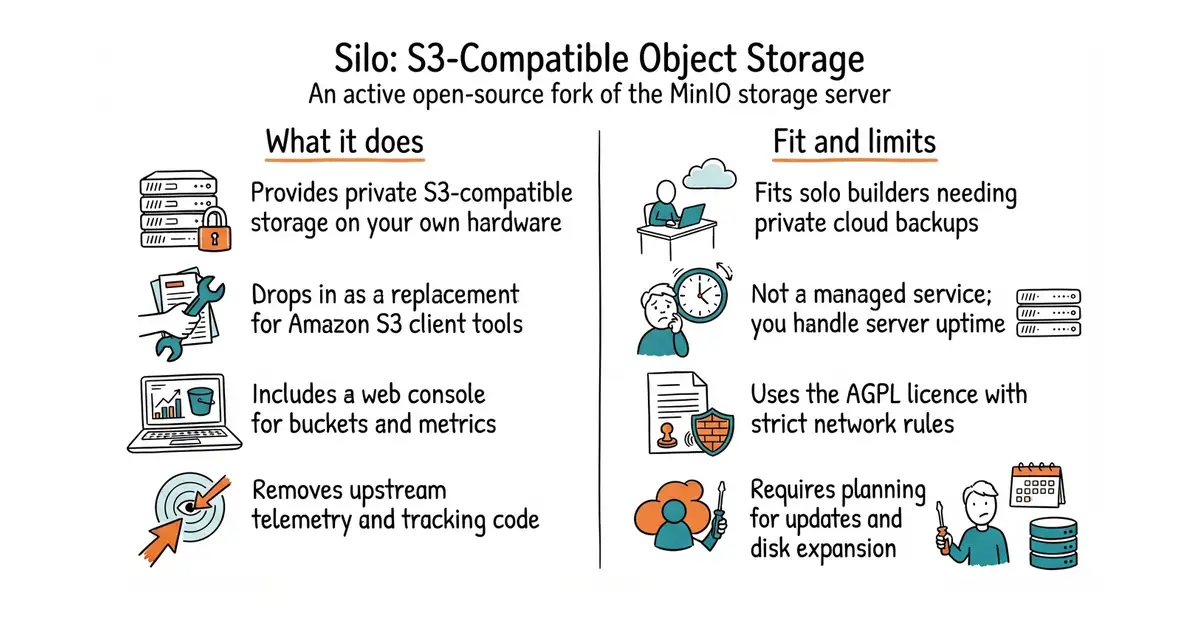
Silo is an S3-compatible object storage server that forks and continues the open-source MinIO project. It provides prebuilt packages, Docker images, and an included web interface for managing buckets and viewing storage metrics.
What it is good for
Solo builders who want a private, self-hosted alternative to cloud storage for backups, file uploads, or media hosting without paying monthly cloud fees.
- Keeps a vital open-source storage project active with regular security updates and prebuilt releases.
- Drop-in compatible with existing Amazon S3 tools, client libraries, and environment variables.
- Includes a full web console for managing your buckets and monitoring disk usage without using the command line.
- Requires manual server administration, including setting up TLS certificates, monitoring disk space, and planning disaster recovery.
- Uses the AGPL-3.0 licence (a license that requires you to share your source code if you modify the software and let others use it over a network).
- Requires careful testing when upgrading because breaking changes in upstream libraries or storage formats can occasionally happen.
Upstream MinIO community editions and paid cloud object storage services.
pgsty/pigsty
- seaweedfs/seaweedfs36k stars
Another self-hosted distributed storage system with O(1) disk lookups and S3 support.
- pocketbase/pocketbase62k stars
An all-in-one backend that includes built-in file storage alongside a database and authentication.


- caprover/caprover15k stars
A web page that installs apps and databases onto one rented computer, and sorts out the addresses and certificates.
- google/slo-generator564 stars
Turns a written reliability target into a measured number and a remaining budget.
- vectordotdev/vector23k stars
One collector that gathers logs and numbers from machines and sends them to one or more monitoring services.
docker run -d --name silo -p 9000:9000 -p 9001:9001 \
  -e MINIO_ROOT_USER=minioadmin \
  -e MINIO_ROOT_PASSWORD=change-me-long-password \
  -v "$PWD/data:/data" \
  docker.io/pgsty/silo:RELEASE.2026-10-18T00-00-00Z server /data --console-address ":9001"