22.8k stars · MPL-2.0 · v0.60.0 (2026-10-19) · Track this in Scout
One collector that gathers logs and numbers from machines and sends them to one or more monitoring services.
▶Repo detailsthe review · specs · pros & cons · install
What it does
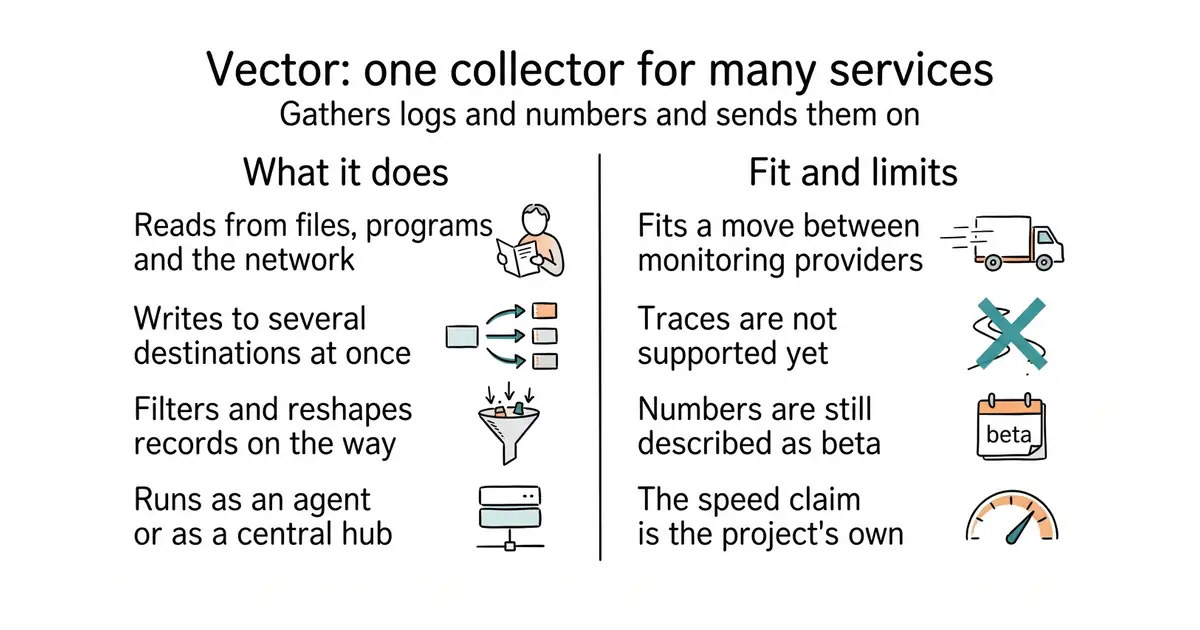
You run it on each machine as a small agent, and optionally once more in the middle as a hub that everything reports to. It reads from files, programs and network sources, reshapes what it finds, and writes to one or more places at once. Being able to write to several places matters because it is how you test a new monitoring provider without turning off the old one. It is written in Rust, which the project says it chose for reliability, and it is maintained by Datadog's community open-source team. Version 0.60.0 was released on 19 October 2026. The project publishes its own benchmark table, and that table is worth a look for an unusual reason: on one of the tests, parsing text with patterns, it reports 13.2 MiB per second against a competitor's 20.5. Here is the boundary. Traces, which record one request's whole journey through several services, are listed as not supported yet. Metrics are marked as still in beta. And the claim of being up to ten times faster than every alternative is the project's own marketing line, not a figure verified here.
Why it matters
Who it suits. Anyone running more than two or three machines who has lost track of which collector is installed where. It suits a move between monitoring providers more than anything else, because sending to both at once turns a risky switch into a dull one. It also suits anyone paying per record, since filtering noise before it leaves the machine is the cheapest place to do it. Skip it if one machine writes one log file and a single hosted agent already handles it, and skip it if traces are the thing you actually need.
Verdict. The right tool for the job it claims, and the job is narrower than the front page suggests. Treat the headline speed claim as a direction rather than a number, especially since the project's own table shows it losing one of the five tests. Two practical notes. The repository gives no install commands and no stated requirements, so everything about setting it up lives on the documentation site. And traces being absent after more than fourteen thousand commits is a real signal about what this project is for: it is a logs and metrics pipeline, and if you need traces you want open-telemetry/opentelemetry-collector instead. The licence is also worth a glance. MPL-2.0 is a middle-ground licence: you may use it in a commercial product, but changes to the project's own files have to be published.
- One collector reads from many sources and writes to many destinations at once.
- Writing to two providers at the same time makes switching monitoring services safe.
- An active release line, with version 0.60.0 three days before this edition.
- Traces are not supported, and metrics are still described as beta.
- No install commands and no stated requirements on the repository page.
- The speed claim is the project's own, and its own benchmark table shows a competitor winning one test.
- fluent/fluent-bit
Apache-2.0, a smaller and older collector for logs, metrics and traces; it won the pattern-parsing test in the project's own benchmark table.
Track this in Scout - open-telemetry/opentelemetry-collector
Apache-2.0, the vendor-neutral standard collector, and the one to reach for when traces are part of the job.
Track this in Scout
# the project's install script
curl --proto '=https' --tlsv1.2 -sSf https://sh.vector.dev | bash
# or the container image
docker pull timberio/vector:latest-debian