Radar check
What we found when we opened it. Every bar is one fact, with its date.
Last code pushed 25 Mar 2026, 7 months before this check.
Latest release v0.1.1-alpha on 23 Feb 2024.
Public since November 2023, a little over 2 years.
10,323 stars and 854 forks.
0 commits and 3 new issues in the last 90 days.
32 contributors. No pull requests merged in 90 days; changes go in directly.
No security policy file says how to report a problem. No published security advisories.
How the bars are scored
- Alive. Days since the last code push: a week or less 100, a month 90, three months 70, six months 50, a year 30, eighteen months 15, older 0.
- Releases. Age of the latest GitHub release, on a similar scale; no bar when the project publishes no releases.
- Maturity. Age of the project: eight years 100, five 90, three 70, two 55, one 40, six months 25, younger 10.
- Adoption. Stars on a log scale: 100,000 stars is 100, 10,000 is 80, 1,000 is 60, 100 is 40.
- Activity. Commits in the last 90 days: 300 or more 100, 100 85, 30 65, 10 45, any 25.
- Community. People who have contributed: 100 or more 100, 30 80, 10 60, 5 40, 2 25, one 10.
- Security. A published security policy 80, none 40; published advisories are listed, not scored.
Checked by Repo Radar on 26 Oct 2026 from the repository on GitHub.
In simple English
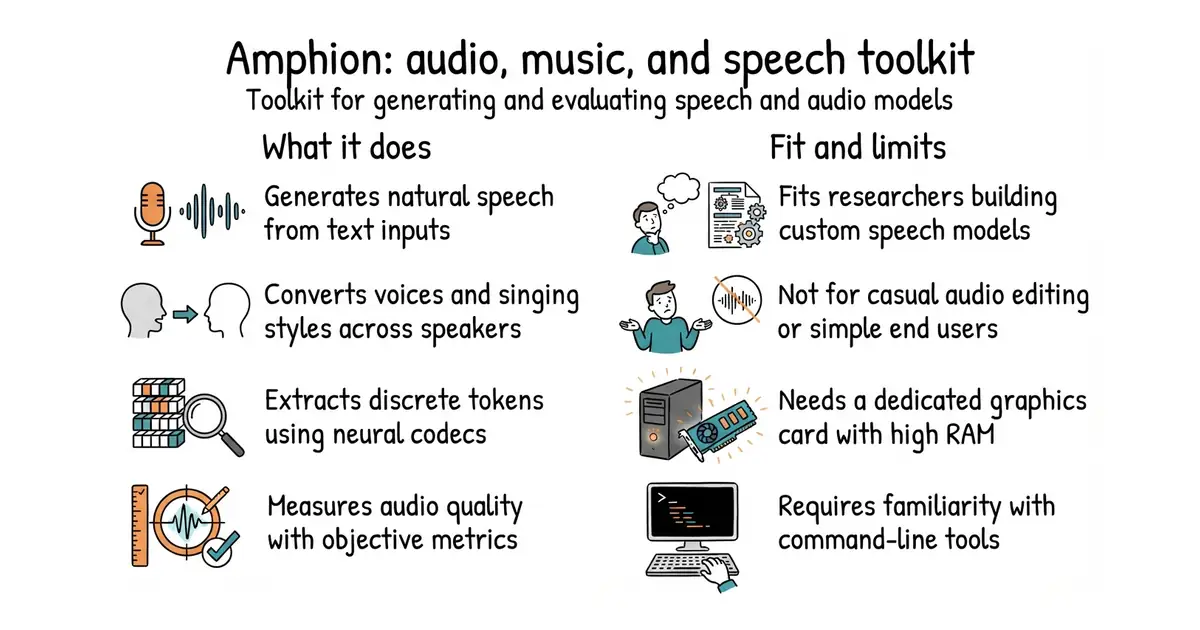
This toolkit helps you build and test AI models that generate human speech, singing, and sound effects. It includes pre-built architectures like text-to-speech and voice changers so you do not have to write them from scratch. You also get visualization tools to see how internal model layers work. It is free to use under an MIT licence. You need a powerful computer with a dedicated graphics card to train or run these models.
What it is
Amphion is a Python-based research toolkit supporting tasks like text-to-speech, singing voice conversion, voice conversion, and neural audio codecs. It packages state-of-the-art models, data preprocessing pipelines, and evaluation metrics into a single repository.
What it is good for
Researchers and developers who want to train custom voice models, synthesize realistic speech, or experiment with state-of-the-art audio generation architectures without assembling disparate libraries.
- Supports multiple popular speech and audio architectures like VITS, FastSpeech2, and MaskGCT.
- Includes built-in evaluation metrics to assess audio quality, intelligibility, and speaker similarity.
- Provides official preprocessing pipelines for large speech datasets like Emilia.
- Requires an advanced graphics card (GPU) with substantial video memory for model training and inference.
- Complex configuration files and command-line workflows have a steep learning curve for non-programmers.
- Heavy dependencies on specialized audio and deep learning libraries can make environment setup fragile.
assembling multiple isolated research repositories and custom evaluation scripts
Hugging Face transformers and PyTorch
- coqui-ai/TTS46k stars
Provides a comprehensive deep learning toolkit specifically focused on text-to-speech generation.
- espnet/espnet10.0k stars
An end-to-end speech processing toolkit that covers speech recognition, translation, and synthesis.


- spotify/pedalboard6.4k stars
Applies audio effects to recordings from Python, including studio plug-ins, without calling another program.
- iver56/audiomentations2.3k stars
Spoils sound recordings on purpose, 39 ways, so a model trained on them copes with real rooms.
- shaka-project/shaka-packager2.6k stars
Cuts a video file into the pieces and index files that a browser needs in order to stream it.
git clone https://github.com/open-mmlab/Amphion.git
cd Amphion
conda create --name amphion python=3.9.15
conda activate amphion
sh env.sh