Radar check
What we found when we opened it. Every bar is one fact, with its date.
Last code pushed 27 Oct 2026, the same day before this check.
Latest release v0.1.0 on 27 Oct 2026.
Public since October 2026, 1 months.
118 stars and 4 forks.
24 commits and 1 new issues in the last 90 days.
1 contributor. 21 pull requests merged in 90 days. A small team carries it.
No security policy file says how to report a problem. No published security advisories.
How the bars are scored
- Alive. Days since the last code push: a week or less 100, a month 90, three months 70, six months 50, a year 30, eighteen months 15, older 0.
- Releases. Age of the latest GitHub release, on a similar scale; no bar when the project publishes no releases.
- Maturity. Age of the project: eight years 100, five 90, three 70, two 55, one 40, six months 25, younger 10.
- Adoption. Stars on a log scale: 100,000 stars is 100, 10,000 is 80, 1,000 is 60, 100 is 40.
- Activity. Commits in the last 90 days: 300 or more 100, 100 85, 30 65, 10 45, any 25.
- Community. People who have contributed: 100 or more 100, 30 80, 10 60, 5 40, 2 25, one 10.
- Security. A published security policy 80, none 40; published advisories are listed, not scored.
Checked by Repo Radar on 28 Oct 2026 from the repository on GitHub.
In simple English
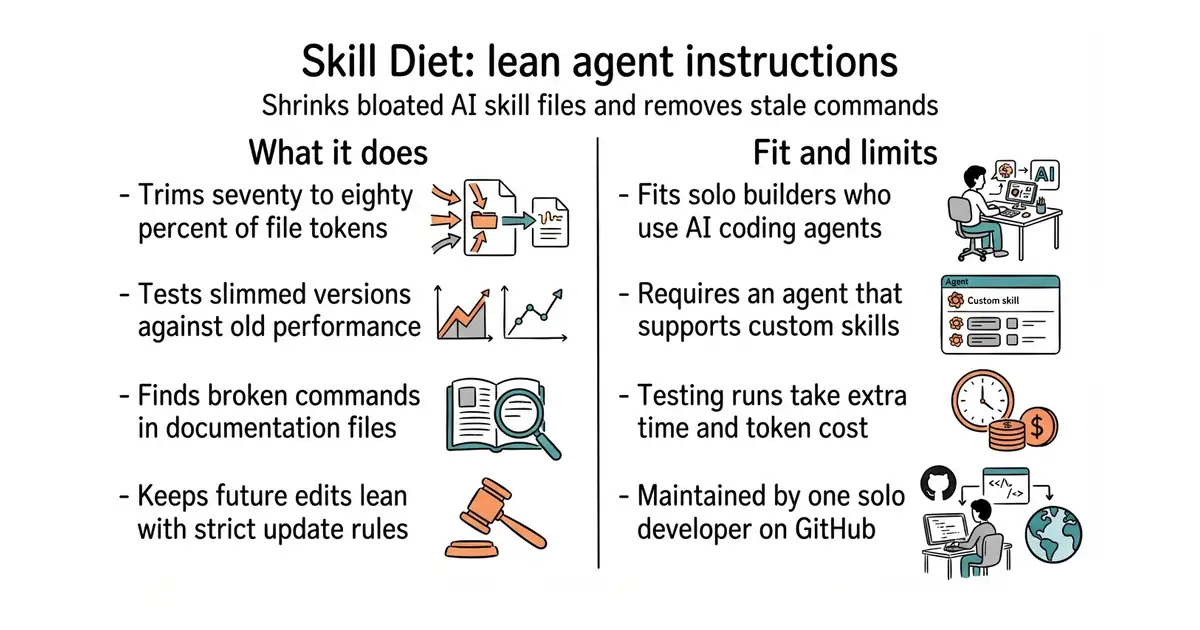
AI coding agents read long instruction files every time they start a task. These files get crowded with duplicate details, human explanations, and outdated commands that waste memory and money. This tool puts those instruction files on a diet. It cuts out the waste and tests the slimmed-down version to make sure the agent still does the job well. You install it once into your coding agent, and it keeps your project instructions short and accurate.
What it is
An AI agent skill that shrinks bloated instruction files and keeps them correct during future edits. It includes scripts to measure token usage, run before-and-after tests, and check that commands still match your tools.
What it is good for
Solo builders who use AI coding agents and want to stop wasting context window space on bloated, outdated instruction files.
Summary (Key Points)from the README
Key features
- Token cut: On real skills, a diet cut 70–80% of tokens with no drop in test results.
- Broken commands: A diet found commands that a skill documented but that no longer worked.
- Five-step diet: It measures the skill, places each fact on the lowest level that still reaches the agent in time, cuts and rewrites, then runs the before/after test.
- Before/after test: It runs agents on the old skill, the new skill and no skill, and keeps the slim version only if it does at least as well. A full diet test is 45 runs.
- Tool-skill extras: For skills that teach a tool, it proves each mismatch, reads session logs to find the most-used calls, and can trim a tool's schema to the fields agents use when the tool is yours.
- Compact command format: Plain usage lines cost 1× tokens, against 1.5× for a markdown table, 1.6× for TypeScript types, 2.8× for JSON Schema and 4.7× for OpenAPI.
- Growth rule: Once a skill grows about 10% past its last diet, it is due for another.
- Update rules: Before an agent adds to a skill, it works through five checks, starting with whether a clearer error or a check in the tool would fix the problem.
- Drift warning: It leaves a check that warns after a commit when the skill no longer matches the tool.
Ways to install
| Platform or method | What it needs | Effort |
|---|---|---|
| Pi | The Pi agent and its install command | One command |
| Claude Code | Claude Code and its plugin marketplace | One command |
| Codex, Cursor and other agents | npx, to run the skills installer | One command |
| Manual clone | git, and a link into the Claude Code skills folder for Claude Code | Clone and link by hand |
Important
- Cost: The before/after test runs real agent sessions, so it takes time and tokens. Run it before shipping a slimmer skill, not after every update.
- Coverage: The checks cover the eval tasks and everything the old skill said. To include your own use, run the diet right after you use the skill, or name the case when you ask.
- Test limits: Calibration can't confirm that token counts are exact. An agent with a shell can still find another copy of the skill on disk; the scorer warns when a run reads one.
- Adapter: Your agent writes the script that runs its own sessions, so the adapter must pass calibration before each eval. Codex took 7 to 16 minutes to write one in the authors' tests.
- Logger scope: The call logger wraps command-line tools only. For native tools, MCP servers, APIs and SDKs, calls are read from session logs instead.
- Log formats: Agent log formats change between releases, so log readers can go stale. The authors' own shipped reader did, which is why the agent writes its own.
- Double install: Installing through two routes for the same agent loads the skill twice.
Written by an AI model from the project’s README; not part of the review, and it can be wrong.
- Cuts 70 to 80% of instruction file tokens without hurting test performance.
- Finds and fixes broken commands and outdated references in your skill files.
- Works across popular AI coding agents like Claude Code, Cursor, and Pi.
- Running before-and-after evaluations consumes time and tokens.
- Requires a coding agent that supports skills and shell commands.
- Keeping instructions lean requires ongoing discipline during future updates.
manual editing of bloated AI agent instruction files
Claude Code or Cursor

- vllm-project/vllm96k stars
A serving engine that makes one graphics card answer many requests at once.
- infiniflow/ragflow93k stars
A question-answering system built on a document collection, with the sources shown beside every answer.
- basicmachines-co/basic-memory4.3k stars
Gives an AI assistant a memory that is stored as plain text files you can read.
npx skills add nicobailon/skill-diet -g