Radar check
What we found when we opened it. Every bar is one fact, with its date.
Last code pushed 26 Oct 2026, the same day before this check.
Latest release v2.3.0 on 19 Oct 2026.
Public since January 2026, 9 months.
207 stars and 58 forks.
67 commits and 2 new issues in the last 90 days.
7 contributors. 58 pull requests merged in 90 days. A small team carries it.
No security policy file says how to report a problem. No published security advisories.
How the bars are scored
- Alive. Days since the last code push: a week or less 100, a month 90, three months 70, six months 50, a year 30, eighteen months 15, older 0.
- Releases. Age of the latest GitHub release, on a similar scale; no bar when the project publishes no releases.
- Maturity. Age of the project: eight years 100, five 90, three 70, two 55, one 40, six months 25, younger 10.
- Adoption. Stars on a log scale: 100,000 stars is 100, 10,000 is 80, 1,000 is 60, 100 is 40.
- Activity. Commits in the last 90 days: 300 or more 100, 100 85, 30 65, 10 45, any 25.
- Community. People who have contributed: 100 or more 100, 30 80, 10 60, 5 40, 2 25, one 10.
- Security. A published security policy 80, none 40; published advisories are listed, not scored.
Checked by Repo Radar on 26 Oct 2026 from the repository on GitHub.
In simple English
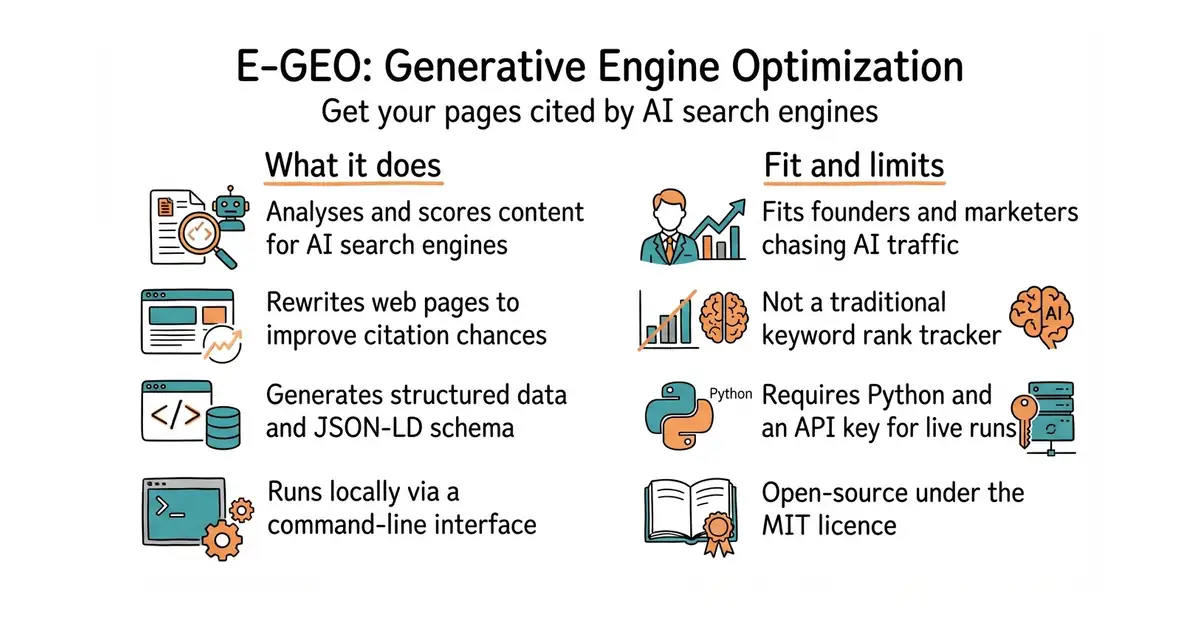
AI search engines like ChatGPT and Perplexity now answer questions directly instead of showing a list of blue links. If your website is not cited in those answers, customers will never find you. This open-source toolkit rewrites your web pages so AI models can read, understand, and cite them easily. You can run it from your command line or use it with an AI coding assistant. It costs nothing to download and use under the MIT licence, though you need an AI model key to run live updates.
What it is
E-GEO is an open-source command-line tool and set of AI agent skills that analyses web pages and rewrites them for generative search engines. It applies ten research-backed optimisation rules, such as competitive framing and structured data generation, to improve your visibility in AI answers.
What it is good for
Solo founders and content creators who want their landing pages and articles to appear in recommendations made by ChatGPT, Claude, and Gemini.
- Automates the entire process of rewriting content and generating schema markup.
- Includes a mock mode that runs without an API key or paid subscriptions.
- Based on published academic research on generative engine optimization.
- Requires comfort with the command line and basic Python environments.
- Quality depends on the external AI model you connect for live runs.
- AI search rankings change constantly, so outputs need regular review.
manual keyword stuffing and guesswork for AI search visibility
Claude Code
- cursor/cursor33k stars
Cursor is an AI code editor, while E-GEO is a specific optimization toolkit for AI search engines.
- browserbase/stagehand26k stars
Stagehand automates web browsers for agents, whereas E-GEO focuses purely on optimizing content for AI citations.


- GoogleChrome/lighthouse-ci7.1k stars
Runs the standard page audit on every code change and fails the change if the page got slower.
- harlan-zw/nuxt-seo1.5k stars
Seven search-engine and answer-engine modules for Nuxt sites, installed as one package.
- Swetrix/swetrix1.2k stars
Website analytics with no cookies, plus performance monitoring and error tracking, which you can host yourself.
pip install egeo
GEO_EVAL_MOCK=1 egeo optimize your-page.md