Radar check
What we found when we opened it. Every bar is one fact, with its date.
Last code pushed 28 Oct 2026, the same day before this check.
Latest release v6.8.2 on 28 Oct 2026.
Public since December 2024, a little over 1 year.
1,401 stars and 164 forks.
192 commits and 3 new issues in the last 90 days.
27 contributors. 78 pull requests merged in 90 days.
No security policy file says how to report a problem. No published security advisories.
How the bars are scored
- Alive. Days since the last code push: a week or less 100, a month 90, three months 70, six months 50, a year 30, eighteen months 15, older 0.
- Releases. Age of the latest GitHub release, on a similar scale; no bar when the project publishes no releases.
- Maturity. Age of the project: eight years 100, five 90, three 70, two 55, one 40, six months 25, younger 10.
- Adoption. Stars on a log scale: 100,000 stars is 100, 10,000 is 80, 1,000 is 60, 100 is 40.
- Activity. Commits in the last 90 days: 300 or more 100, 100 85, 30 65, 10 45, any 25.
- Community. People who have contributed: 100 or more 100, 30 80, 10 60, 5 40, 2 25, one 10.
- Security. A published security policy 80, none 40; published advisories are listed, not scored.
Checked by Repo Radar on 28 Oct 2026 from the repository on GitHub.
In simple English
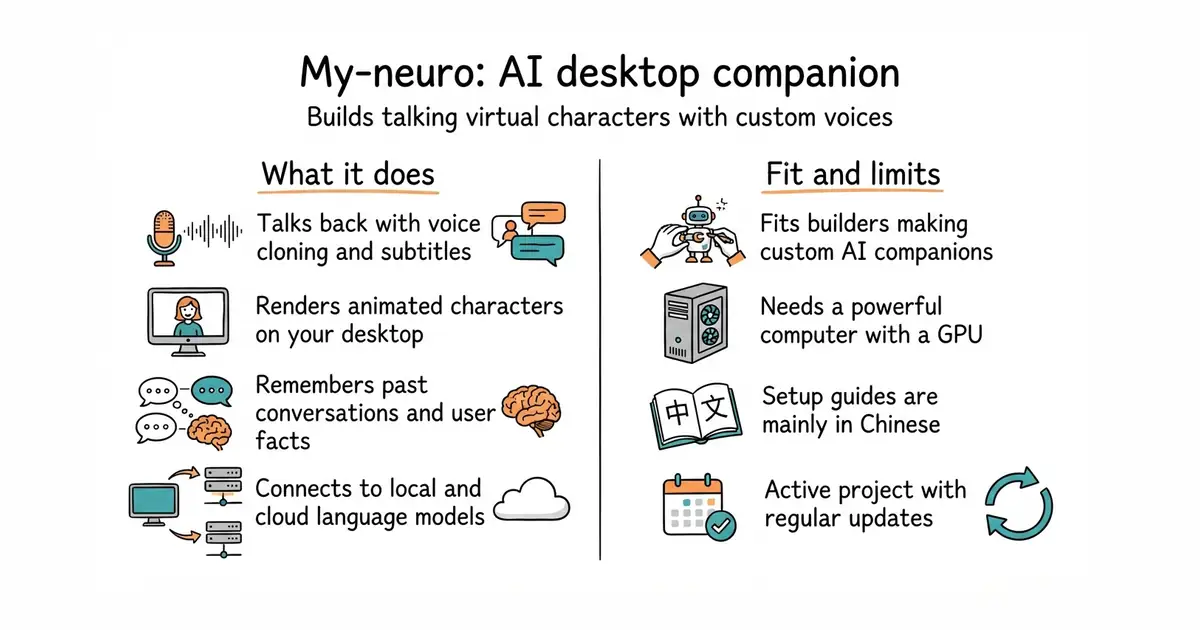
This tool lets you build a custom computer companion that talks to you out loud. You can change how it looks, what voice it uses, and what personality it has. It remembers past chats and can even see your screen. You need a powerful computer to run all these parts at once. It is free to download and use.
What it is
My-neuro is an open-source workbench for building interactive AI characters with custom voices, long-term memory, and desktop control. It combines a live-rendered visual avatar with speech recognition and language models to let you talk back and forth.
What it is good for
Solo builders who want to create a personalised virtual assistant, a streaming character, or an interactive gaming companion with voice and visual features.
Summary (Key Points)from the README
Key features
- Local low-latency chat: Full local inference with conversation latency under 1 second, per the README.
- Synced subtitles and voice: Subtitles and speech output are synchronized, and subtitles can be shown in Chinese while the audio plays in a foreign language.
- Voice customization: Supports male and female voices and switching between character voice styles, with TTS training defaulting to the open-source GPT-SoVITS project.
- Open and closed models: Open-source models can be fine-tuned and deployed locally, and closed-source models can be connected.
- Interruption and typing: You can interrupt the AI while it speaks by voice or keyboard, and you can also chat by typing.
- Vision and expressions: Image recognition is integrated, with the model deciding from language intent when to use vision, and actions and expressions follow the conversation.
- Desktop and web tools: Voice-controlled desktop actions such as opening software, MCP tool support, internet search for recent information, and long-term memory.
- Streaming and games: Bilibili live streaming, Live2D model replacement, and game play with Minecraft and galgame currently connected.
Important
- Setup guide is external: The README points to an official website tutorial for deployment and gives no install command in the file itself.
- Much of the list is unfinished: Real emotional states, free on-screen movement, screen color changes, and overseas streaming platforms are unchecked or marked as considered later.
- Completion is self-reported: The author says about 30% of the features are done, aims for a long-term emotion system within two months, and targets about 60% completion by June 1.
- Web interface not yet connected: The web UI is described as finished but not yet integrated.
- Proactive dialogue is early: The feature is labeled V1.
- Bundled character origin: The packaged character "fake neuro" is described by the author as imitating Neuro-sama.
- Mainly Chinese documentation: The main README is in Chinese, with a separate English README linked from the top.
Written by an AI model from the project’s README; not part of the review, and it can be wrong.
- Responds quickly with synchronized voice and subtitles.
- Supports custom voice training and 2D character models.
- Includes long-term memory and visual recognition features.
- Requires a strong computer, ideally with a dedicated graphics card for local AI models.
- Complex setup process with many dependent tools and services to configure.
- Documentation and tutorials are primarily in Chinese, which makes English setup harder.
commercial virtual assistant apps
GPT-SoVITS
- RVC-Boss/GPT-SoVITS64k stars
Provides the voice cloning and text-to-speech engine used for character voices.


- vllm-project/vllm96k stars
A serving engine that makes one graphics card answer many requests at once.
- infiniflow/ragflow93k stars
A question-answering system built on a document collection, with the sources shown beside every answer.
- basicmachines-co/basic-memory4.3k stars
Gives an AI assistant a memory that is stored as plain text files you can read.
Visit the project website and release page at mynewbot.com for download links and deployment instructions.