Radar check
What we found when we opened it. Every bar is one fact, with its date.
Last code pushed 11 Jan 2026, 9 months before this check.
No releases published on GitHub; the code date above is the one to trust.
Public since September 2024, about 2 years.
2,939 stars and 238 forks.
0 commits and 3 new issues in the last 90 days.
15 contributors. No pull requests merged in 90 days; changes go in directly.
No security policy file says how to report a problem. No published security advisories.
How the bars are scored
- Alive. Days since the last code push: a week or less 100, a month 90, three months 70, six months 50, a year 30, eighteen months 15, older 0.
- Releases. Age of the latest GitHub release, on a similar scale; no bar when the project publishes no releases.
- Maturity. Age of the project: eight years 100, five 90, three 70, two 55, one 40, six months 25, younger 10.
- Adoption. Stars on a log scale: 100,000 stars is 100, 10,000 is 80, 1,000 is 60, 100 is 40.
- Activity. Commits in the last 90 days: 300 or more 100, 100 85, 30 65, 10 45, any 25.
- Community. People who have contributed: 100 or more 100, 30 80, 10 60, 5 40, 2 25, one 10.
- Security. A published security policy 80, none 40; published advisories are listed, not scored.
Checked by Repo Radar on 28 Oct 2026 from the repository on GitHub.
In simple English
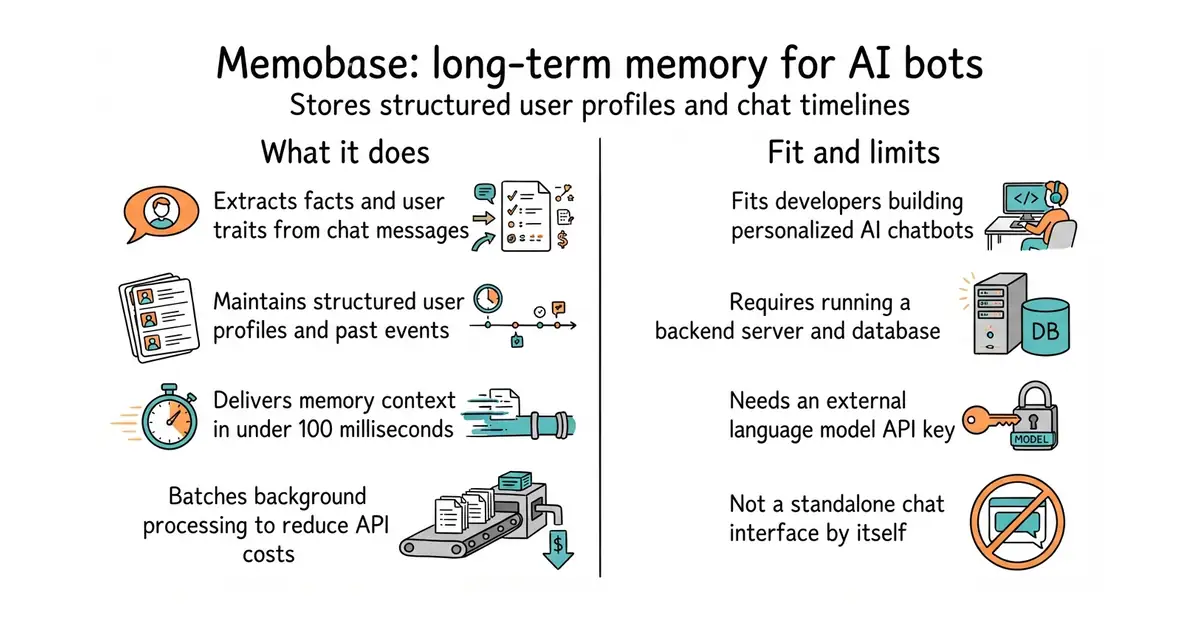
When people talk to your chatbot, they share facts about themselves. This tool remembers those facts and hands them back to your AI later. Your bot will recall names, jobs, and past events without reading through thousands of old chat logs. It runs on your own server using Python, FastAPI, Postgres, and Redis. You will need some server setup time and an API key for your language model.
What it is
Memobase is a user profile-based memory system for AI applications. It groups user chats into structured profiles and timelines, keeping online lookup times under 100 milliseconds.
What it is good for
Anyone building a custom AI assistant, virtual companion, or customer support bot who wants the AI to remember user details across multiple separate chat sessions.
Summary (Key Points)from the README
Key features
- Profile and event memory: Each user gets a structured profile (topic, sub_topic, content) plus a timeline of events, so the most important memories are available without pre-processing.
- Batch buffering: Chats go into a per-user buffer that flushes when it reaches about 1024 tokens or sits idle for about 1 hour, or when you call `flush()` yourself.
- Lower LLM cost: Version 0.0.40 cut LLM calls per run from roughly 3-10 to a fixed 3, which the README says reduces token costs by about 40-50%.
- Low online latency: The README says that, with no pre-processing and only a few SQL operations, online latency stays under 100ms.
- Context API: `context()` packs memories into a single string with a token budget (for example `max_token_size=500`) for direct insertion into a prompt.
- Fine-grained event search: Version 0.0.37 added event gists for detailed search over a user's timeline, and the README reports SOTA results on the LOCOMO benchmark after re-running it.
- Customizable profiles: You can define and control which user information is captured.
- Multi-language SDKs: Python, Node and Go clients are provided, along with a raw API and an MCP option.
- Production stack: The server is built with FastAPI, Postgres and Redis, supports request caching, auth and telemetry, and is fully dockerized.
Ways to install
| Platform or method | What it needs | Effort |
|---|---|---|
| Python SDK (`pip install memobase`) | Python, plus a project URL and token | One command |
| Local server | Server setup as described in the server readme; the README says it is fully dockerized | Not stated in the README |
| Memobase Cloud | A free-tier account on memobase.io; cloud URL and token | Sign-up only |
| Node SDK | Package on npm and JSR; the README links to its own readme | Not stated in the README |
| Go SDK | Go module referenced on pkg.go.dev; the README links to its own readme | Not stated in the README |
| MCP server | Available in the repo's MCP folder | Not stated in the README |
Important
- Data retention: By default, Memobase deletes blobs once they are processed, so raw chats are not stored unless you change the storage configuration.
- Async flush: Flushing runs asynchronously by default, so new memories will not appear until processing finishes unless you pass `sync=True`.
- Credentials: The local defaults are the URL `http://localhost:8019` and the token `secret`; change these before any real use.
- Latency conflict: The README claims under 100ms online latency, but it also says the context search takes 500-1000ms depending on the embedding API, so measure the path you plan to use.
- Not built for search: The README says Memobase is not specifically designed for RAG or search tasks.
- Personal data: Profiles can hold sensitive personal details, as the partial example shows, so plan for privacy and consent.
- License: Apache 2.0.
Written by an AI model from the project’s README; not part of the review, and it can be wrong.
- Keeps user profiles structured so your AI can read them easily.
- Batches chat history to keep language model costs down.
- Responds in under 100 milliseconds for fast chatbot replies.
- Requires running a backend server with Postgres and Redis.
- Needs an external language model API for processing chat data.
- Setup requires comfort with Python and command-line tools.
manually injecting raw chat history into every prompt
FastAPI, PostgreSQL, and Redis for running the backend service
- mem0ai/mem068k stars
Another popular memory layer for large language models that retrieves relevant facts for chatbots.


- vllm-project/vllm96k stars
A serving engine that makes one graphics card answer many requests at once.
- infiniflow/ragflow93k stars
A question-answering system built on a document collection, with the sources shown beside every answer.
- basicmachines-co/basic-memory4.3k stars
Gives an AI assistant a memory that is stored as plain text files you can read.
pip install memobase