Radar check
What we found when we opened it. Every bar is one fact, with its date.
Last code pushed 28 Oct 2026, the same day before this check.
Latest release livekit-agents@1.8.9 on 24 Oct 2026.
Public since October 2023, about 3 years.
14,970 stars and 4,007 forks.
643 commits and 260 new issues in the last 90 days.
581 contributors. 649 pull requests merged in 90 days.
No security policy file says how to report a problem. 1 published security advisory.
How the bars are scored
- Alive. Days since the last code push: a week or less 100, a month 90, three months 70, six months 50, a year 30, eighteen months 15, older 0.
- Releases. Age of the latest GitHub release, on a similar scale; no bar when the project publishes no releases.
- Maturity. Age of the project: eight years 100, five 90, three 70, two 55, one 40, six months 25, younger 10.
- Adoption. Stars on a log scale: 100,000 stars is 100, 10,000 is 80, 1,000 is 60, 100 is 40.
- Activity. Commits in the last 90 days: 300 or more 100, 100 85, 30 65, 10 45, any 25.
- Community. People who have contributed: 100 or more 100, 30 80, 10 60, 5 40, 2 25, one 10.
- Security. A published security policy 80, none 40; published advisories are listed, not scored.
Checked by Repo Radar on 28 Oct 2026 from the repository on GitHub.
In simple English
This tool helps you build artificial intelligence agents that can talk, listen, and see in real time. You can use it to create voice assistants, phone bots, or video avatars. It connects your chosen speech models, language models, and phone lines into one smooth conversation. Building these apps takes Python knowledge and API keys for AI services. The software is free to use on your own servers under an open-source licence.
What it is
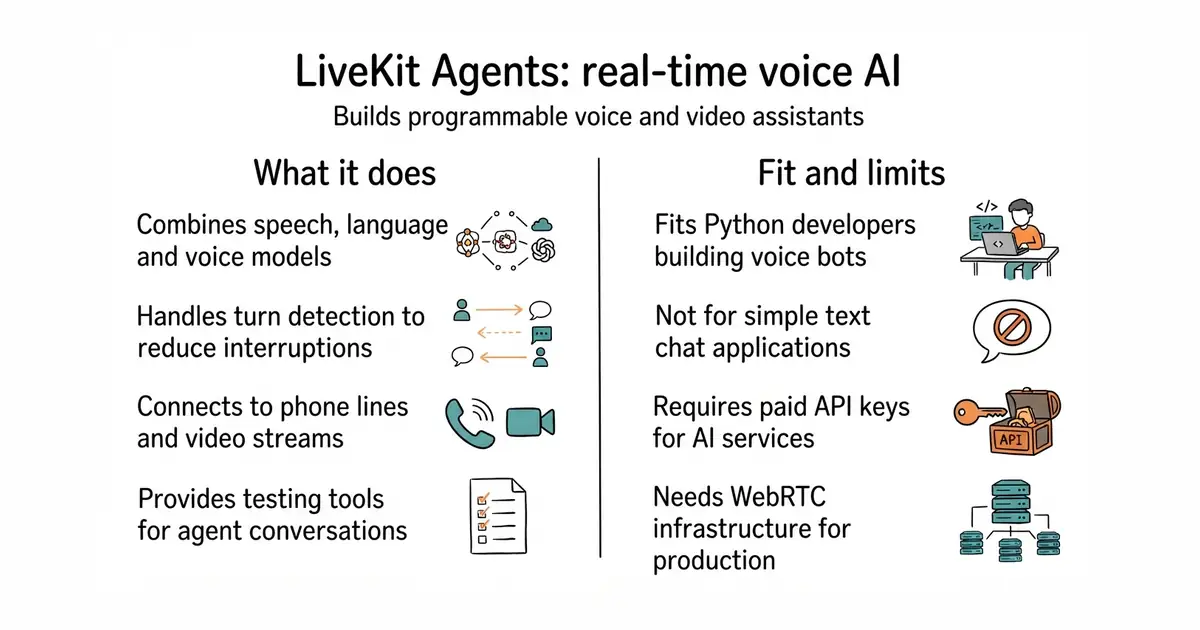
A Python framework for creating programmable real-time participants that run on servers. It coordinates speech-to-text, text-to-speech, and language models with built-in task scheduling and WebRTC (a way to stream live audio and video directly between browsers and apps) support.
What it is good for
Solo builders who want to create voice-based AI applications, customer support phone bots, or interactive video assistants without writing complex media streaming code from scratch.
Summary (Key Points)from the README
Key features
- Flexible integrations: Mix and match STT, LLM, TTS, and Realtime API providers for each use case.
- Integrated job scheduling: Built-in task scheduling and distribution through dispatch APIs connects end users to agents.
- Extensive WebRTC clients: LiveKit's open-source client SDKs cover all major platforms.
- Telephony integration: Agents can make outbound calls to phones or receive inbound calls through LiveKit's telephony stack.
- Data exchange with clients: RPCs and other Data APIs let agents exchange data with client applications.
- Semantic turn detection: A transformer model detects when a user has finished speaking, which helps reduce interruptions.
- MCP support: Tools provided by MCP servers can be integrated with one line of code.
- Built-in test framework: Tests can use judges to check that an agent behaves as expected.
- Self-hostable stack: The whole stack can run on your own servers, including the LiveKit server.
- Run modes: `console` runs locally with terminal audio, `dev` adds hot reloading, and `start` runs with production optimizations.
Ways to install
| Platform or method | What it needs | Effort |
|---|---|---|
| pip install of the core library with provider plugins | Python and pip | Low: one command, `pip install "livekit-agents[openai,deepgram,cartesia]"` |
| Development setup from the repository | Clone of the repo and the uv package manager | Moderate: run `uv sync --all-extras --dev` in the project |
Important
- Credentials: Agents connect to LiveKit Cloud or a self-hosted server, so `LIVEKIT_URL`, `LIVEKIT_API_KEY`, and `LIVEKIT_API_SECRET` must be set.
- Model access: The main example uses LiveKit Inference, which runs models through LiveKit Cloud. To use provider keys directly, you must configure those providers yourself.
- Licensing: The framework is Apache-2.0, but the turn detection models fall under the separate LiveKit Model License.
- Abbreviated snippets: The multi-agent handoff example is abbreviated and uses names such as `chat_ctx`, `StoryData`, and `openai` without defining or importing them. The testing example similarly uses `google` and `MyAgent` without imports.
- Integration tests: Plugin integration tests need various API credentials and run in CI only for PRs from project maintainers. Unit tests can be run with `uv run pytest --unit`.
Written by an AI model from the project’s README; not part of the review, and it can be wrong.
- Connects easily with popular speech and language models.
- Includes tools for testing agent behavior and handling phone calls.
- Supports handoffs so conversation can move between different agents.
- Requires Python programming skills and external API keys.
- Relies on third-party speech and AI services that charge per use.
- Running a production server requires managing WebRTC infrastructure.
custom WebRTC media streaming servers and manual audio pipeline code
livekit/livekit
- openai/openai-realtime-console3.6k stars
A reference implementation for OpenAI's real-time voice API, though less modular for multi-provider pipelines.

- vllm-project/vllm96k stars
A serving engine that makes one graphics card answer many requests at once.
- infiniflow/ragflow93k stars
A question-answering system built on a document collection, with the sources shown beside every answer.
- basicmachines-co/basic-memory4.3k stars
Gives an AI assistant a memory that is stored as plain text files you can read.
pip install "livekit-agents[openai,deepgram,cartesia]"