29,443 stars · Apache-2.0 · v2.0.5 (2026-10-05) · Track this in Scout
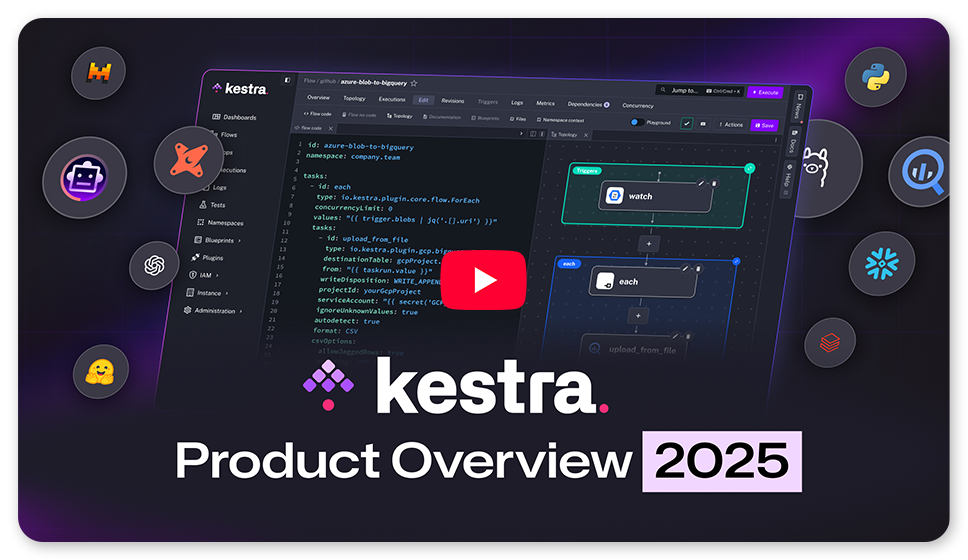
Runs scheduled and event-driven workflows declared in YAML, with a web interface showing every run and every step.
▶Repo detailsthe review · specs · pros & cons · install
What it is
Kestra is a Java orchestration server. Workflows are declared as YAML files rather than written in a programming language, and the individual steps are supplied by plugins, so a step can run a container, a query, a script in any language, or a call to a service.
What it is good for. Anyone whose important jobs currently live in cron lines on three different machines with no record of whether they ran. The thing an orchestrator gives you that cron cannot is the history: which run failed, at which step, with what output, and a retry that you did not have to write.
- Workflows are plain YAML, so a person who does not write code can read and change one, and the whole thing lives in version control.
- Any language runs as a step, through plugins fetched on demand, so you are not forced to rewrite existing scripts in the platform's language.
- Actively developed: code landed on 9 October 2026, the morning this was checked, and v2.0.5 arrived on 5 October 2026.
- ⚠ The official
docker-compose.ymlhas authentication commented out, so a default install is completely open. The wholekestra.server.basic-authblock is commented; the example credentials inside the comment areadmin@kestra.io/Admin1234!. The same file also publishes a database password,POSTGRES_PASSWORD: k3str4, and declares ports as"8080:8080"with no host address, which means Docker binds them on every interface. An orchestrator that can run arbitrary commands, open to the network, with no login. - ⚠ The container runs as root and mounts the Docker socket, which the file's own comment admits is "intended for development purpose" — that is administrator-level control of the host.
- No memory, processor or disk figure is published in the README, the compose file or the contributor notes, and there are 464 open issues against 168 open pull requests. The paid Enterprise Edition — multi-tenancy, single sign-on, role permissions, audit logs — is a separate product whose terms are not in this repository, so what you can and cannot do with the free version has to be read off a marketing page rather than a licence.
- apache/airflow
Schedules the same kind of pipeline, but each one is written as Python code, and it is scheduler-centred rather than event-driven.
Track this in Scout - PrefectHQ/prefect
Adds orchestration to existing Python functions by decorating them, which is lighter to adopt and Python-only.
Track this in Scout - dagster-io/dagster
Organised around data assets and their lineage rather than around tasks and events, which suits analytics work and fits awkwardly around general automation.
Track this in Scout
docker run --rm -it \
  --name kestra \
  -p 127.0.0.1:8080:8080 \
  --user=root \
  -v kestra_data:/app/storage \
  -v kestra_db:/app/data \
  -v /var/run/docker.sock:/var/run/docker.sock \
  -v /tmp:/tmp \
  -e KESTRA_PLUGINS_AUTO_INSTALL_ENABLED=true \
  kestra/kestra:latest-slim server local