10.5k stars · AGPL-3.0 · v1.52.1 (2026-08-27) · Track this in Rising ↗
Open-source metering and usage-based billing API — counting what someone used and turning it into a number they owe.
Radar check
What we found when we opened it. Every bar is one fact, with its date.
Last code pushed 23 Oct 2026, 4 days before this check.
Latest release v1.55.0 on 7 Oct 2026.
Public since February 2022, a little over 4 years.
10,713 stars and 773 forks.
50 commits and 4 new issues in the last 90 days.
55 contributors. 45 pull requests merged in 90 days.
No security policy file says how to report a problem. No published security advisories.
How the bars are scored
- Alive. Days since the last code push: a week or less 100, a month 90, three months 70, six months 50, a year 30, eighteen months 15, older 0.
- Releases. Age of the latest GitHub release, on a similar scale; no bar when the project publishes no releases.
- Maturity. Age of the project: eight years 100, five 90, three 70, two 55, one 40, six months 25, younger 10.
- Adoption. Stars on a log scale: 100,000 stars is 100, 10,000 is 80, 1,000 is 60, 100 is 40.
- Activity. Commits in the last 90 days: 300 or more 100, 100 85, 30 65, 10 45, any 25.
- Community. People who have contributed: 100 or more 100, 30 80, 10 60, 5 40, 2 25, one 10.
- Security. A published security policy 80, none 40; published advisories are listed, not scored.
Checked by Repo Radar on 26 Oct 2026 from the repository on GitHub. Covered in Edition 11.
▶Repo detailsthe review · specs · pros & cons · install
What it does
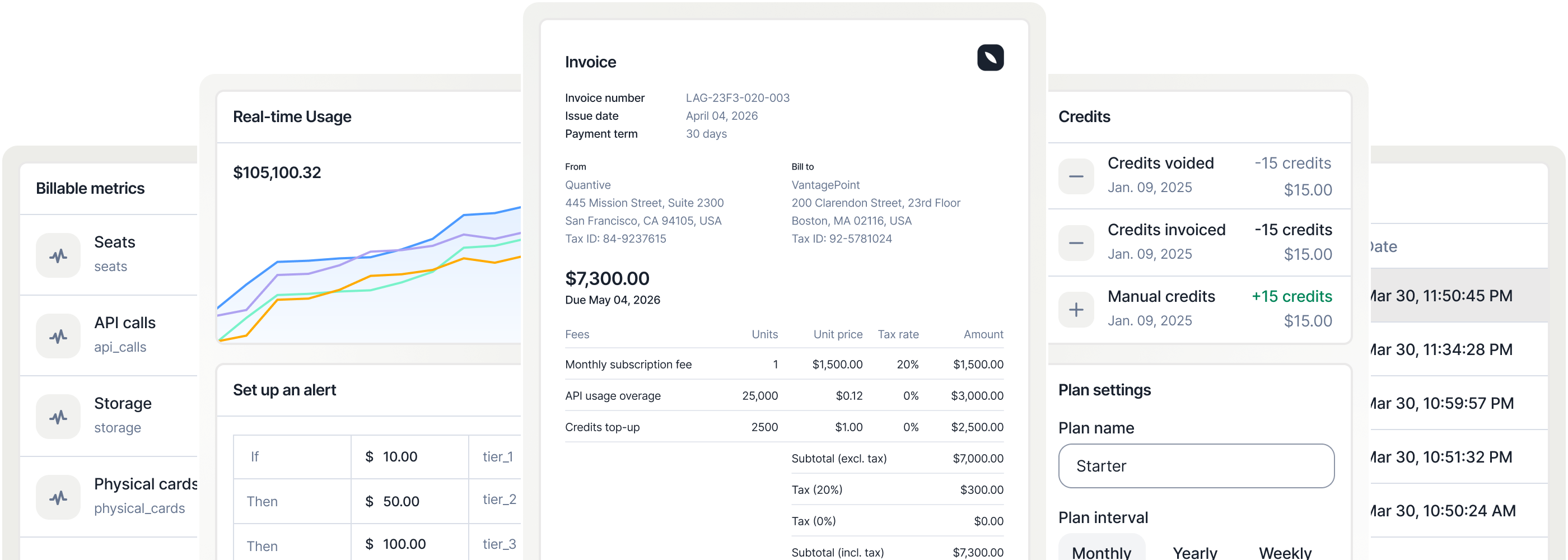
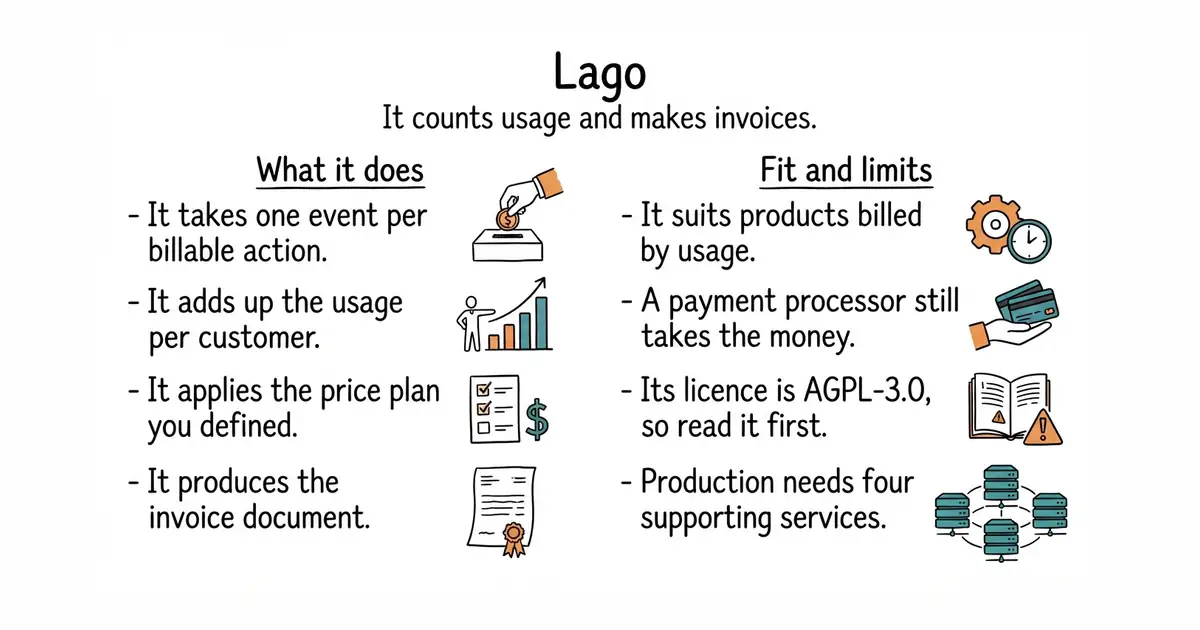
You send it a usage event for every billable thing a customer did. It adds those events up per customer and per billing period. It then applies the price plan you defined: a flat fee, a price per unit, a package of included units, or a combination. It handles subscriptions, prepaid wallets, credits and coupons. It can show a customer what they have spent so far in the current period, before any invoice arrives. It produces the invoice itself and reports on revenue. It is an API, which means a program talks to it rather than a person. What it does not do is move the money: the card charge is handed to a payment processor such as Stripe, and there is no checkout page here for a visitor to see.
Why it matters
Who it suits. Products whose real cost rises with use, such as model calls, document processing or storage. For those, a flat monthly price either loses money on heavy customers or overcharges light ones, and nobody can tell which until the use is counted. It also suits a team that expects to change its price plan more than once, because the plan lives in configuration rather than in code. Skip it if a fixed monthly subscription is the whole pricing story; the counting machinery earns nothing then.
Verdict. Worth the work only once usage-based pricing is a decision already taken. Two things to weigh first. The licence is AGPL-3.0, which is fine for software run as a service inside one company but needs reading by a lawyer before any of it is linked into something distributed to customers. The production setup wants Rails with PostgreSQL, Redis, Kafka and ClickHouse behind it, which is several services to keep alive rather than one container. If the need is to accept money this month, entry 2 is the answer and this is the thing to revisit later. openmeterio/openmeter at entry 3 overlaps it directly; pick one, because two counters that disagree is worse than neither.
Summary (Key Points)from the README
Key features
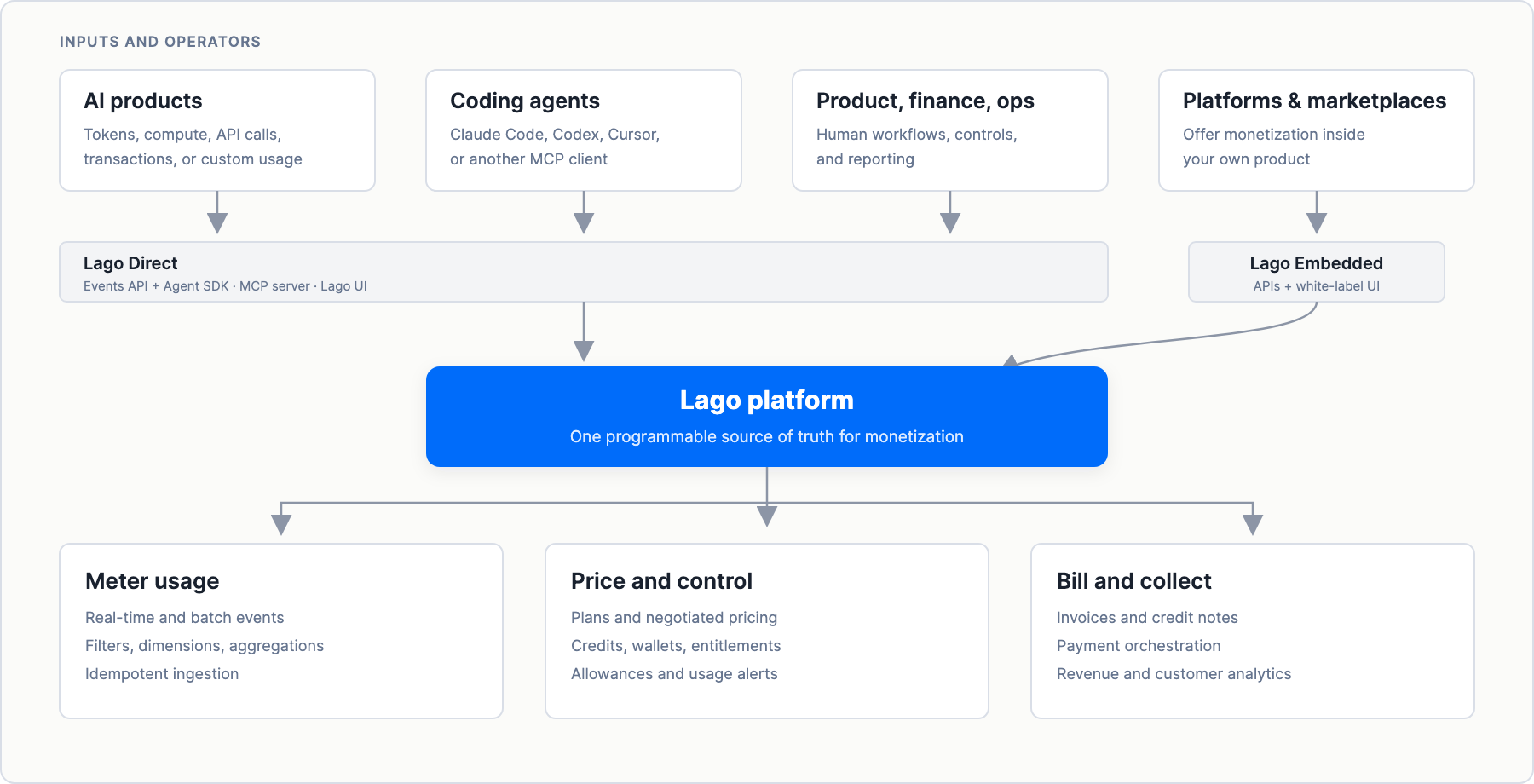
- Idempotent ingestion: Usage events are deduplicated by transaction_id, so retried events are not billed twice.
- Atomic batches: If one event in a batch is invalid, the whole batch is rejected and none of its events are persisted.
- Broad pricing models: Supports usage-based, recurring, prepaid, percentage, graduated, package, volume, minimum-commitment, and hybrid charges.
- Entitlements and credits: Covers allowances, wallets, credit grants, top-ups, and usage alerts.
- Payment independence: Connects to Stripe, Adyen, GoCardless, or other providers without making their catalog the source of truth, with retries, dunning, and payment-status sync.
- Agent interfaces: Offers a REST API with OpenAPI, a CLI, and an MCP server with read and write tools for invoices, usage, customers, payments, and credit notes.
- Agent SDKs: The JavaScript/TypeScript SDK wraps OpenAI, Anthropic, Mistral, Gemini, and AWS Bedrock clients with under 5 ms p99 wrapper overhead.
- Two operating models: Lago Direct bills your own customers, while Lago Embedded provides white-label metering and billing for your customers.
- Observability: Exposes Prometheus metrics for APIs, queues, workers, events, billing, webhooks, and dependencies.
Ways to install
| Platform or method | What it needs | Effort |
|---|---|---|
| Maintained local demo (Docker Compose) | Docker, curl, and jq; ports 8080 and 3001 free or overridden | One demo run; removable with a cleanup command |
| Source-based local deployment | Not specified in the README (the command is not shown) | Not specified |
| Self-hosted deployment guide | Persistent storage, SMTP, TLS, object storage, Redis, and database configuration | Not specified; guide covers upgrades |
| Lago Helm charts | Kubernetes setup, with dedicated workers for larger deployments | Not specified |
| Lago Cloud | Managed service through a sales conversation | Managed by Lago |
Important
- License: The platform is AGPLv3; the Agent SDKs and MCP server are separate MIT-licensed repositories.
- Agent credentials: The MCP server inherits the permissions of its Lago API key, so keep those keys privileged and review tool calls.
- Financial changes: Confirm the target organization and environment, and keep human confirmation around sensitive billing changes.
- Demo credentials: The bundled login and API key are disposable and meant only for the local demo; the demo does not access Lago Cloud.
- Demo cleanup: The demo keeps running until you remove its isolated Compose project and data volume.
- Premium features: The Billing Assistant is Premium and available on request; other premium capabilities vary by feature.
- Telemetry: Self-hosted instances collect basic product analytics by default; you can review or opt out.
- Company figures: Customer scale numbers describe the companies, not volume processed by Lago.
Written by an AI model from the project’s README; not part of the review, and it can be wrong.
- Built for usage from the start, with wallets, credits and mid-period spend visible to the customer.
- Releasing often: version 1.55.0 landed on 7 October 2026 and code landed on 9 October 2026.
- An API first, so any language can talk to it and there is no required client library.
- AGPL-3.0, which has real consequences for anything distributed rather than hosted.
- Four supporting services in production, so this is not a small container on a shared machine.
- Choosing what to count is a product decision that is expensive to change once customers are billing against it.
git clone https://github.com/getlago/lago.git
cd lago
docker compose up -d