3,174 stars · GPL-3.0, read from /blob/master/LICENSE, standard and unmodified, and THE FILE NAMES NO PROJECT COPYRIGHT HOLDER — only the Free Software Foundation's own boilerplate line, with the 'How to Apply These Terms' placeholders left unfilled. · V1.1.2 of 2026-08-21, the release page reading '21 Aug 15:52' with no year and settled by the PyPI project page, which dates financepy 1.1.2 to 21 August 2026. GitHub and PyPI agree exactly. ungh's releases endpoint is years stale here, knowing only V0.360 of 2024 and V0.185 of 2020, while its repo record for the same project is fresh — the two-endpoint split again. · Track this in Scout
A Python library that prices financial derivatives and measures their risk, from government bonds to Bermudan swaptions.
▶Repo detailsthe review · specs · pros & cons · install
What it does
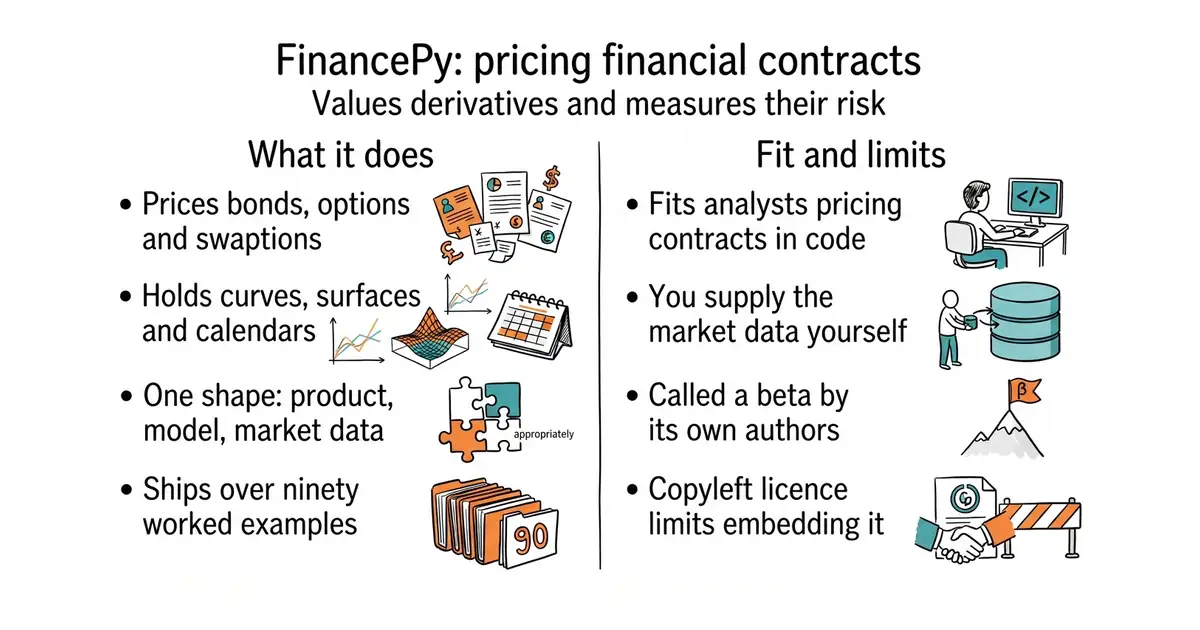
It is organised in four parts. One holds the dull but essential machinery: dates, business-day calendars, day-count conventions and payment schedules. One holds market data structures: interest-rate curves, volatility surfaces, prices. One holds models, from the classic Black-Scholes formula up to stochastic volatility. The last holds the products themselves, from a plain government bond up to a Bermudan swaption. The idea is stated as a formula in the README: a valuation is a product plus a model plus market data, and every product object exposes a value() method that takes the other two. Speed comes from Numba, a tool that compiles Python to machine code at runtime. The project ships more than ninety example notebooks. What it does not do is supply market data, execute trades or connect to a broker. Its own README also calls the library a beta and says values "should be close to if not identical to" a commercial terminal, which is not the same as identical.
Why it matters
Who it suits. Anyone who needs to price or risk-manage a contract in Python and would otherwise be implementing a textbook by hand: a quantitative analyst building a model, a risk team cross-checking a vendor's number, a student working through the theory with runnable code. The ninety notebooks are the real draw, because they show the arithmetic rather than hiding it. Skip it if you want a trading system; this is the calculation layer only.
Verdict. The most approachable of the serious open pricing libraries, and the one with the shortest path from install to a priced instrument. lballabio/QuantLib at 7,615 stars is the reference implementation the industry actually uses, is far more complete, and is C++ with Python bindings — choose it when correctness against market convention matters more than readability. goldmansachs/gs-quant at 11,903 stars is larger but is tied to one bank's services for much of its value. Two cautions here: the licence is GPL-3.0, which has real consequences if you embed this in something you sell, and the first import is slow while Numba compiles.
- More than ninety worked example notebooks, which is the fastest way into a subject like this.
- One consistent shape across every product: supply a model and market data, call
value(). - Covers four asset classes — equity, foreign exchange, interest rates and credit — plus bonds.
- GPL-3.0, so embedding it in a product you distribute obliges you to publish source.
- Described by its own authors as a beta, with no guarantee of agreeing with a commercial pricing terminal.
- Its licence file names no copyright holder at all; only the Free Software Foundation's own boilerplate line is present.
- lballabio/QuantLib
The long-established reference library for the same job, at 7,615 stars, written in C++ with Python bindings; more complete and much harder to read.
Track this in Scout - goldmansachs/gs-quant
A bank's own Python toolkit, at 11,903 stars, strong on risk and partly dependent on that bank's hosted services.
Track this in Scout - google/tf-quant-finance
The same arithmetic written to run on graphics hardware, at 5,523 stars, useful for very large batches of valuations.
Track this in Scout
python3 -m venv venv
source venv/bin/activate
pip install financepy