Radar check
What we found when we opened it. Every bar is one fact, with its date.
Last code pushed 19 Oct 2026, 6 days before this check.
Latest release v1.6.0 on 19 Oct 2026.
Public since February 2026, 8 months.
308 stars and 74 forks.
14 commits and 1 new issues in the last 90 days.
1 contributor. No pull requests merged in 90 days; changes go in directly. A small team carries it.
No security policy file says how to report a problem. No published security advisories.
How the bars are scored
- Alive. Days since the last code push: a week or less 100, a month 90, three months 70, six months 50, a year 30, eighteen months 15, older 0.
- Releases. Age of the latest GitHub release, on a similar scale; no bar when the project publishes no releases.
- Maturity. Age of the project: eight years 100, five 90, three 70, two 55, one 40, six months 25, younger 10.
- Adoption. Stars on a log scale: 100,000 stars is 100, 10,000 is 80, 1,000 is 60, 100 is 40.
- Activity. Commits in the last 90 days: 300 or more 100, 100 85, 30 65, 10 45, any 25.
- Community. People who have contributed: 100 or more 100, 30 80, 10 60, 5 40, 2 25, one 10.
- Security. A published security policy 80, none 40; published advisories are listed, not scored.
Checked by Repo Radar on 26 Oct 2026 from the repository on GitHub.
In simple English
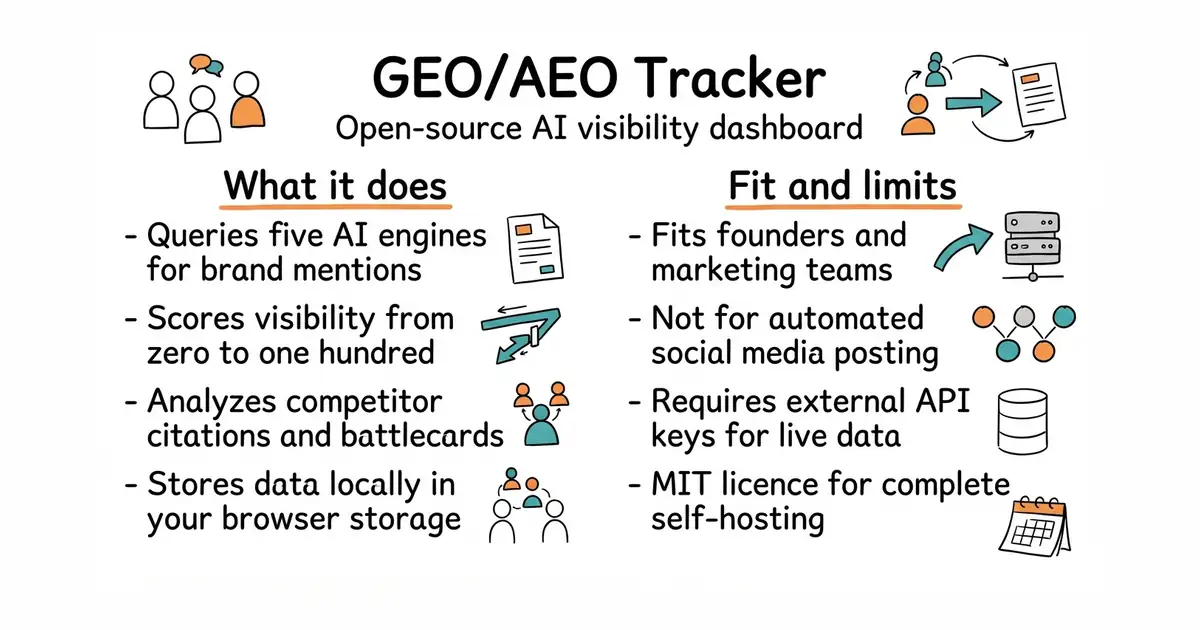
When people ask AI chat tools questions, your brand might appear in the answers or stay invisible. This tool checks how five major AI search systems talk about your company. It scores your visibility, shows which domains link to you, and flags what your competitors do better. You run it on your own server or computer, so your data stays private. The code is free, but you pay external data providers for each query they run for you.
What it is
GEO/AEO Tracker is an open-source Next.js application that queries multiple AI models to measure brand visibility, sentiment, and citation frequency. It stores your tracking history locally in your browser by default, with an optional connection to a Supabase database for cloud sync.
What it is good for
Marketing teams and founders who want to track their presence in AI-generated search results without paying high monthly fees to commercial analytics vendors.
- Tracks five major AI engines simultaneously including ChatGPT, Perplexity, and Gemini.
- Stores your search history and settings in your browser so no external database is required.
- Provides 13 built-in tabs covering competitor battlecards, site audits, and visibility analytics.
- Requires paid API keys from data providers like Bright Data and OpenRouter to fetch live results.
- Setup involves configuring environment variables and external service credentials.
- Relies on third-party scraping APIs that can break if provider endpoints change.
Expensive commercial AI visibility platforms like Semrush AI Visibility and AthenaHQ.
Next.js applications and Supabase cloud storage.
- GoogleChrome/lighthouse-ci7.1k stars
Runs the standard page audit on every code change and fails the change if the page got slower.
- harlan-zw/nuxt-seo1.5k stars
Seven search-engine and answer-engine modules for Nuxt sites, installed as one package.
- Swetrix/swetrix1.2k stars
Website analytics with no cookies, plus performance monitoring and error tracking, which you can host yourself.
git clone https://github.com/danishashko/geo-aeo-tracker.git
cd geo-aeo-tracker
npm install
cp .env.example .env
npm run dev