In simple English
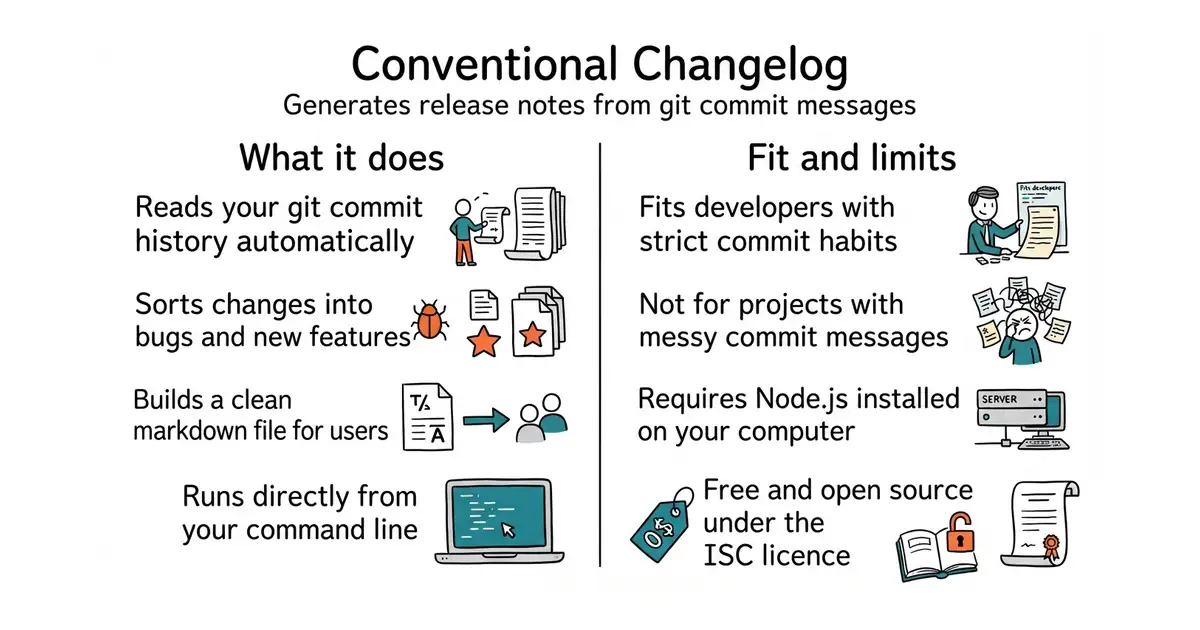
When you write code, you write small messages to explain each change. This tool reads those messages and turns them into a clean update log for your users. It saves you from writing release notes by hand every time. It costs nothing to run, but your team must agree to write commit messages in a strict format. If your commit messages are messy, your update logs will also be messy.
What it is
Conventional Changelog (a collection of tools that reads git commit history to build release notes automatically) reads the history of your project repository (a storage space for code and revision history). It sorts your changes into sections like bug fixes and new features based on keywords.
What it is good for
It helps solo developers and software teams who want to automate their release process without spending time writing changelogs by hand.
- Saves hours of manual writing before every software release.
- Turns messy code histories into clear and readable change logs.
- Integrates smoothly into automated build pipelines.
- Demands strict discipline from everyone writing commit messages.
- Requires Node.js (a software environment that runs JavaScript on your computer) installed on your machine.
- Fails to produce useful output if your team ignores the commit rules.
writing release notes by hand in a text file for every single update
commitlint to check that your commit messages follow the required format
- semantic-release/semantic-release24k stars
Fully automates the package release workflow including version determination and publishing.

- mkdocs/mkdocs23k stars
Turns a folder of Markdown files into a documentation website, controlled by one settings file.
- squidfunk/mkdocs-material28k stars
Turns a folder of Markdown files into a searchable documentation website, with every formerly sponsor-only feature now included.
- halo-dev/halo40k stars
A self-hosted website and blog platform, written in Java, with a marketplace of themes and plugins.
npm install --save-dev conventional-changelog-cli