Radar check
What we found when we opened it. Every bar is one fact, with its date.
Last code pushed 31 May 2026, 4 months before this check.
No releases published on GitHub; the code date above is the one to trust.
Public since May 2023, a little over 3 years.
1,228 stars and 162 forks.
0 commits and 0 new issues in the last 90 days.
3 contributors. No pull requests merged in 90 days; changes go in directly. A small team carries it.
No security policy file says how to report a problem. No published security advisories.
How the bars are scored
- Alive. Days since the last code push: a week or less 100, a month 90, three months 70, six months 50, a year 30, eighteen months 15, older 0.
- Releases. Age of the latest GitHub release, on a similar scale; no bar when the project publishes no releases.
- Maturity. Age of the project: eight years 100, five 90, three 70, two 55, one 40, six months 25, younger 10.
- Adoption. Stars on a log scale: 100,000 stars is 100, 10,000 is 80, 1,000 is 60, 100 is 40.
- Activity. Commits in the last 90 days: 300 or more 100, 100 85, 30 65, 10 45, any 25.
- Community. People who have contributed: 100 or more 100, 30 80, 10 60, 5 40, 2 25, one 10.
- Security. A published security policy 80, none 40; published advisories are listed, not scored.
Checked by Repo Radar on 26 Oct 2026 from the repository on GitHub.
In simple English
This toolkit lets you make AI-generated song covers. You take a song from YouTube, split the vocals from the music, and train an artificial voice model to sing it. It runs in the cloud through Google Colab (a free web service by Google for running code in your browser). You do not need a powerful computer to run it. It costs nothing to start on the free tier, though you may need a paid account for heavy training.
What it is
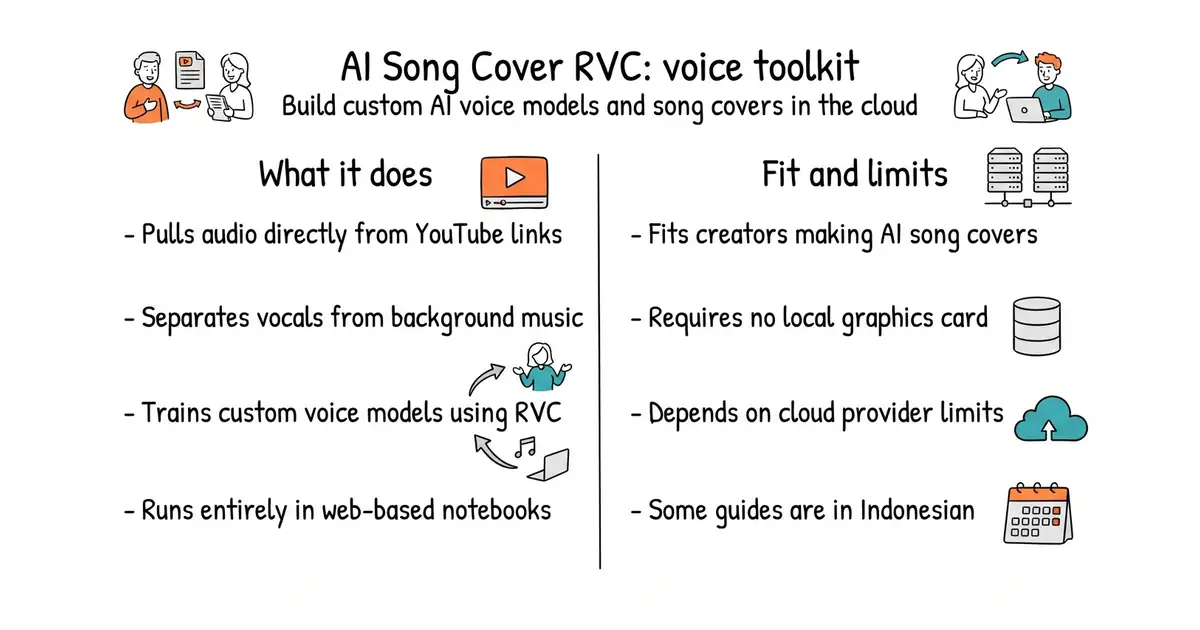
A collection of Jupyter Notebooks (interactive web pages that run code step-by-step) designed for the Retrieval-based Voice Conversion (RVC) ecosystem. It automates audio downloading, vocal separation, dataset preparation, and voice model training in one place.
What it is good for
Solo creators and music experimenters who want to build custom voice models and generate AI song covers without setting up local GPU hardware.
- Runs entirely in the cloud via Google Colab, so local hardware does not matter.
- Handles the full workflow from YouTube download to final song generation.
- Includes step-by-step notebooks for both training and inference.
- Relies on Google Colab, which can disconnect during long training sessions.
- Free cloud tiers have usage limits that may cut off large jobs.
- Documentation and tutorials are limited, and some are in Indonesian.
manual audio splitting workflows and complex local voice conversion setups
Google Colab
- RVC-Project/Retrieval-based-Voice-Conversion-WebUI39k stars
The underlying voice conversion engine this toolkit uses for training and inference.
- SociallyIneptWeeb/AICoverGen1.5k stars
A popular alternative command-line tool focused specifically on generating AI song covers.


- spotify/pedalboard6.4k stars
Applies audio effects to recordings from Python, including studio plug-ins, without calling another program.
- iver56/audiomentations2.3k stars
Spoils sound recordings on purpose, 39 ways, so a model trained on them copes with real rooms.
- shaka-project/shaka-packager2.6k stars
Cuts a video file into the pieces and index files that a browser needs in order to stream it.
Open any of the provided Jupyter Notebooks directly in Google Colab using the badges in the repository README.